
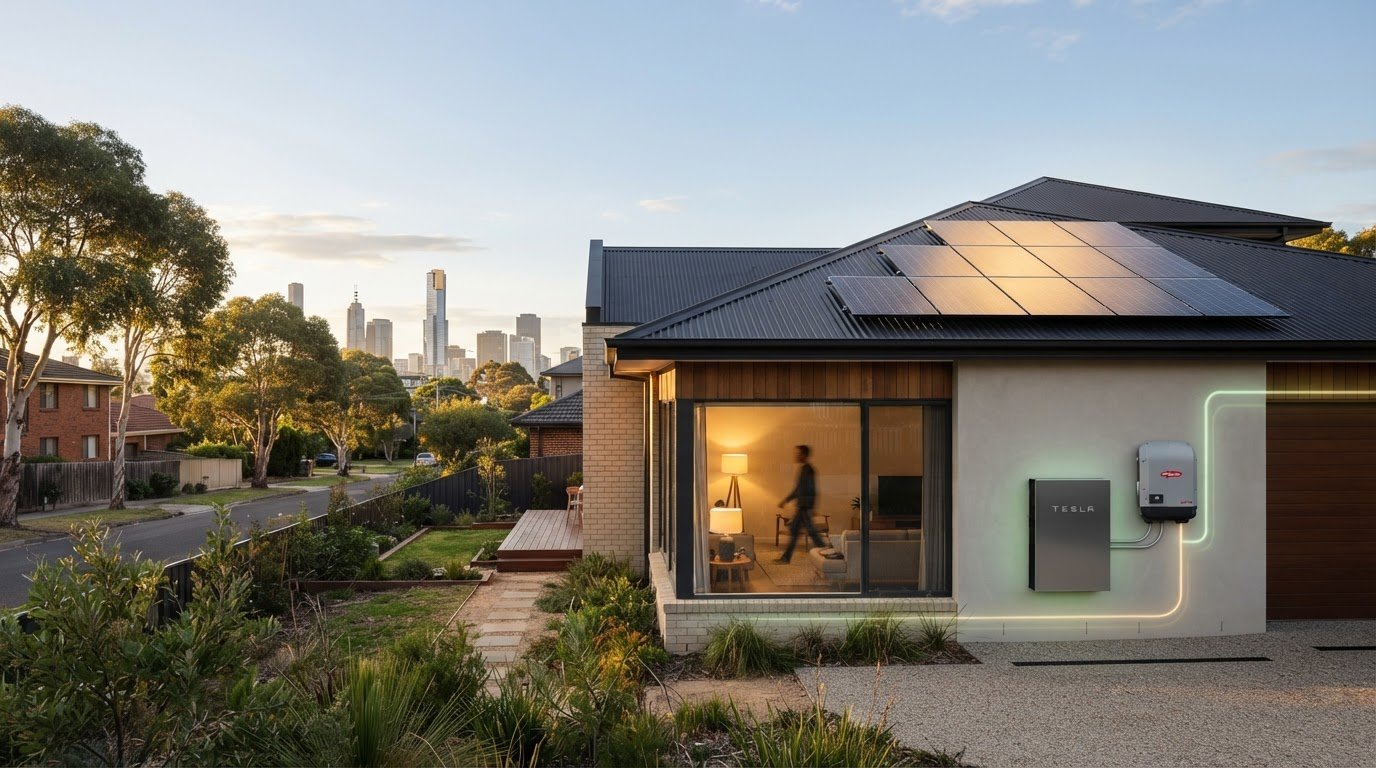
The best battery upgrade may work with the solar panels already on your roof. To work out how to choose the right solar battery in Melbourne, match its usable capacity and power output to your household’s evening use, solar generation and backup needs. For an existing solar system, AC coupling is the usual arrangement.
Look beyond battery size alone. The system needs enough usable storage for the energy you want to save and enough output to run the appliances you’ll use at once. This guide explains how home batteries store and supply solar electricity, what affects their lifespan and potential bill savings, and how system type and sizing shape your choice. It also covers costs and adding storage to an existing setup, helping you weigh the practical trade-offs for your Melbourne home.
Key Takeaways
- Size a battery around your household’s evening electricity use and the solar energy available to charge it, not household size alone.
- For an existing solar system, AC coupling is the usual battery arrangement; the right setup also depends on your inverter and system design.
- Compare potential bill savings with upfront cost and payback time, since battery economics depend on your usage and electricity tariff.
- Added battery storage between 14 and 28 kWh receives 60% of the national battery rebate value, according to the Australian Government Department of Climate Change, Energy, the Environment and Water.
- Before adding storage, consider how your current solar system operates and whether it can reliably charge the battery you’re considering.
How long do solar batteries last?
Most home solar batteries last 10 to 15 years. The right capacity depends on when your household uses energy, how much your solar system generates and whether backup power matters. Start with your electricity use across a typical day, then focus on the evening demand you want the battery to cover.
Daily use offers a useful starting point, but household size is only a guide. A 1-2 person household using 10-15 kWh per day may suit a 5-7 kWh battery. For 3-4 people using 15-25 kWh daily, the suggested range is 8-13 kWh. A household of five or more using at least 25 kWh daily may consider 13-18+ kWh. Lower-energy users may need less than 5 kWh. Compare these examples with your actual electricity use before choosing capacity.
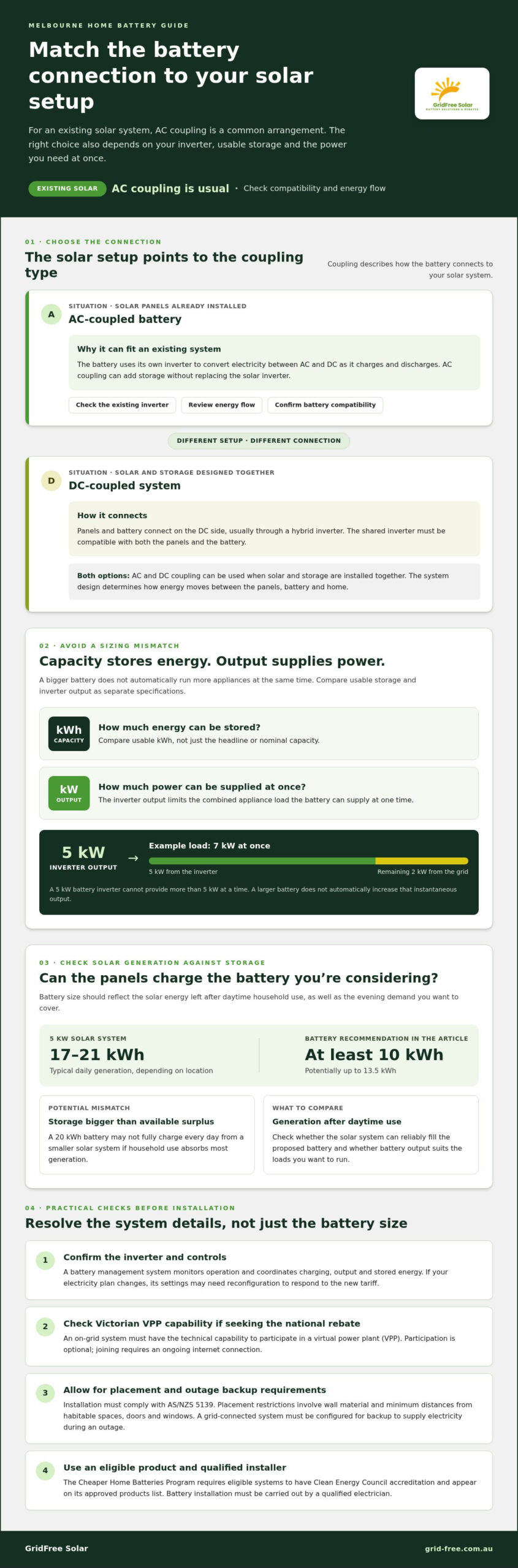
Capacity and power output solve different problems. Capacity, measured in kWh, describes how much energy a battery stores; inverter output, measured in kW, limits how much power it can supply at once. A 5kW battery inverter can’t provide more than 5kW at a time. If appliances draw 7kW together, the remaining 2kW must come from the grid. A larger battery doesn’t automatically increase that instantaneous output.
Usable capacity also differs from nominal capacity. Lithium batteries can generally be safely discharged to about 80-90% of nominal capacity, while lead-acid batteries are generally discharged to about 50-60%. Flow batteries can be discharged to 100%. Lithium-ion usable capacity is typically 5 to 10% less than actual capacity, and charging and discharging typically lose about 10% of stored energy. Look at usable kWh and efficiency when comparing brands, not just the headline capacity.
For context, a 20kWh battery supplying an average household load of 4kW can run it for roughly five hours, allowing for minor transfer losses. That example doesn’t guarantee the same runtime in every home: appliance demand changes the result. Check whether your solar system can reliably fill the battery and whether its output suits the loads you want to run.
Battery life also depends on warranty conditions and how the warranty measures use, such as years, charge-discharge cycles, energy throughput or a combination. Lithium batteries will usually retain about 60-80% of original capacity at end of life. A battery may still operate then, but store less energy than when new.
The Australian Government’s Cheaper Home Batteries Program requires eligible battery systems to have Clean Energy Council accreditation and appear on the Council’s approved products list. Battery installation must be carried out by a qualified electrician.
AC-coupled and DC-coupled systems
Coupling describes how a battery connects to your solar system. For a battery added to existing panels, AC coupling is a common arrangement. Solar panels produce direct current (DC), which the solar inverter converts to alternating current (AC) for household use. An AC-coupled battery uses its own inverter to convert electricity between AC and DC as it charges and discharges.
With DC coupling, the panels and battery connect on the DC side, usually through a hybrid inverter. This can suit a new solar-and-battery installation, where the components are designed to work together. Both AC and DC coupling can be used when solar and storage are installed together. The right configuration depends on your existing inverter, the proposed battery and how energy needs to move between the panels, battery and home.
For an existing system, AC coupling can add storage without replacing the solar inverter. The system design still matters: compare how electricity flows and check usable capacity, inverter output and charging and discharging controls. A DC-coupled system uses a shared hybrid inverter, which must be compatible with both the panels and battery.
A battery management system monitors battery operation and coordinates charging, output and stored energy. If your electricity plan changes, the management system may need reconfiguration so the battery responds to the new tariff settings. Lithium-ion batteries are common in home storage, while the inverter and control system determine how the battery works with your solar equipment. Ask for the proposed system design to show these components together.
For a 5kW solar system, typical daily generation is 17-21 kWh, depending on location. One recommendation is a battery of at least 10 kWh, potentially up to 13.5 kWh. The useful battery size depends on how much solar energy remains after daytime household use and whether the panels can reliably charge it. A 20 kWh battery won’t be fully charged by a smaller solar system every day if household use absorbs most generation.
For Victorian homes seeking the national battery rebate, an on-grid system must have the technical capability to participate in a virtual power plant (VPP). You can choose whether to participate; joining requires an ongoing internet connection.
Installation must comply with AS/NZS 5139. Battery placement is subject to restrictions involving wall material and minimum distances from habitable spaces, doors and windows. A qualified electrician must install the battery, and a grid-connected system needs to be configured for backup if it is to supply electricity during an outage.
If you’re planning a new system or upgrading existing equipment, explore solar and battery installation options suited to your setup.
Battery costs and potential bill savings
Battery economics in Melbourne depend on upfront cost, household energy use and electricity tariffs. Compare estimated bill savings with the system cost and likely payback period, rather than judging value by capacity alone.
Battery budgets and costs
Set a budget for equipment and installation, then compare quotes on the same basis. The final cost depends on battery capacity, inverter compatibility, whether solar panels are installed at the same time and the work required at your property.
Adding storage to existing solar can cost more than installing a battery with new panels. A combined system may be more economical than retrofitting storage, but the comparison depends on the equipment already in place. Match capacity to the energy your panels can reliably generate and your home can use; storage that cannot be adequately charged may weaken the financial case.
Include the applicable rebate in your budget calculation, but compare the eligible system’s total cost with its likely bill savings. A rebate reduces upfront expense, not the amount of electricity your home needs. Installation and equipment details shape the final quote, which is provided after a quote request.
Potential bill savings
Bill savings come from using stored solar energy instead of buying electricity from the grid. Their value depends on how much solar energy the battery stores, when your household uses electricity and the rates on your tariff.
A Melbourne estimate puts annual savings at A$610, with a simple payback period of 13.9 years. These figures are examples, not a forecast for every household: the tariff and daily usage pattern change the result.
Homes using more than 15 kWh daily on time-of-use tariffs have an estimated battery payback period of 5-7 years. The financial benefit can be stronger when a household uses stored solar during expensive evening periods, rather than exporting that energy and buying electricity later. Compare the tariff’s peak and off-peak rates with your actual usage.
A battery may also provide blackout backup when configured for that purpose, but resilience is separate from bill savings. A VPP may offer another way to use stored electricity, subject to its participation arrangements. Assess each benefit separately, then compare the combined value with the upfront cost and expected payback. For some Victorian households, lifetime bill savings may be lower than the cost of adding storage to existing solar.
State/Territory Rebates & Loans?
For Melbourne households, the national battery rebate is the key incentive in this section. Victoria also has a battery loan, while other states and territories may offer different support.
Victorian battery incentives
Victorian battery incentives reduce the upfront cost of eligible storage, making the total system estimate more useful than its advertised price alone. Eligibility for the national battery rebate depends on meeting program requirements, including having solar installed. A battery must have a nominal capacity of 5-100 kWh, with the rebate applying to the first 50 kWh of usable capacity.
Battery storage between 14 and 28 kWh receives 60% of the national battery rebate value, according to the Australian Government Department of Climate Change, Energy, the Environment and. Solar Victoria also offers an interest-free battery loan of up to A$8,800. Treat a loan and a rebate differently: a loan must be repaid, while a rebate reduces eligible upfront costs.
State and territory support
State and territory support varies, so location affects which incentive belongs in your estimate. The Northern Territory Home and Business Battery Scheme lists a maximum battery subsidy of A$12,000, but that scheme is not a Victorian household incentive.
For a Melbourne home, distinguish national support from Victoria-specific support when comparing quotes. Ask for the eligible battery capacity and rebate amount used in each estimate. Comparing the same system before and after incentives makes it easier to assess quotes without confusing different battery sizes or inclusions.
The national rebate value is tiered by added storage: the first 14 kWh receives 100% of its value, storage between 14 and 28 kWh receives 60%, and storage between 28 and 50 kWh receives 15%. The rebate can be claimed once per household. These tiers matter when considering a larger battery, because extra capacity does not receive the same rebate value across every band.
Eligibility also depends on system and installation details. The Australian Government’s Cheaper Home Batteries Program requires eligible batteries to have Clean Energy Council accreditation and appear on its approved products list. On-grid systems must be technically capable of participating in a virtual power plant, although participation is optional. A system must be installed on or after 1 July 2025 to qualify, and the federal program is currently set to end in 2030.
Rebates lower upfront costs, but they don’t establish whether a battery suits your household. Compare the adjusted estimate with likely bill savings, usable capacity and backup needs. Use the incentive as one part of your decision, alongside system fit and cost.
Adding a battery to existing solar panels
Adding storage to existing solar panels lets you keep surplus electricity for later household use. Match the battery to your panels, inverter and exported energy rather than choosing capacity in isolation.
Start by reviewing your solar system’s generation and household consumption across the day. The amount of surplus electricity available to charge a battery depends on how much solar power the household uses during daylight hours. Your own surplus changes with daytime appliance use, solar generation and seasonal conditions.
For an existing solar setup, AC coupling is a common arrangement. The battery connects through its own inverter and works alongside the solar inverter already installed, which can allow storage to be added without replacing that inverter. The design still needs to suit the inverter’s capabilities and the way electricity flows through your home.
DC coupling is another option when the system design supports it, often using a hybrid inverter to manage the panels and battery. It is more commonly considered when solar and storage are installed together. For a retrofit, compare which existing equipment can remain and what the new system requires. Compatibility affects the design, installation work and how surplus energy reaches storage.
Check usable capacity against your exported solar, not just the battery’s nominal size. If your panels regularly export less energy than the battery can store, solar alone may not fill it. If household use consumes most daytime generation, a smaller battery may better match the available surplus. Review how much excess energy your system produces on a typical day.
Adding a battery to existing solar may cost more than installing storage alongside new panels. A battery installed with a new solar system may be more economical than a retrofit, depending on the existing equipment and installation requirements. Compare the system design and total quoted scope, not battery capacity alone.
Backup requires deliberate configuration. A grid-connected battery must be set up to supply electricity during an outage; simply having a battery does not guarantee blackout backup. Decide which household circuits matter during an outage, then make sure the system design accounts for those loads and the battery’s power output.
If your existing panels are ready for storage, consider a battery upgrade for an existing solar system tailored to your equipment and energy use.
GridFree Solar: Battery Upgrade & Replacement
GridFree Solar helps homeowners add storage to existing solar through Battery Upgrade & Replacement. If your panels export surplus electricity or your household’s energy needs have changed, a battery upgrade can help you store solar power for later use. The system design considers your existing solar equipment, energy use and backup priorities.
For a new setup, GridFree Solar provides residential solar panel installation and solar and battery installation in Melbourne and Victoria. The team also helps customers navigate and claim solar and battery rebates, reducing the upfront cost of eligible systems. A tailored assessment can clarify which option fits your home and current solar setup.
For guidance on your solar battery options, visit GridFree Solar.
Make your next solar decision count
A battery should suit how your home uses energy now while allowing for changing routines. Before choosing the right solar battery in Melbourne, consider which appliances matter most during an outage and whether your household’s energy use may shift. These priorities can help shape a system that fits your home, rather than adding storage for its own sake.
GridFree Solar provides battery upgrades and replacements for homes with existing solar, as well as residential solar panel installation and commercial solar solutions in Melbourne and Victoria. Discuss your current setup, energy priorities and suitable system options with the team. A tailored assessment is a practical next step for weighing your choices and planning what comes next.
Contact GridFree Solar to discuss your solar battery options. A clear plan can help you move towards a solar setup that works for your household.
Frequently Asked Questions
How do home batteries work?
Home batteries store surplus electricity from solar panels and supply it when panels aren’t generating enough, such as after sunset. A battery inverter manages the conversion between the system and your home’s electrical supply. For example, daytime solar can charge the battery while household demand is low, then stored energy can run lights or appliances later. The grid can supply electricity when demand exceeds the battery’s output.
What Size Battery Do I Need?
Choose a capacity based on the electricity you want to cover, especially after solar generation falls. Review your usage patterns and identify the evening loads you want the battery to supply. To choose the right solar battery in Melbourne, compare that demand with usable capacity and the surplus your solar system generates. A larger battery does not necessarily provide more power at once, so check inverter output too.
Am I Eligible For Battery Rebates?
You may qualify for the national battery rebate if your system meets the programme requirements. The battery must have a nominal capacity of 5-100 kWh, be installed on or after 1 July 2025, and be paired with solar. Eligible products must have Clean Energy Council accreditation and appear on its approved products list. On-grid systems must also be capable of virtual power plant participation, though joining is optional.
What battery capacity is suitable for an average Melbourne household?
Use 10 kWh as a starting point for comparison, not a fixed prescription. An Australian household’s average electricity use is 16 kWh per day, while a typical household purchases 10.67 kWh from the grid outside daylight hours. A battery with at least 10 kWh capacity would cover that example’s grid-purchased energy, but actual suitability depends on your household’s timing of use and available solar surplus.
How do I size a solar battery based on electricity use and solar system output?
Compare your household’s electricity use after sunset with the surplus your panels export during the day. For example, a typical 5kW solar system produces 17-21 kWh daily, and around 13 kWh may be fed back to the grid. Your export varies with daytime appliance use and generation. A battery sized beyond the regular surplus may not fill fully from solar, so match capacity to both figures.
Which solar battery brands are best available in Melbourne, Australia?
There isn’t one best brand for every Melbourne home. Compare batteries by usable storage, inverter compatibility, efficiency, warranty terms and ongoing support. For rebate eligibility, the product must be Clean Energy Council-accredited and appear on the Council’s approved products list. Check that the proposed battery works with your solar equipment, especially when adding storage to an existing system.
What should I compare when choosing a solar battery: usable capacity, efficiency, warranty and lifespan?
Compare usable capacity first, because nominal capacity can overstate the energy available to your home. Then check efficiency and warranty conditions, including whether coverage is measured by years, charge-discharge cycles, energy throughput or a combination. Consider the battery’s stated end-of-warranty capacity too. This helps you assess how much storage may remain as the system ages, rather than comparing products only by their new-battery specifications.
What Victorian and Australian rebates or incentives are available for home batteries in Melbourne?
Melbourne households can consider the federal Cheaper Home Batteries Program and Solar Victoria’s interest-free battery loan of up to A$8,800. The national rebate is tiered by storage capacity, so the eligible amount can vary with system size. Victoria’s loan is separate from the federal rebate and must be repaid. Include each eligible incentive separately when assessing the upfront cost and expected bill savings.