
Your biggest carbon reductions may come from changes beyond your electricity bill. Reducing your business’s carbon footprint in Victoria matters because emissions arise across operations and supply chains, and the state’s 2035 target is a 75-80% reduction below 2005 levels, according to the Victorian Government. A clear plan helps you identify where to act first and track progress.
Measuring emissions can feel complex, especially when sources extend beyond your premises. To make it manageable, separate emissions your business controls directly from those linked to purchased electricity and those generated across your value chain.
This article explains why business emissions matter, how Scope 1, 2 and 3 differ, and how to sequence reduction initiatives. You’ll see how to start with a useful emissions baseline, prioritise practical changes such as renewable electricity, and build towards broader supplier engagement over time.
Key Takeaways
- Separate direct fuel and vehicle emissions, purchased electricity, and value-chain emissions to see where your business’s footprint comes from.
- Build an emissions baseline, then prioritise practical operational changes such as renewable electricity and energy efficiency.
- Look beyond your premises: supplier choices, logistics, packaging and business travel can all contribute to your footprint.
- Sequence the work: measure and act on immediate opportunities first, then deepen supplier engagement and track progress over time.
1. Scope 1, 2 and 3 emissions
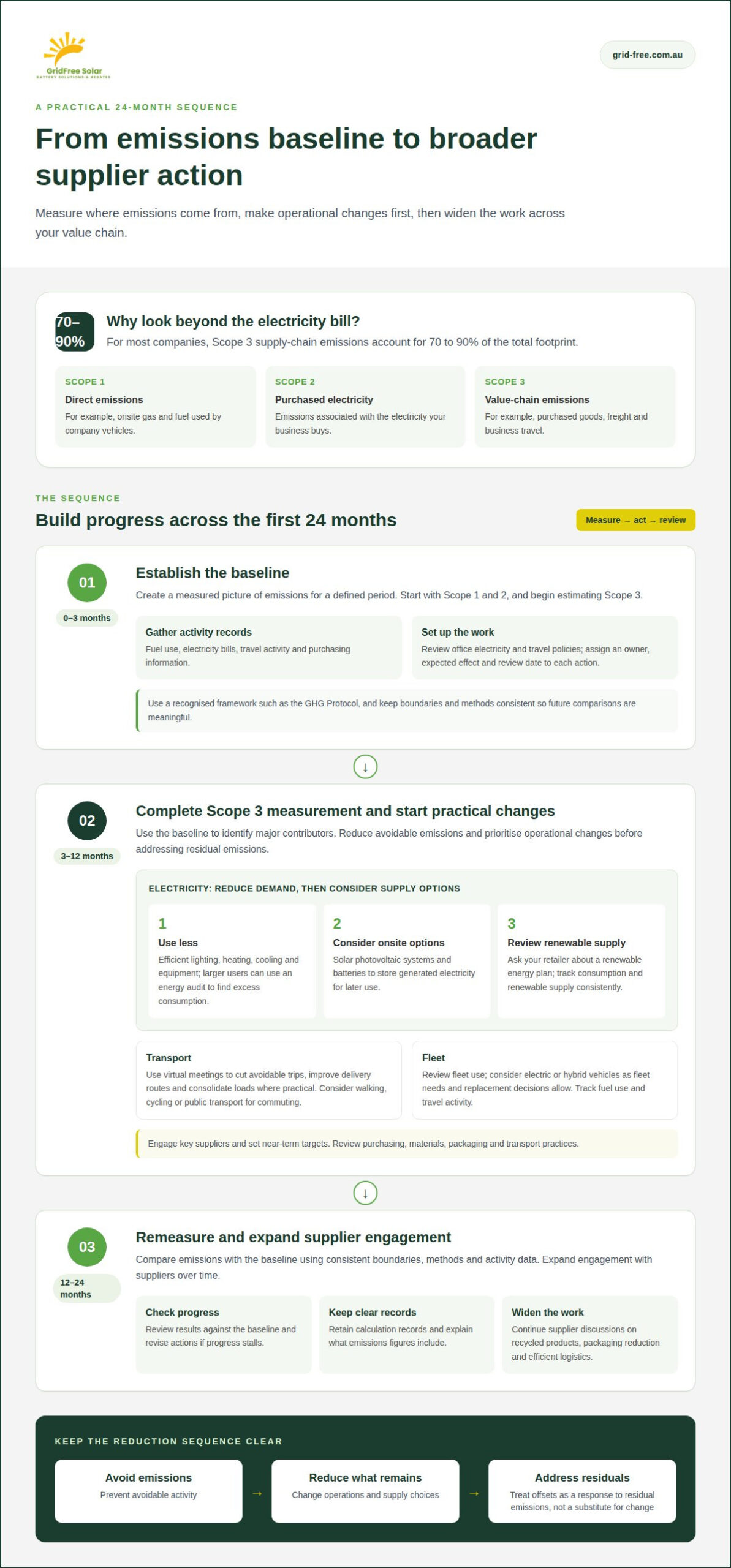
A business carbon footprint covers greenhouse gas emissions from its operations, supply chains and products. Scope 1 means direct emissions from sources the business owns or controls. Examples include gas burned onsite and fuel used by company vehicles. Scope 2 covers emissions associated with purchased electricity. Scope 3 captures other indirect emissions across the value chain, such as purchased goods, freight and business travel.
These categories reveal why an electricity bill alone won’t show your full impact. For most companies, Scope 3 supply-chain emissions account for 70 to 90% of their total footprint. Victoria’s interim emissions reduction target for 2035 is 75-80% below 2005 emissions levels, according to the Victorian Government. The Climate Action Act 2017 provides a framework for state policies called sector pledges.
Start with a baseline: a measured picture of emissions for a defined period. Use a recognised framework such as the GHG Protocol to organise Scope 1, 2 and 3 data consistently. Gather records such as fuel use, electricity bills, travel activity and purchasing information. Carbon calculation tools or advisers can help estimate emissions where direct measurements aren’t available. Keep the boundaries and methods consistent so future comparisons show meaningful changes.
Next, focus on suppliers. Purchased materials, packaging and transport can generate emissions before goods reach your business. Review purchasing records and discuss suppliers’ sustainability practices, recycled products, packaging reduction and more efficient logistics. These conversations turn measurement into action. Clear priorities from leadership can also make emissions reduction part of everyday purchasing decisions.
To verify reductions, compare emissions with your baseline using consistent boundaries, methods and activity data, and retain records for each calculation. Report direct reductions separately from offsets, state what each claim covers and use credible verification for offset projects. Assess additionality, permanence, double counting, measurement, verification and leakage. Avoid claiming carbon neutrality based on offsets alone. Reduce or avoid emissions first, then address residual emissions transparently.
Business action on climate change
For a business reducing its carbon footprint in Victoria, climate action starts with operational decisions. Appoint a leader to coordinate the work, involve staff who understand daily processes and set measurable targets. An office, for example, can track electricity, fleet fuel, staff travel and waste separately. This makes it easier to identify practical changes that cut emissions and support sustainability.
Start with electricity. A business can install solar photovoltaic systems behind the meter or ask its retailer about green energy options. Victoria’s renewable electricity generation targets are 65% by 2030 and 95% by 2035, according to the Victorian Government. Businesses can also reduce demand by upgrading to LED lighting, improving heating and cooling controls, and choosing energy-efficient equipment—such as modern climate control systems installed by Nature Carer Environmental Solutions. Larger energy users can use an energy audit to identify processes that consume excess power.
Next, review transport. Reduce avoidable business travel with virtual meetings, and encourage public transport, walking or cycling for commuting. Fleet choices matter too: adopting electric or hybrid vehicles, or using fewer cars, can reduce road emissions. Track fuel use and travel activity over time to see whether these changes are helping meet your targets.
Make waste reduction practical. Provide reusable cups, bottles, plates and utensils instead of disposable options. Improve recycling and composting, cut single-use plastics and print on both sides of each sheet. When purchasing, ask suppliers about recycled materials, refurbished equipment and resource-efficient packaging. These steps connect day-to-day operations with wider supply-chain sustainability.
A practical plan for reducing your business’s carbon footprint in Victoria starts by avoiding emissions, then reducing those that remain. Treat offsets as a way to address residual emissions, not a substitute for operational change. Measure progress against your baseline, revise actions if results stall and explain what your figures include. Clear records help staff understand the financial and environmental case for each initiative, while transparent targets guide leadership’s next decisions.
3. Carbon reduction initiatives and sequencing
Sequence initiatives by emissions source, not by visibility. Use your baseline to identify major contributors and distinguish immediate operational changes from longer-term projects. Assign an owner to each action, record its expected effect and set a review date. This gives staff a clear path from climate commitments to measurable progress.
For electricity emissions, reduce demand first through efficient lighting, heating, cooling and equipment. Then consider onsite solar, batteries to store generated electricity for later use, and a renewable energy plan through your retailer. Solar and storage can complement each other, but the right mix depends on your building, electricity use and operating patterns. Track consumption and renewable supply consistently.
For transport, cut avoidable trips with virtual meetings and improve delivery routes to prevent unnecessary travel. Review fleet use, consolidate loads where practical, and encourage staff to walk, cycle or use public transport for commuting. You can also consider electric or hybrid vehicles as fleet needs and replacement decisions allow.
Build the plan in phases across the first 24 months. In 0 to 3 months, establish a Scope 1 and 2 baseline, review office electricity and travel policies, and begin Scope 3 estimates. In 3 to 12 months, complete Scope 3 measurement, engage key suppliers and set near-term targets. In 12 to 24 months, remeasure against the baseline and expand supplier engagement.
Common risks include incomplete activity data, unclear responsibility and relying on offsets instead of reducing emissions. Document calculation methods, assign accountable owners and prioritise direct reductions before offsets. Involve staff in choosing practical changes, then measure progress against the same baseline. A net zero goal is more credible when actions, timelines and remaining emissions are transparent, rather than presented as a broad claim without supporting evidence.
4. What are the biggest sources of carbon emissions for businesses in Victoria, Australia?
Every Victorian business has a different emissions profile. A manufacturer may use substantial energy in production, while a professional services firm may have a smaller onsite footprint but significant emissions from purchased goods, travel and digital equipment. The main sources depend on what the business buys, how it operates and where its products go.
For many organisations, the supply chain deserves close attention. Supply-chain emissions are, on average, 26 times higher than operational emissions. Raw materials can carry emissions from extraction, processing and land use before a business receives them. A construction firm, for example, can examine materials and freight; an office can review computers, furniture, paper and contracted services.
Electricity is another significant source, particularly for businesses with energy-intensive premises, refrigeration, machinery or long operating hours. Emissions from purchased electricity depend on consumption and the generation mix behind the supply. Onsite fuel creates direct emissions too, including gas for heating or processes and fuel used by vehicles or equipment. Separate these sources to identify whether electricity, fuel or purchasing needs attention first.
Transport and distribution emissions go beyond a company’s own fleet. Deliveries, freight providers, employee travel and customer journeys can all contribute. The production and transport of goods also generate emissions across the wider economy. Map how key inputs and products move, then review shipment frequency, packaging and logistics to find practical opportunities for improvement.
Use purchasing and activity records to rank sources rather than relying on assumptions. Compare electricity and fuel data with spending categories, supplier information, freight activity and travel records. The resulting picture will show which emissions are direct, which relate to electricity and which sit across the value chain. For a practical next step, explore ways to reduce electricity-related emissions through onsite energy options.
GridFree Solar
If your emissions baseline identifies purchased electricity as an opportunity, GridFree Solar offers Commercial Solar Solutions and solar and battery installation for businesses considering onsite generation and energy storage. For an existing solar system, Battery Upgrade & Replacement can increase storage capacity.
The right solution depends on your business’s electricity use, operating patterns and existing system. Solar can reduce emissions associated with business operations, while a battery stores generated energy for later use. These options are relevant when your reduction plan prioritises electricity and you are ready to assess an onsite system or upgrade.
Contact GridFree Solar to discuss a solar or battery solution for your business.
Turn your emissions plan into sustained progress
Reducing your business’s carbon footprint in Victoria is an ongoing process, not a one-off project. Turn priorities into clear actions, assign responsibility and review results as your operations change. Keep records consistent, involve people who influence day-to-day decisions and use new information to refine the plan. This makes climate action part of how your business operates, rather than a separate initiative that loses focus.
If electricity is a priority in your plan, GridFree Solar can help you consider solar and battery options for your business. Contact GridFree Solar today to discuss a practical next step. Start with the action that best fits your needs, then keep building on that progress.
Frequently Asked Questions
Why should my business reduce its carbon emissions?
Reducing emissions can help your business manage climate-related risks and prepare for a lower-emissions economy. It can also reveal ways to use energy and materials more efficiently. Tracking fuel and electricity, for example, can show where operational changes may reduce both waste and emissions. Clear measurement gives staff, customers and suppliers a stronger basis for understanding your sustainability priorities and progress.
Carbon reduction vs offsetting: What’s the difference, and which should come first?
Carbon reduction means preventing or lowering emissions from your business activities. Offsetting supports projects intended to compensate for emissions elsewhere. Prioritise avoiding and reducing your own emissions, for example by changing energy use or purchasing, and consider offsets only for residual emissions. Report reductions separately from offsets and explain what your claim covers so readers can see the difference.
How can companies limit global warming?
Businesses can contribute by reducing greenhouse gas emissions across their operations and value chains. Set clear measurement boundaries, then identify practical changes to energy use, transport, purchasing and waste. For example, reduce avoidable freight movements and choose lower-emissions materials where suitable. Track results against a baseline, and update actions as suppliers, technology and business needs change.
How can companies reduce their carbon footprint?
Focus on changes that address the emissions your business actually generates. Review energy-intensive equipment, avoid unnecessary travel, reduce material use and discuss lower-emissions options with suppliers. Assign an owner to each action and record the activity data needed to assess its effect. Then review results and adjust the plan. This makes emissions reduction part of operational decisions, not a one-off sustainability statement.
How can a Victorian business calculate its carbon footprint, and which tools or standards should it use?
A Victorian business can calculate its footprint by setting organisational boundaries, gathering activity data and applying suitable emissions factors. Use the GHG Protocol to organise direct and indirect emissions consistently. Useful records include electricity and fuel invoices, freight data, purchasing records and travel expenses. A carbon calculator or emissions adviser can help estimate the footprint. Document methods and assumptions so future measurements remain comparable.
What Victorian government grants or rebates help businesses reduce emissions?
Support depends on each program’s eligibility rules, including whether it covers businesses, the premises and the proposed project. Don’t assume a household solar or battery rebate applies to a commercial installation. Before including support in a business case, review the scheme’s applicant, system and timing criteria. GridFree Solar helps customers navigate and claim solar and battery rebates, which may be relevant to an eligible installation.