Table of Contents
- Microinverter vs Power Optimizer: How Each System Works
- Solar Panel Performance in Shade: What Changes at Panel Level
- Energy Production, Clipping and Panel-to-Inverter Ratios
- Panel-Level Solar Monitoring: What You Actually See
- Microinverter Cost vs Optimiser: Upfront and Lifecycle
- Microinverter Reliability and Maintenance Over 25 Years
- Choosing by Roof, Battery and Backup Needs
- Frequently Asked Questions
Last Updated: October 12, 2026
Microinverter vs Power Optimizer: How Each System Works
The performance differences between a microinverter and a power optimizer come down to where the DC-to-AC conversion happens.
This guide breaks down how each approach performs in real conditions, so you can match the right architecture to your roof, your battery plans, and your budget.
Panel-Level Conversion and Maximum Power Point Tracking
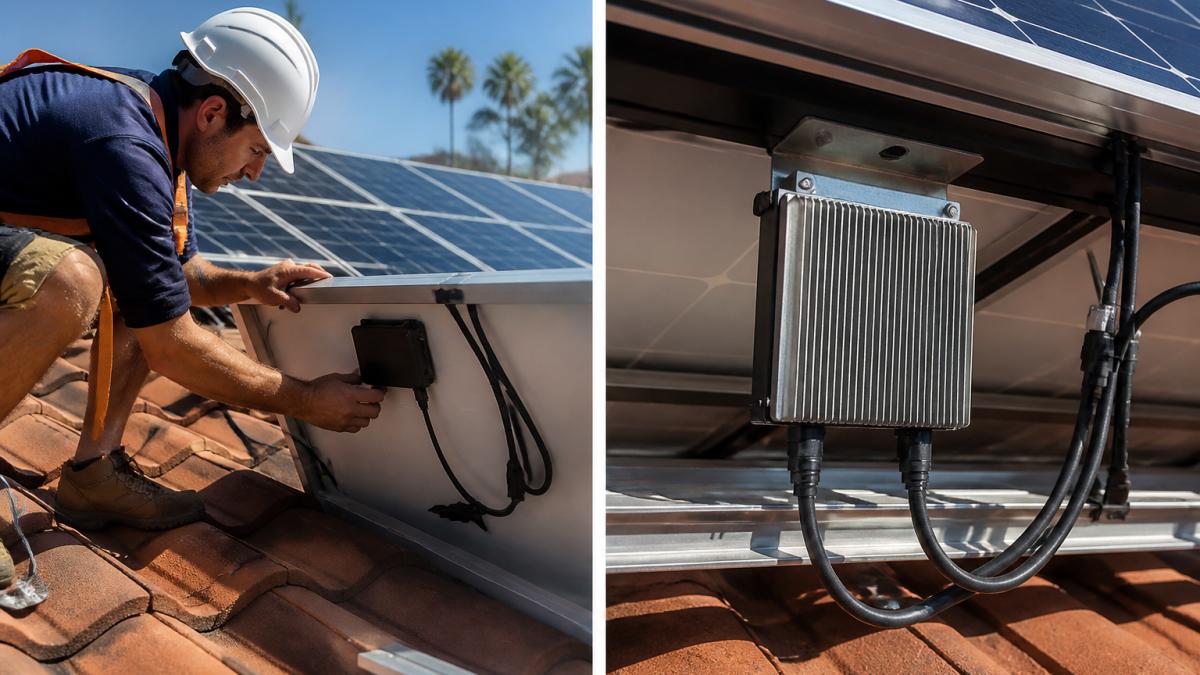
Maximum power point tracking (MPPT) is the process of continuously adjusting electrical load to extract the most power from a panel as conditions change. In a traditional string setup, one MPPT governs the whole series string, so the weakest panel drags the rest down. Module-level power electronics fix that by giving every panel its own MPPT.
Microinverters perform MPPT and DC-to-AC conversion together at the panel. Power optimizers perform MPPT only, leaving conversion to the string inverter. Both let each panel operate independently, which matters most when shade, soiling, or panel mismatch would otherwise cap the array’s output.
Solar Panel Performance in Shade: What Changes at Panel Level
Shade tolerance is where panel-level electronics earn their keep. In a plain string system, shading one panel reduces output across the entire series string because current is limited by the weakest module. Module-level MPPT isolates that loss to the shaded panel alone.
The practical difference depends on your shade pattern. A single chimney shadow crossing one panel in the afternoon is handled well by either microinverters or optimizers. Broad, dappled shade from a tree across several panels still reduces total energy harvest, because shaded panels genuinely produce less, but the unshaded panels keep working at full output instead of being dragged down.
Ask your installer for a shade analysis based on your actual roof, not a generic estimate. Afternoon shade patterns in particular change the economics of panel-level electronics, and the difference between “one panel shaded” and “half the array shaded” decides whether the extra cost pays for itself.
Energy Production, Clipping and Panel-to-Inverter Ratios
Clipping happens when a panel’s output exceeds what the inverter can convert, so the surplus is lost. It sounds like a flaw, but a controlled amount of clipping is normal and often deliberate. Installers size inverters below the array’s peak DC rating (a lower DC-to-AC ratio) because panels rarely hit nameplate output, and the saved equipment cost can outweigh the clipped energy.
Microinverters clip per panel, so a single oversized module only affects itself. String inverters clip across the whole array, which makes the panel-to-inverter ratio a bigger design decision. A ratio that’s too aggressive clips too much on clear, cool days when panels perform at their best.
| Factor | Microinverter | Power Optimizer + String Inverter |
|---|---|---|
| Conversion location | At each panel (DC to AC) | Central inverter (DC to AC) |
| Clipping scope | Per panel | Whole array |
| Shade response | Full panel independence | Panel-level MPPT, shared inverter |
| Monitoring detail | Per panel | Per panel |
| Single point of failure | None central | Central inverter |
Panel-Level Solar Monitoring: What You Actually See
Panel-level solar monitoring shows the output of every individual module, not just the array total. Both microinverters and optimizers deliver this, which makes troubleshooting far faster: if one panel underperforms, you see it immediately rather than guessing.
That visibility has a real maintenance benefit. A dropped panel can mean a failed unit, a loose connection, or soiling, and per-panel data tells your installer where to look before anyone climbs on the roof. For systems with a battery, monitoring also shows how stored energy is being used across the day.
Microinverter Cost vs Optimiser: Upfront and Lifecycle
Microinverter cost versus optimiser cost splits into two parts: what you pay upfront and what you pay over the system’s life. Most quotes you receive will bundle hardware, mounting, labour and commissioning into a single per-watt figure, which makes the two architectures look closer than they really are.
Upfront cost structure
- A microinverter system buys one conversion unit per panel. There is no central inverter, but the per-panel hardware count is higher and every unit needs roof mounting.
- An optimiser system buys one DC-to-DC unit per panel plus a single central string inverter. The per-panel hardware is usually cheaper, but the central inverter is a significant line item on its own.
- Because both approaches add module-level electronics, both carry more roof-level labour than a plain string system. The gap between them is narrower than marketing suggests.
Lifecycle cost structure
The lifecycle picture is where the two diverge, and it is driven by three things: replacement timing, replacement labour, and warranty coverage.
- A central string inverter is a single component with a finite service life. Over a 25-year system, most practitioners expect at least one replacement, and often a second if the first unit was installed early in the system’s life. Replacement is a ground-level or wall-mounted job, which keeps labour contained.
- Microinverters spread conversion across many small units. A failure affects one panel rather than the whole array, but replacing one means roof access, and roof access is the expensive part of any service call. On a steep or tiled roof, the labour can exceed the hardware cost.
- Optimisers sit between the two. The panel-level units are relatively simple DC electronics with fewer heat-stressed components than a microinverter, but the central inverter still carries the same replacement expectation as any string system.
Warranty coverage is not the same as cost coverage
Warranty length is a common selling point, but the number that matters is what the warranty actually pays for. A long product warranty that covers the replacement unit but not the labour to remove and refit it still leaves you paying for the roof work. When you compare quotes, ask specifically:
- Does the warranty cover parts only, or parts and labour?
- Does it cover the cost of getting a technician to the roof, or just the replacement unit?
- What is the claims process, and who coordinates it, the manufacturer, the installer, or you?
Rebates and incentives change the maths
Small-scale technology certificates under the federal Renewable Energy Target reduce the upfront cost of eligible systems, and the value of those certificates varies with the system’s rated output and the current market price. Because the certificate value is tied to capacity rather than architecture, it does not by itself favour microinverters or optimisers.
Do not compare microinverter and optimiser quotes on the headline per-watt price alone. Ask each installer for a 25-year view that includes expected inverter replacement, an estimate of roof-access labour for a panel-level failure, and a written statement of what the warranty pays for. That document is the only fair basis for comparison.
Pricing depends on your roof, system size, and current rebate eligibility, so we quote each home individually rather than publishing figures that will not match your situation.
Microinverter Reliability and Maintenance Over 25 Years
Microinverter reliability and maintenance comes down to heat, electronics and where the failure points sit. Understanding the actual mechanisms makes the 25-year picture far clearer than a simple “microinverters run hot” summary.
What actually fails, and why
- Microinverters sit under panels in high temperatures, and the electrolytic capacitors inside them are the components most sensitive to heat. Capacitor degradation is the classic long-term failure mode, and it is why enclosure design, thermal derating and mounting clearance matter more than headline efficiency.
- String inverters sit in a shaded garage or on a wall mount, a gentler thermal environment, but they contain the same class of components plus higher-power switching devices. They are a single point of failure for the whole array.
- Optimisers are relatively simple DC-to-DC units with fewer heat-stressed parts than a microinverter, but they still rely on the central inverter for conversion, so the system-level failure point is unchanged.
- Connectors, cable glands and roof-level terminations are a shared weak point across all three architectures. Water ingress and thermal cycling at the connector are common causes of intermittent faults, and they are not unique to any one brand or topology.
Expected service intervals
Over a 25-year system, plan for the following as a baseline rather than a worst case:
- Central string inverter: at least one replacement, often two. This is the single most predictable maintenance cost in a string or optimiser system.
- Microinverters: individual unit failures are expected to be isolated rather than systemic, but the failure rate is spread across many more devices. A small number of replacements over 25 years is a reasonable planning assumption.
- Optimisers: generally treated as long-life DC electronics, but they are still roof-mounted and still subject to the same thermal and moisture stresses as any panel-level device.
- All architectures: periodic inspection of roof-level connectors, earthing and isolation, plus a check of monitoring data for drift.
How monitoring changes the maintenance equation
Panel-level monitoring is the single biggest practical difference between a well-run system and a neglected one.
A common pattern is that the first sign of trouble is not a hard failure but a gradual decline in one panel’s daily yield relative to its neighbours. Per-panel data catches that; array-level data does not.
Compliance and installation quality
Reliability is not only a hardware question. Wiring practices, isolation, and rapid shutdown requirements all affect how safely and how long a system operates.
A long product warranty does not guarantee a low-cost repair. Before signing, confirm who pays for roof access, who lodges the claim, and how long a replacement typically takes to arrive. Those three answers predict your real maintenance experience more accurately than the warranty term printed on the datasheet.
Neither approach is maintenance-free, and both benefit from the same thing: monitoring that flags a problem early, and an installer who will act on it.
Choosing by Roof, Battery and Backup Needs
The right choice depends on your roof, your battery plans, and whether you want backup power. Microinverters suit complex roofs with multiple orientations and heavy, scattered shade, because every panel works independently. Optimizers plus a string inverter often win on larger, simpler roofs where upfront cost matters and shade is limited.
Battery and backup compatibility is the factor most buyers overlook. If you plan to add storage, the system architecture needs to support it cleanly, and some inverter and battery combinations pair more easily than others. For homes with a shaded afternoon roof and battery ambitions, a properly designed panel-level system with smart monitoring is where the long-term value sits.
Frequently Asked Questions
What is the difference between a power optimizer and a microinverter?
A power optimizer is a DC-to-DC device mounted behind each panel that performs maximum power point tracking and sends DC power to a central string inverter. A microinverter converts DC to AC at the panel itself, so no central inverter is needed. Both give independent panel operation and panel-level data. The practical difference is where conversion happens, which affects clipping behaviour, replacement logistics and how the system pairs with batteries.
Which performs better in partial shade: microinverters or power optimisers?
Both handle shade far better than a plain string system because each panel operates independently. In controlled comparisons the gap between the two is usually small, often within a few percent of annual production. What matters more is the specific shade pattern, roof orientation and how the array is split into strings. A site assessment with shade modelling tells you more than a blanket brand claim.
Are microinverters worth the extra cost over optimisers?
It depends on your roof and your plans. Microinverters typically cost more upfront, but they suit complex roofs with multiple orientations and heavy afternoon shade, and they avoid a single central inverter failure bringing the whole array down. Optimisers plus a string inverter often cost less and pair simply with battery storage. Ask for both options quoted against your actual roof layout.
Which system is easier to maintain: microinverters or optimisers?
Optimisers keep the electronics off the roof, so most faults are diagnosed and fixed at the inverter on the ground. Microinverters sit under each panel, meaning a failure may require roof access and panel removal. Both are generally reliable and come with long warranties, but replacement labour differs. Panel-level monitoring on either system shows which unit has failed before anyone climbs up.
Shaded roofs and battery plans are exactly where a generic quote falls short. GridFree Solar designs panel-level systems around your actual roof, backs them with CEC-accredited installation, AS/NZS 5139:2019 and AS/NZS 3000 compliance, and provides ongoing monitoring support so you can see every panel working. Connect Now with GridFree Solar and get a system matched to your home, not a template.