

Table of Contents
- Understanding Feed-In Tariffs and Export Potential
- Step 1: Assess Your Solar System’s Current Performance
- Step 2: Optimise Battery Storage vs Grid Export Strategy
- Step 3: Use Time-Of-Use Electricity Pricing
- Step 4: Implement Smart Load Shifting and Energy Management
- Step 5: Maintain Your Solar System for Maximum Export Efficiency
- Preparing for 2026 Regulatory Changes and Grid Connection Rules
- Frequently Asked Questions
Last Updated: August 17, 2026
Understanding Feed-In Tariffs and Export Potential
A feed-in tariff compensates you for excess solar energy exported back to the grid. Your solar inverter measures the kWh you send to the network, and your retailer pays you a rate per kilowatt-hour, transforming your system into a revenue-generating asset.
The export rate depends on your state, retailer, and time of day. Some offer flat rates year-round; others use time-of-use pricing that rewards you for exporting during peak demand windows, typically 6-8pm when grid strain is highest. Understanding your specific tariff structure is essential for maximising earnings.
Your system’s export potential hinges on three factors: system size (measured in kW), location (which determines solar irradiance), and self-consumption behaviour. A 5kW system in a sunny region might generate 20-25 kWh per day in summer, but only 8-12 kWh in winter. The portion you don’t use immediately becomes available for export.
Recent changes to grid connection rules in 2026 have introduced voltage regulation requirements and export limits in some regions to protect grid stability. Before implementing any export-maximisation strategy, verify your local network operator’s current rules and your inverter’s export capacity rating. GridFree Solar’s CEC-accredited installers stay current with these standards and can advise whether your system meets AS/NZS 5139:2019 compliance requirements for safe grid export.
Your feed-in tariff rate is negotiable. Many householders accept their retailer’s standard offer without checking alternatives. Switching retailers to access a higher export rate can add hundreds of dollars annually to your earnings.
Step 1: Assess Your Solar System’s Current Performance
Before optimising for export, you need baseline data. Most modern solar systems include a monitoring app or web portal that logs generation, consumption, and export in real time.
Review your solar yield and grid export data
Pull 3-6 months of historical data from your monitoring system. Look for:
- Daily generation profile: When does your system produce most power? (typically 9am-3pm)
- Self-consumption rate: What percentage of generated power do you use immediately versus export?
- Seasonal variation: How much does winter generation differ from summer?
- Current export volume: How many kWh per day are you exporting on average?
This data reveals whether your current behaviour is optimised or wasteful. Many households export 40-60% of their generation without any deliberate strategy.
If you lack granular data, request it from your installer or monitoring platform provider. GridFree Solar customers benefit from comprehensive energy management system monitoring that tracks export patterns down to the hour.
Identify peak generation and export windows
Plot your generation profile against your retailer’s time-of-use tariff. If you export at 15¢/kWh from 6-8pm but generate most power at noon, you have a timing mismatch. Create a simple table comparing time windows, average generation, your export rate, and current export behaviour to identify where tariff arbitrage opportunities exist.
Step 2: Optimise Battery Storage vs Grid Export Strategy
The choice between battery storage and direct grid export depends on your tariff, consumption pattern, and financial goals.
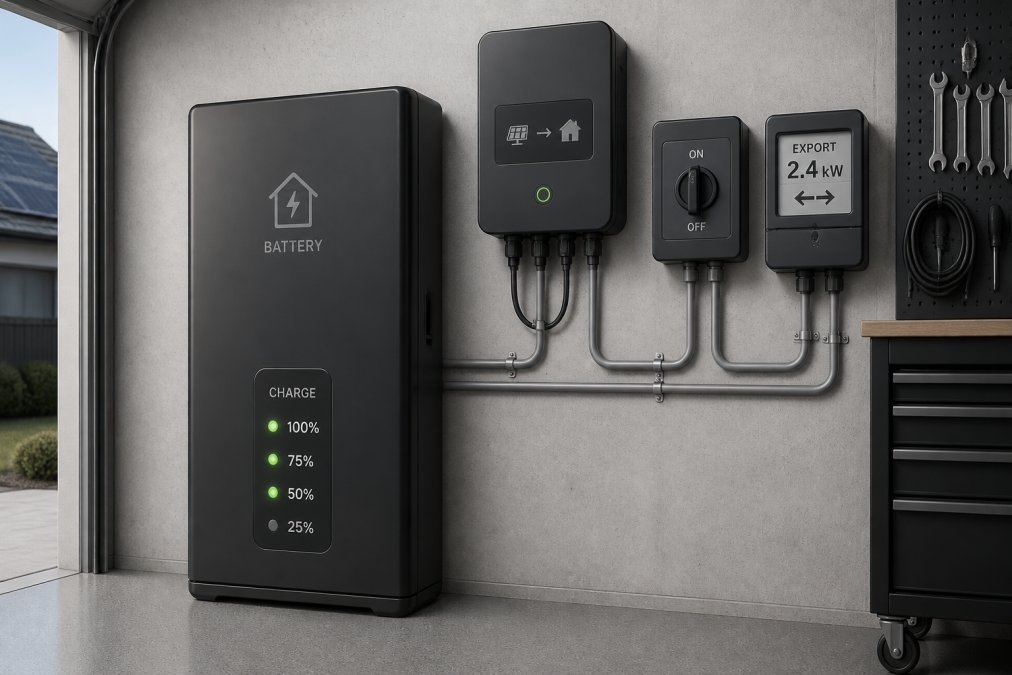
Direct grid export is immediate and simple: excess generation goes straight to the grid and you earn the export rate. Battery storage adds a step: you charge the battery with midday surplus, then discharge it during peak-rate windows (typically 6-8pm) to export at a higher rate or avoid purchasing grid power at peak rates.
The maths depends on your tariff spread. If your peak export rate is 40¢/kWh and you’re currently exporting at 8¢/kWh during the day, storing and shifting that power to evening export can double your earnings.
When to prioritise battery discharge during peak tariff periods
Battery discharge is most valuable when your retailer offers time-of-use export rates with a significant spread (e.g., 8¢/kWh daytime vs. 15-20¢/kWh evening), your system generates surplus power during off-peak hours, and your battery has sufficient capacity to store a meaningful volume for evening export.
A typical scenario: your 10kWh battery charges to 80% by 2pm (7kWh stored). From 6-8pm, you discharge at 15¢/kWh, earning £1.05 per kWh discharged. Over a year, this strategy can add £500-£1,200 to your earnings. GridFree Solar’s battery systems are designed for this use case, with the $1 daily bonus for avoiding grid use during peak hours combined with the 15¢/kWh export rate from 6-8pm.
When to export directly to the grid for immediate returns
Direct export is preferable when your retailer offers a flat export rate, your battery is at capacity or degradation risk, or you prioritise simplicity and minimal battery cycling. In these scenarios, storing power costs more in battery wear than you gain in tariff arbitrage.
The break-even point for battery storage is typically 2-4 years in high-tariff-spread regions. If your export rate spread is less than 8¢/kWh, direct export is usually more economical.
Step 3: Use Time-Of-Use Electricity Pricing
Time-of-use pricing is the hidden lever that transforms export earnings. Most retailers now offer peak, shoulder, and off-peak rates that vary by time of day and day of week.
Understanding your tariff structure and export rates
Request a detailed tariff document from your retailer showing off-peak rates (typically 11pm-7am), shoulder rates (typically 7am-11am and 3pm-6pm), and peak rates (typically 6pm-10pm). Your export rates usually follow the same windows. When grid demand is high, your retailer pays more for your export because they can sell it at a premium.
Many households export passively throughout the day without considering the time-of-use structure. Storing midday generation and exporting it during peak windows can increase your earnings by 50-100% with no additional hardware.
Scheduling appliances and battery discharge for peak earnings windows
Your energy management system can automate this. Set rules such as charging your battery from 12pm-3pm (when generation is highest), discharging from 6pm-8pm (when export rates peak), running pool pumps or hot water heating from 11am-2pm, and avoiding grid consumption from 6pm-8pm. GridFree Solar’s monitoring platform includes this capability, allowing you to earn the $1 daily bonus for peak-period grid avoidance whilst maximising your 15¢/kWh evening export rate.
Step 4: Implement Smart Load Shifting and Energy Management
Load shifting means moving your energy consumption to times when it’s cheapest or when your solar generation is highest, reducing grid purchases and increasing export volume during high-rate windows.
Using smart meters and energy management systems
A smart meter measures your consumption in half-hourly intervals. An energy management system (EMS) sits between your smart meter, solar inverter, and battery, making real-time decisions about when to charge, discharge, and consume based on current solar generation, battery state of charge, time-of-use tariff rates, and your consumption forecast.
Automating appliance schedules to avoid peak demand periods
Identify your biggest energy consumers: hot water heating (2-4 kWh per day), pool pumps (1-3 kWh per day), electric vehicle charging (5-15 kWh per charge), and dishwasher/washing machine (2-3 kWh per cycle). Schedule hot water heating from 11am-2pm or during 6-8pm export window, pool pumps from 12pm-3pm, EV charging overnight or during 11am-2pm, and laundry during shoulder rates. This strategy alone can reduce your grid consumption by 15-25% and increase export volume by a similar margin, translating to £200-£500 in additional savings annually.
Avoid scheduling all major loads into the same window. Simultaneous demand can exceed your solar system’s capacity and force you to draw from the grid at peak rates.
Step 5: Maintain Your Solar System for Maximum Export Efficiency
A poorly maintained solar system loses 10-20% of its potential output. Dust, debris, bird droppings, and inverter faults all reduce generation and export earnings.

Regular monitoring and performance tracking
Check your monitoring app weekly and compare your generation to historical averages. A sudden drop of more than 10% signals a problem: soiling, inverter fault, or grid export limit breach. Most modern inverters log fault codes. If your inverter shows “export limit” or “grid voltage out of range,” contact your installer immediately.
Establish a baseline in your first full year and use it as a benchmark. Any consistent shortfall suggests degradation or maintenance issues.
Preventive maintenance to sustain solar yield
Annual tasks include visual inspection for loose connections or corrosion, panel cleaning (quarterly in dusty regions, annually otherwise), inverter inspection to ensure cooling vents are clear, and battery maintenance including firmware updates. GridFree Solar’s maintenance support includes annual system health checks and performance reporting. Solar panels degrade roughly 0.5% per year normally, but premature degradation from poor maintenance is avoidable. A well-maintained system sustains 95%+ of its original output for 20+ years.
Preparing for 2026 Regulatory Changes and Grid Connection Rules
The grid connection landscape is tightening. In 2026, new rules governing export limits, voltage regulation, and demand response have come into effect across most regions.
Export limits: Some network operators now cap residential export at 5kW or 10kW, regardless of your system size. Check your network operator’s current export limit for your property.
Voltage regulation: Your inverter must actively manage voltage to prevent grid instability. If your system was installed before 2020, verify that your inverter meets AS/NZS 5139:2019 voltage ride-through requirements.
Demand response: Some retailers now offer dynamic pricing that adjusts your export rate based on real-time grid conditions, requiring an advanced energy management system to participate.
GridFree Solar’s CEC-accredited installers are trained on these regulatory changes and can advise whether your system needs upgrades to remain compliant.
Maximising your solar export earnings in 2026 requires understanding your tariff, aligning your generation and consumption to your tariff windows, and maintaining your system to sustain output. Battery shifting, load scheduling, and smart automation can increase your earnings by £1,000-£2,500 per year, reducing your investment payback period from 6-8 years to 4-5 years. Connect with GridFree Solar to assess your system’s current performance, identify optimisation opportunities specific to your home, and implement the monitoring and automation needed to sustain those earnings through 2026 and beyond.
Frequently Asked Questions
How do time-of-use tariffs affect my solar export earnings in 2026?
Time-of-use pricing charges different rates depending on demand periods. Off-peak hours typically offer lower rates, while peak demand windows (often 6-8pm) offer higher export rates. By scheduling battery discharge or shifting energy-intensive appliance use to align with peak tariff periods, you can earn more per kWh exported. Your energy management system should track these windows automatically to maximise returns without manual intervention.
Is it better to store solar energy in a battery or export it to the grid?
The answer depends on your feed-in tariff rates and consumption patterns. If your export rate exceeds the cost of grid electricity during peak demand, exporting directly often yields better returns. However, battery storage offers flexibility: you can store energy generated during midday and discharge it during expensive peak periods (6-8pm) when export rates are highest. A hybrid approach, monitored by your energy management system, typically maximises earnings by choosing the best option for each time window.
What maintenance steps ensure maximum solar export efficiency?
Regular monitoring of your solar system’s performance is essential. Check for shading, soiling (dirt or debris on panels), and inverter faults that reduce generation. Battery storage systems require periodic health checks to maintain discharge capacity. Professional solar system monitoring and maintenance services can identify performance drops before they significantly impact earnings. Most systems benefit from annual inspections and prompt repairs to sustain optimal solar yield and grid export capacity.
Why is my solar export so low, and how can I improve it?
Low export can stem from several causes: shading on panels, inefficient battery discharge scheduling, suboptimal inverter settings, or a system sized too small for your needs. Start by reviewing your solar yield data and identifying generation patterns. Ensure your battery discharge is timed to peak tariff periods. Check that your grid connection allows full export capacity. If issues persist, professional solar system monitoring and maintenance services can diagnose specific problems and recommend upgrades or configuration adjustments to boost earnings.
This article was written using GrandRanker