

Melbourne households faced a 15% increase in wholesale electricity costs compared with three years earlier. A home solar system can generate electricity for your household to use instead of buying all of it from the grid. Securing your family’s energy future in Melbourne starts with understanding how solar can fit your home and daily energy use.
Rising energy costs make it sensible to seek more control over household electricity. Securing your family’s energy future in Melbourne takes more than installing panels: your roof, energy habits, solar generation and available incentives all matter.
This guide explains how to assess those factors, understand Solar Victoria rebates and plan for greater energy independence. Use these practical steps to make a considered decision based on your home, budget and energy needs.
Key Takeaways
- Compare how much solar electricity your household can use directly with what you still need to buy from the grid.
- Assess roof orientation and local weather together to understand how your home’s solar generation may vary.
- Explore eligibility for Solar Victoria’s solar rebate, which may be up to A$1,400 in 2026.
- Consider whether Battery Upgrade & Replacement could help you store more solar energy for household use.
Why Solar Installation is Vital for Melbourne Homes in 2026
For Melbourne families, securing an energy future starts by comparing solar generation with household demand. Assess your costs, installation needs and long-term plans before choosing a system.
-
Compare solar and grid electricity costs
Compare your electricity bills with the solar power your household could use directly. Solar panels generate electricity for household use, reducing how much you need to buy from the grid. Consider when your family uses power: running appliances during the day can make more of your solar generation useful at home. Also account for electricity you’ll still draw from the grid, rather than treating solar as a complete replacement.
-
Estimate installation costs and returns
Estimate the upfront investment alongside the potential reduction in grid purchases. Most Melbourne homeowners can recoup installation costs within 3 to 5 years. Treat that as a planning estimate, not a promised result: your household’s electricity use and the amount of solar power used directly affect the outcome. Compare projected savings with your current bills before deciding.
-
Choose an installer and ongoing support
Choose an installer by comparing the system design, installation scope and support arrangements in the proposal. Ask how the system is sized for your household’s electricity use, and review warranty coverage for panels, inverter, battery and workmanship. The key risks to assess include fire-safety issues linked to unsuitable design or installation, and warranty gaps that leave components or workmanship uncovered. Also consider property value: sustainable features and certifications can improve a home’s resale value and appeal to future generations.
-
Check Victorian installation rules
Confirm the installation plan addresses Victoria’s relevant technical and electrical requirements. Solar systems should be tested to meet Australian installation standard AS/NZS 5033. A Certificate of Electrical Safety is issued by an independent inspector within 5 business days after installation. Victorian solar installations also need a smart meter to record exported electricity in 30-minute intervals. These are practical checkpoints for understanding how the installation is tested and how exported power is recorded.
Melbourne weather and roof orientation
Prepare for outages by identifying essential household needs and planning how your family will manage interruptions. Include extreme-weather conditions and backup arrangements in your household energy plan.
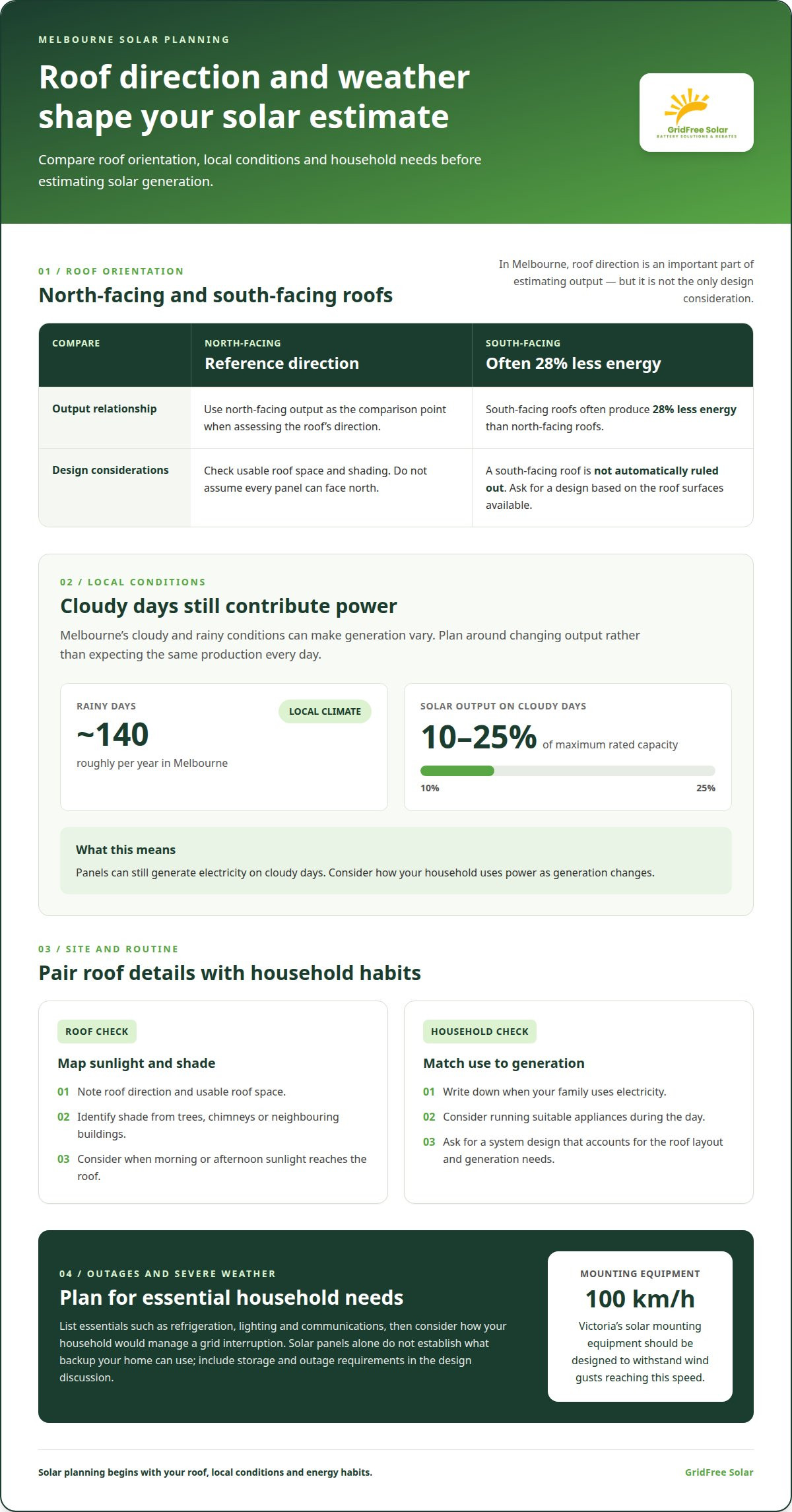
- Check your roof’s direction before estimating solar output. In Melbourne, south-facing roofs often produce 28% less energy than north-facing roofs. That difference makes orientation an important part of system planning, but it doesn’t automatically rule out a south-facing roof. Consider usable roof space and shading too. Ask for a design that accounts for the surfaces available, rather than assuming every panel can face north.
- Factor Melbourne’s cloudy and rainy conditions into your expectations. The city experiences roughly 140 rainy days annually, and panels can still generate electricity on cloudy days. In Melbourne, solar panels produce 10% to 25% of their maximum rated capacity on cloudy days. Use this range to understand why output varies, then plan household electricity use around changing generation instead of expecting identical production each day.
- Review roof shade and household routines together. A tree, chimney or neighbouring building can limit sunlight on part of a roof, while morning or afternoon exposure varies with orientation. Note where shade falls and when your family uses electricity. This gives the system design a practical basis. A tailored solar system design can account for roof layout and generation needs.
- Include outages and severe weather in your energy plan. List essential loads, such as refrigeration, lighting and communications, then consider how your household will manage if grid power is interrupted. Solar panels do not, by themselves, establish what backup a home can use, so make storage and outage requirements part of the design discussion. In Victoria, solar mounting equipment should be designed to withstand wind gusts reaching 100km/h. Ask how the mounting design addresses this condition.
Energy independence and control over household costs
- Shift flexible electricity use into solar-generation hours. Run cooling, laundry or other suitable appliances during the day, when your system produces power. Using air conditioning during daytime solar production can reduce annual cooling expenses by 75% or more. Start by reviewing your household routine, then move suitable tasks away from evening use. This helps make more generated electricity useful at home. Matching usage with generation is a practical step towards securing your family’s energy future in Melbourne.
- List the appliances that still rely on gas and consider a practical transition to electric alternatives. Switching from residential gas to electricity can lower household energy bills and reduce Australia’s emissions. Plan the change around your solar generation and the appliances your family uses most. Electrification and energy-efficiency upgrades can support ongoing bill reductions, unlike one-off payments. Prioritise changes that meet household needs rather than replacing equipment without a clear purpose.
- Pair solar with energy-efficiency improvements. LED lighting and quality insulation can reduce the energy needed for lighting, heating and cooling, helping lower electricity bills. Identify rooms that are difficult to keep comfortable, then consider whether insulation or efficient lighting addresses the cause. These measures complement solar by cutting demand. A practical efficiency plan can help secure your family’s energy future in Melbourne by making household generation go further.
- For an apartment building, investigate collective electricity purchasing through the City of Melbourne. Its buying group aims to secure 100% renewable electricity for participating buildings, with long-term supply contracts lasting 5-7 years. Offers are for common areas, not individual apartments. Check whether your building fits those conditions before planning around this option.
Potential rebates and incentives for eligible homeowners
Use these steps to assess the Victorian solar rebate criteria and factor potential support into your household’s solar plans.
- Start by checking the rebate amount. According to Solar Victoria, eligible Victorian households may receive a solar rebate of up to A$1,400 in 2026. Treat this as potential support towards a solar installation, not as the full project budget. Compare the rebate with your household’s overall energy plans, including expected electricity use and whether you’re considering solar alone or a battery too.
- Review the household income test before planning your application. According to Solar Victoria, Victorian solar rebate applicants must have combined household taxable income below A$210,000 per year. Use taxable income across the household, rather than relying on one person’s income alone. Organise the relevant household income information early, so you can assess this criterion alongside the property requirement.
- Assess the property value against the threshold. According to Solar Victoria, the property value must be under A$3 million for an existing home or when construction is complete. Consider which situation applies to your home, then compare its value with the stated limit. This criterion sits alongside the household income test, so meeting one does not replace checking the other.
- Bring the eligibility criteria together before making decisions about the installation. Note the rebate amount, combined taxable income and property value in one place. Then consider how a potential rebate affects your plans, without treating it as a guaranteed reduction to a particular installation cost. Keep your household’s energy needs central: the system design should suit how your family uses electricity, not simply the availability of an incentive. For practical next steps, prepare your solar rebate application with the criteria in view.
GridFree Solar: Battery Upgrade & Replacement
GridFree Solar provides Battery Upgrade & Replacement for households looking to increase the storage capacity of an existing solar system. Consider an upgrade if you generate solar electricity but want to store more for use when your panels aren’t producing. For a new home system, GridFree Solar also provides Residential Solar Panel Installation and solar and battery installation.
The right next step depends on whether you already have solar and what you want your household system to do. If you have an existing battery, an upgrade or replacement can address changing storage needs. If you’re planning a new system, solar and battery installation brings generation and storage together.
Contact GridFree Solar or visit grid-free.com.au to discuss your household’s solar plans.
Make your next energy decision with confidence
Securing your family’s energy future in Melbourne is an ongoing plan, not a single purchase. Start by deciding what matters most to your household: reducing reliance on grid electricity, storing more solar generation or planning a system for a new property. That priority gives your next conversation a clear purpose.
GridFree Solar provides Residential Solar Panel Installation and Battery Upgrade & Replacement for household energy projects, as well as Commercial Solar Solutions for businesses in Melbourne and Victoria. Bring your energy goals and details of your existing system to discuss a practical next step.
Contact GridFree Solar to discuss your options and move forward with a plan that fits your needs. A more considered energy future starts with one practical decision.
Frequently Asked Questions
What does securing your family’s energy future mean for Melbourne households?
For Melbourne families, securing your energy future means making household energy more manageable and less dependent on grid purchases. Identify essential appliances, when your family uses electricity and which loads could shift to daytime. Then consider whether storing solar generation suits your routine. A practical plan connects those choices with your home, rather than treating panels or batteries as a one-size-fits-all fix.
What do home solar panels and battery systems cost in Melbourne, including rebates?
Solar and battery installation costs depend on system size, roof characteristics, equipment and the storage capacity selected. The price depends on the case and is given after a quote request, with the system design, components and installation scope shaping the figure. An eligible rebate may reduce the upfront amount. Compare proposals on what each system includes and how it fits your household’s energy use, not on headline figures alone.
What Victorian solar and home battery rebates or incentives are available in 2026?
Eligible Victorian households may receive a Solar Victoria solar rebate of up to A$1,400 in 2026. Solar Victoria states that Victorian solar rebate applicants must have combined household taxable income below A$210,000 per year. For battery incentives, assess the system’s eligibility and applicable program conditions separately. Keep rebate assumptions distinct from the total installation cost when planning your household budget.
How much can a Melbourne household save with solar panels and a battery?
Savings depend on how much solar electricity your household uses directly and how much stored energy it later consumes. To estimate your own result, compare bills across seasons and note daytime usage, evening demand and grid imports. A battery’s contribution depends on whether stored solar is available when household demand occurs.
What should Melbourne families consider when choosing an energy retailer, solar installer, or battery?
Compare electricity import rates, feed-in tariffs and contract conditions against your household’s usage pattern. When reviewing a solar proposal, check the system design, written scope, component warranties and support arrangements. For a battery, consider whether its capacity suits your evening demand and how it integrates with your existing solar equipment. Keep these details together to compare the complete household energy solution, not isolated product claims.