

Your solar bill tells two stories, and only one is obvious. The amount due shows what remains to pay, but it doesn’t immediately tell you how much electricity you bought from the grid or how much your panels sent back. If you’re searching for how to read your solar electricity bill Victoria, start by separating those grid transactions from the electricity your home used directly from solar.
It’s easy to expect solar to make your bill shrink dramatically, then feel unsure when usage charges remain or feed-in credits look small. Your bill records exported electricity and the credit your retailer applies. Solar power used directly in your home usually won’t appear as a bill credit, even though it can reduce the electricity you need to buy.
This guide shows you where to find the amount due, grid imports, solar exports, usage rates, daily supply charges and feed-in credits. Victorian retailers don’t all present these details in the same place, so use the labels, units and billing dates to identify and compare figures. You’ll also learn what to review if a charge, meter reading or credit seems unexpected, and how to use bill data to understand your household’s energy use.
Key Takeaways
- Follow a simple order when checking your bill: billing dates, amount due, account summary, then detailed charges.
- Learn how to read your solar electricity bill Victoria by separating grid usage charges from fixed supply charges and feed-in credits.
- Compare solar generation, household use, grid imports and exports, while recognising that your bill may not show every behind-the-meter figure.
- If the total looks higher than expected, review the billing period, previous balance, rates and meter readings before drawing conclusions.
- Smart Energy Monitoring can help you compare solar-system performance with bill periods, with local solar and battery guidance from GridFree Solar in Melbourne and Victoria.
How to Read a Solar Electricity Bill in Victoria: Start with the Summary
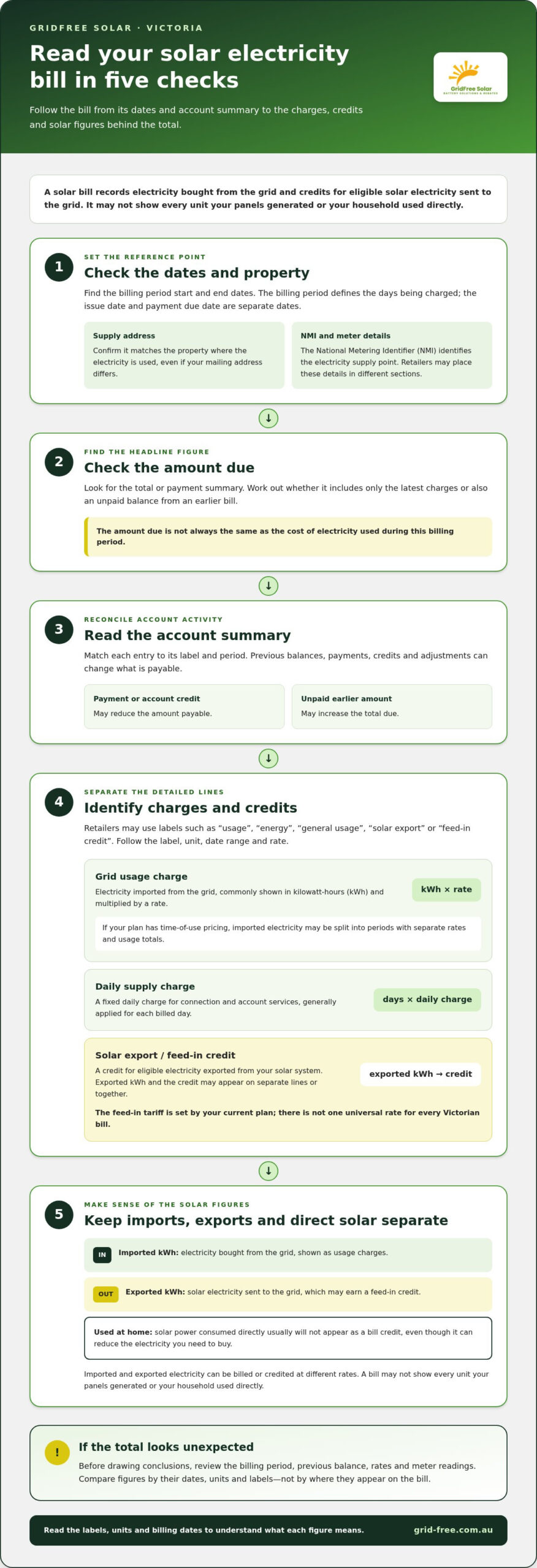
A solar electricity bill records the charges, credits and account activity for a property over a set period. It may show electricity imported from the grid and credits for solar electricity exported, but it won’t necessarily show every unit your panels generated or your household used directly. Solar is part of Australia’s changing energy mix, as outlined in Solar Power in Australia, but your retailer’s bill is an account statement first. Read it in a consistent order to distinguish what you owe from the details behind the total.
The billing period is the date range covered by the electricity charges on your bill. Start there, then check the amount due, review the account summary and move on to the detailed charges. This helps you avoid comparing different periods or mistaking an old balance for new usage. Retailers arrange bills differently, so identify each figure by its purpose and label, not by its position on the page.
- Check the billing dates. Find the start and end dates for the charges, then note the bill issue date and payment due date. The billing period defines the days being charged; the due date tells you when payment is expected.
- Find the amount due. Look for the total or payment summary. Check whether it includes only the latest charges or also an unpaid balance from an earlier bill.
- Read the account summary. Look for labels such as previous balance, payment received, credit or adjustments. These entries show how account activity affects the total payable.
- Review the detailed charges. Once the summary makes sense, check the itemised section to see how current electricity charges and credits contribute to the amount due.
Find the billing period, amount due and account summary
Separate the current bill’s charges from any amount carried forward. For example, a previous balance may be reduced by a payment or account credit before the latest charges are added. A credit may reduce what’s payable, while an unpaid amount from an earlier bill may increase the total due. Match each entry to its label and period rather than assuming the headline amount represents electricity use during this period alone.
Identify the meter and the property being billed
Check the supply address against the property where the electricity is used. It may differ from your mailing address, particularly if bills are sent elsewhere. Find the National Metering Identifier (NMI), which identifies the electricity supply point, and compare it with the property details on your account. Retailers may place the address, NMI and meter information in different sections, so scan the account, supply or meter details rather than relying on a standard page position.
These opening checks give you a reliable reference point for the solar figures that follow. If you’re learning how to read your solar electricity bill Victoria, confirm the property and dates first. Otherwise, even correctly labelled usage and export figures may relate to the wrong address or billing period.
Decode Electricity Usage, Supply Charges and Solar Feed-in Credits
Once you’ve checked the account summary, separate charges for electricity drawn from the grid from credits for solar energy sent out. Your bill may use labels such as “usage”, “energy”, “general usage”, “solar export” or “feed-in credit”. Wording and layout vary by retailer, so follow each line’s unit, date range and rate rather than relying on a familiar heading.
Read the usage and supply charge lines
A supply charge is a fixed daily charge for connection and account services, as set out in your plan. It generally applies for each billed day, whether you use much electricity or little. Usage charges are different: they’re calculated from electricity imported from the grid, commonly recorded in kilowatt-hours (kWh) and multiplied by a rate.
Find the daily supply charge and usage lines separately. If your plan has time-of-use pricing, the bill may split imported electricity into periods, each with its own rate and usage total. Match the dates, units and rate labels printed on your bill. To understand the pricing benchmark for standing offers, see the Essential Services Commission’s Victorian Default Offer. It’s a benchmark, not necessarily the rate on your plan.
As a simple check, a usage line combines the number of imported kWh with its applicable rate. The supply line reflects the number of billed days and the daily charge. Don’t add these quantities together: one measures electricity and the other is a fixed account charge. Check the bill’s calculation and any separate time bands before comparing charges across periods.
Understand solar exports and feed-in tariff credits
A feed-in tariff (FiT) is a credit for eligible electricity exported from your solar system to the grid. Your bill may show exported kWh on one line and the credit on another, or combine them in an export-credit entry. The FiT is set by your current plan, so there isn’t one universal rate for every Victorian bill.
Imported kWh are electricity you buy from the grid; exported kWh are solar electricity sent to the grid, and the two can be billed or credited at different rates. A feed-in credit may reduce the bill total, but don’t assume each exported unit cancels an imported unit at the same value. Check whether the export credit uses a flat or time-based rate and whether the bill shows the credit before or after other account adjustments.
- Usage: grid electricity imported, measured in kWh and charged at the plan’s applicable rate.
- Supply: a daily charge shown separately from energy use.
- Solar export: eligible electricity sent to the grid, with a plan-based credit.
For a clearer comparison, line up the bill’s imported and exported kWh against the same billing dates. Smart Energy Monitoring can help you view solar-system performance alongside bill periods. GridFree Solar’s solar and battery guidance can help Melbourne and Victorian households put those figures in context.
Check Solar Generation, Grid Imports and Export Data Side by Side
Your bill’s export figure is only one part of the solar picture. To understand how electricity moved through your home, compare four measures for the same dates: total solar generation, energy used at home, electricity imported from the grid and electricity exported to it. A standard electricity bill may show grid imports and exports, but not all behind-the-meter solar generation or household self-consumption.
| Measure | What it means | Where to look |
|---|---|---|
| Solar generated | Electricity produced by your solar system | Solar inverter or monitoring data |
| Energy used at home | Electricity consumed by household appliances and systems | Monitoring data, if available |
| Grid imports | Electricity drawn from the grid | Usage or consumption lines on the bill |
| Grid exports | Electricity sent from your system to the grid | Export or feed-in data on the bill |
Exported energy is not the same as total solar generation: some solar electricity may be used in your home before any surplus reaches the grid. That self-consumed power can reduce the amount you import, but it usually won’t appear as a separate bill credit. A modest export total alone doesn’t show how much solar your household generated or used directly.
Compare bill data with your solar monitoring
Match the dates before comparing figures. A bill covers a defined billing period, while a monitoring app or inverter display may default to a calendar day, month or another date range. Set both records to the same start and end dates where possible. Otherwise, a difference may reflect mismatched periods rather than a system issue.
Monitoring and meter data measure related but different things. The meter records electricity flowing between the property and the grid. Solar monitoring reports system performance and may show generation and household use. Smart Energy Monitoring can help you view system performance alongside bill information, making it easier to compare the same period and spot patterns in imports and exports.
Read export credits and VPP entries carefully
Keep feed-in tariff credits separate from other account entries. A bill may include adjustments, rebates or programme-related rewards, and their labels and placement can differ between retailers. Check the description, applicable dates and whether an entry is measured in kWh or shown as a dollar credit. Don’t assume every credit is payment for exported solar.
GridFree Solar’s Virtual Power Plant (VPP) rewards include a $1 daily bonus, 15¢/kWh export credit, and free grid charging from 11 am-2 pm. Check the bill or programme information to understand how any VPP entry is recorded and which period it covers. When you’re learning how to read your solar electricity bill Victoria, keep bill export data, solar monitoring and programme rewards distinct: each shows a different part of your energy use.
What to Check When Your Victorian Solar Bill Looks Unexpected
A higher bill doesn’t automatically mean your solar system has stopped working. The total can change because of the dates covered, electricity use, plan rates, account activity or how much solar your household generated and used during that period. Check the details in sequence before drawing conclusions. A structured review can show whether the difference relates to charges, meter readings or solar exports.
Follow a simple bill-checking sequence
Compare the current bill with the previous one, but make sure you’re comparing equivalent periods. A longer billing period can include more daily supply charges and more days of electricity use. Then work through the figures that make up the total:
- Confirm the billing dates and note whether the periods match closely enough for a useful comparison.
- Check the account balance for an unpaid previous amount, payments received, credits or adjustments.
- Compare imported electricity in kWh, the applicable usage rates and any time-of-use categories against the previous bill.
- Review supply charges and check the daily rate and number of billed days shown on the account.
- Check meter reads to see whether they’re marked actual or estimated, and compare the read dates with the billing period.
- Compare solar exports only across matching meter and monitoring date ranges. A different period can make exports look unusually high or low.
Usage and solar generation can shift between bills. Seasonal conditions affect how much sunlight your system receives, while household routines influence when electricity is used and how much is drawn from the grid. For example, changing when appliances run can alter grid imports even if the system is generating solar power. Use the same dates and check both usage and export figures before deciding what has changed.
Know when to seek clarification
If a calculation, meter read or plan term still doesn’t make sense, contact your electricity retailer and refer to the exact bill line and dates you’re querying. For unresolved Victorian energy complaints, the Energy and Water Ombudsman Victoria (EWOV) provides an independent complaints pathway. You can also use Energy Compare Victoria to compare energy plans, and consult the Essential Services Commission for current Victorian energy consumer guidance.
A bill alone can’t diagnose a solar-system fault. Compare its export figures with system monitoring for the same period; a mismatch may come from different date ranges or because the bill and monitoring show different measures. If the figures remain difficult to interpret, get clear solar and battery guidance from GridFree Solar for your Melbourne or Victorian home.
Turn Your Solar Bill into a Clearer Energy Plan with GridFree Solar
Once you can separate grid imports, solar exports and account charges, your bill becomes a useful starting point for reviewing how your home uses energy. GridFree Solar supports homeowners across Melbourne and Victoria with residential solar panel and battery installation, battery upgrades and Smart Energy Monitoring. These services help connect the figures on your bill with how your system performs, without promising a particular bill outcome.
Use bill insights to review your solar and storage setup
Look for patterns across several billing periods. Recurring grid imports may prompt you to consider when your household uses electricity, while regular exports may show that solar generation exceeds daytime demand at certain times. Neither figure alone proves that a system needs changing. Compare the bill with household routines and monitoring data before deciding what questions to explore.
Smart Energy Monitoring helps customers view solar-system performance alongside bill periods. Match the monitoring dates to the billing dates, then consider generation, imports and exports together. This can help distinguish electricity used directly at home from surplus sent to the grid, giving you clearer context for a discussion about solar or storage options.
GridFree Solar provides solar panel installation, solar and battery installation, and battery upgrades for existing systems. For STC eligibility, a battery must be installed with a new or existing solar PV system and have a capacity between 5 kWh and 100 kWh. Eligibility and the value of any incentive depend on the applicable requirements, so a bill figure alone doesn’t confirm eligibility. GridFree Solar also provides rebate assistance to help customers with solar and battery rebate claims.
Understand installation documentation and next steps
Clear records matter alongside system performance. Battery installations must comply with AS/NZS 5139:2019, AS/NZS 3000, UN38.3, IEC 62040-1 and related standards. These requirements cover installation and equipment; keep the specific system documentation supplied for your property with your records.
From 1 Mar 2026, installers must capture geotagged, timestamped photos of key labels/signage. Retailers/installers must provide clear written documentation to the consumer. Keep these records with your system information so you can refer to them when comparing monitoring data, discussing an upgrade or checking which equipment is installed.
Understanding how to read your solar electricity bill Victoria gives you a practical baseline: the bill shows grid transactions and charges, while monitoring adds insight into system performance. Bring the billing periods and matching monitoring data together before making decisions. For local solar and battery guidance, explore how GridFree Solar can help you assess your setup and the options that may suit your household.
Make Your Next Energy Decision with Confidence
Understanding how to read your solar electricity bill Victoria gives you a useful baseline for future decisions. Keep each bill alongside the matching solar monitoring data, then revisit the figures as your household’s energy needs change. This can help you have a more informed conversation about whether your current solar and battery setup still suits the way you use electricity.
GridFree Solar supports Melbourne and Victorian households with local solar and battery guidance. As a CEC Accredited Installer, the team offers Smart Energy Monitoring to help customers view system performance alongside bill periods, with lifetime remote monitoring and 24×7 support.
Ready to consider your next step? Explore solar and battery guidance for Melbourne and Victoria and move forward with a clearer view of your energy options.
Frequently Asked Questions
Why is my electricity bill high when I have solar panels?
Solar panels don’t supply every household need at every hour. You may still import electricity at night, during cloudy periods or when appliances use more power than your system is generating. A bill can also cover more days than the one before, include a previous balance or reflect a change in your plan’s rates. To understand how to read your solar electricity bill Victoria, compare matching billing periods and check when your household uses the most power.
Does a solar feed-in tariff reduce my electricity bill?
Yes. A feed-in tariff credit can reduce the amount payable by crediting eligible electricity your system exports to the grid. It doesn’t usually credit solar power you use directly at home, because that electricity hasn’t been exported. Check the bill for the export quantity, credit rate and any plan conditions. A credit may not offset imported electricity at the same rate, so compare the credit amount with the import charges rather than just the kWh totals.
Can I see all the electricity my solar panels generate on my bill?
Usually not. Your bill generally focuses on electricity flowing between your property and the grid, rather than total rooftop generation. For example, solar power used by a fridge or other appliance as it’s generated may reduce grid imports without appearing as a separate figure. Check your inverter display or solar monitoring for system generation, and set it to the same dates as the bill before comparing results.
What does an estimated meter read mean on a Victorian electricity bill?
An estimated read means the billed usage is based on an estimate rather than a meter reading taken for that billing point. The estimate may differ from actual consumption. Look for an “estimated” or similar label beside the read, and compare the meter-read dates with the bill period. If a later actual reading changes the account balance, ask your retailer how the adjustment was calculated and which dates it covers.
How do I compare solar electricity bills from different retailers?
Compare plans using the same household usage and export information, not just the headline offer. In Energy Compare Victoria, check the daily supply charge, usage rates for each time period, feed-in tariff and any conditions attached to credits or discounts. For Melbourne homes, location can affect available network charges and offers. Use recent bills with matching periods where possible, and check the plan details before switching.
Who can help with an electricity bill dispute in Victoria?
Start by raising the specific issue with your electricity retailer and keep a copy of the bill, meter details and any written replies. Explain which charge, reading or credit you dispute, and note the relevant billing dates. If the matter remains unresolved, contact the Energy and Water Ombudsman Victoria (EWOV), which handles Victorian energy complaints. Having the account reference and supporting documents ready can make it easier to explain the issue clearly.
Can a solar battery change what appears on my electricity bill?
Yes. A battery can store some solar electricity for use later, which may change how much energy your home imports from or exports to the grid. It doesn’t make the bill show every unit generated or used inside the home. If the battery also charges from the grid, that electricity may appear among imports. Compare bill readings with monitoring data over matching dates to understand how charging and discharging relate to grid flows.