
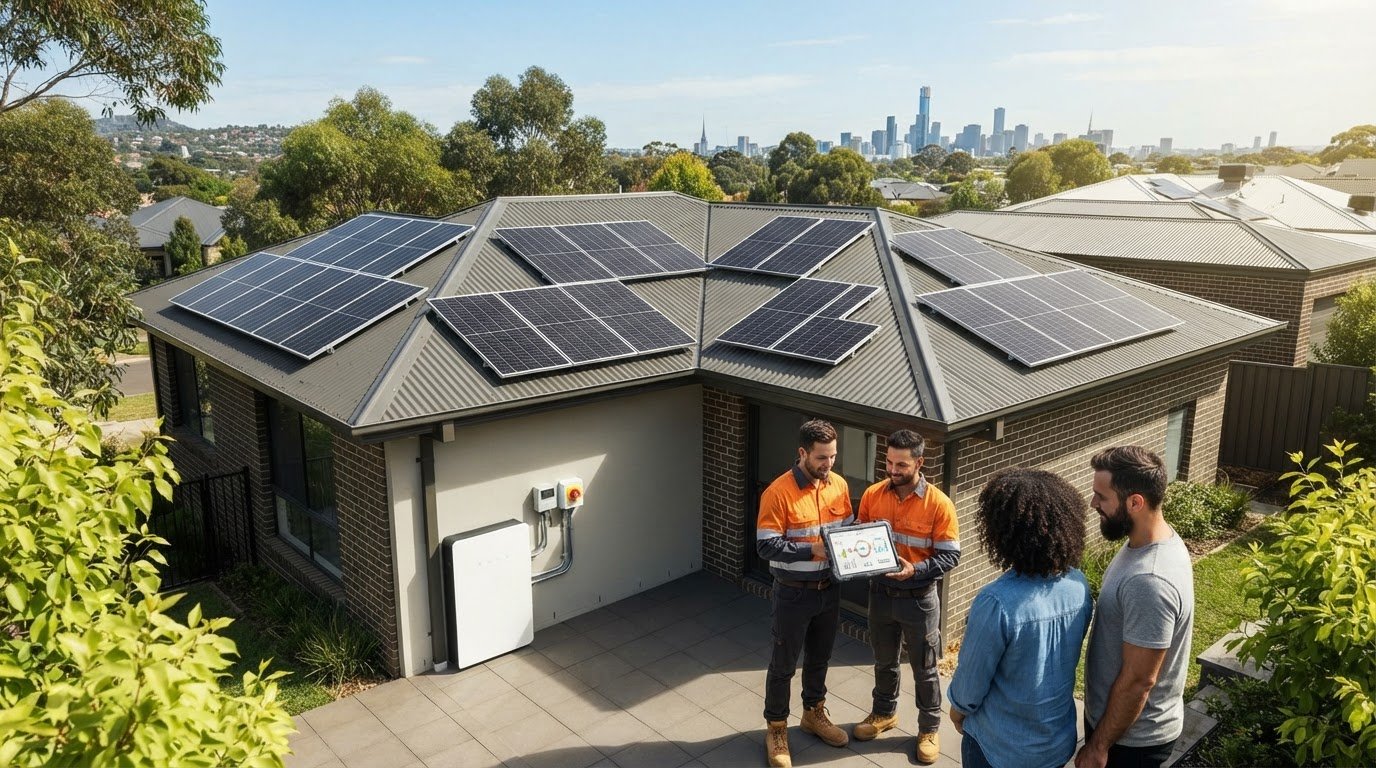
A low solar quote isn’t proof of a good deal. If the proposal’s assumptions, installation responsibilities or follow-up support are vague, comparing prices alone won’t show what you’re getting. Knowing how to choose a reputable solar company in Melbourne means looking for evidence behind the offer, including how the design fits your property and energy use.
When quotes differ, compare what each one actually includes. This Melbourne-focused guide gives you practical checks for system design, installer accreditation, equipment, communication and post-installation support. You’ll also learn how to assess proposals against your roof, electricity use and plans for adding a battery, rather than relying on a sales pitch.
We cover key checks for 2026, including Solar Accreditation Australia accreditation and product eligibility, then explain how GridFree Solar’s residential and commercial solar, battery installation, upgrades and rebate guidance can support different energy needs. The aim is a shortlist based on clear evidence and a proposal you can understand before deciding.
Key Takeaways
- Learn how to choose a reputable solar company in Melbourne by assessing accountability and project details, not review scores or advertising alone.
- Compare proposals on equivalent system design, battery scope, installation responsibilities, rebate handling and follow-up support.
- Check that relevant accreditations apply to the people responsible for designing and installing your system.
- Use your roof’s orientation, shading and site conditions to assess whether a proposal is tailored to your Melbourne property.
- See how GridFree Solar’s residential, commercial and battery services can support different energy needs, alongside rebate guidance.
Choosing a reputable solar company in Melbourne starts with evidence
Your choice of solar company affects more than the equipment on your roof. The design needs to suit your property, installation responsibilities need to be clear, and you should understand what support is described after commissioning. That’s why how to choose a reputable solar company in Melbourne comes down to checking the work behind the sales pitch.
A polished proposal or high review score can make a company look appealing, but neither shows whether the design reflects your roof, energy use or battery plans. Look for project-specific explanations: what has been proposed, which assumptions shaped the design, who is responsible for each stage and what follow-through the proposal describes.
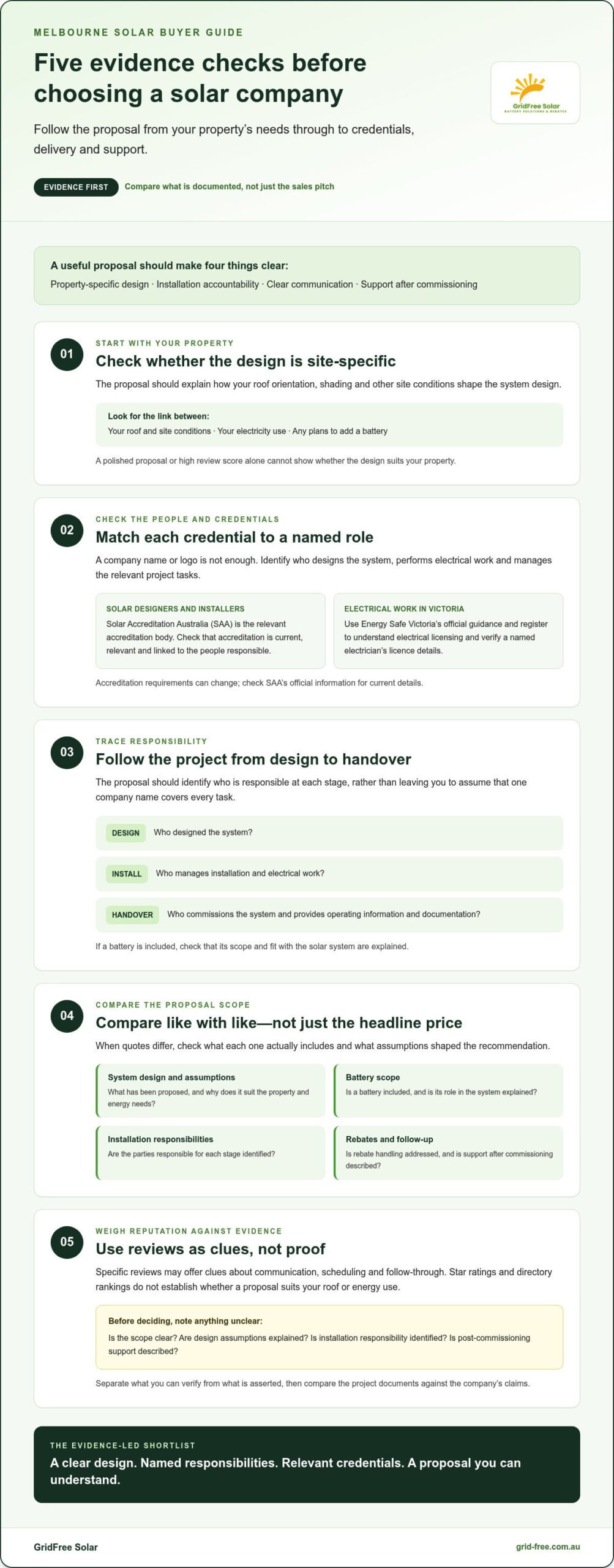
Assess four things before deciding: the property-specific design, installation accountability, clear communication and support after commissioning. These give you a practical basis for comparing proposals and checking whether the company’s claims are supported by the project details.
What does “reputable solar company” mean for a Melbourne customer?
Reputation should show up in decisions a company can explain, not just confident claims or polished marketing. A useful proposal connects the system to the property and its energy needs. Roof orientation, shading and other site conditions can influence design choices, so check whether the proposal explains how they were considered. The aim is to understand why the system was recommended and what each party is responsible for before work begins.
Solar is a familiar part of Australia’s energy mix, but that broad context doesn’t establish whether a specific design suits your home or business. The Solar power in Australia overview provides background on the technology’s development and role. For your decision, focus on evidence tied to your own site and proposed installation.
Why reviews and rankings are only part of the picture
Reviews can offer clues about communication, scheduling and how customers describe their experience. Look for specific comments about how information was explained and whether issues were followed through, rather than relying only on a star rating. Reviews can’t show whether a proposed system accounts for your roof, energy use or site conditions.
A directory ranking reflects that directory’s criteria, not necessarily the suitability of a proposal for your property. Compare general reputation signals with the project documents: are the system scope and assumptions clear, is installation responsibility identified, and is post-commissioning support described? Those details make a company’s claims more useful to your decision.
Separate what you can verify from what is asserted, and note any unclear part of the proposed scope. This isn’t about assuming something will go wrong. It’s about understanding what has been designed, who is accountable for delivery and what happens once the system is operating.
Check credentials, design responsibility and installation accountability
Credentials matter when they relate to the people and tasks involved in your project. A company name on a proposal doesn’t, by itself, show who designed the system, who will carry out electrical work or who will manage commissioning. Check that credentials are current, relevant to the work and linked to the individuals responsible.
In Australia, Solar Accreditation Australia (SAA) is the relevant accreditation body for solar designers and installers. Accreditation requirements can change, so use SAA’s official information for current details rather than relying on an old article or a general marketing claim. In Victoria, Energy Safe Victoria’s official guidance and register can help you understand electrical licensing and verify a named electrician’s licence details.
Which solar credentials and evidence should customers understand?
Look beyond a logo. Match each person’s name and role to the work they’ll perform, and check that their accreditation or licence is current and appropriate. If a proposal refers to an accredited designer or installer, it should identify that person and their project responsibilities. The Victorian Government Solar Energy Information is also a useful official reference for Victorian solar initiatives and support.
Who owns the design, installation and handover?
Clear responsibility makes it easier to follow a project from system design through installation, commissioning and handover. GridFree Solar installs residential and commercial solar systems, as well as solar and battery systems. Look for a clear outline of who coordinates each stage and how you’ll receive system documentation and an explanation of the installed system.
You should be able to identify who is responsible at every project stage, from design and installation to commissioning and handover. Trace that responsibility through the proposal rather than assuming one company name automatically covers every task. A useful project summary identifies the designer, the party managing installation, the person responsible for electrical work and who provides handover information. It should also explain how questions about the installed scope will be handled.
For handover, check that the process covers operating information and the documents you’ll need to understand what has been installed. If the project includes a battery, the proposal should explain its scope and how it fits with the solar system. This helps you understand how the system is intended to work and who is managing its delivery.
These checks make how to choose a reputable solar company in Melbourne more concrete: connect each credential to a person, each project stage to a responsible party, and each handover item to a clear process. For an integrated approach, explore GridFree Solar’s residential solar and battery installation.
Compare Melbourne solar proposals on scope, not just the headline
A lower headline figure can reflect a different system, different inclusions or different assumptions. Compare what each proposal delivers before weighing the totals. A like-for-like solar proposal uses clearly stated, comparable assumptions about system design, inclusions, installation responsibilities and support. Without that shared basis, you may be comparing different solutions rather than competing offers.
What should a solar proposal make clear?
Look for the proposed system components and the reasoning behind the design. The proposal should state whether it covers solar panels, battery storage or both, and set out the project scope in plain terms. Separate confirmed inclusions from assumptions, exclusions and tasks assigned to you. A battery listed as an option, for example, is not the same as one included in the quoted system.
Use this checklist to compare each offer side by side:
| Compare | What to look for |
|---|---|
| System design | Proposed components, layout rationale and site assumptions. |
| Battery scope | Whether storage is included, optional or outside the proposal. |
| Installation | Included work, customer responsibilities and who coordinates delivery. |
| Rebates | Any rebate assumptions, eligibility basis and who handles the claim. |
| Support | Commissioning, handover information and the support described after installation. |
How to compare proposals without fixating on price
Compare each row before considering the total. If one offer includes a battery and another doesn’t, they aren’t equivalent. The same applies if installation responsibilities, rebate handling or post-installation support differ. Mark anything described as “subject to site conditions” or “to be confirmed”, then understand how that assumption could affect the scope before deciding.
Read rebate wording carefully. Check whether an incentive is treated as an assumed reduction or whether the proposal explains the eligibility basis and claim responsibilities. For current Victorian industry information and standards, consult Solar Victoria Industry Guidance and Standards. Clear wording helps you distinguish an estimate from a confirmed inclusion.
GridFree Solar provides residential and commercial solar solutions, including solar and battery systems for different energy needs. Considering generation and storage together can make the proposed scope easier to assess. For more context on the installation process, look for the Solar Panel Installation Melbourne guide alongside your proposal review.
As you decide how to choose a reputable solar company in Melbourne, focus on whether each proposal explains what is being designed, what work is included and who is responsible for each part. A clear comparison gives you a stronger basis for judging value than the headline alone.
Assess Melbourne-specific fit, communication and support before deciding
A proposal should make sense for your property and how you use energy, not simply present a system size and a confident prediction. In Melbourne, roof orientation, shading from trees or nearby buildings and other site conditions can affect design choices. Treat these as factors to understand, not as a guarantee of a particular output. A sound review connects the site assumptions to your energy needs and explains what the provider will manage.
Does the proposal reflect the property and energy needs?
Look for an account of the roof layout and shading considered, along with the energy-use information that shaped the recommendation. Residential and commercial projects can have different priorities: a household may focus on when occupants use electricity, while a business may need a design considered against its operating patterns. The proposal should explain its reasoning without promising savings, output or payback unsupported by project-specific evidence.
Use this four-step check before deciding:
- Clarify your needs. Note how and when you use electricity, whether you’re considering a battery and what you want the system to address.
- Review site assumptions. Check that roof layout, orientation, shading and relevant site conditions are reflected in the design.
- Confirm responsibilities. Make sure it’s clear who coordinates the work and what information or decisions are required from you.
- Assess support. Understand how updates will be provided, what handover information you’ll receive and what support is described after installation.
What communication and after-installation support should feel like
Good communication is specific. You should be able to follow project updates, know who is responsible for the next step and understand the handover material without decoding technical jargon. Before committing, check that the proposal describes commissioning and customer handover, and explains how questions about the installed system will be handled. That sets clearer expectations from the outset.
GridFree Solar installs residential and commercial solar systems, solar and battery systems, and provides battery upgrades and replacements. Its rebate guidance helps customers navigate and claim solar and battery rebates. When planning a battery, consider how storage fits your usage and solar system rather than treating it as a separate add-on. This is also the focus of the Energy Storage Solutions Melbourne guide.
Use your answers to assess whether the proposed scope fits your site, whether responsibilities are clear and whether communication gives you confidence throughout the project. GridFree Solar brings solar, battery and rebate guidance together for different property needs. Explore solar and battery solutions for your property and consider how the proposed system aligns with your energy requirements.
Choose a Melbourne solar company with a clear path from design to delivery
Base your decision on four things: evidence behind the recommendation, a scope suited to your property, clear responsibility for delivery and understandable post-installation support. A strong proposal makes those elements easy to follow. If you can’t tell what’s included, who manages each stage or what happens at handover, get those details clarified before proceeding.
A final checklist before moving ahead
Use these checks to make your decision practical, not rushed:
- Review the design. Can you understand why the system suits your property and energy needs, and which site assumptions shape the recommendation?
- Read the scope. Are the proposed components, included work, exclusions and your responsibilities clearly set out?
- Trace accountability. Is it clear who coordinates installation, commissioning and customer handover, and what information you’ll receive?
- Check rebate details. Before relying on an incentive in your decision, compare the proposal’s wording with current official Victorian guidance. Eligibility, claim steps and program details can change.
Don’t treat an incentive as assured simply because it appears in a proposal. Understand whether it’s an estimate or an amount the provider expects to claim, what eligibility conditions apply and who is responsible for the claim. Use current official information for Victorian rebate requirements. This keeps your decision grounded in the project scope rather than an assumed benefit.
How GridFree Solar can support your next step
GridFree Solar installs solar and battery systems for residential and commercial customers, with solutions tailored to different property and energy requirements. If you already have a solar system, battery upgrade and replacement services may also be relevant. Discussing solar and storage together can help you consider how the system fits your broader energy needs rather than assessing a battery in isolation.
GridFree Solar also guides customers through solar and battery rebates. This support can help make rebate steps easier to understand, while eligibility and approval remain subject to the applicable program requirements. Review the project scope alongside current official information, and make sure the proposed work and your responsibilities are clear before moving ahead.
That’s the practical answer to how to choose a reputable solar company in Melbourne: choose a provider whose design, scope, project responsibilities and support are understandable and relevant to your property. If you’re ready to explore a connected solar and battery option, Explore GridFree Solar’s solar and battery installation services.
Turn your shortlist into a confident next step
Before choosing, define what you need your solar system to do. Note when you use the most electricity, any changes you expect at home or work, and whether battery storage is part of your plans. These priorities give you a useful starting point for a focused discussion about your property.
Knowing how to choose a reputable solar company in Melbourne is ultimately about making a decision you can explain to yourself: the proposed system fits your priorities, responsibilities are understood and you feel comfortable with the process ahead. Take the time you need, then use your shortlist to explore options that align with your next energy goal.
GridFree Solar supports projects for homes and businesses, including solar and battery installation, battery upgrades and replacements, and guidance with solar and battery rebates. Take the next step and explore GridFree Solar’s solar and battery solutions.
A well-informed choice can make the move to solar feel clearer from the first conversation onward.
Frequently Asked Questions
Is a high Google rating enough to identify a reputable solar company?
No. A high Google rating can offer clues about customer service, communication and how concerns were handled, but it can’t show whether a design fits your Melbourne property. Read reviews for relevant experiences, then assess the project documents separately. The answer to how to choose a reputable solar company in Melbourne should rest on more than online ratings: look for clear, project-specific information you can assess before making a commitment.
What should a Melbourne solar proposal include before I accept it?
It should describe the proposed system and its components, explain the design assumptions and state what the quoted scope includes. Check that it identifies optional items, exclusions and tasks you’re expected to handle. If the proposal names a particular panel or inverter, for example, make sure the equipment is identified clearly rather than described as an unspecified allowance. Keep the final proposal and accepted contract together for reference.
How can I check solar installer accreditation in Victoria?
Use Solar Accreditation Australia’s current official information to check whether the relevant designer or installer holds the accreditation required for their role. Match the name to the person connected with your project, rather than relying only on a company logo or general claim. For electrical licensing, consult Energy Safe Victoria’s official guidance and public register. Requirements can change, so use current Victorian and SAA sources rather than older summaries.
Can one company install solar panels and a battery together?
Yes. A provider can design and install a combined solar and battery system as one project. This can make it easier to consider how generation and storage fit together rather than treating the battery as a separate decision. GridFree Solar provides solar and battery installation for residential and commercial customers. If you’re adding storage to an existing system, battery upgrade or replacement work may also be relevant.
Who can help me understand solar and battery rebates in Victoria?
Solar Victoria and other relevant government program sources provide current Victorian rebate information, including eligibility and claim steps. GridFree Solar also helps customers navigate and claim solar and battery rebates. Treat any rebate shown in a proposal as subject to current program rules and your circumstances. Confirm official requirements before relying on an incentive in your project budget or deciding which system to install.
What documents should I keep after a solar installation?
Keep the accepted proposal and contract, final system design, invoices, equipment details, commissioning and handover documents, and any rebate application or claim records. Store operating instructions and equipment warranty documents as well. If you sell the property or need to understand the system later, a complete file makes it easier to identify what was installed and locate the relevant paperwork.
Does a solar company need to be based in Melbourne to serve Melbourne customers?
No. A company doesn’t necessarily need a Melbourne street address to work with customers in the city. What matters is whether it serves Melbourne and can explain how your project will be managed, including site-specific design, installation coordination and handover. Make sure the business and project details are clear in writing, and that you know your point of contact. GridFree Solar serves Melbourne customers with residential and commercial solar and battery systems.