Accreditation must match the work being done, not just the installer’s claim. To learn how to check if a solar installer is accredited in Victoria, ask for their Solar Accreditation Australia (SAA) number and use SAA’s service to confirm their current status. Grid-connected solar PV installers and designers need Small-scale Renewable Energy Scheme accreditation, while grid-connected battery installers need SAA battery installer accreditation.
Check credentials before proceeding with a quote. Accreditation relates to training and standards, and it can also affect eligibility to claim Small-scale Technology Certificates under the Australian Government’s Small-scale Renewable Energy Scheme. This guide explains how to check an installer’s status, what accreditation covers, and how it applies to certificates and grid-connected solar and battery systems in Victoria. You’ll have a clearer basis for assessing credentials relevant to your project.
Key Takeaways
- Match an installer’s accreditation scope to the work: design, installation or both, and the relevant system type.
- Understand how ongoing training and professional development help accredited installers maintain their skills.
- In Victoria, check that solar PV and battery installers hold an unrestricted Class A electrical licence registered with Energy Safe Victoria.
- Distinguish installer credentials from retailer authorisation, particularly when considering a Solar Homes Program installation.
1. How to check an installer’s Solar Accreditation Australia accreditation status
Solar Accreditation Australia (SAA) took over the installer accreditation scheme from the Clean Energy Council on 29 May 2024. The Clean Energy Regulator approved SAA as the new scheme operator on 29 February 2024. To learn how to check if a solar installer is accredited in Victoria, use SAA’s accreditation check service.
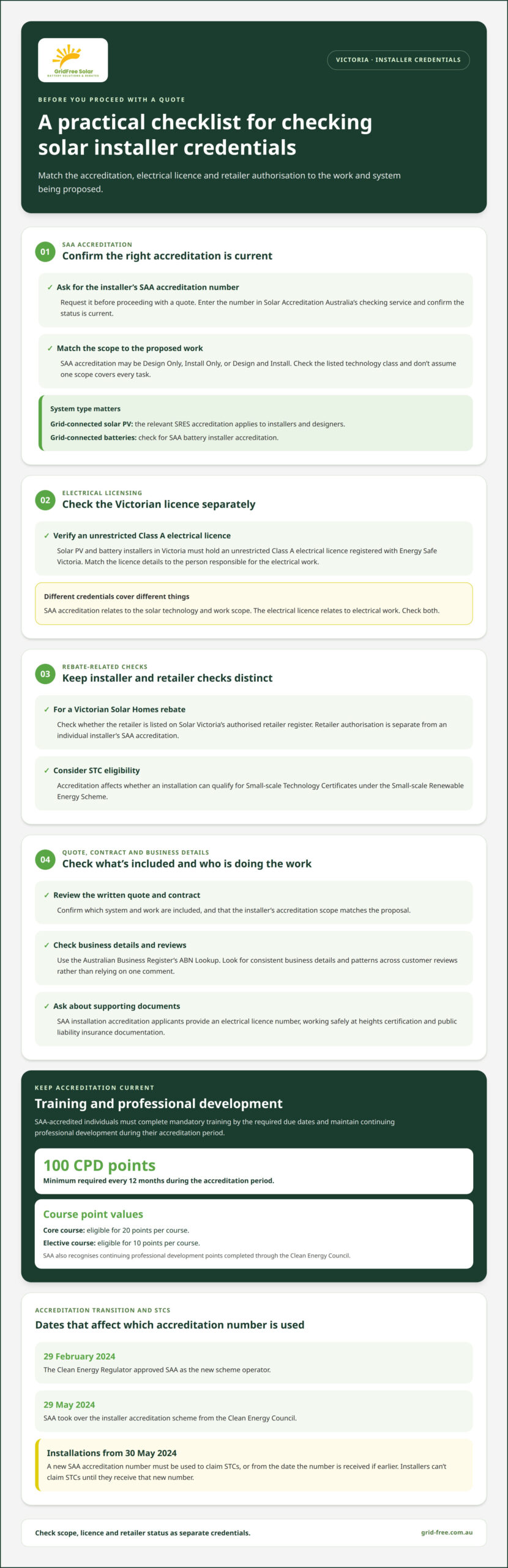
Ask the installer for their SAA accreditation number before requesting a quote. Enter the number in SAA’s checking service and confirm the accreditation is current. Check that the listed accreditation covers the work proposed, such as installing solar PV or batteries, rather than design-only work.
For the Victorian Solar Homes rebate, check whether the retailer appears on Solar Victoria’s authorised retailer register. Retailer authorisation and an individual installer’s SAA accreditation are separate checks. A rooftop solar system also needs an accredited installer for the buyer to access Australian Government rebates under the Small-scale Renewable Energy Scheme.
Before signing, request the installer’s SAA number and electrical licence details. Review the written quote and contract to understand which system and work are included. Installation accreditation applicants provide SAA with an electrical licence number, working safely at heights certification and public liability insurance documentation.
For electrical work in Victoria, check that the installer holds an unrestricted Class A electrical licence registered with Energy Safe Victoria. Match the licence details to the person responsible for the electrical work.
Check a solar company’s ABN using the Australian Business Register’s ABN Lookup. Business history and customer reviews are separate considerations; look for consistent business details and patterns in reviews rather than relying on one comment.
An unaccredited installer can put access to Small-scale Technology Certificates at risk. Accreditation also supports safe, compliant work and standards-based installation. Use SAA’s checking service to review accreditation, and check electrical licences and retailer authorisation through Energy Safe Victoria and Solar Victoria respectively.
2. Training and standards for installers and designers
Solar Accreditation Australia (SAA) oversees training and standards for accredited solar installers and designers. Accredited individuals must complete mandatory training courses by the required due dates to keep their knowledge current across solar PV, battery and standalone power systems. SAA’s compliance procedures aim to uphold Australian Standards, SAA guidelines, other regulations and work standards.
Accreditation scope matters. For each technology class, SAA offers Design Only, Install Only, or Design and Install accreditation. Design Only covers system design; Install Only covers installation. Design and Install accreditation covers both activities within its listed technology class. Check the scope against the planned work instead of assuming one accreditation covers every system or task.
Ongoing development is part of maintaining accreditation. SAA-accredited individuals must complete a minimum of 100 CPD points every 12 months during their accreditation period. SAA also recognises continuing professional development points completed through the Clean Energy Council. Its core courses are eligible for 20 points per course, while elective courses are eligible for 10 points per course.
In Victoria, solar PV and battery installers must have an unrestricted Class A electrical licence registered with Energy Safe Victoria. SAA installation accreditation applicants must also provide an electrical licence number, working safely at heights certification and public liability insurance documentation. These credentials cover different requirements: SAA accreditation relates to the relevant solar technology and work scope, while the electrical licence relates to electrical work. Check both to assess whether the installer’s credentials align with your project.
Accredited installers are certified and trained to ensure rooftop solar systems and batteries meet industry best practice and relevant Australian standards. Solar Accreditation Australia says accredited installers help ensure systems are safe and compliant, use approved quality components, and are designed for performance and longevity. Solar Accreditation Australia’s compliance procedures aim to ensure that Australian Standards, SAA guidelines and other regulations are followed and that work standards are upheld.
In some Australian states and territories, solar installers must also hold their own electrical contractors licence or an appropriate builder’s licence. Checking the applicable licensing requirement alongside the relevant SAA scope helps establish whether the installer’s credentials align with the proposed work.
3. Accreditation and Small-scale Technology Certificates
Small-scale Technology Certificates (STCs) are linked to installer accreditation under Australia’s Small-scale Renewable Energy Scheme. For a consumer, the practical point is clear: accreditation affects whether an installation can qualify for STCs. Individuals who design or install grid-connected photovoltaic systems, grid-connected battery systems or standalone power systems must hold accreditation under the Solar Accreditation Australia Scheme to be eligible.
The accreditation transition changed which number applies. Following the legislated three-month transition period, installer and designer accreditation fully transitioned to Solar Accreditation Australia (SAA). For installations from 30 May 2024, a new SAA accreditation number must be used to claim STCs, or from the date the number is received if earlier. Installers can’t claim STCs until they receive that new number.
There was a limited rule for older installations. A Clean Energy Council accreditation number can be used to claim STCs only for installations completed before 29th May 2024 or until the installer receives a new SAA number, whichever is earlier. The completion date and the installer’s accreditation-number history therefore determine which number applies. Don’t assume an old number remains valid for a later installation.
Before proceeding, ask which accreditation number applies to the proposed installation and whether the installer’s SAA accreditation covers the system type and work. SAA offers Design Only, Install Only, and Design and Install scopes for relevant technology classes. Because design and installation are distinct activities, a number alone doesn’t establish that the installer is accredited for every task.
For a rooftop solar system, an accredited installer is required for the buyer to access Australian Government rebates under the Small-scale Renewable Energy Scheme. If an installer’s accreditation number is newly issued, its issue timing also matters for STC eligibility. Check the number and scope before signing, then keep the installation date and accreditation details with your project paperwork.
4. Accreditation for grid-connected solar systems
For grid-connected solar PV in Victoria, accreditation must match the work and technology. Solar installers and designers must hold Small-scale Renewable Energy Scheme (SRES) solar accreditation for grid-connected PV systems. A general claim of being “accredited” doesn’t show that the person’s scope covers the proposed work.
Battery work has its own accreditation scope. Installers of grid-connected batteries in Victoria need Solar Accreditation Australia (SAA) battery installer accreditation. SAA accreditation covers grid-connected photovoltaic systems, grid-connected battery systems and standalone power systems. Its categories include Design Only, Install Only, or Design and Install accreditation for each technology class.
Match the installer’s accreditation type to your system. A grid-connected PV installation requires the relevant PV installation scope, while battery installation calls for battery installer accreditation. If your project includes both technologies, check that the accreditation covers each part of the work. Design accreditation and installation accreditation aren’t interchangeable.
Electrical licensing is a separate check. Solar PV and battery installers in Victoria must have an unrestricted Class A electrical licence registered with Energy Safe Victoria. Confirm that the licence holder is responsible for the electrical work, and consider the licence alongside the SAA technology and work scope. Each credential answers a different question.
Accreditation is also intended to support compliant work, appropriate system design and the use of approved quality components. That matters for a renewable system connected to a home or business grid, where design and installation must align with the system type. The practical takeaway: check the PV or battery scope, the design or installation category, and the electrical licence before proceeding. For a project involving a new grid-connected system, explore residential solar installation as a next step.
A buyer does not have to purchase a rooftop solar or battery system from a New Energy Tech Consumer Code-approved seller; approval is not required for the purchase.
GridFree Solar
Once you understand which accreditation and electrical credentials matter, GridFree Solar can help with your project. Its residential solar panel installation and solar and battery installation services cover grid-connected systems, while businesses can consider its commercial solar solutions.
Bring your project requirements and questions about the proposed system to the discussion. Accreditation checks clarify the credentials relevant to the work; system design and installation are separate parts of planning your project. GridFree Solar also provides battery upgrades and replacements for existing storage systems.
Contact GridFree Solar to discuss your solar or battery project.
Make your next solar decision with clarity
Knowing how to check if a solar installer is accredited in Victoria gives you a clearer starting point, but credentials are useful only when they match the proposed work. Next, consider what you need your system to do, how solar and storage suit your property, and which details you want clarified in the project proposal.
A focused discussion can turn technical terms into practical decisions. Set out your priorities, describe the property and explain whether you’re planning a new installation or reviewing an existing system. This gives the conversation a clear purpose and helps align the proposed work with your needs.
GridFree Solar can discuss solar and battery projects, including residential and commercial installations and battery upgrades. If you’re ready to explore the next step, contact GridFree Solar for advice. Move forward with a clear understanding of your priorities and the questions that matter to your project.
Frequently Asked Questions
How do I check whether a solar installer is accredited by Solar Accreditation Australia (SAA)?
Ask for the individual installer’s SAA accreditation number, then search it using SAA’s accreditation-check service. Confirm that the result identifies the person carrying out the work instead of relying on a company’s general statement about its credentials. If one person designs the system and another installs it, check that each person’s accreditation matches their role.
What accreditation is required for solar installers in Victoria to install grid-connected solar panels?
Grid-connected solar PV installation in Victoria requires the relevant Small-scale Renewable Energy Scheme solar accreditation, alongside an unrestricted Class A electrical licence registered with Energy Safe Victoria. Check that the accreditation covers installation, not design alone. For a project combining solar panels and a battery, confirm that the installer’s accreditation covers each technology involved, as the relevant scope can differ by system type.