
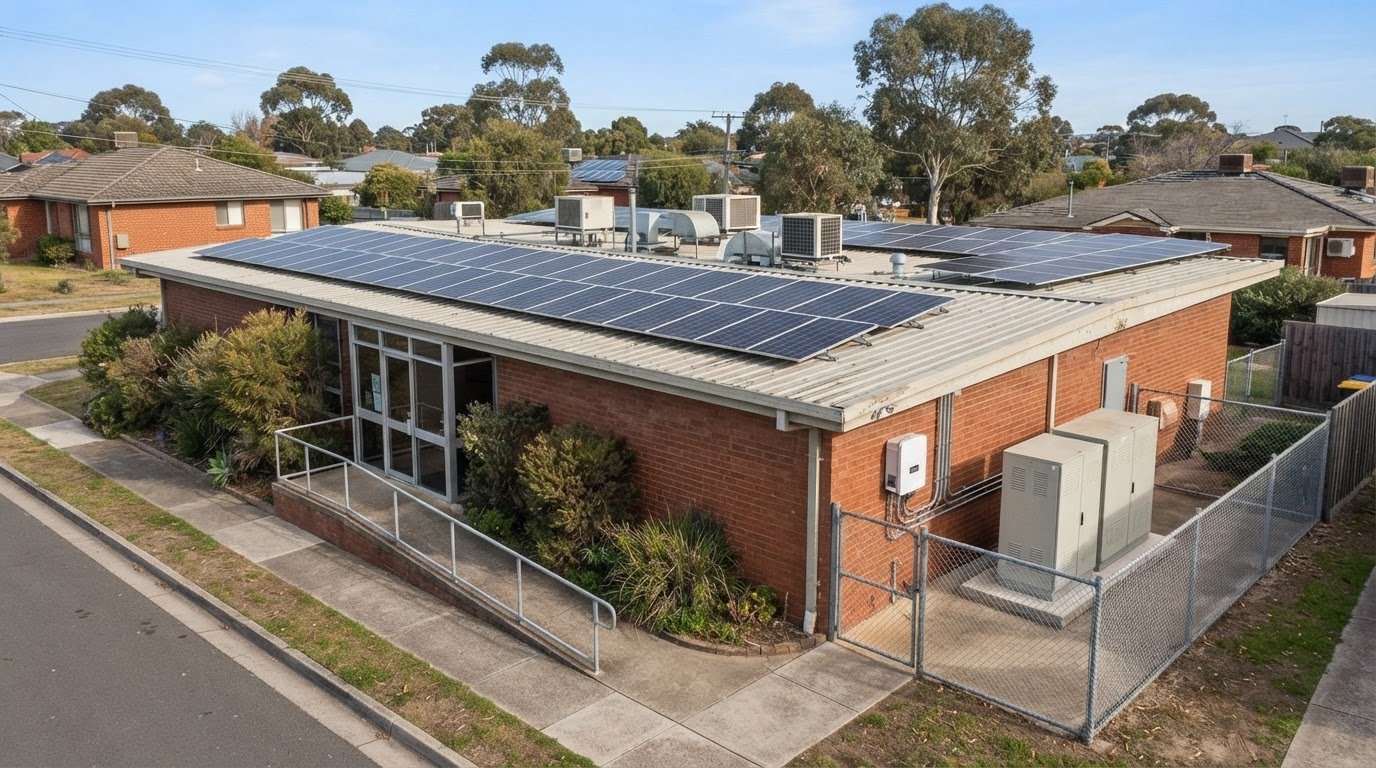
The cheapest-looking system may not deliver the best value for your clinic. Commercial solar for medical clinics in Victoria has no single price: system size, panel type and installation complexity shape the quote. Eligible business systems between 30kW and 200kW can access an upfront discount through Victorian Energy Upgrades, which can reduce the initial outlay.
It makes sense to weigh the full investment against potential savings, rather than focusing only on installation costs. A clinic’s daytime electricity use, the amount of solar power it can use on site and whether battery storage suits its needs all affect the value of commercial solar.
This guide explains what shapes a clinic’s solar system design, how to estimate potential bill savings and what influences payback. It also covers Victorian incentives and battery storage, helping you assess options against your clinic’s energy needs.
Key Takeaways
- Match system size to your clinic’s daytime electricity use and energy goals, rather than sizing it by roof area alone.
- Estimate savings using your electricity-use patterns and how much solar generation the clinic can consume on site.
- Assess whether battery storage suits your clinic’s energy use and backup needs before factoring it into the investment.
- Check how Victorian Energy Upgrades discounts may affect eligible business solar systems, including systems between 30kW and 200kW.
What’s the typical payback period for solar on a medical practice or surgery?
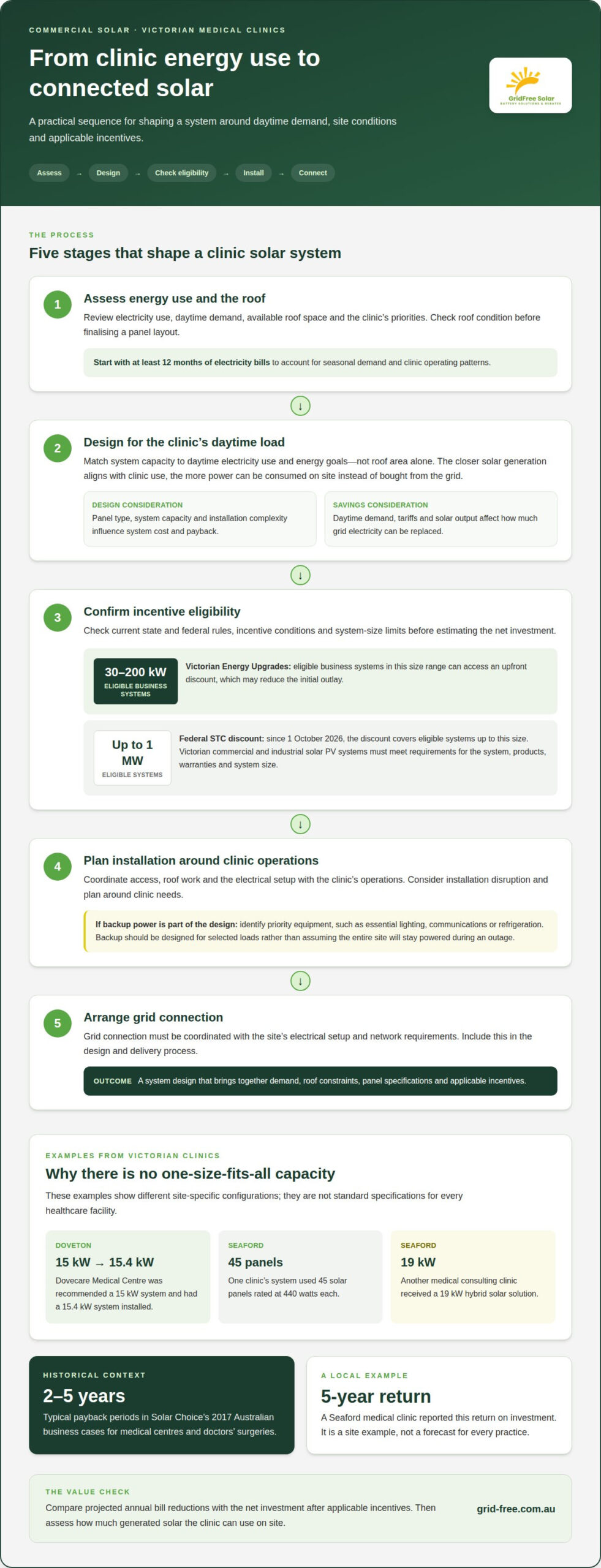
Payback varies with system cost, electricity use and the share of solar energy consumed during clinic hours. Solar Choice’s 2017 business cases for Australian medical centres and doctors’ surgeries showed typical payback periods of 2 to 5 years. A Seaford medical clinic reported a 5-year return on investment, a useful local example rather than a forecast for every practice.
Size the solar system around the clinic’s daytime load, not roof area alone. Review energy use, available roof space and whether the priority is bill savings or greater energy independence. Dovecare Medical Centre in Doveton was recommended a 15kW system and had a 15.4kW system installed. That example shows why the final capacity is shaped by the site and its needs.
Panel count and rated output also matter. A Seaford clinic’s solar system used 45 solar panels rated at 440 watts each, while another Seaford medical consulting clinic received a 19kW hybrid solar solution. These examples illustrate different configurations; they aren’t a standard specification for every healthcare facility. System costs vary with capacity, panel type and installation complexity, which also influence payback.
Since 1 October 2026, the federal STC discount covers eligible systems up to 1MW. Victorian commercial and industrial solar PV systems must meet requirements for the system, products used, product warranties and system size to qualify for the discount.
For clinics in Melbourne and across Victoria, current state and federal rules, incentive conditions and system-size limits are important considerations. Grid connection must also be coordinated with the site’s electrical setup and network requirements. The process typically includes assessing energy use and the roof, designing the system, confirming incentive eligibility, installing the equipment and arranging grid connection.
A tailored design brings together the clinic’s electricity demand, roof constraints, panel specifications and applicable incentives. Comparing system capacity with daytime consumption helps estimate how much generated energy the practice can use directly, which is central to potential savings and payback.
How much will solar save a medical clinic?
Clinic savings depend on how much solar energy replaces electricity bought from the grid. Victorian examples show how actual bills and broader health-service results can inform an estimate.
Worked Example of Clinic Solar Savings
A useful starting point is to compare the clinic’s electricity bills before and after solar installation. Any reported change is specific to that site, not a standard result for every practice.
For a fair comparison, separate bill changes from other factors, such as shifts in clinic operations or electricity use. Apply the same before-and-after method to your own bills to estimate how much grid electricity solar could replace during operating hours.
Medical Practice Payback Periods
Payback measures how long bill savings take to offset the system’s upfront cost. Solar Choice’s 2017 business cases for medical centres and doctors’ surgeries across Australia reported internal rates of return between 20% and 30%. This historical benchmark adds context, but a clinic’s payback depends on its own energy use and system economics.
To estimate savings, compare projected annual bill reductions with the net investment after applicable incentives. Then assess how much generated energy the clinic can use on site instead of exporting. Daytime demand, tariffs and system output all affect the result.
Solar Savings and Payback
Solar savings come from electricity costs avoided when a clinic uses its own generation.
That statewide figure isn’t an individual clinic forecast. For a practice-level estimate, review at least 12 months of electricity bills and compare usage with expected solar generation. This helps account for seasonal demand and clinic operating patterns. The closer generation matches the clinic’s daytime energy use, the more solar power can offset grid purchases and contribute to payback.
Battery value, demand charges and backup power
A battery stores solar electricity for use when panels aren’t generating, including after clinic hours. For eligible Victorian businesses, the Commonwealth Cheaper Home Batteries Program may provide rebates for batteries up to 100 kWh, helping reduce upfront cost.
A battery’s value depends on when the clinic uses electricity and how its tariff is structured. Storage can shift solar energy to periods of higher grid use, while any reduction in demand charges depends on how those charges are calculated and when demand peaks. Weigh potential bill savings against the battery’s cost and operating needs.
Solar panels and battery storage can raise grid independence for some clinics to 70 to 80 per cent. That doesn’t mean every practice can operate fully during an outage. Backup performance depends on system design, battery capacity and which clinic equipment is connected for backup.
Medical clinics should account for roof condition, installation disruption and the equipment that may need backup power. Assess the roof before finalising the panel layout, and plan installation around clinic operations to manage access and disruption. Identify priority equipment, then design backup for those loads rather than assuming the entire site will stay powered.
For example, a clinic might prioritise essential lighting, communications or refrigeration rather than every circuit. The backup load affects battery sizing and how long stored energy can support selected equipment. Clear priorities help ensure storage capacity suits the clinic’s operational needs.
Battery incentives can change the upfront calculation, but eligibility and system design still matter. The federal battery rebate is described as reducing eligible small-business battery costs by roughly 30 per cent. Compare the eligible rebate, expected solar use after clinic hours, tariff benefits and backup requirements together. A battery adds value when its stored electricity serves a defined need, not simply because storage is available.
Victorian Energy Upgrades discounts for business solar
Victorian Energy Upgrades (VEU) can reduce the upfront cost of eligible business solar. The program offers discounts for systems between 30kW and 200kW through an accredited provider. For clinics, the key is whether the proposed system and installation pathway meet the program’s eligibility conditions.
Victorian businesses and non-residential sites, including community buildings, schools and hospitals, can apply for solar PV installation discounts. Commercial and industrial systems must be installed by providers accredited to create Victorian energy efficiency certificates for this activity. This accreditation is essential to accessing the discount, so address it during project planning.
Systems larger than 200kW can be installed under VEU’s project-based activity. That is a maximum, not a fixed discount for every clinic. The applicable amount depends on eligibility and the project.
Include any VEU discount when estimating the upfront investment, then compare the adjusted cost with expected bill savings. Victorian businesses may also qualify for incentives under relevant Australian Government solar schemes. Assess each incentive’s eligibility separately rather than assuming qualification for one means the clinic qualifies for another.
Which Victorian electricity retailers offer the best solar feed-in tariffs for businesses? There is no single best retailer for every clinic. Value depends on the export rate, contract terms and how much electricity the clinic sends to the grid. Compare export income with the value of using solar power on site, since a higher tariff alone may not deliver the best overall result.
For clinics considering commercial solar in Victoria, establish the system size, VEU eligibility and expected on-site use before comparing proposals. These factors affect the discount’s impact on project costs and how much renewable energy the clinic can use directly.
Explore commercial solar solutions for a clinic system designed around its energy use and applicable solar rebates.
GridFree Solar: Battery Upgrade & Replacement
GridFree Solar designs and installs commercial solar and battery systems for clinics in Melbourne and across Victoria. If your clinic already has solar, GridFree Solar also provides Battery Upgrade & Replacement to help assess whether additional storage suits its usage patterns and backup priorities.
For a new project, consider how clinic operating hours, daytime electricity demand and after-hours loads interact. This context helps shape a system around the practice, rather than treating panels and batteries as separate decisions. Financial incentives may affect the upfront investment, depending on eligibility.
If you’re weighing a battery upgrade or planning commercial solar for your clinic, contact GridFree Solar to discuss the project.
Make the next decision practical
Turn your clinic’s solar decision into a clear internal brief. Bring operations and finance together to agree on the priorities: more predictable energy costs, backup for essential equipment or a lower-carbon way to power the practice. Shared priorities help keep the project aligned with clinical operations, not just building capacity.
For commercial solar for medical clinics in Victoria, the right design must suit both the site and the people who rely on it each day. Decide who will coordinate the project, how installation can fit clinic routines and which outcomes the practice will use to assess its investment.
GridFree Solar can discuss commercial solar options for your clinic and battery upgrades for existing systems. Contact GridFree Solar about clinic solar to explore a practical next step. A well-framed decision can help your clinic move towards a more efficient energy future with confidence.
Frequently Asked Questions
How much does a business solar system cost?
There is no single price for a commercial solar system; cost depends on the project. Key factors include system capacity, panel type, roof and electrical conditions, installation complexity and whether battery storage is included. A small clinic and a multi-site medical centre can have very different needs, so compare proposals against the same design scope.
What does a medical clinic’s power use look like?
Clinic electricity demand often follows its operating schedule, with heating and cooling among the largest loads. HVAC accounts for approximately 40 to 50 percent of a medical centre’s total electricity use. Equipment, lighting and other building services contribute too. Reviewing the clinic’s interval data helps reveal when demand peaks and whether solar generation would align with those hours.
Which solar panel is best for commercial use?
Monocrystalline panels are often considered for commercial systems because of their energy output and lifespan. The right option still depends on the clinic’s roof area, layout and system objectives. Compare panel specifications as part of the complete design, including the inverter and expected energy use. Higher-output panels may be useful when roof space is limited.
What commercial solar system size suits a medical clinic in Victoria?
Choose a system capacity that aligns with the clinic’s electricity demand, roof space and savings goals. A specialist practice with daytime imaging or other energy-intensive equipment may need a different design from a smaller consulting clinic. Consider when energy is used, not only total consumption: generation that matches clinic loads can be more useful than excess capacity.
How much does commercial solar cost for a medical clinic in Victoria?
The cost depends on the individual clinic’s design and is provided after a quote request. System capacity, panel selection, roof access, switchboard requirements and installation complexity can all affect the project scope. Battery storage and grid-connection work may also shape the design. Comparing proposals on a like-for-like basis helps distinguish system inclusions from differences in capacity or configuration.
What rebates, grants or tax incentives are available for Victorian clinics installing solar?
Potential support includes Victorian Energy Upgrades discounts for eligible business solar and federal incentives. Since 1 October 2026, the federal STC discount covers eligible systems up to 1MW. Eligible Victorian businesses may also access the Commonwealth Cheaper Home Batteries Program for batteries up to 100 kWh. Eligibility depends on the system and program requirements, so assess each incentive against the proposed installation.