
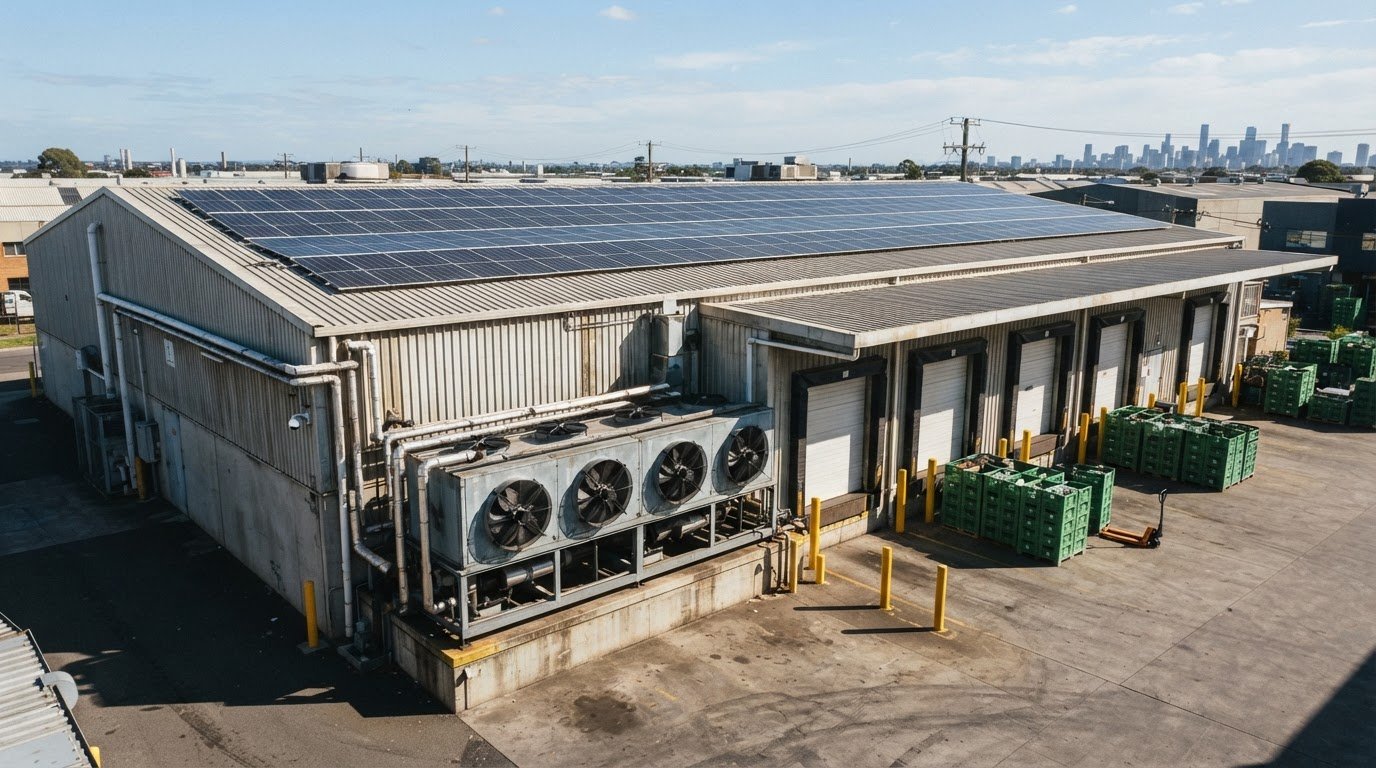
It’s a useful example of what commercial solar for cold storage facilities in Melbourne can deliver when the system is designed around the site’s energy needs.
Cold stores need dependable refrigeration around the clock, so reducing electricity costs must not come at the expense of operations. A sound solar design starts with the facility’s power-use patterns, how much electricity can be used on site, and what the roof and electrical infrastructure can support.
Here, you’ll learn how solar can lower cold-storage electricity costs, how to compare system proposals and installers, and how to match generation with refrigeration loads. We’ll also explain where batteries may fit and which design details matter when a facility needs dependable cooling through every operating cycle.
Key Takeaways
- Use a full year of interval data to see when your cold store draws power and how much solar it could use on site.
- Compare proposals by their generation assumptions, on-site use, export value, system design and warranty terms, not just panel capacity.
- Align solar generation with refrigeration and operational schedules; consider battery storage when shifting daytime power could support night-time or peak-period loads.
- Account for roof suitability, electrical infrastructure and operational continuity when assessing the benefits and practical fit of a commercial solar system.
Its 210-kilowatt installation is expected to cover about 40% of the facility’s total energy load.
Sizing a System from Electricity Bills
System sizing uses electricity bills and interval data to match panel capacity to a facility’s demand. For a cold store, the assessment needs to account for continuous refrigeration, not just annual electricity consumption.
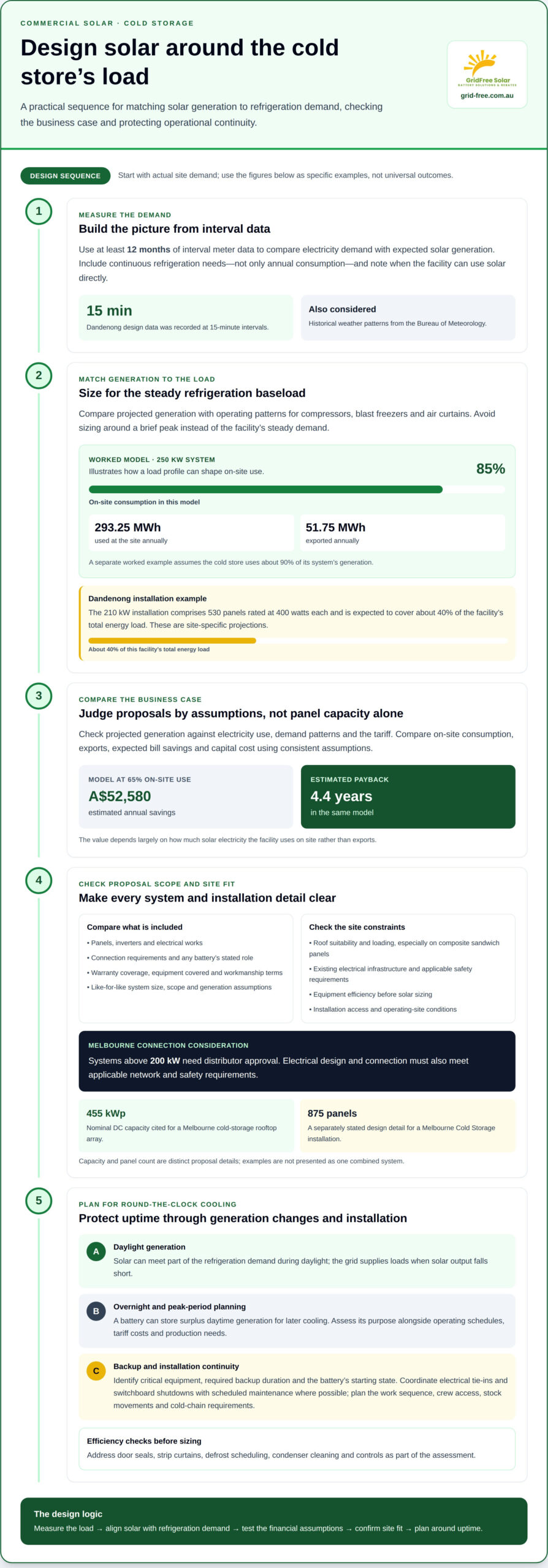
Designers can use at least 12 months of interval meter data to compare demand with expected generation. For Dandenong, data recorded every 15 minutes informed the solar design, alongside historical weather patterns from the Bureau of Meteorology. This helps show when solar can be used directly and whether the proposed kilowatt capacity fits the site.
The Dandenong system comprises 530 panels rated at 400 watts each. These are site-specific projections, not a universal outcome for Melbourne cold stores.
Costs and Payback Periods
To assess cost and payback, compare the system’s capital cost with expected bill savings over time. For a cold store, the value depends largely on how much solar electricity the facility uses on site rather than exports.
At 65% on-site use, the model estimates A$52,580 annual savings and a 4.4-year payback.
For Melbourne, systems above 200 kW need distributor approval. Electrical design and connection must also meet applicable network and safety requirements. Cold-store risks include roof loading, especially on composite sandwich panels, and disruption during electrical tie-ins; roof capacity and installation timing need to account for the operating site. Equipment efficiency, including door seals, strip curtains, defrost scheduling, condenser cleaning and controls, should be addressed before sizing solar.
Comparing commercial solar installers, products, prices and warranties
Compare proposals by their assumptions, equipment and installation plan, not just by system size. For a Melbourne cold store, assess projected generation alongside electricity use, demand patterns and the tariff. A useful proposal explains how these factors affect on-site consumption, exports and financial returns, so you can judge the business case against the facility’s operating profile.
Check what each system includes, from panels and inverters to electrical works and connection requirements. If battery storage is proposed, the design should explain its purpose and role. Review warranty terms just as carefully: note which equipment is covered, what the coverage includes and how workmanship issues are handled. Clear inclusions make proposals easier to compare.
A Melbourne cold-storage solar installation provides a practical reference point: a rooftop array at a local facility has a nominal DC capacity of 455 kWp. Another stated design detail for a Melbourne Cold Storage installation is its use of 875 panels. These examples show why a proposal should identify capacity and panel count separately, rather than relying on a broad label such as “large commercial system”.
Installation planning is essential when refrigeration and compressors need to keep running. Coordinate electrical tie-ins and switchboard shutdowns with scheduled maintenance where possible to limit disruption to production and temperature-controlled operations. A detailed plan should explain the work sequence and crew access to operational areas. It should also account for stock movements and cold-chain requirements.
Compare prices on a like-for-like basis, using the same system size, equipment scope and assumptions about generation and consumption. Site conditions and design affect the quote, so inclusions and exclusions should be clear. For a cold-storage project, commercial solar system design should connect equipment choices with operating demands, installation timing and the facility’s electricity use.
Matching solar generation to cold-storage and manufacturing loads
Design the system to match solar output to refrigeration demand while protecting uptime. Backup planning should identify critical equipment, the required backup duration and the battery’s starting state. Demand peaks also influence the financial case.
Continuous Refrigeration Loads and Solar Generation
A continuous refrigeration load is the electricity a cold store needs to keep cooling equipment operating day and night. Solar can meet part of that demand during daylight, while grid electricity supplies the loads when solar output falls short.
This overlap matters for production planning. Compressors, blast freezers and air curtains all use electricity, but their demand can vary. Compare expected solar generation with operating patterns to avoid sizing the system around a brief peak instead of the steady refrigeration load.
Matching Generation to Refrigeration Baseload
Matching generation to the baseload means designing solar capacity around the facility’s steady electricity use. This can increase direct consumption and reduce reliance on exporting surplus generation.
In a hypothetical 250 kW model, 85% on-site consumption corresponds to 293.25 MWh used at the site annually, with 51.75 MWh exported. A separate worked example assumes the cold store uses about 90% of its system’s generation. These examples show why load profiles matter more than panel capacity alone.
Solar Generation for Round-the-Clock Refrigeration
Solar generates electricity during daylight, but refrigeration continues overnight. The grid can supply electricity when solar output is unavailable, while a battery can store surplus daytime generation for later cooling.
Coastal Cold Storage had used cheaper overnight off-peak rates for many compressors and considered shifting some use to daylight if solar made it cost-effective. The example highlights the trade-offs: changing operating schedules can affect tariff costs, production needs and how much solar the site uses directly.
Designing for Uptime, Backup Power and Demand Peaks
Uptime planning distinguishes between solar generation, battery demand management and backup for critical refrigeration equipment. Battery power, measured in kW, indicates the load it can serve at once; capacity, measured in kWh, indicates how much energy it stores.
Plan backup separately by identifying the equipment to support, the required duration and the battery’s starting state. Assess demand peaks too: many commercial tariffs calculate demand charges from the site’s highest monthly peak. Solar and battery controls can be designed around those peaks, while the network connection affects how the system works alongside grid supply.
Commercial solar benefits for cold storage
For cold stores, commercial solar can reduce grid purchases by supplying some of the daytime refrigeration load. Matching expected generation to operating demand helps the facility use more of the electricity it produces. Batteries can shift surplus solar into evening cooling or peak-tariff periods. Panels may also shade roof surfaces and reduce heat gain into the building.
Interval data shows when compressors and other equipment draw power, and when solar generation can meet that demand. Reviewing a full operating profile alongside electricity bills helps determine whether generation is likely to be used on site or exported. This matters because financial benefits depend on avoided grid purchases, export value and tariff structure, not generation alone. Efficiency improvements, such as better door seals or controls, can also change the load the solar system needs to serve.
Australian incentives have eligibility limits. According to the Clean Energy Regulator, current Small-scale Renewable Energy Scheme guidance caps eligible solar PV system size at 100 kW. Victoria’s VEU program has a deemed pathway for eligible non-residential solar systems from 30 kW to 200 kW. Federal and Victorian incentives may both apply when each scheme’s rules are met, but VEU deemed and measurement-and-verification pathways cannot cover the same system. The Cheaper Home Batteries Program requires eligible batteries to be installed with solar PV of no more than 100 kW.
Eligibility thresholds can affect system design, battery choices and the value of any upfront incentive. For commercial solar for cold storage facilities in Melbourne, compare system capacity, site consumption and export arrangements with the relevant program criteria before assessing financial returns. A large cold-store array may exceed a program’s size limit, while a smaller design may qualify only if it meets that scheme’s rules.
For a cold store weighing solar generation against refrigeration demand, discuss a commercial solar design that fits its load profile and site requirements. This is a practical starting point for commercial solar for cold storage facilities in Melbourne.
GridFree Solar: Commercial Solar Solutions
GridFree Solar provides Commercial Solar Solutions for cold-storage operators assessing solar against refrigeration demand, site conditions and operating schedules. When you’re ready to turn interval data and generation goals into a facility-specific design, GridFree Solar can help with the next step.
GridFree Solar tailors commercial solar systems to a facility’s electricity use and project requirements. Where storage is part of the plan, the company also provides solar and battery installation, as well as Battery Upgrade & Replacement for existing systems. The right configuration depends on the site’s goals, including how much solar to use directly and whether stored energy should support selected loads.
For a project-specific discussion, contact GridFree Solar.
Turn your energy goals into a project brief
Bring finance, facilities and operations into the decision early. Agree on the priorities, such as reducing purchased electricity, supporting refrigeration uptime, planning for future capacity or balancing these goals. A shared project brief keeps system design connected to the cold store’s commercial and operational needs.
For commercial solar for cold storage facilities in Melbourne, a clear brief guides discussions about site constraints, operating requirements and the role of battery storage. It also gives decision-makers a sound basis for assessing proposed designs and assumptions, rather than focusing on equipment in isolation.
GridFree Solar provides Commercial Solar Solutions and Battery Upgrade & Replacement for businesses considering solar or storage. Start a conversation with GridFree Solar about how your facility’s priorities can shape the project.
Contact GridFree Solar to discuss your facility. A well-defined brief is a practical foundation for moving forward with confidence.
Frequently Asked Questions
Does a 24 hour refrigeration load automatically justify a battery?
No. Continuous refrigeration alone doesn’t show whether battery storage is financially suitable. The case depends on when solar surplus is available, electricity tariff periods and the battery’s intended role. Demand management and backup are different goals: a battery designed to reduce peak grid use may not provide backup for refrigeration during an outage. Identify the critical equipment and operating objective before comparing storage options.
How does solar energy integrate with existing refrigeration systems?
Solar connects to the facility’s electrical system and supplies power alongside grid electricity. Refrigeration equipment can use solar output as it is generated, while the grid supplies power when generation doesn’t meet demand. Integration planning considers the switchboard, existing equipment and operating schedules. For example, a facility with scheduled daytime production can assess whether those loads align with solar output without changing refrigeration settings.
Is solar worth it for a cold store in Melbourne?
Solar can be worthwhile if the value of electricity used on site supports the project’s costs. Melbourne cold stores should assess their consumption profile, electricity tariff, expected solar output and export arrangements together. A sound business case also considers seasonal operating changes and planned equipment upgrades. These factors help show whether solar can offset enough purchased electricity to meet the facility’s financial objectives.
So what should your business actually do?
Set a clear project brief before choosing a design. Identify the priority, such as reducing grid purchases, supporting selected refrigeration loads or planning for future expansion. Include operating schedules, electricity bills, interval data and planned equipment changes in the assessment. Then compare proposals using consistent assumptions for generation, on-site consumption, exports and system inclusions. This makes design differences and expected performance easier to assess.
What are the typical costs for a cold storage solar installation?
There is no typical cost that applies to every cold store. Cost depends on the project and is provided after a quote request. Key factors include system size, roof and electrical conditions, connection requirements, equipment selection and whether battery storage is included. A useful proposal separates components and installation scope so you can assess the business case against expected on-site use and export value.
What is the typical commercial solar system size for a cold storage facility in Melbourne?
No single system size suits every Melbourne cold store. Design depends on electricity demand, usable roof area, connection capacity and how much generation the facility can consume. A facility with high daytime refrigeration use may need a different design from one with its largest loads outside solar hours. Assessing peak demand alongside overall consumption helps determine a practical capacity for the site.