
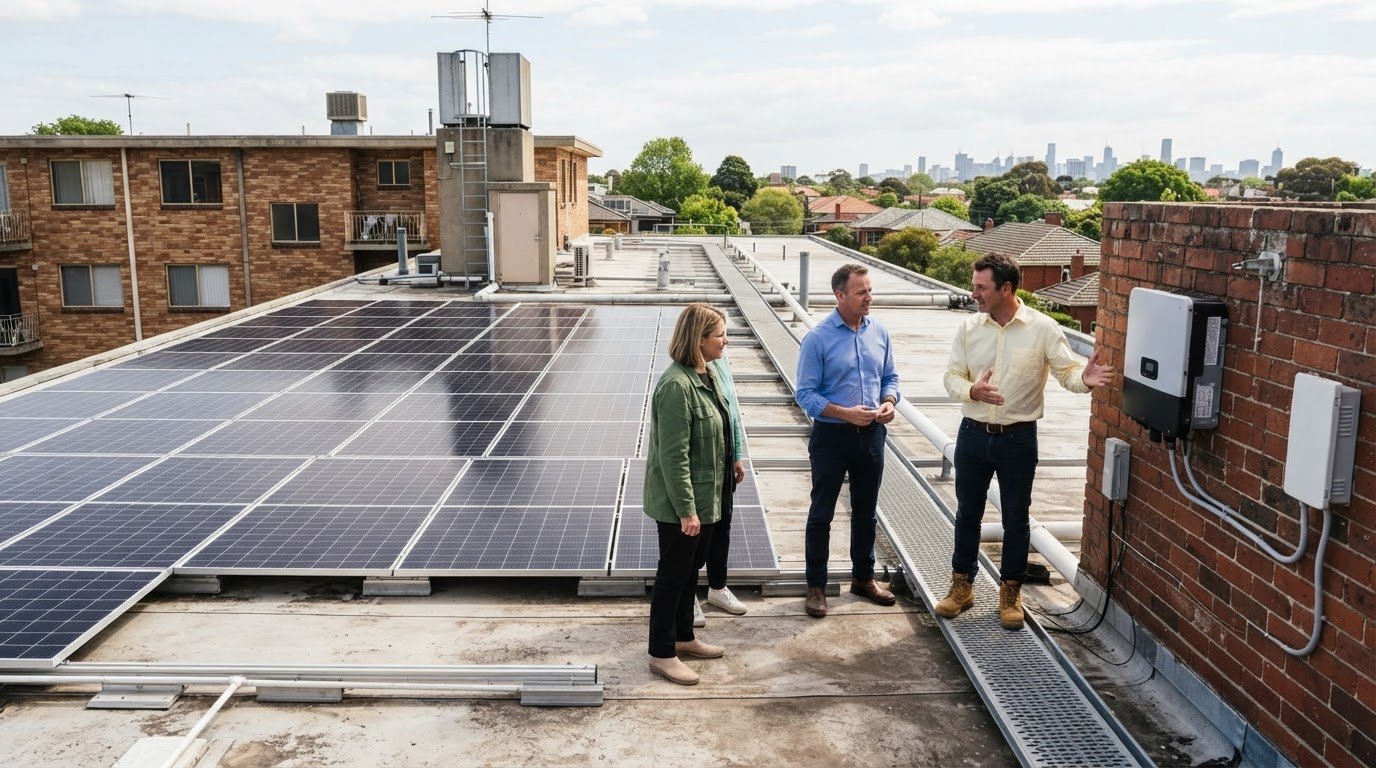
Common-property solar in Victoria requires owners corporation approval, so the governance pathway matters as much as the panels. Commercial solar for body corporates in Victoria can be designed to supply shared loads, such as lifts and corridor lighting, or to serve individual apartments.
When approval, committee input and landlord interests are involved, the decision can feel complicated. Solar Victoria recommends obtaining at least three quotes from authorised solar retailers for a similar-sized system, giving the owners corporation a clearer basis for comparing proposals.
This guide explains how common-property approval works, what committees and landlords may need to consider, and how by-laws can affect a proposed installation. It also covers what to look for in quotes, including whether the system design suits the building’s needs. The goal is to support an informed decision and reduce surprises between the proposal and approval.
Key Takeaways
- Common-property solar usually needs owners corporation approval; the relevant voting pathway depends on the proposed works and the property’s arrangements.
- Bring committee members and landlords into the discussion early, especially when the system will serve shared areas or rented premises.
- Compare at least three quotes for a similar-sized system to assess the proposed design, expected use and installation requirements.
- Match the system to the building: roof space, daytime electricity use and whether power is shared or supplied to individual apartments all matter.
Body corporate approval for common-property installations
In Victoria, owners corporations manage common property and can decide on proposed solar works through voting or ballots. The approval pathway depends on what the system affects, who benefits and how it uses shared areas.
Common-property approval requirements
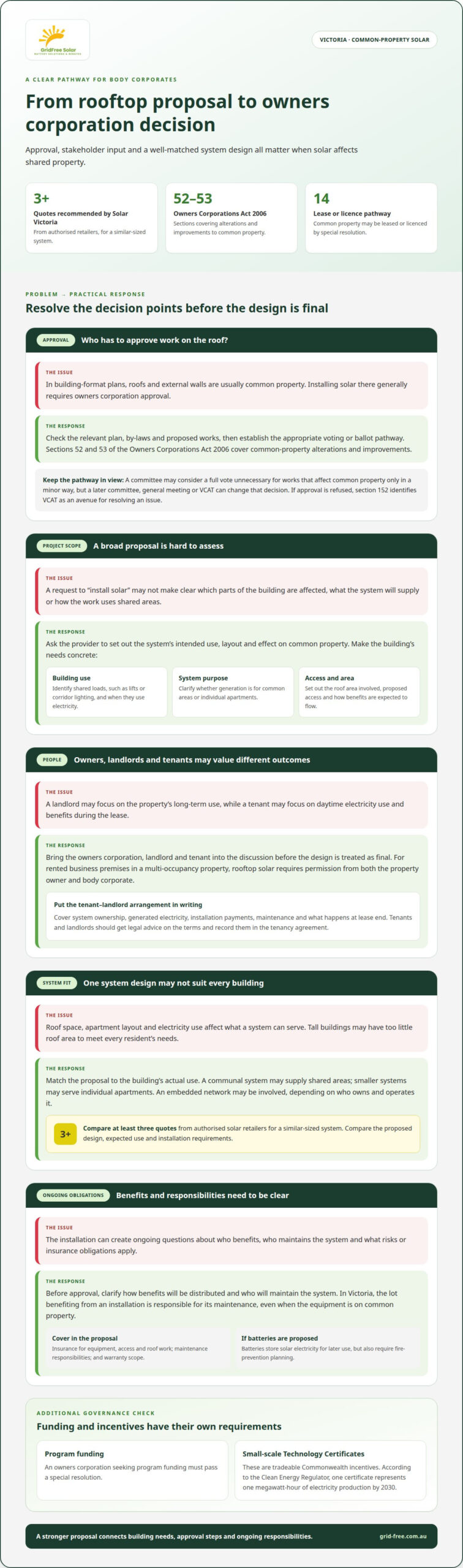
Common-property approval is the owners corporation’s decision on solar works affecting shared parts of a development. In building-format plans, roofs and external walls are usually common property, so installing solar there generally requires approval. Sections 52 and 53 of the Owners Corporations Act 2006 cover owners corporation alterations and improvements to common property. Apartment owners usually need approval for a system serving their own lot, too.
A Victorian owners corporation may lease or licence common property by special resolution under section 14. A committee may decide a full vote is unnecessary when works affect common property only in a minor way, but a later committee, general meeting or VCAT can change that decision. If approval is refused, section 152 identifies VCAT as an avenue for resolving an issue.
Working with a solar provider to approach owners corporations about solar
A solar provider can prepare a proposal outlining the system’s intended use, layout and effect on common property. The committee can consider it alongside the relevant plan, by-laws and approval pathway. Decisions should be recorded in minutes and kept in the owners corporation’s records.
For rented business premises in a multi-occupancy property, rooftop solar requires permission from both the property owner and body corporate. A written tenant-landlord agreement should cover system ownership, generated electricity, installation payments, maintenance and what happens at lease end. Tenants and landlords should get legal advice on the terms and record them in the tenancy agreement.
Shared solar can supply common areas, while smaller systems may serve individual apartments. An embedded network may be involved, depending on who owns and operates it. Batteries store solar electricity for later use, but also require fire-prevention planning.
An owners corporation seeking program funding must pass a special resolution. Small-scale Technology Certificates are tradeable Commonwealth incentives; according to the Clean Energy Regulator, one certificate represents one megawatt-hour of electricity production by 2030.
Solar can reduce common-area electricity costs, while allocation to individual apartments depends on the system design and electricity arrangements. Before approval, clarify how benefits will be distributed and who will maintain the system. In Victoria, the lot benefiting from an installation is responsible for its maintenance, even when the equipment is on common property.
Discuss insurance and contractor risks in the proposal, including cover for the equipment, access and roof work, maintenance responsibilities, and warranty scope. This helps the owners corporation understand ongoing obligations before voting.
Professional support consulting owners corporation committees and landlords
A solar provider can turn a building’s energy needs into a proposal the owners corporation committee can assess. For example, lifts and corridor lighting create daytime demand that a communal photovoltaic system may be sized to serve. Matching the design to shared loads makes the proposal relevant to the building’s actual electricity use.
Committee discussions are more productive when the proposal connects technical choices to practical outcomes. A provider can explain how the system would serve common areas, which parts of the building it would use, and how the owners corporation could approach the decision. This gives committee members a defined scope to discuss rather than a broad request to install solar.
- Building use: Identify shared loads, such as lifts or corridor lighting, and when they use electricity.
- System purpose: Explain whether generation is intended for common areas or individual apartments.
- Decision points: Set out the roof area involved, proposed access and how benefits are expected to flow.
Landlords need a separate discussion when tenants occupy business premises. A landlord may prioritise the property’s long-term use, while a tenant may focus on daytime electricity consumption and benefits during the lease. A provider can make these interests clear in the project proposal, helping the parties discuss who benefits and how the arrangement works.
For a tenant using electricity during daylight hours, solar generation may align with business activity. For a landlord, the proposal should explain whether the installation would serve the tenant’s premises or shared building loads. A written agreement can record the commercial arrangement, with legal advice to support its terms.
Bring the owners corporation, landlord and tenant into the discussion before the design is treated as final. A proposal for commercial solar solutions can give each party a clearer basis for discussing building use, responsibilities and the intended benefits.
Professional solar advice and quotes for body corporates
A useful quote connects the building’s electricity use with a practical solar design. For commercial solar for body corporates in Victoria, it should also give committee members a clear basis for comparing proposals.
Suitable commercial solar systems
A suitable system takes account of the building’s roof space, apartment layout and electricity use. A communal system may supply shared areas, while smaller systems may serve individual apartments. Tall buildings may have too little roof area to meet every resident’s needs. Individual systems may suit buildings typically three storeys high when each unit has ample sunny roof space.
Panel number, size, quality, angle and weather all affect output. A quote should explain how the proposed panels relate to usable roof area and intended loads. For commercial solar for body corporates in Victoria, this helps the committee assess whether the design suits the property, rather than relying on panel count alone.
Pre-installation checks
Pre-installation checks assess roof suitability, electrical arrangements, planning considerations and grid connection. They can identify site constraints before the owners corporation considers a final proposal. A roof assessment covers usable area, orientation and access; an electrical review considers the existing supply and how generation would serve common areas or individual lots.
Planning review considers the owners corporation’s approval pathway and building arrangements. Grid-connection assessment explains how the proposed connection and export arrangements affect the design. These checks help define a suitable project scope but do not replace property approvals.
Solar Victoria recommends obtaining at least three quotes from authorised solar retailers for a similar-sized system. Comparing proposals against the same building loads and installation scope makes differences easier to assess.
Solar Victoria authorised retailers are New Energy Tech Approved Sellers, committed to strengthened consumer protection standards for solar systems. Solar Victoria also recommends reading online product reviews. This context can help committee members assess each quote’s design, assumptions and exclusions.
Apartment installations may require cranes to lift components onto the roof or long cable runs. A quote should explain how these site conditions shape the installation. For commercial solar for body corporates in Victoria, compare the system design and scope as well as capacity, so the committee can assess meaningful differences between proposals.
What commercial solar systems are suitable for body corporates in Victoria?
The right configuration depends on roof space, apartment layout and electricity use. In Victoria, a body corporate can assess communal generation, individual systems, or solar paired with battery storage.
A communal rooftop system can be sized around daytime common-property loads, such as lifts and corridor lighting. This directs generation towards electricity the building uses while the panels are producing power. Where suitable, a shared system may connect to an embedded network, depending on who owns and operates it.
Individual systems may suit strata buildings typically 3 storeys high when each unit has ample sunny roof space. Taller apartment buildings may lack enough roof area to meet every resident’s needs. The proposal should therefore relate the available roof area to the intended users, rather than assume one layout works for every building.
Battery storage changes when solar electricity can be used. A battery stores electricity generated during the day for later, though its usable capacity may be less than its total capacity. In a shared building, adding batteries also requires fire-prevention planning. Solar-sharing technology can distribute generation between dwellings separately from the distribution network, although it adds to system cost.
System output depends partly on the number, size and quality of panels, their angle and the weather. Compare these factors with the building’s electricity use and roof conditions. The design can then focus on the best fit:
- Common-area system: Match generation to shared loads used during daylight.
- Individual systems: Consider sunny roof space available to each apartment.
- Solar with batteries: Assess later-use needs alongside storage capacity and fire-prevention planning.
- Solar sharing: Weigh apartment-level distribution against added system cost.
Choose the configuration around the building’s layout and how occupants use electricity, not panel capacity alone. Discuss a suitable commercial solar design for the property’s roof space and energy needs.
GridFree Solar: Commercial Solar Solutions
GridFree Solar provides Commercial Solar Solutions for body corporates considering solar for shared property or business premises. When the owners corporation is ready to move from comparing options to planning an installation, GridFree Solar can develop a proposal around the building’s roof space, electricity use and intended beneficiaries. This helps the committee assess how the design fits its property.
For buildings considering storage alongside generation, GridFree Solar also provides solar and battery installation. The right configuration depends on whether the priority is common-area electricity, individual apartments or later use of stored solar power. Share the building’s project requirements with GridFree Solar to start a practical discussion.
Contact GridFree Solar to discuss commercial solar for your body corporate.
Set the project up for a confident decision
Before refining the design, agree on what success means for the building. Decide whether the priority is reducing shared-area electricity use, supporting apartment residents or planning for future storage. A short project brief can focus committee discussions on outcomes and help the proposal reflect the owners corporation’s priorities. Use the brief as a reference as the project develops, keeping later discussions tied to the building’s purpose.
GridFree Solar’s Commercial Solar Solutions address commercial projects, while Battery Upgrade & Replacement and Residential Solar Panel Installation support related solar needs. For commercial solar for body corporates in Victoria, a clearly defined objective gives the committee a practical starting point for considering a project that suits the property.
Bring the owners corporation’s priorities and project details together, then contact GridFree Solar to discuss your project. A clear next step can help turn the committee’s interest into a considered decision.
Frequently Asked Questions
How much does commercial solar cost for a Victorian apartment building or owners corporation?
The price depends on the building and proposed system and is provided after a quote request. Factors include usable roof area, system design, whether equipment must be lifted onto the roof and the length of cable runs. A shared-system proposal may differ from one designed for individual apartments. Compare quotes for a similar-sized system and scope to assess the options consistently.
What voting threshold and meeting process are needed to install solar on common property in Victoria?
The required decision depends on the works and how common property will be used. Sections 52 and 53 of Victoria’s Owners Corporations Act 2006 cover alterations and improvements to common property. A lease or licence of common property requires a special resolution, as does seeking Solar for Apartments Program funding. A committee may decide a full owners corporation vote is unnecessary for works affecting common property only in a minor way.
How can a body corporate allocate solar savings among common areas and individual apartments?
A communal system can supply common areas, while smaller systems can serve individual apartments. How savings are allocated depends on the system design and electricity arrangements. Savings on common-area electricity may reduce strata fees.