Leasing your premises doesn’t automatically rule out financing a commercial solar project in Victoria. Finance may be available, but lenders can require a substantial period remaining on the lease. Some require the lease to last at least as long as the finance term.
That lease condition matters, but it’s only one part of the decision. System ownership can affect which finance structure suits your business and what happens when the agreement ends.
This guide explains how leased premises shape finance options, how ownership works with leases and chattel mortgages, and how a Power Purchase Agreement differs. It also covers how Small-scale Technology Certificates may affect upfront costs for eligible systems, helping you understand the choices before you commit.
Key Takeaways
- Assess whether the remaining premises lease aligns with the proposed finance term, as this can affect access to finance.
- Understand who owns the system during the agreement and what happens when repayments or lease payments end.
- Compare a PPA’s provider-owned system and energy payments with finance options that fund a system purchase.
- Explore how loan terms and eligible incentives may shape the project’s overall financing approach.
Can I get Commercial Solar Finance when I lease my new premises?
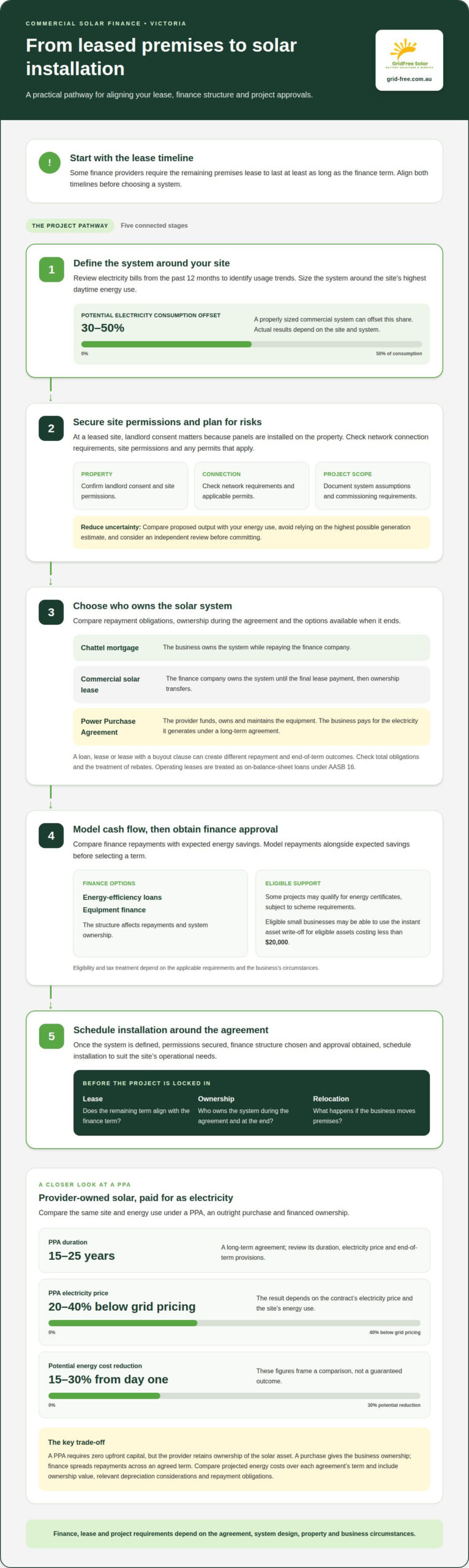
Yes. Businesses leasing premises can seek commercial solar finance in Australia, but the remaining lease term can affect approval. Some finance companies require the premises lease to last at least as long as the finance term, so align both timelines before choosing a system.
Finance providers and energy certificates
Australian solar finance providers offer options such as energy-efficiency loans and equipment finance. The structure affects repayments and system ownership, so match it to your lease and project. Some commercial solar projects may qualify for energy certificates, subject to scheme requirements. Eligibility for energy certificates depends on the requirements of each scheme. The Australian Taxation Office says eligible small businesses may be able to use the instant asset write-off for eligible assets costing less than $20,000.
Cash flow and energy savings
Cash flow reflects the relationship between finance repayments and reduced energy expenses. A properly sized commercial system can offset 30-50% of a business’s electricity consumption. Use electricity bills from the past 12 months to identify usage trends, then size the system around the site’s highest daytime energy use. Matching a finance option to previous energy expenses can help businesses assess whether a project may improve cash flow. Model repayments alongside expected energy savings before selecting a term.
Approvals and project risks
Plan for network connection requirements, site permissions and any permits that apply to the installation. Requirements depend on the system design and property. At a leased site, landlord consent is also important. Manage contractor and performance risks with a clear project scope, documented system assumptions and commissioning requirements. Compare proposed output with your business’s energy use, and avoid relying on the highest possible generation estimate in your finance model. An independent review can help identify gaps before you commit.
Asset ownership under finance and lease arrangements
Your finance structure determines who owns the solar system during repayments and what happens at the end. To finance and install a project, define the system, secure site permissions, choose a finance structure, obtain approval, then schedule installation.
Ownership across finance arrangements
Ownership rules identify who holds the solar asset and when that changes. With a chattel mortgage, the business owns the system while repaying the finance company. Under a commercial solar lease, the finance company owns it until the final lease payment, then ownership transfers. This distinction shapes asset control and end-of-term decisions. Operating leases are treated as on-balance-sheet loans under AASB 16, so account for that treatment in financial planning.
Financing leased and owner-occupied premises
Premises tenure affects how your business plans finance and installation. At a leased site, the remaining lease period can shape the finance term, and landlord consent matters because panels are installed on the property. An owner-occupier can focus on how ownership and repayments fit the business’s assets and credit position. In either case, align the installation plan with the site’s long-term operational needs, including what happens if your business relocates.
Loans, leases and rent-to-own
A loan, lease or lease with a buyout clause creates different repayment and ownership outcomes. These are examples, not universal terms. A lease with a buyout can offer a route to ownership, while a chattel mortgage gives the business ownership during repayment. Before choosing, compare the agreement’s total obligations, end-of-term options and treatment of rebates.
For a commercial solar project, make ownership and repayment assumptions part of the installation plan from the outset.
Power Purchase Agreements
A Power Purchase Agreement (PPA) lets a business use solar without buying the system upfront. The provider funds, owns and maintains the equipment, while the business pays for the electricity it generates under a long-term agreement. This separates energy supply from asset ownership and avoids an upfront capital purchase.
Compare a PPA with buying a system outright or financing a purchase. A capital purchase gives the business ownership, while finance spreads repayments across an agreed term. In both purchase approaches, the business owns the asset, unlike a PPA, where the provider retains ownership. Ownership can affect how the business accounts for the system and considers depreciation. Tax treatment depends on the business’s circumstances and applicable rules.
Commercial solar PPAs typically last 15-25 years. Electricity under a PPA is typically priced 20-40% below grid pricing, and a PPA may reduce energy costs by 15-30% from day one. These figures help frame a comparison, not a guaranteed outcome. The result depends on the contract’s electricity price and the site’s energy use.
The example shows why the end-of-term wording matters: the provider retains ownership, and the business pays for the electricity generated. A PPA requires zero upfront capital, but the business does not own the solar asset under that agreement.
For a sound comparison, model the same site and energy use under each option. Set purchase costs or finance repayments alongside PPA charges, then compare projected energy costs over each agreement’s term. Include ownership value and relevant depreciation considerations in the purchase assessment. Review the PPA’s duration, electricity price and end-of-term provisions alongside the finance agreement’s repayment obligations. The right structure depends on whether your priority is retaining capital, owning the system or buying solar electricity from a provider.
What are the current commercial solar loan and equipment finance rates in Australia?
There isn’t one commercial solar interest rate that applies to every Australian business. Commercial solar loans typically finance system purchases over 5-20 years, while the rate and repayments depend on the finance agreement and the business’s circumstances. Compare the annual rate alongside the loan term, fees, repayment schedule and any end-of-term obligations.
The Clean Energy Finance Corporation (CEFC) supports energy-efficiency loan programs. CEFC-backed energy-efficiency loans typically offer a 0.70% discount on headline rates for clean-energy investments. That discount is not a standalone interest rate: the lender’s headline rate and the loan terms still shape the amount repaid. Ask for the effective rate and total repayment figure in the finance offer, not just the advertised discount.
For a useful comparison, assess each offer against the same solar system and project assumptions. Check whether finance covers installation and associated equipment, how repayments are scheduled, and whether the agreement includes a balloon payment, exit fee or administration charge. A lower headline rate can still mean a different total cost if the repayment term or fees differ.
Cash flow is another key test. Compare scheduled repayments with expected electricity savings, using your business’s energy consumption and the proposed system output. A longer term may reduce each repayment while extending the period of debt; a shorter term changes the repayment profile. Consider these trade-offs alongside system ownership and any eligible certificates or rebates. The option you choose should suit both the project and your business’s financial plan.
Before signing, compare the lender’s written rate, term, fees and repayment schedule with the project proposal. Check that the figures use consistent assumptions, including system scope and any incentives in the calculation. This makes equipment finance and loan offers easier to compare on a like-for-like basis.
Plan your commercial solar project with the finance structure and project assumptions clearly set out.
GridFree Solar: Commercial Solar Solutions
GridFree Solar provides Commercial Solar Solutions for businesses ready to turn their energy needs into a practical solar project. Its commercial installation service is a natural next step after you’ve considered site tenure, system ownership and your preferred finance structure.
A clear picture of your electricity use and premises can help shape a project for your business. If you’re weighing solar against ongoing grid purchases, or considering how solar and storage fit your operation, GridFree Solar provides commercial solar and battery installation.
For a project-specific discussion, contact GridFree Solar.
Turn your solar plans into a practical next step
Move from comparing finance structures to defining what a solar project needs to achieve for your business. A concise project brief can bring together your operating priorities, premises, energy requirements and preferred approach to ownership. It gives the project discussion a clear starting point and connects the finance decision with the system you intend to install. Financing a commercial solar project in Victoria should support how your business plans to use its premises and manage energy over time.
GridFree Solar provides Commercial Solar Solutions, Residential Solar Panel Installation and Battery Upgrade & Replacement. If your next step is to shape a commercial project around your site and business needs, contact GridFree Solar to discuss your project.
Take the next step with a clear project brief and a solar plan built around your business.
Frequently Asked Questions
What financing options are available for commercial solar in Victoria?
Options include business loans, equipment finance, chattel mortgages, leases and Power Purchase Agreements (PPAs). For a leased Melbourne site, the premises lease term can influence which finance structures are practical. Compare system ownership, repayment obligations and end-of-agreement conditions. Financing a commercial solar project in Victoria starts with matching the structure to your premises, cash flow and ownership priorities.
What Victorian and Australian government rebates, grants or incentives apply to commercial solar?
Eligible new solar PV systems may qualify for Small-scale Technology Certificates (STCs), with eligibility applying to systems up to and including 100 kW. Victoria’s Solar for Business Program has closed, so its rebates and interest-free loans are no longer available. Projects above 100 kW may be eligible to create Large-scale Generation Certificates as electricity is generated, according to the Clean Energy Regulator. Eligibility depends on scheme requirements and project details.
How do solar power purchase agreements (PPAs) compare with loans and outright purchase for Victorian businesses?
A PPA suits a business prioritising access to solar electricity without purchasing the equipment; a loan or outright purchase is more relevant when system ownership matters. Consider a tenant planning to leave before a long-term agreement ends: contract duration and transfer conditions become central. Compare the electricity price, system ownership, contract obligations and end-of-term arrangements together, rather than judging options only by initial cash requirements.
What tax deductions, depreciation and GST rules apply to commercial solar investments in Australia?
Tax treatment can differ between ownership and finance arrangements. Lease repayments are generally claimed as each repayment is made, while the tax element for a chattel mortgage can generally be claimed upfront. GST on a system purchase and depreciation may also be relevant. These treatments depend on the transaction and your business’s tax position, so have an accountant assess the project documents before recording deductions.
What are the payback periods and returns for commercial solar projects in Victoria?
Typical estimates put a commercial solar project’s capital expenditure payback at 4-5 years, with reported capital expenditure return on investment of 18-22% per annum. Treat these as project estimates, not a universal outcome. A business should model its own energy use, system size, electricity costs, export assumptions and finance repayments. Changes in those inputs alter projected savings and the time needed to recover the investment.
Which Victorian lenders and providers offer commercial solar finance or PPAs?
Finance companies offer commercial solar loans, equipment finance and leases. PPA providers fund and own systems, then sell the generated electricity under an agreement. CEFC-backed energy-efficiency loan programs are another avenue for clean-energy investment. Specific lender names and terms vary, so compare written offers using the same project scope, repayment structure and fees. The funding provider and solar installer may be separate businesses.