

Last Updated: November 14, 2026
Quick Summary
Calculating ROI for residential solar installations comes down to three numbers: what you pay, what you save each year, and how long the system lasts. Subtract rebates from the quoted price to get net cost, then divide net cost by annual savings for simple payback, or multiply annual savings by system lifespan and divide by net cost for simple ROI.
- Net cost equals the total system price minus every rebate you qualify for.
- Only self-consumed solar power saves the full retail rate; exports earn a lower feed-in tariff.
- In the worked example, a $5,500 net cost and $1,350 annual savings give 4.1-year payback.
- At 20 per cent self-consumption the same system saves $810 a year and payback stretches to 6.8 years.
- Calculate solar battery payback separately by dividing its net cost by the extra annual savings it creates.
Table of Contents
- The Solar ROI Formula: Three Numbers That Decide Everything
- Step 1: Work Out Your Net System Cost After Rebates
- Step 2: Estimate Solar Generation and Your Solar Self-Consumption Rate
- Step 3: Calculate Annual Bill Savings and Your Solar Panel Payback Period
- Step 4: Add the Solar Battery Payback Period to the Equation
- Using a Solar ROI Calculator Without Being Misled by It
- Cash Versus Financed Solar: How Loan Interest Changes the Return
- Stress-Test Your Solar ROI Before You Sign
- Frequently Asked Questions
The Solar ROI Formula: Three Numbers That Decide Everything
Calculating ROI for residential solar installations comes down to three numbers: what you pay, what you save each year, and how long the system lasts. Get those right and the rest is arithmetic.
Homeowners often skip straight to a payback figure from a salesperson. That is where mistakes start.
The formula is simple:
- Net cost = total system price minus rebates
- Annual savings = bill reduction plus feed-in income
- Simple ROI = (annual savings × system lifespan) ÷ net cost
Simple ROI, Payback Period and Lifetime Savings Are Not the Same Thing
These three get mixed up constantly, and the confusion costs people money.
Solar payback period is how long it takes savings to repay your net cost. Simple ROI is total lifetime savings divided by net cost, shown as a percentage. Lifetime savings is the raw dollar figure over the system’s life.
A system can pay back in six years and still deliver a modest lifetime return. Another can pay back in eight and win over 25 years. Payback tells you about risk. ROI tells you about reward. You need both.
Step 1: Work Out Your Net System Cost After Rebates
Start with the quoted price, then subtract every rebate you qualify for. Government schemes such as the Small-scale Renewable Energy Scheme and the Cheaper Home Batteries Program may offer support, and eligibility and rates change over time.
Rules and rates change, so check current figures through the Clean Energy Regulator’s official guidance rather than relying on an old quote.
Your net cost is the only number that matters for the ROI calculation. Ignore the sticker price.
For a full breakdown of what is currently available, see our guide to solar energy financial assistance in Australia 2026.
Step 2: Estimate Solar Generation and Your Solar Self-Consumption Rate
Solar generation is how much power your panels produce. Self-consumption is how much of that you use in your own home rather than export.
Only self-consumed power saves you the full retail rate. Exported power earns a feed-in tariff, which is usually lower.
So a bigger system does not automatically mean a better return. It depends on when you use power.
- Run heavy appliances during daylight hours
- Shift pool pumps and hot water to solar hours
- Check whether your retailer offers a time-varying feed-in tariff
Our article on maximising solar self-consumption without a battery covers the practical steps in detail.
Step 3: Calculate Annual Bill Savings and Your Solar Panel Payback Period
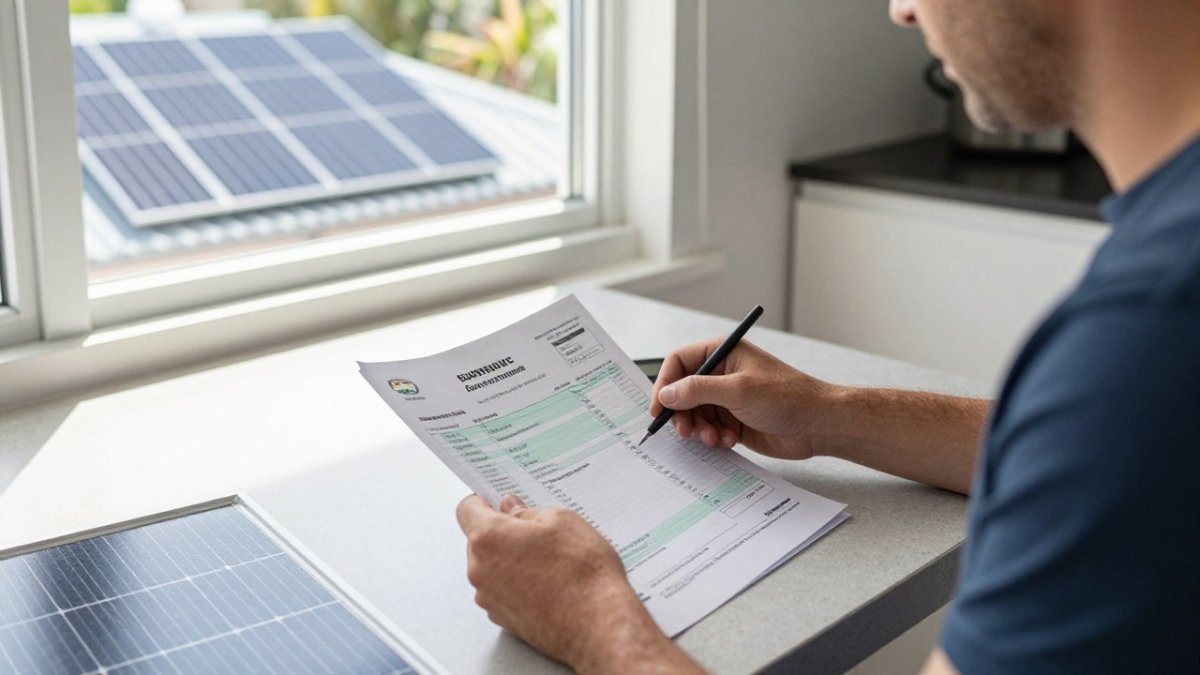
(/how-to-calculate-solar-payback-australia/).
Step 4: Add the Solar Battery Payback Period to the Equation
A battery changes the maths, and not always for the better on paper alone.
Storage lets you use more of your own solar at night, when grid power costs most. That raises self-consumption and lifts annual savings. But it also adds cost.
Calculate the solar battery payback period separately from the panels. Divide the battery’s net cost by the extra annual savings it creates. If that number is longer than the warranty, question the case. A battery’s payback is only as sound as the savings assumptions behind it, so keep those estimates realistic with Solar Hut.
Battery economics vary widely by household. Our solar battery payback calculator lets you test your own figures.
Using a Solar ROI Calculator Without Being Misled by It
A solar ROI calculator is only as good as its inputs. Most online tools assume perfect roof orientation, no shading and steady electricity prices. Real homes rarely match.
Here is what to check before you trust any output:
| Input | What to verify | Why it matters |
|---|---|---|
| Electricity rate | Current rate plus likely rises | Drives all savings |
| Self-consumption | Real usage timing, not guesswork | Biggest swing factor |
| Feed-in tariff | Your actual retailer offer | Often overstated |
| System degradation | Annual panel output loss | Trims later savings |
| Maintenance costs | Inverter replacement, cleaning | Rarely included |
If a calculator will not show its assumptions, treat the result as marketing.
Cash Versus Financed Solar: How Loan Interest Changes the Return
Paying cash gives you the cleanest ROI, because there is no interest to subtract. Financing can still work, but the loan changes the equation.
Add total interest across the loan term to your net cost before calculating payback. A longer term lowers repayments but raises total interest, which drags the return down.
The test is simple: if annual savings exceed annual loan repayments, the system pays for itself as you go. If not, you are subsidising it.
Our guide on financing home solar without upfront rebates walks through the comparison.
Stress-Test Your Solar ROI Before You Sign
Any ROI figure is a forecast, not a promise. The single payback number many quotes give you is a point estimate built on assumptions that will not all hold.
Build three scenarios. Use the worked example from Step 3 as your expected case: net cost $5,500, annual savings $1,350, payback 4.1 years. Now vary the three inputs that matter most: the retail electricity rate, the feed-in tariff, and system performance.
Low-return case. Assume electricity prices stay flat rather than rising, the feed-in tariff falls to 3c per kWh, and panel degradation plus a shading increase trim output by 10 per cent over the period. Self-consumed savings fall to about $972 and export income to about $146, giving annual savings near $1,118 and payback around 4.9 years. The system still repays, but the margin is thinner.
High-return case. Assume retail rates rise faster than expected, the feed-in tariff holds at 5c, and the household shifts more load to daylight, lifting self-consumption to 55 per cent.
What the range tells you. The payback sits somewhere between roughly 3.3 and 4.9 years under plausible assumptions. A system that still stacks up under the pessimistic case is a sound buy. One that only works under perfect assumptions is a gamble. The width of the range is itself information: a wide range means the outcome is sensitive to variables you do not control, such as retail prices and export tariffs.
Include lifetime costs the simple payback ignores. Simple payback stops at the repayment date, but the system keeps running. First, inverter replacement: most string inverters last around 10 to 15 years, and a replacement is a real cost that should be budgeted rather than discovered. Second, panel degradation: output typically falls by a small percentage each year, so year-20 savings are lower than year-one savings.
Separate the metrics before you compare. Simple ROI, payback period, and lifetime savings answer different questions. Payback tells you how quickly you recover capital, which is a risk measure. Simple ROI tells you the total return as a percentage of net cost, which is a reward measure.
Household-specific factors to check before you trust any range. Roof orientation and pitch affect generation; shading from trees or neighbouring buildings affects it more as trees grow; usage timing sets self-consumption; and your tariff structure, including time-varying rates and controlled loads, changes the value of each kilowatt-hour.
Our accredited installers can help design a system around your actual roof, shading and usage patterns rather than a generic model. Our installations are designed with compliance to AS/NZS 5139:2019 and AS/NZS 3000 in mind, and our team provides rebate guidance.
Solar ROI is not a single number a salesperson hands you. It is a calculation you build, test and revisit. Get the net cost, self-consumption and lifespan right, and the return follows.
Get started with GridFree Solar and see a system designed around your real usage, with rebate guidance and compliance handled from quote to commissioning.
Frequently Asked Questions
How do you calculate the ROI of a residential solar installation?
Divide your total lifetime savings by the net system cost, then express it as a percentage. Start with the net cost after the federal rebate is deducted from the quote, estimate annual generation from your system size and roof orientation, split that generation into self-consumed and exported electricity, and price each at your retail rate and feed-in tariff. Subtract lifetime costs such as inverter replacement, then divide total savings by net cost. A system that costs $6,000 net and returns $18,000 over 25 years shows a 200% simple solar ROI.
What is a realistic solar panel payback period?
Most residential systems pay back somewhere between three and seven years, depending on net cost, how much generation you use on site, and your electricity rate. A household that self-consumes most of its output at a high retail rate pays back faster than one exporting most of it for a low feed-in tariff. Shading, roof orientation and system size all shift the timeline. Ask for the payback calculation behind any quote, including the assumptions used for self-consumption and electricity price rises.
How does adding a battery change the solar battery payback period?
A battery raises the upfront cost, so it usually lengthens the simple payback unless you can charge cheaply or export at a premium. It earns its return by shifting generation you would have exported into evening use, avoiding the higher retail rate instead. Programs that reward avoiding peak grid use, plus free daytime grid charging, improve the numbers. Calculate the battery as a separate line: its own net cost against the extra bill savings it creates, not blended into the panel payback.
Is solar still worth it if my household uses most electricity at night?
Yes, but the value shifts from self-consumption to storage and export. Without a battery, most generation is exported for the feed-in tariff, which is lower than the retail rate, so savings are smaller and payback longer. A battery lets you store daytime generation for evening use, and time-of-use tariffs can add further value if you avoid peak rates. Run the numbers on your actual evening usage before deciding whether panels alone or panels plus battery deliver the better return.
