
What if the biggest risk in a commercial solar project isn’t the panel count, but a decision made too late? For commercial solar project management in Melbourne, businesses need to align site conditions, energy use, network connection and installation planning before work begins. Get those decision points right, and the project has a clearer path from assessment to commissioning.
It’s reasonable to want a strong business case without disrupting operations or being caught out by unexpected site work. Yet proposals are difficult to compare when system sizing, savings assumptions, approvals and responsibilities aren’t clearly set out. A tailored design should reflect how your business uses energy and what the site can support, not simply promise an attractive headline return.
This guide sets out a practical sequence for progressing a Melbourne commercial solar project, from assessing the site and usage profile to understanding connection requirements, installation risks and handover. You’ll also learn how to compare proposals consistently, examine savings assumptions and decide whether solar and battery options may suit your business. The aim is fewer surprises and a clearer basis for planning your installation.
Key Takeaways
- Use clear decision points to keep scope, responsibilities and project risks visible from early planning through to handover.
- Progress your Melbourne solar project in sequence, so site and energy information can inform design, approvals and installation planning.
- Compare proposals consistently by looking beyond system size to inclusions, exclusions, connection steps and commissioning.
- Assess generation and savings claims by checking whether the calculation method and key assumptions are disclosed.
- Prepare for commercial solar project management in Melbourne with energy records, site details and identified internal decision-makers.
Why commercial solar project management matters for Melbourne businesses
A commercial solar project brings together several decisions: what the site can support, when the business uses electricity, what the network will allow and how installation fits around daily operations. If these decisions are handled in isolation, gaps can emerge late, when they’re harder to resolve. Effective commercial solar project management in Melbourne means coordinating scope, decisions, risks and handover across the installation lifecycle.
A well-managed commercial solar project turns site and energy information into a coordinated design, approved connection, planned installation and clear handover. That takes more than selecting panels. A commercial photovoltaic system brings together components such as panels, inverters and electrical connections. The project plan needs to account for how those components fit the specific site.
Keep the business case grounded in stated assumptions, not promised savings. Expected generation and financial estimates depend on inputs such as electricity use, operating hours, system design and the value of energy used on site versus exported. Ask for the calculation method and inputs to be made clear, then compare them with your bills and available usage data. A projection is only as useful as the information behind it.
Which businesses benefit from a managed solar project?
Warehouses, offices, retail sites and other businesses with material daytime electricity use may have a useful starting point for assessing solar. Their priorities differ: a warehouse may have substantial roof area but changing operating shifts, while a retail site may need installation planning that accounts for customer access. Review operating schedules, roof area and the site’s load profile together. For businesses with multiple sites, assess each address separately because site conditions and delivery plans can differ.
What makes Melbourne project planning site-specific?
Network arrangements depend on the site address. Melbourne-area businesses may be served by CitiPower, Powercor or United Energy, so identify the relevant distributor for each property rather than assuming one network applies across a portfolio. Connection approval is required before installation; systems above 30 kW may also require a paid manual technical assessment. Confirming the connection pathway early helps inform the design and project sequence.
Site readiness matters just as much. Assessment should consider roof condition, safe access, switchboard capacity and the practical effect of works on business operations. For example, delivery access or work zones may need to be planned around loading activity, staff movements or trading hours. Resolve these project inputs early rather than leaving them until installation.
Bring finance, facilities and operations into the discussion before design decisions are locked in. Finance can review the assumptions behind the business case, facilities can share site information, and operations can flag access and disruption constraints. Clear ownership helps turn separate concerns into a workable scope, with risks tracked and responsibilities understood through commissioning and handover.
The commercial solar project lifecycle: from site assessment to handover
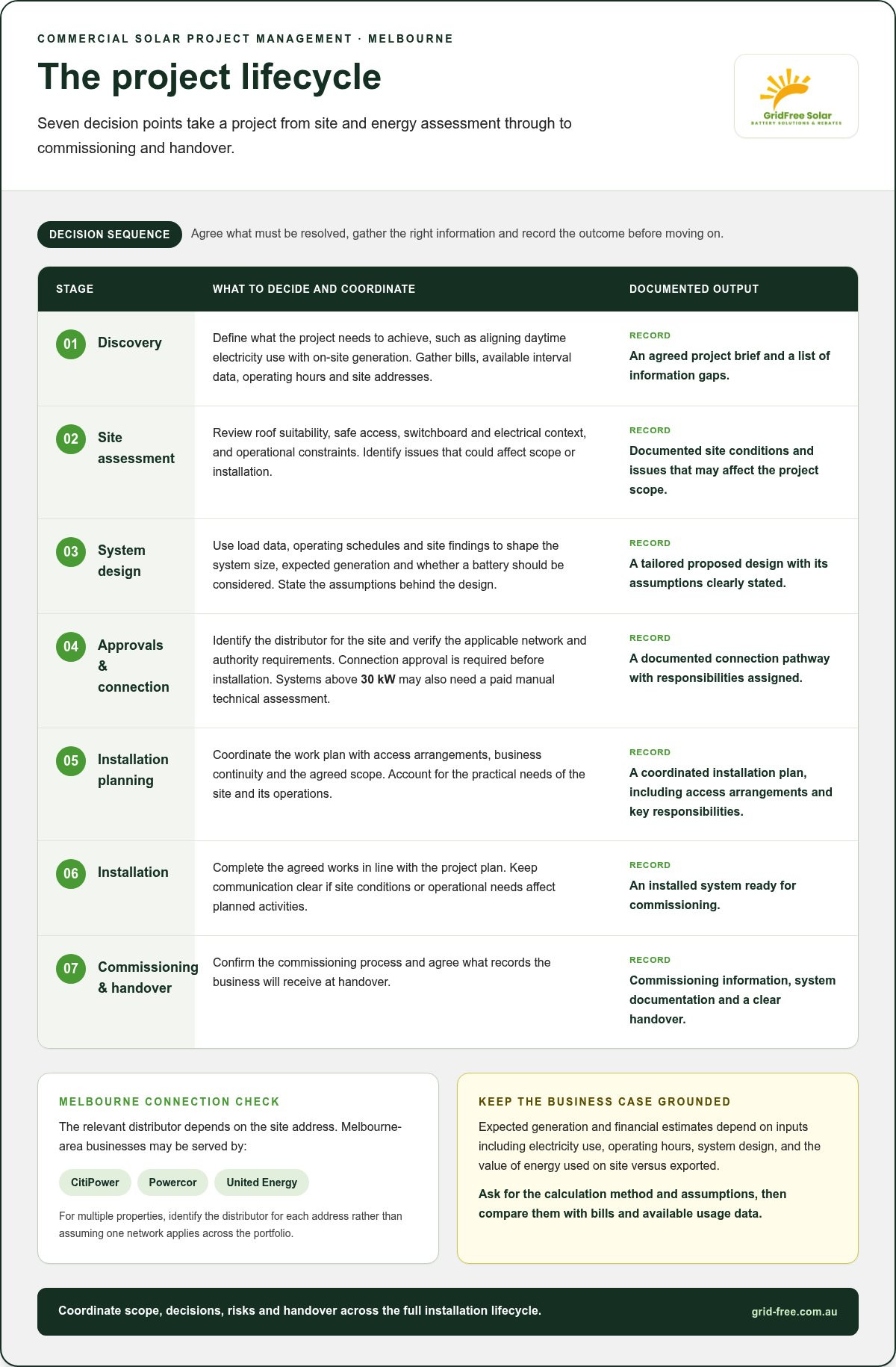
A clear sequence turns a complex installation into manageable decisions. In commercial solar project management, Melbourne businesses should treat each stage as a decision point: agree what needs to be resolved, gather the right information and record the outcome before moving on.
- Discovery. Define what the project needs to achieve, such as better alignment between daytime electricity use and on-site generation. Gather bills, available interval data, operating hours and site addresses. Output: an agreed brief and a list of information gaps.
- Site assessment. Identify what needs closer inspection before developing a design. Review roof suitability, access, switchboard and electrical context, and operational constraints. Output: documented site conditions and issues that may affect scope.
- System design. Decide which proposed configuration best matches the project objectives. Use load data, operating schedules and site findings to inform system size, expected generation and whether a battery should be considered. Output: a tailored design with stated assumptions.
- Approvals and connection. Set out how the project will progress through applicable approval and network processes. Identify the site’s distributor and verify current requirements with the relevant network and authorities. Output: a documented pathway and assigned responsibilities.
- Installation planning. Plan how work can proceed while accounting for site access and business continuity. Align the work plan with operating needs and the agreed scope. Output: a coordinated installation plan, including access arrangements and key responsibilities.
- Installation. Complete the agreed works in line with the project plan. Keep communication clear if site conditions or operational needs affect planned activities. Output: an installed system ready for commissioning.
- Commissioning and handover. Confirm the commissioning process and agree what records the business will receive. Output: commissioning information, system documentation and a clear handover to the people responsible for the site.
What happens during commercial site assessment and design?
Use electricity bills and interval data, where available, to understand when and how the business consumes power. Pair this information with operating hours and site observations, including roof suitability, access, switchboard context and activities that could constrain works. Design assumptions should connect these inputs to the project objectives. System size and battery inclusion need site-specific assessment, not a generic rule based on building type or roof area.
How do approvals, installation and handover fit together?
Approval and connection steps depend on project and site conditions. Verify current requirements with the relevant distributor and authorities before fixing the delivery sequence. The Clean Energy Council provides industry information, while the network’s guidance is key for site-specific connection requirements. Plan installation around access and business operations, then agree on handover records before work starts.
- Commissioning information and relevant system documentation.
- Details of the installed system and its agreed design.
- Records of approvals and connection processes relevant to the project.
- Handover responsibilities and information for the staff managing the site.
Commissioning and documentation are part of the project, not paperwork to leave until the end. They give the business a defined record of what was installed and how the handover was completed. For a tailored commercial solar project, discuss your business’s site and energy needs with GridFree Solar.
How to compare commercial solar project proposals in Melbourne
Compare proposals on a like-for-like basis, not just by quoted system capacity or headline savings. A consistent approach to commercial solar project management in Melbourne makes differences in design assumptions, exclusions and delivery responsibilities easier to spot before you commit.
Use a comparison table to record what each proposal actually includes. If a detail is absent, mark it as unstated rather than assuming it’s covered.
| Area | What to compare |
|---|---|
| Scope | Proposed system capacity, equipment categories, design work and installation activities. |
| System assumptions | Usage profile, operating hours, generation estimate and any stated export constraints. |
| Exclusions | Site work, switchboard changes, access arrangements and other items excluded or dependent on site conditions. |
| Approvals | Connection and approval steps included, responsibilities assigned and dependencies identified. |
| Commissioning | Planned commissioning activities and the information to be recorded. |
| Handover | System documentation, commissioning records and handover responsibilities. |
Which technical and commercial assumptions deserve scrutiny?
Compare proposed capacity, electricity-use assumptions and generation estimates against the same business data. Where export constraints are mentioned, note how they affect the proposal’s generation or financial calculations. Check that orientation, roof conditions and switchboard work are addressed consistently, and that exclusions are explicit. Indicative projections are estimates, not guaranteed business savings. Their value depends on disclosed methods and inputs.
For each projected outcome, record the calculation method and inputs, including the assumed usage profile and how generated electricity used on site or exported is treated. If proposals use different assumptions, their savings figures aren’t directly comparable. Treat incentives as conditional, not certain reductions: eligibility, availability and claim rules can change. Verify current programme requirements before including an incentive in your business case.
Assess battery storage as a separate decision within the proposed design. Consider whether its role matches the business’s energy needs and project objectives, rather than assuming every solar system should include one. Compare a tailored solar and battery solution with a solar-only option using clearly stated design and financial assumptions.
How should Melbourne network and compliance factors be assessed?
Identify the distributor serving the site and compare each proposal’s stated connection and export assumptions with that distributor’s current guidance. Check references to Energy Safe Victoria requirements and relevant Australian Standards against current authoritative material. If a proposal cites Clean Energy Council accreditation, verify its current programme status and the specific scope it covers. Don’t treat the reference as a substitute for project-specific approvals or compliance information.
Finish by noting who owns each approval step, which site conditions could change the scope, and what records are included at handover. The strongest comparison isn’t necessarily the one with the largest system or most optimistic projection. It’s the one whose design, assumptions, exclusions and delivery responsibilities are clear enough for your business to make an informed decision.
A Melbourne commercial solar project readiness checklist
Good preparation turns an initial conversation into a focused project brief. Before requesting a proposal, gather business, site and operational information that can shape the assessment. Assigning decision owners early also helps finance, facilities and operations work from the same priorities. This groundwork gives commercial solar project management in Melbourne a clearer starting point, while leaving design outcomes to site-specific assessment.
What information should a business prepare before requesting a proposal?
Bring together energy records, site details and business objectives. You don’t need to decide system size or battery inclusion in advance. The aim is to give the project team a useful picture of how the site operates and what the business wants the project to achieve.
- Recent electricity bills and interval data, where available.
- Typical operating hours, including shifts or seasonal changes.
- Major electricity loads and when they usually run.
- Project objectives, such as using more generated energy on site or considering battery storage.
- Known site changes, expansions or tenancy changes that could affect future energy use.
- Available roof information, site plans, access details and switchboard records.
- Known constraints, such as restricted access areas or activities that can’t be interrupted.
Make decision ownership explicit. Finance can coordinate business-case review, facilities can organise site records, operations can identify practical constraints, and the person responsible for approvals can track internal sign-offs and relevant external processes. For multiple properties, organise information by address because each site may need its own assessment and delivery plan.
How can a business plan around installation disruption?
Map the parts of the site that installation activity could affect, then identify operating periods that need protection. Note delivery routes, loading areas, staff access and any site-specific safety coordination. Share constraints early so the work plan can account for business continuity. If operations vary by day or shift, record that pattern rather than relying on a general description of “normal hours”.
Discuss staging, site communication and the people who need to know about planned work. Agree how operational changes or unexpected site conditions will be communicated, and who can make decisions on the business’s behalf. These arrangements help facilities and operations teams prepare, without assuming disruption can be eliminated.
Before finalising a proposal, identify the network distributor for each address and establish the relevant connection or approval pathway. Requirements vary by site and project, so verify current guidance with the relevant distributor and authorities rather than relying on a generic checklist. Keep a record of who is responsible for each step and what information is still needed.
For broader context on system considerations, use this commercial solar installation guide for Melbourne alongside your site records. Once the key information and decision-makers are in place, discuss your commercial solar project with GridFree Solar to explore a solution tailored to your business’s site and energy needs.
Plan your Melbourne commercial solar project with GridFree Solar
Once you’ve clarified site conditions, business priorities and proposal assumptions, shape them into a project brief. GridFree Solar designs and installs commercial solar solutions for businesses, with solar and battery options considered against each site’s energy use and requirements. Commercial solar project management in Melbourne is about connecting the business case to a tailored design and a clear path through project decisions.
Start with the information you’ve assembled. Electricity bills and interval data can show when the business uses power, site details help frame what needs assessment, and defined objectives show what the proposed system needs to address. Together, these inputs provide a more useful basis for discussion than choosing a system size before understanding the site and usage profile.
What can GridFree Solar help a business plan?
GridFree Solar provides commercial solar design and installation, including integrated solar and battery solutions for businesses. The right configuration depends on the site, usage patterns and project objectives. A battery can be considered where it aligns with the business’s requirements, rather than treated as an automatic addition. The aim is a tailored proposal with reviewable assumptions, not a generic specification or a promise of savings.
Rebates may also form part of the project assessment. GridFree Solar helps businesses navigate and claim applicable solar and battery rebates, while eligibility, programme availability and claim requirements are assessed against current rules. Treat any incentive in a proposal as conditional until its rules and the project’s eligibility have been established. Keep the project assessment clear so the business can understand the design and financial assumptions separately from any potential rebate.
For broader system context as you prepare, consult the commercial solar installation guide for Melbourne. Use it alongside your site and energy information, not as a substitute for an individual assessment. Conditions and usage differ between properties, including across a business’s multiple sites.
What are the next steps for a Melbourne business?
Organise a concise project pack before the conversation. Include the site address, recent electricity bills, interval data where available, operating hours, known site constraints and the business’s main objectives. Identify contributors from finance, facilities, operations and approvals, and note any planned changes that could affect future energy use. This helps focus the assessment on the decisions that matter to your organisation.
From there, GridFree Solar can discuss a commercial solar solution tailored to the business’s site and energy needs. The discussion can consider system design, whether battery storage suits the project and how applicable rebates should be assessed, without treating projections or incentives as guaranteed outcomes. A clear starting brief helps move from general interest to informed project planning.
Ready to put your site information and objectives into a project conversation? Discuss a commercial solar project with GridFree Solar.
Turn your project brief into a clear next step
Your project doesn’t need every detail settled before progress can begin. It needs a clear starting point: the site, how the business uses energy and what the project should achieve. From there, commercial solar project management in Melbourne becomes a practical process of shaping options, clarifying assumptions and moving towards decisions that fit your business.
GridFree Solar provides commercial solar design and installation for businesses, with solar and battery options considered for business applications. The team also helps customers navigate and claim applicable solar and battery rebates, with eligibility and programme rules assessed against current requirements. The focus is a tailored project, not a one-size-fits-all system or an assumed outcome.
Bring your site and usage information, outline your priorities and start a conversation about what may suit your business. Discuss your Melbourne commercial solar project with GridFree Solar. A well-prepared first step can put your business on a clearer path towards a considered solar solution.
Frequently Asked Questions
How long does a commercial solar project take in Melbourne?
A commercial solar project in Melbourne has no reliable standard timeframe. Duration depends on site assessment, design, approvals, equipment and installation scope. A site needing further network review may follow a different sequence from one with a straightforward connection pathway. Build operating requirements into planning early, and request a project-specific schedule during proposal discussions, including key dependencies and decision points.
Will installing commercial solar disrupt business operations?
It can, depending on the site, access, installation scope and business hours. For example, a business with busy loading areas may need deliveries or work zones coordinated around usual activity. Discuss operational constraints early so the project plan can set out work areas, access windows, safety coordination and communication responsibilities. Planning can help manage disruption, but it shouldn’t be treated as a promise that work will have no operational impact.
Does every Melbourne business need battery storage with commercial solar?
No. Battery storage isn’t automatically required. Its suitability depends on a business’s usage profile, operating hours, site requirements and project objectives. A business that uses most of its electricity during solar generation hours may have different priorities from one with substantial use outside those hours. Assess battery storage alongside the solar design, then compare each proposal’s scope and assumptions. Don’t treat a battery as a guarantee of savings or energy independence.
Can a commercial solar system export electricity to the grid in Melbourne?
Export capacity and connection requirements depend on the site and its network distributor. The proposed system size alone doesn’t establish how much electricity can be exported or which connection pathway applies. Include network assessment in project planning, and verify current export and connection requirements with the distributor responsible for the Melbourne site. This gives the design a site-specific basis rather than relying on a general export assumption.
Can a business claim a solar rebate for a commercial project in Victoria?
Possibly, but eligibility depends on current programme rules, criteria and project details, so don’t assume every business or system qualifies. Incentive availability and claim requirements can change, and any expected benefit should be checked against current authoritative information before it’s included in a business case. GridFree Solar helps customers navigate and claim applicable solar and battery rebates; eligibility still needs to be assessed against the requirements that apply to the project.
What information should I provide for a commercial solar proposal?
Provide recent electricity bills, interval data if available, the site address, operating hours and your main project objectives. Roof and switchboard information can help frame the assessment, as can details about access restrictions or work areas that need to remain clear. This information supports an informed review, but it doesn’t predetermine the system design. Further site-specific details may be needed as the proposal develops.
Are commercial solar project manager job listings the same as hiring a solar installer?
No. Job listings advertise employment opportunities for people seeking project manager roles. A business planning a solar installation needs a provider to assess its site, develop a system design and manage delivery. Search results can mix these two intents because both use similar terms. For a business project, focus on the proposed scope, site assessment, delivery stages and handover information, rather than recruitment requirements or role descriptions.