
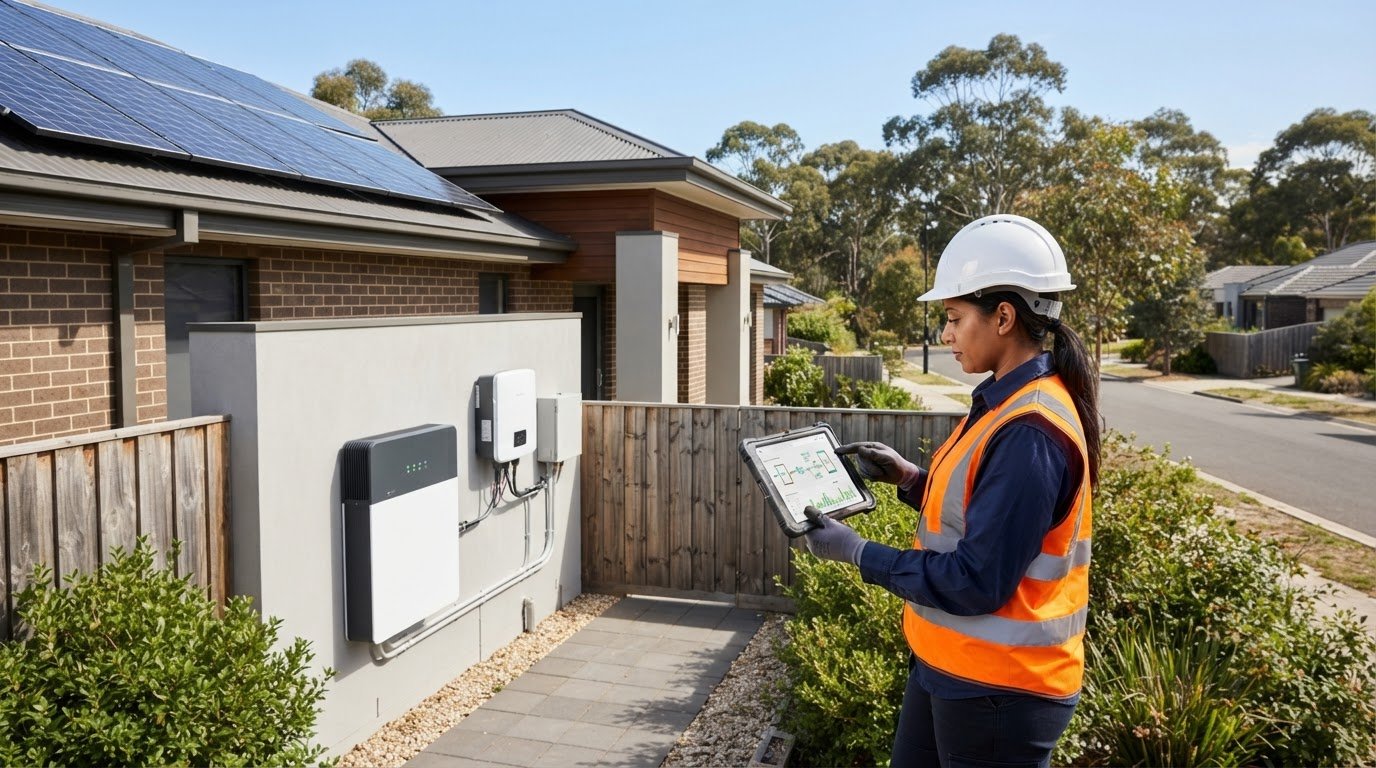
A battery retrofit quote is shaped by the solar system already on your roof, not just the battery you choose. The search phrase “cost to add a battery to solar system Victoria” points to the big question, but your existing inverter, wiring and installation requirements can all affect what a suitable upgrade involves.
It’s reasonable to want a clear installed-cost figure before comparing options, especially if you’re unsure whether your current system is compatible or which rebates may apply. In Victoria, rebate settings and eligibility requirements can change, so check what each quote assumes rather than treating a discount as guaranteed.
This guide explains the main factors behind a battery retrofit quote, the system details to gather before requesting an assessment, and how to compare equipment compatibility, installation scope and rebate assumptions. You’ll also learn what to consider when matching battery capacity to your household’s energy use and future plans. A site-specific assessment can help clarify the practical requirements before you choose.
Key Takeaways
- The cost to add a battery to solar system Victoria depends on your existing setup and installation scope, not battery capacity alone.
- Check your inverter, panels and wiring to understand whether your system can support a battery and what changes may be needed.
- Compare retrofit pathways by equipment compatibility, scope uncertainty and future flexibility before weighing up quotes.
- Verify current Victorian and Australian incentive rules, then compare itemised quotes to see what’s included and what rebate assumptions apply.
- Gather recent electricity bills, inverter details, solar-system documents and backup priorities before requesting a site-specific assessment.
Factors Affecting Solar Battery Costs in Victoria
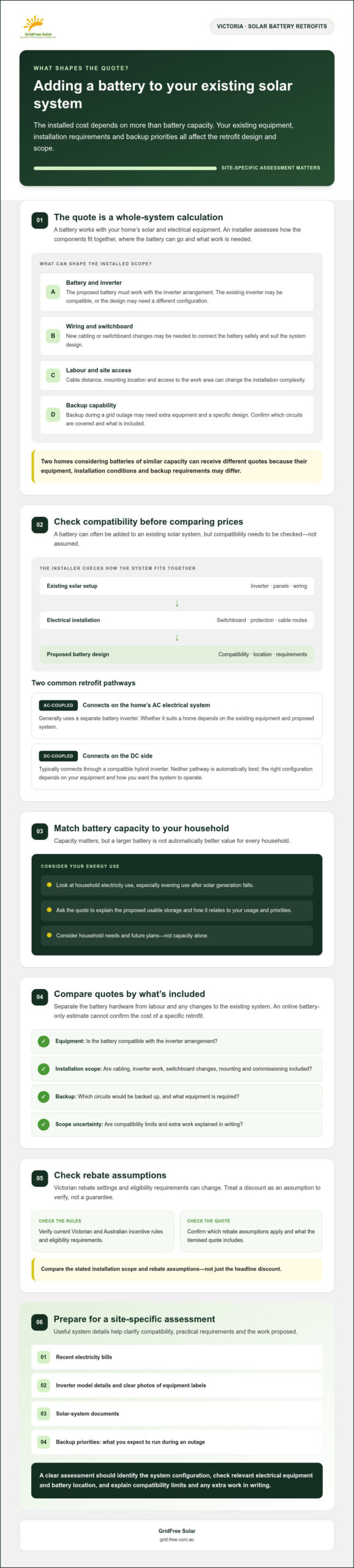
The installed cost depends on your home and the solar system already in place. Battery capacity is only one part of the project scope: the inverter, wiring, switchboard, labour and access to the installation area can all influence what the work involves. That’s why a battery-only online estimate can’t confirm the price of a specific retrofit.
A battery is part of a broader battery energy storage system, connected to your home’s solar and electrical equipment. An installer needs to assess how those components work together, where the battery can be mounted and whether the existing setup needs changes. The assessment can also clarify what’s included in the installation work, rather than just the hardware.
- Battery and inverter: The proposed battery must work with the inverter arrangement. An existing inverter may be compatible, or the design may require a different inverter configuration.
- Wiring and switchboard: New cabling or switchboard changes may be needed to connect the battery safely and suit the proposed system design.
- Labour and site access: Cable distance, mounting location and access to the work area can affect installation complexity and scope.
- Backup capability: Backup during a grid outage may require additional equipment and a specific design. Ask the installer which circuits would be backed up and what components are included.
Two Victorian homes can receive different retrofit quotes because their existing equipment, installation conditions and backup requirements may differ, even if they’re considering batteries of similar capacity.
Which parts of a battery retrofit shape the quote?
Separate the battery hardware from installation labour and any system changes when reviewing a quote. Check whether it includes required cabling, inverter work, switchboard modifications, mounting and commissioning. A longer cable route or less accessible mounting location may add work. If you want backup, confirm the design and equipment required rather than assuming it’s included as standard.
Why battery size is not the whole cost calculation
Choose capacity with your household’s electricity use in mind, especially how much power you typically use in the evening after solar generation falls. A larger battery can store more energy, but that doesn’t automatically make it better value for every household. Ask for an itemised, site-specific quote that explains the proposed usable storage, installation scope and any system changes. Compare options against your usage and priorities, not capacity alone.
Can your existing solar system support a battery addition?
Often, a battery can be added to an existing solar system, but compatibility needs to be checked rather than assumed. The inverter, solar panels, wiring and proposed battery all affect how the equipment can work together. The result may influence the design and scope behind the cost to add a battery to solar system Victoria.
Two common retrofit approaches are AC-coupled and DC-coupled. An AC-coupled battery connects to the home’s AC electrical system, generally using a separate battery inverter, while a DC-coupled battery connects on the DC side, typically through a compatible hybrid inverter. Neither approach is automatically best. The right configuration depends on your existing equipment, the proposed battery and how you want the system to operate. Experienced photovoltaic and battery storage specialists such as Sonalis highlight the importance of aligning storage technology with the property’s specific inverter setup and consumption patterns.
A battery retrofit assessment checks whether your existing solar equipment can work with the proposed battery, what electrical or equipment changes may be needed, and whether the design matches your household’s requirements.
What an installer should check on an existing system
Before an assessment, gather clear photos of equipment labels, your solar-system documents and the inverter model details. Ask the installer to identify the system configuration and assess relevant equipment, switchboard capacity, protective equipment, cable routes and the proposed battery location. Request written confirmation of compatibility limits and any extra work identified, so you can compare the proposed scope with other quotes.
When a retrofit may need more than a battery
An existing inverter may not support the proposed battery, or the design may require additional components or electrical work. Treat backup power as a separate design question: explain what you expect to run during an outage and ask what equipment and circuits the proposed setup would cover. For wider cost context, read this solar battery cost guide.
If you’re checking whether your equipment is a suitable starting point, Solar Victoria’s battery rebate information is the place to verify current Victorian programme details and requirements. Incentive eligibility and claim conditions can change, so confirm them for your circumstances before relying on a rebate in your budget.
GridFree Solar provides battery upgrades and replacements, and an assessment can help clarify compatibility and installation requirements for your existing system. Explore GridFree Solar’s battery upgrade options as a next step.
Compare battery retrofit options before judging the cost
Compare quotes by the work each pathway includes, not just the headline total. A lower initial quote may leave out system changes, backup equipment or other installation work that another quote includes. The best fit depends on your existing setup, household demand and plans for the system.
| Retrofit pathway | Compatibility | Scope uncertainty | Future flexibility | Questions to confirm |
|---|---|---|---|---|
| Retain compatible equipment | Works where the existing system suits the proposed battery. | May be more predictable once compatibility and site requirements are checked. | Depends on the limits of the equipment retained. | What equipment stays, and are any limitations documented? |
| Modify the system | May suit a system that needs additional components or electrical changes. | Can change after the installer checks wiring, switchboard and installation conditions. | May allow a revised configuration, subject to the proposed design. | Which changes are required, and are they itemised? |
| Replace key components | Considered if existing equipment is unsuitable for the proposed setup. | Confirm the full replacement and installation scope before comparing quotes. | Ask how the new configuration supports planned system changes. | Why is replacement recommended, and what happens to existing equipment? |
Replacing an existing battery is a different situation from adding one. If your project involves replacing a battery that’s no longer suitable, this solar battery replacement guide may help you assess that option.
Battery capacity, usable storage, and household demand
A battery’s headline capacity describes its total storage, while usable capacity is the amount available for household use under the system’s specifications. Check both figures. Review electricity bills or interval usage data to see when demand occurs, particularly in the evening. That evidence can help you discuss capacity with an installer, but it can’t guarantee energy independence or bill reductions.
Backup power, warranties, and future system compatibility
Ask whether backup is included, which circuits it covers and what additional design or equipment it requires. Compare warranty conditions and who is responsible for installation in writing. Check that the proposed equipment works with your current setup and any planned changes, such as expanding the solar system.
Keep incentives separate from the equipment comparison. Solar Victoria’s battery loan is closed to new applicants; check the Solar Victoria battery loan status for current information. A clear, itemised scope makes it easier to compare the cost to add a battery to solar system Victoria and understand what each quote actually covers.
How to check Victorian rebates and compare battery quotes
Incentives can affect the amount you pay, but don’t treat a discount shown in an advertisement as confirmed. Victorian and Australian programmes have separate rules, and names, eligibility and application processes can change. If you’re researching “cost to add a battery to solar system Victoria”, check current official information and get each installer to state clearly how any incentive has been factored into the quote.
What to check about battery incentives in Victoria
Start with official programme sources. Solar Victoria’s battery loan is closed to new applicants; check its battery loan information for current status. Separately, check the Australian Government’s Cheaper Home Batteries Program for current requirements. Don’t assume an incentive applies based on location alone. Eligibility can depend on the household, proposed system, approved products and installer requirements. Confirm application timing and any claim steps before committing.
An advertised incentive is an estimate until its eligibility and claim requirements are confirmed for your specific project. For more detailed programme guidance, see this Victorian battery rebate guide, then verify current rules with the relevant official source.
What a clear battery installation quote should show
Use this process to check incentives and compare proposals on a like-for-like basis:
- Gather your system details. Collect recent electricity bills, inverter information and solar-system documents so installers can assess the existing setup.
- Confirm current incentives. Check Victorian and Australian programme information separately. Verify the programme name, eligibility, application timing, approved product requirements and installer conditions with official sources.
- Request itemised quotes. Ask each installer to specify the battery and inverter equipment, installation inclusions, exclusions and any identified wiring, switchboard or other electrical work.
- Compare the full scope. Check whether backup is included, what it covers, and how the quote treats incentives. Ask who is responsible for application steps and what happens if eligibility isn’t confirmed.
Look beyond the headline total. One quote may include system modifications or application support that another leaves out. Ask for unclear assumptions to be explained in writing, including whether an incentive is shown as a confirmed deduction or an estimate. This makes it easier to compare the actual work and equipment proposed, rather than relying on a lower figure that may not cover the same scope.
GridFree Solar helps customers navigate solar and battery rebate processes. Discuss a battery upgrade assessment to clarify your existing system, proposed installation scope and rebate assumptions.
Get a site-specific battery addition assessment from GridFree Solar
You’ve compared retrofit pathways and checked what to look for in a quote. The next step is to have your existing system and household needs assessed together. This gives an installer the context to identify a suitable battery approach and explain the proposed scope. It also helps make the cost to add a battery to solar system Victoria more meaningful for your property than a general estimate.
GridFree Solar provides battery upgrades and replacements, as well as solar and battery installation. An assessment can help clarify how your existing system relates to a proposed battery addition. Expected savings, system performance, incentive eligibility and final project scope depend on your equipment, energy use, site conditions and current programme requirements. They should be confirmed for your circumstances.
Prepare for a useful solar battery assessment
A little preparation makes it easier to discuss what you need, not just which battery might fit. Gather:
- Recent electricity bills and, if available, interval usage data to show how your household uses power throughout the day.
- Inverter information, including photos of the equipment label and any model details you can find.
- Solar-system documents, such as installation records or equipment information, if you have them.
- Household usage notes, including major appliances, occupancy patterns and typical evening electricity use.
- Your priorities, such as backup power, possible future expansion or help understanding rebate requirements.
Be specific about backup expectations. For example, note whether you want power for selected essential circuits during an outage, or whether backup is not a priority. This helps frame the discussion without assuming a particular design or outcome.
Move from quote comparison to a confident decision
Before choosing an option, ask the installer to explain the compatibility findings and any assumptions behind the proposed scope. Confirm inclusions, exclusions, any approvals or electrical work identified, how incentives are treated, and the expected project steps in writing. If a detail is unclear, ask for it to be spelled out before comparing the quote with another proposal.
That written clarity helps you make a considered choice based on your existing system and household priorities, rather than a headline figure alone. For a local solar battery assessment, discuss your Victorian battery addition with GridFree Solar and share the information you’ve gathered.
Make your next battery decision with clarity
The cost to add a battery to solar system Victoria depends on more than the battery itself. Your existing inverter and electrical setup, installation requirements and household priorities all help shape the right retrofit. Compare quotes by checking their equipment, inclusions and rebate assumptions, then verify current incentive requirements against official information.
A site-specific assessment is the practical next step. GridFree Solar provides solar and battery installation, specialises in battery upgrades and replacements, and helps customers navigate solar and battery rebate processes. An assessment can clarify compatibility and proposed work; savings, performance and eligibility depend on your circumstances and current requirements.
Prepare your system details and energy-use information, then request a battery assessment for your existing solar system. With a clearer picture of your options, you can make a confident decision for your home and future energy needs.
Frequently Asked Questions
How much does it cost to add a battery to an existing solar system in Victoria?
There isn’t one fixed price for adding a battery to an existing solar system in Victoria. The quote depends on the battery and usable capacity, inverter compatibility, electrical work, site access and any backup requirements. Ask for an itemised, property-specific quote that separates equipment from installation and system changes. That’s the clearest way to understand the cost to add a battery to solar system Victoria for your Melbourne home.
Can I add a battery to my existing solar system?
Often, yes, but an installer needs to check your system before confirming compatibility. The inverter model and configuration, solar panels, wiring and proposed battery all matter. Some systems may suit an AC-coupled battery, while others may need a compatible hybrid inverter or additional components. Gather your solar-system documents and photos of equipment labels for an assessment. The installer can identify limitations and explain what changes, if any, the proposed retrofit requires.
Are there battery rebates in Victoria in 2026?
Victorian households may be eligible for the Australian Government’s Cheaper Home Batteries Program, which offers a discount of around 30% on eligible battery systems, subject to current rules. The Victorian Solar Victoria battery loan programme is closed to new applicants. The federal programme’s STC factor reduces every six months, and the current rebate amount requires installation and commissioning by 31 December 2026. Confirm eligibility, product and installer requirements with official sources before relying on an incentive.
Will I need a new inverter to add a solar battery?
Not necessarily. Whether your existing inverter can be retained depends on its model, configuration and compatibility with the proposed battery. Some retrofit designs use a separate battery inverter, while others may require a compatible hybrid inverter or a change to existing equipment. Ask the installer to explain the options and list any inverter work in writing. For a Melbourne home, an on-site or system-specific assessment is more reliable than assuming every older inverter needs replacing.
How do I know what size battery I need for my home?
Use your household’s electricity use to guide battery sizing, especially the power you consume after solar generation drops in the evening. Review recent bills or interval usage data, and note major appliances and typical occupancy patterns. Ask the installer to distinguish headline capacity from usable storage and explain how the recommended size matches your demand. A larger battery isn’t automatically a better fit, and the right capacity depends on your usage, priorities and system design.
Does adding a battery mean my home will have backup power during an outage?
No. A battery addition doesn’t automatically provide backup during a grid outage. Backup capability depends on the system design and may require additional equipment or electrical work. Ask whether backup is included, which circuits it can supply and what appliances those circuits support. If you need essential items such as selected lights or a fridge to keep running, tell the installer before the design is finalised. Confirm the backup arrangement and limitations in writing.
What should I compare in solar battery installation quotes?
Compare the proposed battery and inverter, usable capacity, installation inclusions, exclusions and any electrical work identified. Check whether backup is included and what circuits it covers. Ask each installer to explain rebate assumptions, eligibility checks and who handles application steps. Then confirm warranty conditions, compatibility findings and any project assumptions in writing. Like-for-like comparison matters: a lower headline quote may cover a different scope from another proposal for your Melbourne home.