
Table of Contents
- Solar Panel Efficiency: Monocrystalline vs Polycrystalline at a Glance
- How Cell Structure Affects Performance: Monocrystalline vs Polycrystalline
- Solar Panel Degradation Rates Over 25 Years
- The Impact of Temperature Coefficient on Solar Performance
- CEC Approved Solar Panels List: What to Check Before You Buy
- Cost, Roof Space and Return on Investment: Monocrystalline vs Polycrystalline
- Verdict: Which Panel Type Suits Your Home?
- Frequently Asked Questions
Last Updated: September 24, 2026
Solar Panel Efficiency: Monocrystalline vs Polycrystalline at a Glance
When comparing solar panel efficiency monocrystalline vs polycrystalline in Australia, the practical answer is simple: monocrystalline panels convert more sunlight into usable power per square metre, while polycrystalline panels usually cost less upfront. This guide from GridFree Solar breaks down what that difference means for your roof, your bills and your long-term return.
Quick Comparison Table: Efficiency, Cost and Warranty
| Factor | Monocrystalline | Polycrystalline |
|---|---|---|
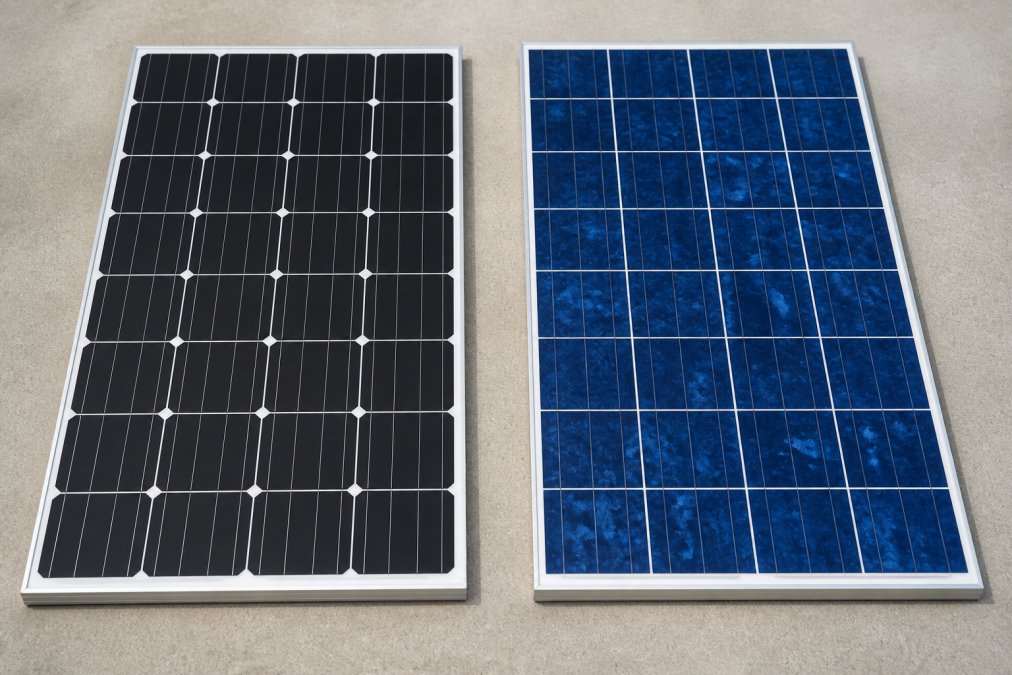
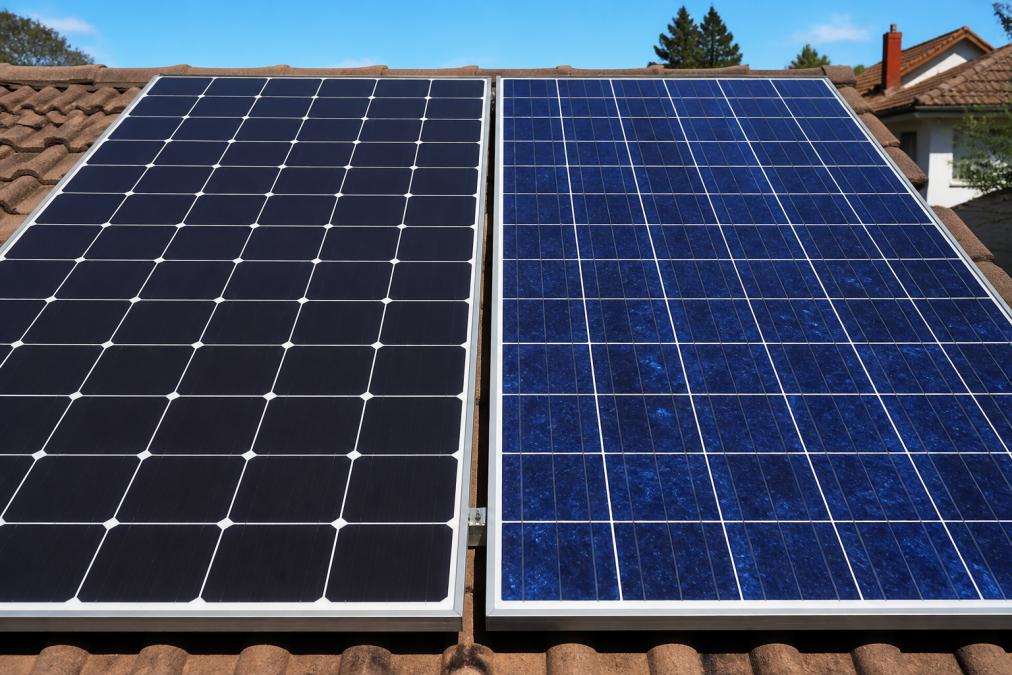
| Cell appearance | Uniform black | Blue, speckled |
| Typical module efficiency | Higher (often 20%+) | Lower (often 15-17%) |
| Roof space needed | Less | More |
| Upfront cost | Higher | Lower |
| Heat performance | Better temperature coefficient | Slightly worse |
| Warranty period | Often longer | Often shorter |
| Best for | Tight roofs, maximum output | Budget-focused, ample roof |
If roof space is limited, monocrystalline wins almost every time. If you have plenty of unshaded roof and a tighter budget, polycrystalline can still deliver solid returns.
How Cell Structure Affects Performance: Monocrystalline vs Polycrystalline
Cell structure decides how much of the sun’s energy a panel captures and how well it handles heat. That single fact explains most of the performance gap between the two technologies.
Silicon Purity and the Czochralski Process
Monocrystalline cells start as a single silicon ingot drawn from molten silicon using the Czochralski process. This produces a wafer with one continuous crystal lattice and very high silicon purity. Higher purity means fewer barriers to electron flow, which raises conversion efficiency.
Why PERC and Passivation Layers Matter for Energy Yield
Modern panels add a passivation layer and PERC (Passivated Emitter and Rear Cell) design to reduce electron loss at the back of the cell. PERC boosts energy yield on both panel types, but it delivers the biggest gains on monocrystalline wafers because their higher purity responds better to the treatment.
Solar Panel Degradation Rates Over 25 Years
Degradation rate is the percentage of original output a panel loses each year, and it is the single most under-discussed number in residential solar. Most buyers compare efficiency at day one; the smarter comparison is total kilowatt-hours delivered over 25 years, because that is what actually pays back the system.
The Two Mechanisms Behind Early Loss
Degradation is not one process. Two dominate the first few years:
- Light-Induced Degradation (LID): Occurs in the first hours and weeks of exposure as boron-oxygen defects in the silicon activate under sunlight. It typically costs 1-3% of output and then stabilises. Mono and poly both experience it, but the effect is well understood and largely baked into modern manufacturing.
- Potential-Induced Degradation (PID): A voltage-driven leakage that occurs when the panel’s frame and cells sit at different potentials, often worsened by heat and humidity. PID can cost several percent if system grounding and inverter design are poor. It is a system-level issue as much as a panel issue, good earthing and the right inverter topology largely prevent it.
Typical Long-Term Rates
- Monocrystalline: commonly warranted at around 0.45-0.55% per year after year one, with a year-25 output floor of roughly 84-87%.
- Polycrystalline: commonly warranted at around 0.55-0.70% per year, with a year-25 floor of roughly 80-83%.
These are warranty floors, not guarantees of actual performance, a quality panel often beats its floor, and a cheap one may only just meet it.
What the Compounding Actually Looks Like
Take a 6.6 kW system in a location receiving an average of 4.2 kWh per kW of installed capacity per day (a reasonable mid-range figure for much of the populated east coast).
- Year-one generation: roughly 10,120 kWh.
- Mono at 0.50%/yr average: cumulative output over 25 years lands near 235,000 kWh.
- Poly at 0.65%/yr average: cumulative output lands near 228,000 kWh.
Reading the Warranty Properly
Every reputable panel carries two separate warranties, and they mean different things:
- Product (or workmanship) warranty: covers defects in materials and manufacturing. Typical terms are 12-25 years, with premium brands at the top of that range.
- Performance (or power) warranty: guarantees a minimum output percentage at specified years. A strong one states a year-one floor (often 98%) and a year-25 floor (often 84-87% for mono).
Many budget quotes only show the product warranty and hide the performance warranty. If a seller cannot show you a guaranteed output figure at year 25, treat that as a red flag. Ask for the warranty document itself, not a summary.
Why This Matters More Than Headline Efficiency
A panel that is 1% more efficient on day one but degrades 0.15% per year faster will be the lower performer well before year 25. For anyone planning to stay in the home long-term, or sizing a system to charge a battery for a decade or more, the degradation curve is the more honest measure of value.
The Impact of Temperature Coefficient on Solar Performance
Temperature coefficient is the spec that decides how much of a panel’s rated output survives an Australian summer. It is expressed as a percentage loss per degree Celsius above the Standard Test Condition (STC) of 25°C cell temperature, not ambient air temperature. On a 38°C day, a roof-mounted panel can easily sit at 60-70°C cell temperature, which is where the coefficient starts eating into your yield.
Typical figures you will see on datasheets:
- Monocrystalline: around −0.29% to −0.35% per °C
- Polycrystalline: around −0.35% to −0.45% per °C
Worked Example: A 6.6 kW System on a Hot Afternoon
Assume a 6.6 kW array with a cell temperature of 65°C, a realistic figure for a dark roof in a heatwave.
- Mono at −0.32%/°C: 40°C above STC × 0.32% = 12.8% output loss. Effective output ≈ 5.75 kW.
- Poly at −0.42%/°C: 40°C above STC × 0.42% = 16.8% output loss. Effective output ≈ 5.49 kW.
Why the Coefficient Varies by Cell Type
Monocrystalline wafers have a single, uniform crystal lattice, so heat-induced electron scattering is more orderly and the voltage drop per degree is smaller. Polycrystalline wafers contain grain boundaries between crystals; at high temperatures those boundaries become more disruptive, which is why the coefficient is typically worse. PERC and advanced passivation layers narrow the gap but do not close it.
Climate-Zone Reality Check
The practical weight you give this factor depends on where the system sits:
- Hot, high-irradiance regions (inland and northern areas): Cell temperatures routinely exceed 60°C. Temperature coefficient deserves real weight in the decision, it is one of the few specs where mono’s advantage is structural, not marketing.
- Temperate coastal regions: Peak cell temperatures are lower and the annual gap narrows. Roof space and upfront cost usually matter more than the coefficient.
- Cooler southern regions: The coefficient is close to a tie-breaker rather than a deciding factor.
What to Check on the Datasheet
Look for the Pmax temperature coefficient (the one that affects power output), not just the Voc or Isc coefficients. A panel with a Pmax coefficient of −0.30%/°C is meaningfully better in the heat than one at −0.40%/°C, regardless of which cell technology it uses. Also check the NOCT (Nominal Operating Cell Temperature) figure, a lower NOCT means the panel runs cooler under the same conditions, which stacks with a good coefficient.
If you are comparing two quotes and the efficiency figures are close, the temperature coefficient is often the tie-breaker that actually changes your summer bill. Ask both installers for the Pmax coefficient in writing.
Mounting and Ventilation Matter as Much as the Cell
A panel with an excellent coefficient still runs hot if it is flush-mounted with no airflow behind it. Leaving a gap between the panel and the roof surface, avoiding dense roof-integrated mounting in hot zones, and keeping panels clear of obstructions all reduce cell temperature. In practice, good mounting can recover more output than the difference between a mid-range and premium temperature coefficient, so treat the two as a package, not separate decisions.
CEC Approved Solar Panels List: What to Check Before You Buy
The Clean Energy Council (CEC) Approved Solar Panels List is the starting point for any purchase, because only approved panels qualify for federal small-scale renewable energy certificates. If a panel is not on the list, you lose access to the rebate that reduces your upfront cost.
Check three things before signing anything:
- Approval status: Confirm the exact model, not just the brand, appears on the current CEC list.
- Installer accreditation: Your installer should be CEC accredited, which also protects your eligibility for incentives.
- Standards compliance: Systems should meet AS/NZS 5033 and AS/NZS 3000 wiring rules and, where batteries are involved, AS/NZS 5139:2019.
Cost, Roof Space and Return on Investment: Monocrystalline vs Polycrystalline
Cost per watt is the cleanest way to compare the two technologies, but it is not the only number that decides your return on investment. Monocrystalline panels cost more per panel, yet they generate more power from the same roof area.
Here is how the trade-off usually plays out:
- Limited roof space: Monocrystalline wins, because you need fewer panels to hit your target system size.
- Ample unshaded roof: Polycrystalline can deliver a lower upfront cost with acceptable output.
- Long-term ownership: Monocrystalline’s lower degradation rate and longer warranty usually improve lifetime return.
- Battery storage plans: Higher-efficiency panels pair better with modern battery storage, since they charge the battery faster during short solar windows.
System Sizing and Shading Loss Considerations
Shading loss is the silent killer of solar ROI. A single shaded panel can drag down the output of an entire string in a traditional setup, which is why shade tolerance matters as much as headline efficiency.
Ask your installer for a shading report that shows hour-by-hour production across the year, not just a single annual estimate. It reveals exactly where shade hurts and how optimisers can recover output.
Verdict: Which Panel Type Suits Your Home?
For most homes with limited roof space or high summer heat, monocrystalline is the stronger choice. It converts more sunlight per square metre, degrades more slowly and holds its output better in the heat. Polycrystalline remains a reasonable option when roof space is plentiful and upfront budget is the priority, but the efficiency gap has narrowed the case for it in recent years.
Australian Energy Market Operator on rooftop solar uptake
Frequently Asked Questions
Which solar panels are the most efficient in Australia?
Monocrystalline panels generally lead the market in efficiency, with many models converting over 20% of sunlight into electricity. Polycrystalline panels typically sit between 13% and 16%. If you have limited roof space, monocrystalline is the better choice. However, the best panel for your home depends on your budget, roof orientation and energy needs. A CEC accredited installer can help you compare options and design a system that maximises your energy yield.
What is the 20% rule for solar panels?
The 20% rule is a rule of thumb suggesting that solar panels should not be shaded by more than 20% of their surface area, as shading can significantly reduce output. In practice, even partial shading on one panel can disproportionately cut the performance of an entire string. Modern systems use optimisers or microinverters to reduce shading loss. If your roof has shading issues, discuss design options with your installer to minimise the impact.
What are the downsides of monocrystalline solar panels?
Monocrystalline panels usually cost more upfront than polycrystalline because of the complex manufacturing process. They can also be slightly more sensitive to high temperatures, though their higher efficiency often compensates. For homes with ample roof space and a tight budget, polycrystalline can still be a practical choice. The main downside is the higher initial investment, but this can be offset by better long-term performance and a lower degradation rate.
Do monocrystalline panels perform better in high-heat environments?
Both panel types lose efficiency as temperatures rise, but the impact depends on the temperature coefficient. Monocrystalline panels often have a slightly better (more negative) temperature coefficient, meaning they lose a bit less output per degree above 25°C. However, the difference is usually small. In hot climates, good ventilation behind the panels and correct mounting can help manage thermal performance. Your installer should factor temperature coefficient into the system design.
Are polycrystalline panels still a cost-effective option for residential systems?
Yes, polycrystalline panels remain a cost-effective option, especially if you have plenty of roof space and want to minimise upfront costs. They typically have a lower price per watt than monocrystalline. However, they require more panels to reach the same system size, which can increase installation labour and balance-of-system costs. For homes with limited roof area, monocrystalline may offer better value despite the higher panel price.
Choosing the right panel is only half the job. The other half is a design and installation that matches your roof, your shading and your energy habits, backed by proper compliance and rebate guidance. GridFree Solar handles that end to end: CEC accredited installers, CEC approved batteries, compliance with AS/NZS 5139:2019 and AS/NZS 3000, plus ongoing monitoring so you can see your system performing. Get started with GridFree Solar and turn your roof into a system that actually pays you back.