
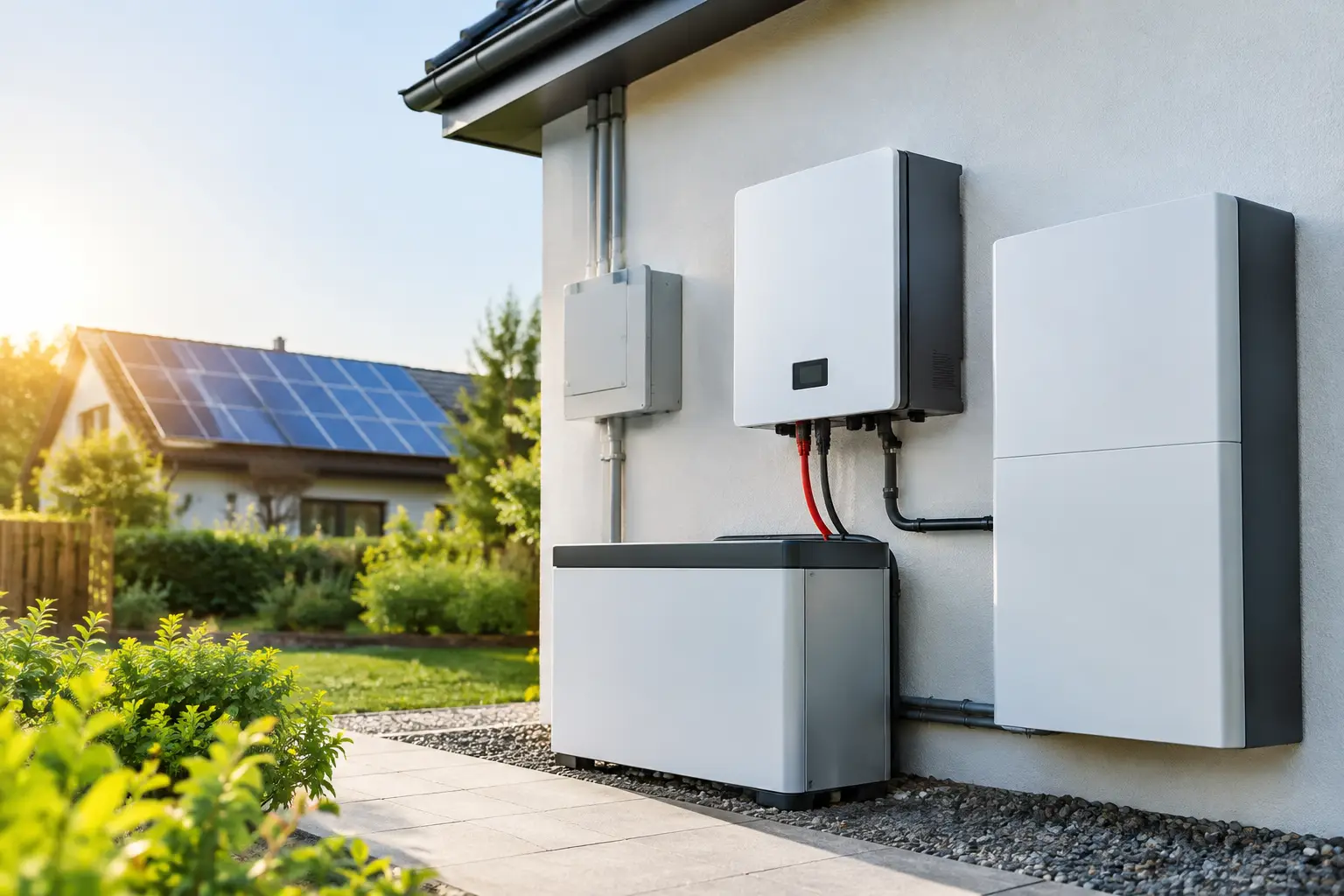
A battery can turn surplus daytime solar into evening power, but the way it connects to your solar system affects cost, efficiency, backup options and future flexibility. In the AC vs DC battery coupling decision, there is no universal winner. The right choice depends on whether you are adding storage to an existing system or designing solar and battery together.
For most households and small businesses, the practical question is simple: which setup will store more of your solar, fit your property cleanly and deliver the backup and bill savings you expect? Understanding the difference helps you invest in a system that works now and remains useful as your energy needs change.
What AC vs DC battery coupling actually means
Solar panels produce direct current (DC) electricity. Most homes and businesses use alternating current (AC) electricity, so a solar inverter converts panel output from DC to AC before it reaches your switchboard.
With AC coupling, the solar system and battery system each have their own inverter. Solar power is converted to AC by the solar inverter. When there is excess generation, the battery inverter converts that AC power back to DC to charge the battery. When the battery discharges, its inverter changes DC back to AC for your property.
With DC coupling, solar panels and the battery connect on the DC side of a compatible hybrid inverter. Solar energy can charge the battery before it is converted to AC for use in the building. The hybrid inverter manages solar generation, battery charging, household consumption and grid imports or exports from one central point.
Both approaches can reduce your reliance on grid electricity. The key difference is where the energy conversion happens and how readily the battery can work with the equipment already on your roof.
AC-coupled batteries: the practical retrofit option
AC coupling is often the straightforward choice for a home that already has solar panels and a functioning solar inverter. Rather than replacing the original system, a compatible battery and battery inverter are added beside it. This can reduce disruption and preserve an existing solar investment.
Imagine a household with a five-year-old solar system that produces plenty of power at midday but exports much of it for a modest feed-in tariff. An AC-coupled battery can capture some of that excess production for use after sunset, when electricity prices may be higher. It gives the household a storage upgrade without necessarily changing the panel array or solar inverter.
This separation can also offer flexibility. If the original solar inverter is still within warranty and performing well, keeping it in service may make financial sense. AC coupling can suit properties with unusual existing solar configurations, multiple roof sections or plans to expand in stages, provided the system is carefully designed for compatibility.
The trade-off is conversion loss. Electricity may be converted from DC to AC, then back to DC to enter the battery, and finally from DC to AC when it is used. Quality equipment is efficient, but each conversion step uses a small amount of energy. Over years of regular charging and discharging, that difference can affect how much of your solar generation reaches your appliances.
AC coupling can also require more wall space, more equipment and more detailed integration work. It is not a drawback in every installation, but it should be considered during the site assessment rather than after the system has been selected.
DC-coupled batteries: efficient for new solar systems
DC coupling is commonly well suited to new solar-and-battery installations. A hybrid inverter manages the panels and battery together, allowing solar energy to charge the battery directly on the DC side. Fewer conversion stages generally mean higher round-trip efficiency, so more of the energy generated on your roof is available for later use.
For a household building a new system, this can create a tidy, integrated design. The installer can size the solar array, inverter capacity and battery storage around expected consumption, export limits, roof space and the household’s priorities. If evening air conditioning, cooking, pool equipment or electric vehicle charging drive higher usage, the system can be designed to retain more solar for those periods.
A DC-coupled setup may also mean less duplicated hardware than separate solar and battery inverters. That does not automatically make it the cheapest option. Equipment pricing, switchboard work, battery size, backup requirements and site conditions still determine the final installed cost. But for a new installation, DC coupling is often the efficient, purpose-built pathway.
The limitation is that it is less convenient when you already have a conventional solar inverter in good condition. Moving to DC coupling may mean replacing equipment before the end of its useful life. In that scenario, the extra efficiency may not outweigh the cost of a full inverter changeover.
Efficiency matters, but it is not the only number
It is tempting to select a battery solely on efficiency. Efficiency is valuable because every stored kilowatt-hour has been generated by your panels or bought from the grid. Yet a highly efficient battery that is too small, cannot support your preferred backup loads or is poorly matched to your consumption may not deliver the best outcome.
Look at usable battery capacity, continuous power output, warranty conditions and the system’s energy management controls alongside round-trip efficiency. Capacity tells you how much energy can be stored. Power output tells you how much the battery can supply at one time. A system may have enough stored energy for the evening but still be unable to run several high-demand appliances simultaneously during an outage.
Backup power is a separate design decision
A battery does not automatically provide blackout protection. To keep selected circuits running during a grid outage, the installation needs appropriate backup capability, isolation equipment and a correctly designed backup circuit. Depending on the product and property, you may choose essential-load backup for items such as lights, refrigeration, internet and selected power points, or a broader whole-home backup arrangement.
AC and DC-coupled batteries can both provide backup power when configured with compatible equipment. The better question is what you need the backup to do. A family wanting to protect food, communications and basic lighting has a different requirement from a small business that needs to keep critical refrigeration, security or point-of-sale equipment operating.
Your installer should confirm the battery’s backup power rating, whether solar can continue charging the battery during an outage, the circuits included and any appliances that need to be managed. High-demand loads such as ducted air conditioning, ovens and electric hot water can quickly exceed available backup power if they are not planned for.
Which battery coupling option suits your property?
AC coupling is often compelling when you already have solar that is performing well and want to add storage with minimal changes to the existing array. It can be a sensible way to increase solar self-consumption, reduce grid purchases in the evening and add selected backup capability.
DC coupling is often the stronger fit when solar and battery are being installed together, or when an existing inverter is due for replacement. It offers an integrated design and can reduce conversion losses between solar generation and storage.
There are exceptions. A newer home may have switchboard constraints that influence the preferred design. A commercial site with substantial daytime consumption may benefit more from solar generation than from a large battery. A household on a time-of-use tariff may prioritise charging and discharging controls, while another may value VPP compatibility and future battery expansion. The best answer comes from matching the system to your load profile, not from choosing a technology label first.
Ask for a design based on your energy use
A reliable recommendation starts with your electricity bills and interval data where available. This shows when your property consumes energy, how much solar is likely to be exported and whether a battery can shift that energy into your expensive grid-use periods. It also identifies whether your goals are primarily bill reduction, backup resilience, greater energy independence or a combination of all three.
Before proceeding, ask how the proposed system will perform in winter as well as summer, what equipment can be added later, how monitoring will show solar production and battery use, and which rebates or incentives may apply. Eligibility and values can vary by state, product and installation date, so accurate paperwork and compliant installation matter.
GridFree Solar can assess existing equipment, household consumption and future plans to recommend an AC or DC-coupled battery system that makes commercial sense for your property. The most valuable battery is not simply the biggest one or the most efficient one on paper. It is the one designed to keep more of your solar working for you, at the times you need it most.