

Why are you still paying some of the world’s highest electricity rates while fearing the next summer storm will plunge your Melbourne home into darkness? It’s a frustrating reality for many Victorians. You want to escape the cycle of rising bills and grid instability, yet the technical jargon around AC versus DC coupling and changing rebate schemes feels like a barrier. You aren’t alone in feeling that the transition to energy independence should be simpler.
This 2026 guide is your definitive roadmap to the tesla powerwall 3. We’ll show you how this high-performance energy engine, with its integrated solar inverter and 11.04 kW continuous output, has redefined home storage. You will discover exactly how to navigate the federal Cheaper Home Batteries Program to secure savings of up to $3,640 now that Victorian state loans have closed. We also detail how to maximise your ROI through Virtual Power Plant participation, potentially earning between $150 and $600 annually. From technical specs to local eligibility requirements, we provide the professional clarity you need to secure your energy future today.
Key Takeaways
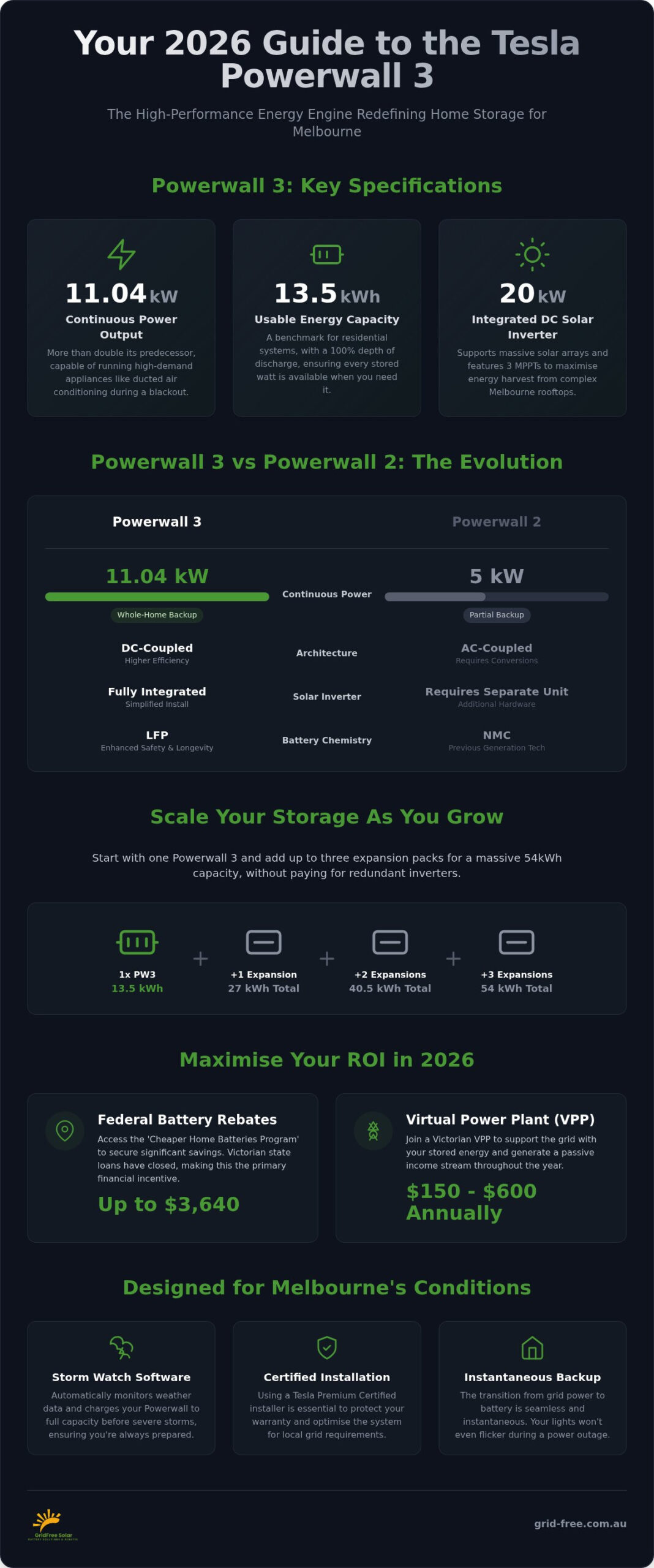
- Master the technical shift to the tesla powerwall 3, which features a massive 11.04kW continuous power output and an integrated 20kW DC solar inverter.
- Compare the advantages of DC-coupled architecture over older AC-coupled systems to achieve true whole-home backup during Melbourne’s unpredictable summer storms.
- Learn how to scale your energy storage up to 54kWh using plug-and-play expansion packs that bypass the need for expensive additional inverters.
- Navigate the 2026 financial landscape by claiming federal rebates of up to $3,640 and joining Victorian VPPs to earn between $150 and $600 annually.
- Understand the necessity of using Tesla Premium Certified installers to protect your warranty and optimise your system for Melbourne’s specific grid requirements.
Tesla Powerwall 3 Specs: The Most Powerful Home Battery in Australia?
Hardware innovation has reached a new peak. The tesla powerwall 3 is no longer just a storage device; it is a high-performance energy engine designed to anchor your entire home ecosystem. While the 13.5kWh of useable capacity remains a benchmark for residential systems, the internal architecture has been completely reimagined for the 2026 market. This isn’t a minor update. It is a fundamental shift in how Australian homes manage power.
This model introduces Lithium Iron Phosphate (LFP) chemistry to the Tesla Powerwall lineage. LFP is the gold standard for safety and thermal stability. It handles the intense cycling demands of a modern household with ease. This chemistry is particularly suited to the Australian climate. It offers superior durability during our notorious summer heatwaves, ensuring your investment remains reliable for the long haul. The build is robust, compact, and engineered for maximum longevity.
The Integrated Solar Inverter Advantage
The most radical change is the built-in solar inverter. By merging the battery and inverter into one chassis, Tesla has reduced the hardware footprint on your wall and simplified the installation process. This integrated unit supports a massive 20kW of DC solar input. This is a significant leap forward. It allows you to significantly oversize your solar array, ensuring your home stays powered even during the shortest, overcast winter days in Victoria.
The system includes 3 Maximum Power Point Trackers (MPPTs). This is essential for Melbourne’s diverse architecture. If your roof has multiple orientations or faces shading from nearby trees, the 3 MPPTs ensure each string of panels operates at its peak efficiency independently. You get more power from every ray of sun. The DC-coupled design also minimises energy loss. Solar power flows directly into the battery without the efficiency hits caused by multiple AC/DC conversions.
Backup Performance During Melbourne Storms
Grid reliability is a growing concern for Victorian families. The tesla powerwall 3 offers a robust solution with its 11.04 kW continuous AC output. This is more than double the sustained power of the previous generation. It means you can run high-demand appliances like ducted air conditioning or pool pumps during a blackout without tripping the system. You don’t have to choose which rooms to keep powered.
Tesla’s “Storm Watch” software acts as a digital sentry. It tracks Bureau of Meteorology data and automatically charges the battery to its maximum capacity if a severe weather warning is issued. Combined with a 100% depth of discharge, you have access to every bit of stored energy when the grid fails. The transition is instantaneous. Your lights won’t flicker and your home office stays online. It is seamless reliability designed for the modern Melbourne home.
Scaling Your Storage: Expansion Packs and 54kWh Capacity
Energy requirements never stay static. Families grow, home offices expand, and the transition to electric vehicles increases your daily demand. The tesla powerwall 3 addresses this through a revolutionary modular design. You don’t have to over-invest on day one. Start with the core 13.5kWh unit and scale as your lifestyle evolves. This future-proof approach ensures you only pay for the storage you actually use.
The system allows you to add up to three expansion packs to a single primary unit. Each pack provides an additional 13.5kWh of useable storage, pushing your total capacity to a staggering 54kWh. This is a massive reservoir of power. It’s enough to sustain most Melbourne homes through multiple days of overcast weather or prolonged grid failures. The plug-and-play nature of these packs simplifies the upgrade process. It eliminates the need for complex rewiring or secondary inverter installations.
Expansion Packs vs. Multiple Powerwalls
The primary advantage of expansion packs is cost efficiency. A standard tesla powerwall 3 includes a high-performance solar inverter. Expansion packs do not. By removing the inverter from the secondary units, Tesla has created a more affordable pathway to high-capacity storage. You aren’t paying for redundant hardware. You are simply buying more fuel tank for your home energy system.
When would you choose a second full unit instead? It comes down to power output. If your property has massive peak loads that exceed the 11.04kW continuous limit of a single unit, a second full Powerwall 3 provides the extra muscle required. For most Victorian residential connections, the expansion packs offer the best ROI. While the state-level loan program has changed, you should monitor official updates on Victorian battery rebates to stay informed about any new local incentives or compliance standards.
Installation Logistics for Melbourne Homes
Space is often at a premium in Melbourne’s inner suburbs. The stackable design of the Powerwall 3 expansion packs is a critical space-saver. These units can be floor-mounted or wall-mounted, fitting neatly into Victorian garages without obstructing vehicle access. The liquid thermal management system is engineered for resilience. It maintains peak performance in temperatures ranging from -20°C to 50°C. Whether it’s a frosty morning in the Dandenongs or a 40-degree scorcher in Werribee, your storage remains stable.
Achieving full functionality requires the Backup Gateway. This acts as the brain of your system, managing the transition between grid and battery power. It also provides the intelligence needed for VPP participation and advanced energy monitoring. If you’re ready to plan your energy roadmap, our specialists can calculate the ideal storage capacity for your specific consumption patterns.
Tesla Powerwall 3 vs. Powerwall 2: Which Should You Choose?
Don’t let the familiar sleek casing fool you. The internal differences between these two generations are seismic. Choosing between them isn’t just about picking the newest model; it’s about matching the architecture to your home’s existing infrastructure. While the Powerwall 2 has been the workhorse of the Australian market for years, its discontinuation for new installations marks a definitive shift toward the DC-coupled future of the tesla powerwall 3.
The fundamental distinction lies in how they handle energy. The Powerwall 2 is an AC-coupled system, meaning it sits “behind” your solar inverter and requires a separate unit to convert sun into useable power. In contrast, the tesla powerwall 3 is a DC-coupled powerhouse with a built-in solar inverter. This eliminates hardware redundancy. It also offers a massive jump in performance. You move from the 5kW continuous output of the older model to a staggering 11.04kW. This isn’t just a spec upgrade. It’s the difference between keeping the lights on and running your entire Melbourne home, aircon included, during a grid failure.
The Retrofit Dilemma: Upgrading Existing Systems
If you’re starting from scratch with a new solar array, the choice is simple. The integrated design of the latest model is the superior financial and technical move. However, for those with healthy, existing solar panels, the decision requires more nuance. Because the new unit *is* the inverter, installing it often means bypassing or removing your current solar inverter entirely.
The “sweet spot” for a full transition occurs when your existing inverter is nearing the end of its life, typically around the five to seven-year mark. Instead of replacing a failing inverter and adding a separate battery, you can consolidate everything into one high-efficiency unit. This simplifies your switchboard and provides a single point of warranty for your entire energy ecosystem. It’s a cleaner, more reliable way to modernise an aging system without the clutter of multiple boxes.
Cross-Compatibility and Firmware Updates
Many Victorian households already own a Powerwall 2 and wonder if they’re locked out of the new technology. Fortunately, a significant firmware update in July 2026 enabled backward compatibility. You can now integrate both generations into a single, mixed-generation fleet. This allows you to expand your storage capacity without discarding your original investment. You can manage the entire system seamlessly through the Tesla App.
There are technical limits to keep in mind. While they can coexist in the same ecosystem, they often operate on separate backup circuits due to their differing battery chemistries and power delivery methods. Mixing LFP and NMC chemistries requires expert configuration to ensure balanced charging and discharging. Our team specialises in these complex battery upgrade and replacement scenarios, ensuring your mixed-gen system operates at peak efficiency without compromising the lifespan of either unit.
Maximising ROI: Victorian Battery Rebates and VPPs in 2026
Achieving total energy independence is only half the battle. To truly master your home’s economics, you must leverage the financial incentives available in 2026. The landscape has shifted significantly. While the state-level battery loan program has concluded, Victorian households now look to the federal Cheaper Home Batteries Program as the primary driver for lowering the upfront cost of a tesla powerwall 3. This federal incentive can reduce your initial investment by approximately $3,400 to $3,640, provided you act before the scheduled tier reduction in January 2027.
The logic is simple. A battery that pays for itself faster is a better investment. With Victorian electricity prices remaining volatile, the combination of upfront rebates and ongoing earnings through grid support has shortened payback periods. Modern energy tariffs in Melbourne now reward those who can discharge power during peak demand. Your battery isn’t just a backup; it’s a financial tool that works while you sleep.
Navigating Solar Victoria Incentives
Eligibility remains a hurdle for those who don’t have expert guidance. As of July 1, 2026, the combined household income limit for solar-related incentives in Victoria is $150,000 per year. You must also ensure your property hasn’t previously claimed specific storage incentives that might disqualify you from the current federal scheme. Documentation is rigorous. You’ll need recent council rates notices, proof of income, and a compliant quote from a certified installer.
GridFree Solar takes the administrative weight off your shoulders. We handle the technical paperwork and ensure your system design meets the strict standards required for a successful claim. To see if your property qualifies, you can review our comprehensive checklist for battery rebate eligibility in Victoria. Getting this right the first time is the difference between securing thousands in savings or paying full price.
Joining a Virtual Power Plant (VPP)
The tesla powerwall 3 is specifically engineered for high-frequency VPP participation. By joining a VPP, you allow a provider to occasionally draw small amounts of power from your battery to help stabilise the Victorian grid during peak loads. In exchange, you receive premium credits. In 2026, Victorian households are earning between $150 and $600 annually through these programs. Some providers, such as Simply Energy, are offering export rates as high as 18 to 25 cents per kWh.
You remain in control. The Tesla App allows you to set a “Backup Reserve,” ensuring the VPP never drains your battery below a level that would leave you vulnerable during a blackout. This balance between personal security and grid participation is what makes “negative” power bills a reality for savvy Melbourne homeowners. If you want to start earning from your storage, our team can help you claim your federal battery rebate and find the best VPP for your area.
Professional Installation: The GridFree Advantage in Melbourne
Precision matters. A tesla powerwall 3 is a high-performance asset, but its ROI depends entirely on the quality of its integration. Choosing a Tesla Premium Certified installer isn’t optional; it’s essential for long-term warranty protection and system safety. We don’t just install batteries. We engineer energy solutions. Our team understands the specific electrical requirements of Melbourne homes, ensuring your switchboard is ready for the massive 11.04kW output this unit delivers. This level of expertise prevents the technical bottlenecks that often plague DIY or cut-price installations.
Hardware is only as good as its configuration. We ensure every connection meets Tesla’s rigorous standards. This isn’t just about bolting a box to a wall. It’s about integrating a sophisticated energy engine into your home’s unique electrical architecture. By choosing a local specialist, you gain a partner who understands the Victorian grid and the specific challenges of our regional climate.
Melbourne-Specific Solar Design
Melbourne’s weather is notoriously unpredictable. Our winter sun sits low on the horizon, often filtered through heavy cloud. This makes panel placement critical. We use advanced shading analysis to ensure your solar panel installation in Melbourne feeds the Powerwall efficiently year-round. If your panels aren’t optimised for these conditions, your battery won’t reach full capacity when you need it most. We design for the worst-case winter scenario, not just the easy summer days.
We also navigate the administrative landscape of Victoria’s Distributed Network Service Providers (DNSPs). From Citipower and Powercor to United Energy, we ensure your export limits and grid connections are fully compliant. This is vital for 2026. As the grid becomes more congested, meeting these local requirements is the only way to guarantee your system is approved for VPP participation and export credits. We handle the technical dialogue with the authorities so you don’t have to.
Your Journey to Energy Independence
The transition is seamless when you have the right partner. Our process is transparent and fast-paced. It begins with a custom energy profile of your household. We look at your consumption peaks, your future EV charging needs, and your backup priorities. Once the design is finalised, we take over the administrative burden. We manage the entire Victorian rebate approval process, ensuring you secure the maximum federal incentive before deadlines shift.
GridFree provides more than just a quote. We provide a decade of local expertise and high-authority advice. We monitor your system’s performance long after the installation is complete, helping you adjust settings as energy tariffs evolve. You aren’t just buying hardware; you’re investing in a partnership that guarantees total energy independence. The grid is becoming more expensive and less reliable every year. Don’t wait for the next price hike. Get a professional Tesla Powerwall 3 quote today and take command of your home’s power.
Take Command of Your Energy Future Today
The 2026 energy landscape demands a smarter, more assertive approach to residential storage. You’ve seen how the tesla powerwall 3 redefines performance with its integrated inverter and massive power delivery. It isn’t just a battery; it’s a strategic asset for your Melbourne home. By combining this technology with federal rebates and Virtual Power Plant participation, you transform a monthly expense into a high-yielding energy investment.
Don’t leave your energy independence to chance or uncertified installers. As Melbourne-based storage specialists and Tesla Premium Certified installation experts, GridFree Solar ensures your transition is seamless and technically sound. We include full Victorian rebate application assistance to ensure you secure every available dollar before federal incentives decrease. Secure your path to total grid independence with a local team that understands the Victorian climate and administrative landscape.
Secure Your Tesla Powerwall 3 Quote and Rebate Check
Take the first step toward a blackout-proof, cost-efficient future today. Your home deserves the security of modern, intelligent innovation.
Frequently Asked Questions
Is the Tesla Powerwall 3 available in Australia yet?
The tesla powerwall 3 is officially available for installation across Melbourne and Victoria as of September 2026. It has replaced the Powerwall 2 as the primary storage solution in the Tesla energy ecosystem. Local households can now access the increased power output and integrated inverter technology immediately. Because demand remains high in the inner suburbs, we recommend checking your site’s readiness early to secure your installation slot and claim any eligible federal battery rebates.
Can I add a Powerwall 3 to my existing solar system?
You can certainly integrate it with an existing solar array, but the process differs from older models. Since the unit features a built-in solar inverter, it often replaces your aging string inverter to create a more efficient, DC-coupled system. This is a common scenario for a battery upgrade & replacement project. Our team assesses your current panels to ensure they are compatible with the 20kW DC solar input capacity of the new hardware.
How much does a Tesla Powerwall 3 cost in Melbourne in 2026?
Total investment for a tesla powerwall 3 in Melbourne depends on several variables, including the complexity of your switchboard and whether you require the mandatory Backup Gateway. While the hardware represents a significant portion of the cost, the federal Cheaper Home Batteries Program can significantly reduce your upfront expenses. We provide tailored quotes that account for these incentives and your specific household energy needs to ensure you achieve the best possible return on investment.
Does the Powerwall 3 support three-phase power?
The current model available in Australia is a single-phase unit. If your Melbourne home has a three-phase connection, the system can still be installed to back up specific phases or used across the entire property with professional configuration. A native three-phase version, known as the Powerwall 3P, has launched overseas and is anticipated to arrive in Australia by late 2026, pending final approval from the Clean Energy Council for local grid integration.
What is the difference between Powerwall 3 and the Expansion Pack?
The primary unit is a complete energy engine containing both the storage cells and a high-capacity solar inverter. Expansion packs are storage-only units designed to increase your total kWh capacity without the added expense of redundant inverters. You can add up to three expansion packs to a single primary battery, reaching a total capacity of 54kWh. This modular approach allows Victorian families to scale their energy independence as their consumption or EV needs grow.
Will the Powerwall 3 work during a blackout?
Yes, the system provides a seamless transition during grid outages. With a continuous AC output of 11.04kW, it is powerful enough to run heavy appliances like ducted air conditioning or large kitchen appliances that would have tripped older systems. The Storm Watch feature also monitors local Victorian weather data, automatically charging your battery to its maximum capacity if a severe storm warning is issued, ensuring you have a full reservoir of backup power.
How long is the warranty for the Tesla Powerwall 3 in Australia?
Tesla provides a 10-year warranty for the unit in Australia, covering both the hardware performance and its energy retention capacity. To maintain this protection, the system must be installed by a Tesla Premium Certified professional and remain connected to the internet for regular firmware updates. Our Melbourne-based team ensures your installation meets all manufacturer standards, providing you with the long-term security and expert local support required to keep your storage system running at peak efficiency.
Can I use the Powerwall 3 to charge my Tesla EV?
You can use the stored energy to charge your Tesla EV through the integrated Tesla App, which allows you to prioritise solar self-consumption. This ensures your vehicle is powered by clean energy rather than expensive grid electricity. However, it’s important to note that Vehicle-to-Home (V2H) technology, which allows the car to power the house, is still under development and is not yet available for the Australian market as of September 2026.