
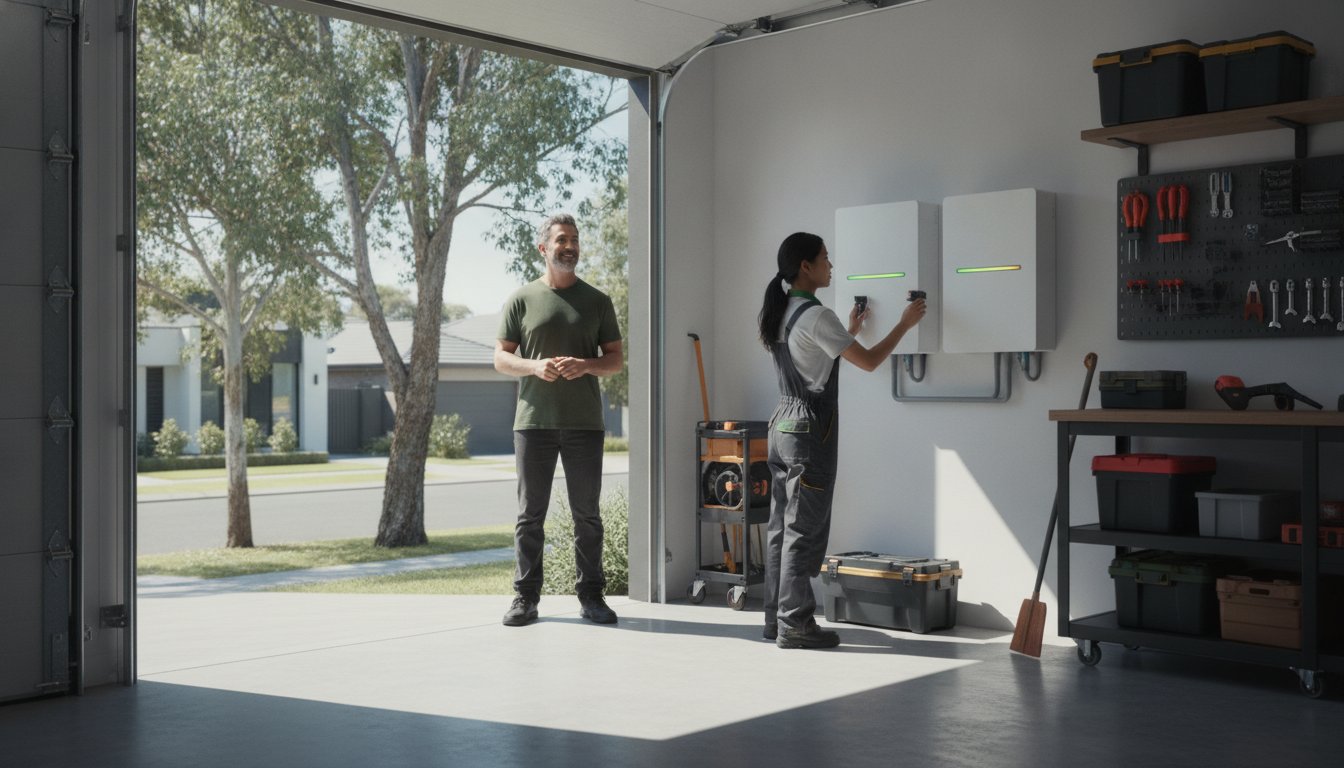
Your solar battery should be a powerhouse of independence, not a source of evening anxiety when the charge hits zero at 9 PM. If your system is running dry before the dishwasher even starts, you are missing out on the full ROI of your investment. It is a common Melbourne frustration. You want to sever ties with the grid, but technical jargon and warranty fears create unnecessary hurdles.
This guide shows you exactly how to increase solar battery storage capacity to achieve near-zero power bills and total energy autonomy. We cut through the confusion regarding inverter throughput and LiFePO4 retrofitting. You will discover the most efficient technical pathways to expand your storage while navigating the latest 2026 federal incentives. We’ll explore how the Cheaper Home Batteries Program provides a point-of-sale discount of up to $350 per kilowatt-hour of usable capacity. From matching voltage requirements to future-proofing for EV charging, we provide the definitive roadmap to a smarter, larger storage system.
Key Takeaways
- Maximise self-consumption as feed-in tariffs decline. Learn why storing your own energy is now significantly more profitable than selling it back to the Melbourne grid.
- Identify the right technical path for your home. Discover how to increase solar battery storage capacity through parallel unit expansion or high-density LiFePO4 replacements.
- Avoid the “Age Gap” trap. Understand the critical compatibility issues that arise when mixing new battery modules with older units and how to protect your system’s lifespan.
- Monetise your excess power. Explore how joining a Virtual Power Plant (VPP) can provide the ongoing credits needed to offset the cost of your storage upgrade.
- Future-proof your investment with a load profile audit. Ensure your expanded system is perfectly calibrated for your current evening usage and future EV charging requirements.
Why Increase Solar Battery Storage Capacity in 2026?
The Melbourne energy market has fundamentally shifted. Feed-in tariffs have plummeted, rendering the old “export and earn” model obsolete. In 2026, the financial logic is clear. You must store every possible watt your roof produces. Relying on the grid during peak evening hours is a guaranteed way to bleed money. When you choose to increase solar battery storage capacity, you stop being a victim of fluctuating retail rates. You become the manager of your own power station. It is the only way to shield your household from the inevitable price hikes that occur the moment the sun goes down.
Victorian storms are increasing in frequency and intensity. We have seen local networks struggle to maintain stability during extreme weather events. A larger storage buffer isn’t just about saving money. It is about survival. It ensures your lights, refrigeration, and essential medical devices stay active when the rest of the neighbourhood goes dark. If you are planning to transition to an electric vehicle, the urgency is even greater. Charging an EV requires significant headroom. Your current system likely isn’t equipped to handle a car and a household simultaneously.
The Shift Toward Total Grid Independence
We are moving beyond “supplemental solar.” The goal now is a self-sustaining microgrid. By expanding your home energy storage systems, you create a reservoir large enough to power your home through Melbourne’s greyest winter days. Many households find that a small, entry-level battery provides a false sense of security. It covers the evening peak but fails by midnight. A high-capacity system provides the psychological peace of mind that comes from knowing you have a 48-hour buffer. You aren’t just using solar. You are living on it 24/7.
Maximising ROI on Existing Solar Arrays
Your current solar panels are likely underperforming because they have nowhere to send their energy once your battery is full. This “clipped” energy is pure waste. Expanding your capacity allows you to capture this lost potential, significantly lowering your levelised cost of energy (LCOE). You have already paid for the panels. It makes strategic sense to utilise their full output. In 2026, ROI is defined as the total reduction in grid-imported kilowatt-hours balanced against the accelerated payback period achieved through maximised self-consumption. By choosing to increase solar battery storage capacity, you accelerate the timeline to a zero-bill household and ensure your infrastructure is ready for the high-draw demands of the future.
Technical Pathways to Expanding Your Storage
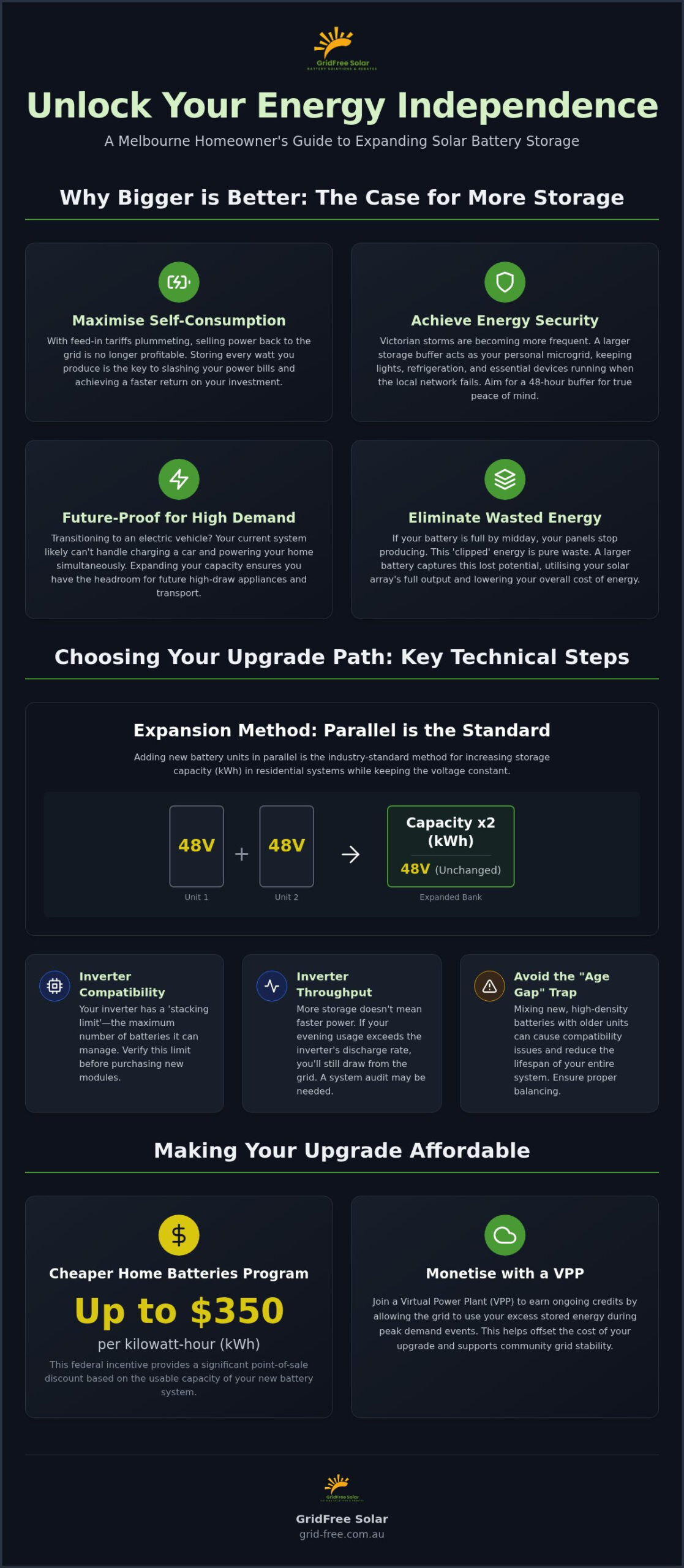
Expanding your storage isn’t a simple “plug and play” exercise. It requires precise technical alignment. To increase solar battery storage capacity, you must first determine if your current architecture supports additional modules. Most Melbourne residential systems utilise parallel expansion. This method adds kilowatt-hours (kWh) without altering the system voltage. It is the most reliable path for standard 48V setups. You aren’t just adding a battery. You are expanding a reservoir.
Parallel Expansion vs. Series Strings
Parallel wiring is the industry standard for capacity growth. It allows multiple battery units to work together as a single, larger pool of energy. Series strings, by contrast, increase the voltage. This is typically reserved for specialised high-voltage DC systems. If you are adding to a standard lithium bank, parallel is your go-to. Safety is paramount here. You must ensure correct fusing and circuit protection for the expanded bank. Without it, you risk thermal runaway or equipment failure. Professional installers will always balance the internal resistance across all units. This prevents one battery from doing all the heavy lifting while others sit idle.
Inverter Compatibility and Throughput Limits
Your inverter is the gatekeeper. Every hybrid inverter has a “stacking” limit. This is the maximum number of battery modules it can communicate with simultaneously. You might have the physical space for four batteries, but if your inverter software only recognises two, the extra capacity is useless. There is also the “bottleneck” effect. Adding more capacity doesn’t automatically mean your house can draw power faster. Your inverter’s discharge rate stays the same. If your peak evening load exceeds the inverter’s throughput, you will still pull from the grid despite having a full battery. If your current hardware is outdated, a professional system audit might be necessary to unlock the full potential of your expansion.
Architecture matters. DC coupling is highly efficient for new installations, but AC coupling often offers a more flexible pathway for retrofitting storage to an existing solar array. The most critical factor is BMS synchronisation. Your new battery must “talk” to your existing units perfectly. If the Battery Management Systems (BMS) are out of sync, the system will default to the lowest common denominator. This leads to uneven wear and reduced lifespan. To increase solar battery storage capacity successfully, every component must operate as a single, cohesive unit. This ensures your investment pays off through years of reliable, grid-independent power.
Expanding Existing Units vs. Full Battery Replacement
Deciding whether to add a new module or scrap your current setup is a high-stakes calculation. The “Age Gap” is your primary enemy. When you increase solar battery storage capacity by adding a brand-new unit to a five-year-old bank, you create a technical imbalance. Lithium cells degrade at different rates. Your system’s software will often throttle the new, high-performance battery to match the reduced capacity of the aging one. You end up paying for performance you can’t actually use.
Warranty alignment is another hurdle. Adding a third-party module to an existing stack can frequently void your original manufacturer’s coverage. It is a risk many Melbourne homeowners overlook until a fault occurs. To avoid this, always stick to the same brand and generation if your system is relatively young. However, if your current battery is approaching its cycle limit, the logic shifts toward a clean break. Modern energy density has improved so rapidly that you can now fit triple the storage in the same physical footprint as a 2018-era unit.
When Expansion Makes Sense
Expansion is the logical choice if your system is less than three years old. Systems with modular architecture, like a BYD Premium stack, are designed for this specific purpose. Adding a single 5kWh module to a three-year-old system is a cost-effective way to increase solar battery storage capacity without the overhead of a full overhaul. It is a surgical upgrade. You gain the extra headroom needed for a new pool pump or an additional air conditioner while keeping your initial investment intact. If your inverter is already “VPP-ready,” a simple module addition is often all you need to start trading energy.
The Case for a Modern LiFePO4 Replacement
Legacy lithium-ion batteries typically offer around 2,000 cycles. Modern Lithium Iron Phosphate (LiFePO4) chemistry has pushed that to 6,000 cycles or more. It is a generational leap in longevity. LiFePO4 is also significantly safer during Melbourne’s extreme summer heatwaves. The risk of thermal runaway is drastically lower compared to older chemistries. If your current system is failing to make it through the night, a full replacement with LiFePO4 technology provides a fresh ten-year warranty and superior reliability. When you upgrade, don’t just bin the old unit. Victoria has established recycling pathways to ensure old lithium cells are processed responsibly, keeping hazardous materials out of our landfill.
Financial Incentives: Victorian Rebates and VPPs in 2026
The financial landscape for Melbourne energy storage has shifted dramatically in 2026. Financing an upgrade is no longer just about calculating out-of-pocket costs. It is about timing. The Victorian Solar Homes program underwent a significant change on 1 July 2026, with the combined household taxable income cap reduced to $150,000. If your household sits above this threshold, the window for certain state-based incentives has closed. However, for those under the cap with a property value below $3 million, the opportunity to increase solar battery storage capacity remains highly subsidised.
The primary driver for expansion in 2026 is the federal Cheaper Home Batteries Program. This initiative provides a substantial point-of-sale discount ranging from $252 to $350 per kilowatt-hour of usable capacity. For a standard 10kWh expansion, this can slash your upfront costs by over $2,500. When combined with Small-scale Technology Certificates (STCs), which still offer an upfront discount of approximately $1,400 for a typical 6.6kW system, the business case for a larger reservoir is undeniable. You aren’t just buying hardware. You are purchasing a hedge against rising retail tariffs.
Navigating the Solar Victoria Application
Claiming your subsidy requires precision. Solar Victoria mandates that all installations be performed by an authorised retailer using approved products to remain eligible. You will need your recent council rates notice and proof of income for all owners listed on the property title. Because the state-based interest-free battery loan program is now closed, most Melbourne residents are pivoting to the federal discount scheme for their storage growth. For a detailed breakdown of the current paperwork requirements, consult our Victorian Battery Rebate Guide. Professional guidance is essential here. One clerical error can delay your approval by months, potentially missing the current rebate cycle.
Virtual Power Plants: The ROI Multiplier
A Virtual Power Plant (VPP) turns your “excess” capacity into a revenue stream. Providers like Amber or the Tesla Energy Plan now offer sophisticated Melbourne-based programs that pay you to support the grid during peak events. By choosing to increase solar battery storage capacity, you gain the headroom needed to participate without draining your own household reserves. Some VPPs offer credits as high as $1/kWh for exports during critical grid stress. This participation can reduce your system’s payback period by several years. It transforms your battery from a passive storage unit into an active financial asset that trades energy when prices are at their peak. If you are ready to stop paying for peak-hour power, we can help you claim your 2026 battery rebate and start your upgrade today.
The GridFree Approach: Professional Battery Upgrades
GridFree Solar doesn’t believe in guesswork. We treat every storage expansion as a precision engineering project. To effectively increase solar battery storage capacity, we begin with a comprehensive system audit. This isn’t a simple glance at your inverter. We map your household’s actual load profile to identify exactly when and where your energy is being consumed. By understanding your peak draw times, we can recommend a capacity that doesn’t just look good on paper but actually delivers a zero-bill result based on your specific consumption habits.
Design is the next pillar. We select the specific chemistry and module size that aligns with your existing inverter’s throughput. Our focus remains on high-reliability LiFePO4 upgrades. These units offer the thermal stability required for Melbourne’s volatile climate. During the physical swap or expansion, we prioritise a seamless installation process. We know you can’t afford to have your home offline. Our team organises the transition to minimise downtime, ensuring your new reservoir is charging before the next sunset. Post-install, we provide active monitoring. We track your new capacity to ensure every cell is balancing correctly and delivering the promised ROI.
Melbourne-Specific Grid Compliance
Safety in the Victorian market isn’t optional. Every expansion we perform adheres to the rigorous standards set by local distributors like United Energy, CitiPower, and Powercor. Navigating these grid compliance rules is complex. It requires a deep understanding of current AS/NZS 4777.2 requirements and the specific export limits of your local network. We only employ CEC-accredited installers. This guarantees your system remains safe, legal, and fully covered by your home insurance policy. If you’re unsure whether your aging hardware can handle an upgrade, check our guide on Solar Battery Replacement Melbourne for a clear diagnostic checklist.
Commercial and Industrial Scaling
Melbourne businesses face a unique challenge with peak demand charges. For commercial sites, we don’t just add batteries; we deploy strategic energy buffers. GridFree Solar specialises in large-scale storage that allows businesses to “peak shave” during high-tariff periods. By choosing to increase solar battery storage capacity at a commercial level, you can slash thousands from your quarterly overheads. We handle the complex logistics of industrial retrofitting, from site-specific fire safety engineering to high-voltage grid integration. Explore our specialised Commercial Solar Installation Melbourne services to see how we future-proof local enterprises against the 2026 energy market.
Take Control of Your Energy Future Today
The window to secure total grid independence is narrowing as Melbourne’s energy landscape evolves. Transitioning from a supplemental system to a full-scale microgrid is no longer a luxury; it’s a financial necessity. By choosing to increase solar battery storage capacity, you protect your household from volatile peak rates and ensure your infrastructure is ready for the high demands of EV charging. Whether you’re retrofitting a modular unit or performing a full LiFePO4 replacement, technical precision and rebate timing are the keys to long-term success.
Don’t leave your energy security to chance or complex paperwork. As a Victorian Government Authorised Provider and CEC Accredited Installers, we take the complexity out of the technical process. We are specialists in 2026 rebate claims, ensuring you capture every available federal and state incentive before the cycles reset. Upgrade your Melbourne solar storage with GridFree Solar today and experience the confidence of a home that never goes dark. Your path to near-zero power bills starts with a single, intelligent upgrade.
Frequently Asked Questions
Can I add a different brand of battery to my existing solar system?
Mixing different battery brands within the same DC-coupled stack is generally not possible due to communication conflicts between different Battery Management Systems (BMS). However, you can add a different brand by using an AC-coupled architecture. This involves installing a separate battery inverter that works alongside your existing solar setup. It is a reliable way to increase solar battery storage capacity without being locked into your original manufacturer’s ecosystem.
How much extra storage capacity do I actually need for a Melbourne home?
A typical Melbourne household consuming 15-20kWh per day usually finds that a 10kWh to 13.5kWh battery provides the best balance for overnight independence. If you are preparing for an electric vehicle or have high winter heating demands, expanding toward 20kWh is advisable. The goal is to have enough “buffer” to last from sunset until the panels begin generating again the following morning, even on overcast Victorian days.
Will adding more batteries void my current solar panel warranty?
No, expanding your storage capacity does not impact the performance or warranty of your solar panels. Your panels and batteries operate on different stages of the system. However, the warranty on your existing hybrid inverter could be affected if the expansion exceeds its rated input limits or if the work is performed by unaccredited technicians. Always ensure a specialist verifies the “stacking” compatibility of your hardware before proceeding with an upgrade.
Does the Victorian battery rebate cover expanding an existing system?
The federal Cheaper Home Batteries Program, which is the primary incentive for Melbourne residents in 2026, specifically supports the installation of new storage capacity. This includes adding modules to an existing system to increase solar battery storage capacity. While the older state-based loan program has concluded, this federal point-of-sale discount significantly reduces the upfront cost of expansion. Eligibility is assessed based on your household income and the specific technology being installed.
What happens if my inverter isn’t compatible with newer battery models?
If your older inverter cannot communicate with modern LiFePO4 modules, you don’t necessarily need to scrap your entire system. We often recommend an “AC-retrofit” where the new battery comes with its own dedicated inverter. This allows your old solar inverter to continue managing the panels while the new unit handles the storage. It is a cost-effective way to modernise your home’s energy reservoir without a total hardware overhaul.
How long does it take to install additional battery storage?
Most battery expansions are completed within a single day, typically taking between four and six hours. The process involves mounting the new units, upgrading the switchboard protection if necessary, and configuring the software to recognise the additional kWh. We schedule these installations to ensure your system is back online and charging well before the evening peak, minimising any reliance on the grid during the transition period.
Is it better to have one large battery or several smaller ones in parallel?
Modular systems using several smaller units in parallel offer far better redundancy and flexibility. If a single large battery fails, your entire storage capability is lost until a repair occurs. With a parallel modular setup, the remaining units can continue to power your home even if one module requires maintenance. This architecture also allows you to scale your storage gradually as your household energy needs grow over time.
Can I increase my storage capacity myself or do I need an electrician?
You must engage a licensed electrician who is also a CEC-accredited battery installer. In Victoria, DIY battery installation is strictly prohibited and highly dangerous due to the risk of DC arcing and thermal runaway. Furthermore, Energy Safe Victoria requires a Certificate of Electrical Safety (COES) for all storage work. Attempting a self-install will void your insurance and disqualify you from any grid-connection agreements with distributors like United Energy or CitiPower.