
Table of Contents
- What Solar Battery Monitoring Systems Do
- Solar Battery Monitoring App Features That Matter
- How to Track Solar Battery Performance in Real Time
- Optimising Solar Self-Consumption With Smart Monitoring
- Top Solar Battery Monitoring Systems Compared
- 1. GridFree Solar, Best for Comprehensive Support and Australian Compliance
- 2. Tesla Powerwall 3, Best for Premium All-in-One Integration
- 3. Sungrow SBR Battery, Best for Cost-Effective Modular Expansion
- 4. GoodWe Lynx Home Battery, Best for Mid-Range Flexibility
- 5. AlphaESS SMILE5, Best for Affordable All-in-One Entry
- 6. BYD Battery-Box Premium HVS/HVM, Best for Inverter Flexibility
- 7. LG Chem RESU, Best for High Energy Density and Broad Compatibility
- 8. Redback Smart Hybrid System, Best for Australian Design and Integrated Backup
- 9. Fronius Reserva Battery, Best for Fronius Ecosystems and DC Coupling Efficiency
- Integration, Compatibility, and Long-Term Management
- Frequently Asked Questions
Last Updated: September 2, 2026
What Solar Battery Monitoring Systems Do
A solar battery monitoring system tracks energy storage, consumption, and grid interaction in real time through software and hardware. It measures state of charge, power flow, and energy yield, giving you visibility into what’s happening with your energy now.
Most systems display data via mobile dashboard or web portal, showing solar generation, battery capacity, consumption, and grid export. Advanced platforms offer energy arbitrage, load shedding automation, and tariff optimisation. GridFree Solar integrates monitoring seamlessly with installation, ensuring compliance with AS/NZS 5139:2019 and AS/NZS 3000 standards.
Without proper monitoring, you won’t know if your battery is degrading, whether your system operates efficiently, or when firmware updates are available. Real-time telemetry transforms a static battery into an active energy management tool.
Solar Battery Monitoring App Features That Matter
Real-time power flow visualisation is essential. Colour-coded diagrams showing watts flowing from solar array, battery, and home let you understand energy movement instantly.
State of charge and battery health metrics must be prominent. Your app should display current battery percentage, remaining capacity, and cycle life data to spot problems before they become expensive.
Historical data logging and export separates casual monitoring from serious management. You need 12 months of granular data at 5-minute intervals to identify seasonal patterns and optimise tariff strategies. CSV or JSON export lets you analyse data externally.
Push notifications and alerts keep you informed without constant checking. Customisable alerts for low battery, high consumption, system faults, and firmware updates prevent surprises.
Mobile dashboard responsiveness affects daily usability. Sub-30-second update intervals provide near-real-time data for peak shaving opportunities.
Integration with third-party services extends functionality. Smart home connections enable automated load shedding; tariff database integration calculates optimal export times.
| Feature | Why It Matters | What to Look For |
|---|---|---|
| Real-time power flow visualisation | Understand energy movement instantly | Colour-coded diagrams, tap-to-drill functionality |
| State of charge and battery health | Track degradation and lifespan | Voltage monitoring, cycle counting, capacity trends |
| Historical data logging | Analyse patterns and validate savings | 12-month data retention, CSV export, 5-minute intervals |
| Push notifications | Stay informed without constant checking | Customisable thresholds, fault alerts, firmware notifications |
| Mobile dashboard responsiveness | Daily usability and engagement | Fast load times, sub-30-second update intervals |
| Third-party integrations | Extend automation and control | Smart home compatibility, tariff integration, inverter support |
How to Track Solar Battery Performance in Real Time
Real-time tracking requires three components: hardware sensors, inverter communication, and cloud connectivity.
Your inverter is the primary data source, measuring voltage, current, frequency, and power. Modern hybrid inverters from Sungrow, GoodWe, and Fronius have built-in Ethernet or Wi-Fi connectivity, transmitting data every 5-30 seconds. Battery management systems (BMS) add a second layer, tracking cell voltages, temperatures, and charge cycles.

Setting up real-time monitoring involves five steps:
-
Verify inverter connectivity. Check that your inverter has Wi-Fi or Ethernet enabled and confirm cloud connectivity is active.
-
Create a manufacturer account. Register on the inverter manufacturer’s platform (Sungrow iSolarCloud, GoodWe SmartOS, Tesla app, or Fronius Solar.web) with a strong password and two-factor authentication.
-
Verify data transmission. Log in to the manufacturer’s app and wait 5 minutes. Live power data confirms transmission is working.
-
Configure alerts and thresholds. Set notifications for low battery, high consumption, export windows, and firmware updates. Avoid alert fatigue by disabling trivial notifications.
-
Test export functionality. Verify that export data is being logged. Knowing your export volumes is critical for tariff optimisation.
Remote diagnostics become possible once monitoring is active. Your installer or manufacturer can identify firmware issues, configuration problems, or hardware faults without visiting your home. GridFree Solar’s CEC Accredited Installers monitor systems continuously and alert you to problems before they escalate.
Optimising Solar Self-Consumption With Smart Monitoring
Self-consumption is the percentage of solar energy you use on-site rather than exporting. Smart monitoring enables three optimisation strategies.
Load shifting moves consumption to peak solar hours (typically 10 a.m. to 2 p.m.). Run dishwashers, washing machines, and pool pumps during these windows. Some systems automate this with smart relays; manual shifting requires discipline but costs nothing.
Peak shaving reduces consumption during expensive grid hours. Most Australian time-of-use tariffs charge premium rates between 3 p.m. and 9 p.m. If your battery is charged, you can power your home from storage instead of the grid. Advanced systems automate peak shaving by reserving battery capacity for peak hours.
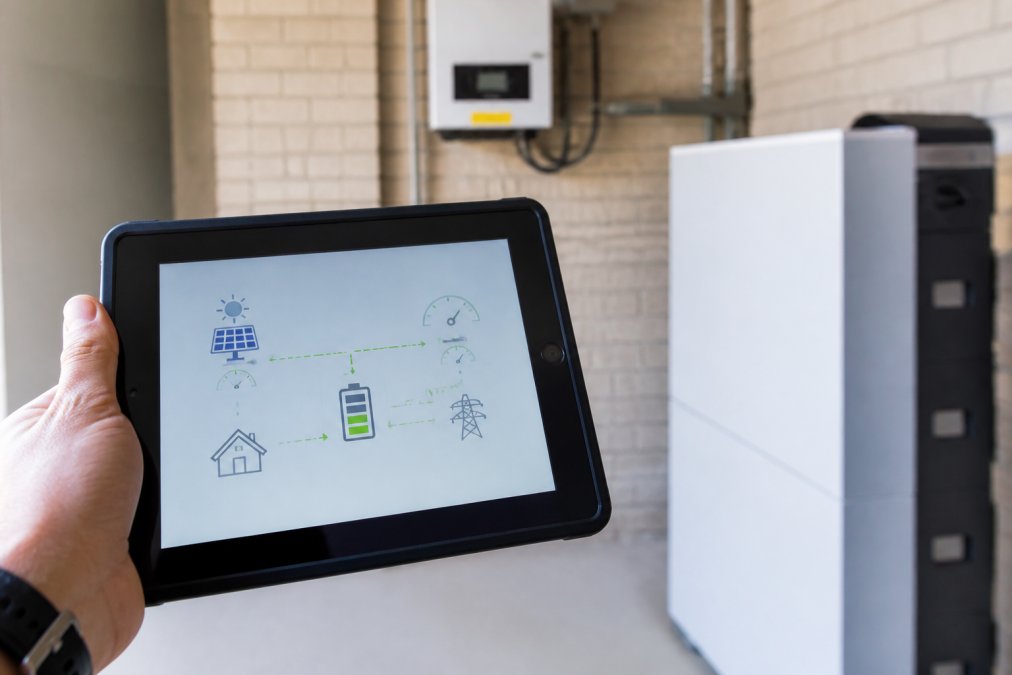
Grid export optimisation captures premium rates during specific windows, often 6 p.m. to 8 p.m. when demand peaks. If your battery is charged by 6 p.m., you can export stored solar energy at premium rates. GridFree Solar’s monitoring systems track export windows and alert you when conditions are optimal.
A monitoring system displaying your tariff schedule is essential. Many Australian retailers now publish half-hourly tariffs; advanced platforms integrate these directly into dashboards. Firmware updates also affect self-consumption, improving efficiency by 2-3%, translating to hundreds of dollars annually on a 10 kWh battery (peer-reviewed research).
Top Solar Battery Monitoring Systems Compared
1. GridFree Solar, Best for Comprehensive Support and Australian Compliance
GridFree Solar combines monitoring software with professional installation, rebate guidance, and ongoing maintenance. The platform integrates with leading battery brands, Tesla Powerwall 3, Sungrow SBR, GoodWe Lynx, ensuring hardware compatibility across the market.
GridFree Solar’s monitoring dashboard displays real-time power flow, battery health, state of charge, and historical energy yield. Post-installation support distinguishes it: your installer monitors your system continuously, alerts you to firmware updates, and troubleshoots remotely. The platform integrates export tariff data, helping you optimise grid export timing and track financial returns.
Pros: CEC Approved Battery and Accredited Installer credentials; expert rebate guidance; compliance with AS/NZS 5139:2019 and AS/NZS 3000; comprehensive battery upgrade services; post-installation support.
Cons: Requires professional installation; pricing depends on system size.
2. Tesla Powerwall 3, Best for Premium All-in-One Integration
The Tesla Powerwall 3 bundles battery, inverter, and monitoring into one 13.5 kWh unit. The Tesla app provides real-time monitoring, backup control, and grid export management. It excels at blackout protection, transitioning to battery backup in milliseconds.
Installation typically runs A$14,850-A$17,000 before rebates. The Powerwall 3 requires a Tesla Backup Gateway unit for full functionality, adding cost.
Pros: High power output (11.04 kW continuous AC); excellent brand reputation; integrated inverter; outstanding blackout protection.
Cons: Higher upfront cost; requires compulsory Backup Gateway unit; limited interoperability with non-Tesla components.
3. Sungrow SBR Battery, Best for Cost-Effective Modular Expansion
The Sungrow SBR series delivers modular energy storage from 6.4 kWh to 25.6 kWh using LiFePO4 technology with 100% usable capacity. At approximately A$7,500-A$10,500 installed (after federal rebate for 9.6 kWh), it’s competitive on price per kilowatt-hour. campervan battery management.
The modular design allows expansion as energy needs grow. Sungrow’s iSolarCloud monitoring displays real-time power flow, battery health, and historical data. It integrates exclusively with Sungrow SH-series hybrid inverters.
Pros: Excellent value per usable kWh; modular design; 100% usable energy; strong 10-year warranty; LiFePO4 safety.
Cons: Requires compatible Sungrow inverter; limited non-Sungrow compatibility; blackout backup requires additional configuration.
4. GoodWe Lynx Home Battery, Best for Mid-Range Flexibility
The GoodWe Lynx Home Battery offers modular capacity from 5.4 kWh to 32.4 kWh using LiFePO4 technology. At approximately A$7,500-A$10,000 installed (after federal rebate for 10.8 kWh), it’s positioned between budget and premium options.
The Lynx series integrates with GoodWe ES, EM, and SBP inverters. GoodWe’s SmartOS monitoring is user-friendly. The 10-year warranty with 70% capacity retention is competitive.
Pros: Competitive pricing per kWh; modular design; strong reputation; user-friendly monitoring; 10-year warranty.
Cons: Requires compatible GoodWe inverter; lower brand recognition; limited non-GoodWe compatibility.
5. AlphaESS SMILE5, Best for Affordable All-in-One Entry
The AlphaESS SMILE5 integrates a 5 kW hybrid inverter with modular battery capacity (typically 13.3 kWh, expandable to 80 kWh). At approximately A$5,000-A$13,000 installed, it’s an affordable entry point.
The integrated inverter simplifies installation. The AlphaCloud app provides 24/7 monitoring. UPS-grade backup protects essential circuits during outages.
Pros: Cost-effective entry point; integrated inverter; modular design; UPS-grade backup; 24/7 monitoring.
Cons: 5-year warranty is shorter than competitors; lower brand recognition.
6. BYD Battery-Box Premium HVS/HVM, Best for Inverter Flexibility
The BYD Battery-Box Premium series offers modular stacking from 5.1 kWh to 32.0 kWh using LFP technology. At approximately A$8,100-A$12,100 installed (after federal rebate for 16.6 kWh HVM), it’s mid-range on pricing.
BYD’s strength is compatibility with most major hybrid inverters, Sungrow, GoodWe, Fronius, and others. This flexibility avoids vendor lock-in. The 10-year warranty and IP55 protection for indoor/outdoor installation are standard.
Pros: High compatibility with various inverters; lower price per kWh; modular design; 10-year warranty; IP55 protection.
Cons: Requires separate hybrid inverter; blackout backup may need additional UPS box.
7. LG Chem RESU, Best for High Energy Density and Broad Compatibility
LG Chem RESU batteries range from 3.3 kWh to 16 kWh using Li-NMC chemistry. At approximately A$3,240 for a 6.5 kWh unit (battery only), they’re among the most compact options.
LG’s strength is energy density. Li-NMC chemistry packs more energy into smaller space than LiFePO4. RESU batteries are compatible with many inverter brands, Solis, Sungrow, GoodWe, SMA. The 10-year warranty is competitive.
Pros: Excellent energy density and compact design; broad inverter compatibility; strong brand reputation; 10-year warranty; high efficiency.
Cons: Slightly higher price per kWh than LiFePO4; some models require separate combiner box.
8. Redback Smart Hybrid System, Best for Australian Design and Integrated Backup
The Redback Smart Hybrid System is Australian-designed and manufactured, combining inverter and battery storage with modular capacity from 4.6 kWh to 28.4 kWh. The integrated backup circuit with UPS feature protects against blackouts without additional hardware.
Redback’s strength is local support and design for Australian conditions. The IP65 rating handles harsh climates. The Redback Portal and MyRedback app provide real-time monitoring and smart load control.
Pros: Australian-designed and supported; all-in-one unit; integrated backup and UPS; smart load control; IP65 rating.
Cons: 5-year battery warranty is shorter; requires good LAN or Wi-Fi connection.
9. Fronius Reserva Battery, Best for Fronius Ecosystems and DC Coupling Efficiency
The Fronius Reserva Battery is modular LFP storage starting from 6.3 kWh, designed to DC couple with Fronius GEN24 and Verto Plus inverters. At approximately A$5,891.60 for a 6.3 kWh unit (battery only), it’s competitively priced for Fronius users.
DC coupling delivers 2-3% better round-trip efficiency than AC coupling (peer-reviewed research). The integrated BMS handles cell balancing and safety. Fronius Reserva only works with Fronius GEN24 and Verto Plus inverters.
Pros: High efficiency due to DC coupling; modular and scalable; strong brand reputation; integrated BMS.
Cons: Requires compatible Fronius inverter; limited non-Fronius compatibility.
Integration, Compatibility, and Long-Term Management
Choosing a monitoring system shapes your system’s evolution. Hardware compatibility matters: a system working with only one inverter brand locks you into that ecosystem. Multi-brand compatible systems give you flexibility for future upgrades.
Firmware update management is critical. Inverters and batteries receive regular updates improving efficiency, fixing vulnerabilities, and adding features. A monitoring system alerting you to available updates ensures you stay current.
Remote diagnostics become increasingly valuable over time. GridFree Solar’s CEC Accredited Installers view your system remotely and identify problems before they escalate. Battery degradation tracking helps you understand capacity loss patterns and plan replacements. Ensure your system retains at least 12 months of granular (5-minute interval) data.
Cloud connectivity reliability affects daily usability. Some systems offer local network monitoring as fallback; others rely entirely on cloud. Test your home network stability before committing to cloud-only systems.
| Management Task | Why It Matters | What to Look For |
|---|---|---|
| Hardware compatibility | Flexibility for future upgrades | Multi-brand support, open standards, documented APIs |
| Firmware update management | Efficiency gains, security fixes, new features | Automated updates, release notes, testing environment |
| Remote diagnostics | Proactive problem identification | Installer access, remote monitoring, alert systems |
| Battery degradation tracking | Plan replacements before failure | Voltage monitoring, cycle counting, capacity trends |
| Data retention | Analyse patterns and validate savings | 12-month minimum, granular intervals, export functionality |
| Cloud connectivity reliability | Consistent access and visibility | Local network fallback, redundant connections, uptime guarantees |
Selecting the right solar battery monitoring system requires balancing features, compatibility, and long-term support. GridFree Solar’s comprehensive approach, combining professional installation, CEC-accredited expertise, and ongoing monitoring support, ensures your system operates at peak efficiency for decades. Whether you choose an all-in-one solution like Tesla Powerwall 3 or a modular system like Sungrow SBR, prioritise monitoring platforms offering real-time data, historical analytics, and tariff integration. The monitoring system you choose today shapes how effectively you optimise self-consumption, capture export revenue, and maintain battery health for years to come. Connect with GridFree Solar to design a monitoring system tailored to your home’s energy profile and Australian rebate eligibility.
Frequently Asked Questions
What features should I look for in a solar battery monitoring app?
Look for real-time telemetry showing state of charge, depth of discharge, and energy consumption across your home. The best apps display power flow direction (grid import, solar generation, battery discharge), push notifications for system issues, and historical data logging for trend analysis. Mobile dashboard access via Wi-Fi or cloud connectivity lets you monitor remotely. Ensure the app shows voltage monitoring, system uptime, and firmware update notifications. Advanced options include tariff optimisation features and load shedding controls for peak shaving during high-cost periods.
How does real-time monitoring help reduce my electricity bills?
Real-time monitoring reveals when you’re drawing from the grid versus using stored solar energy. By tracking state of charge and energy consumption patterns, you can shift high-load activities (laundry, heating) to peak solar generation hours to maximise self-consumption. Some systems enable grid export features where you sell excess power back during high-tariff periods, earning 15¢ per kilowatt-hour or more. Monitoring also identifies inefficiencies and hardware compatibility issues that drain battery health, protecting your cycle life and long-term investment value.
Are solar battery monitoring systems compatible with all inverter brands?
Most modern solar battery monitoring systems work with major inverter brands through standard inverter communication protocols, but compatibility varies. Some systems like Tesla Powerwall require their own inverter, while modular batteries from Sungrow, GoodWe, and BYD work across multiple inverter ecosystems. LG Chem RESU and Fronius Reserva offer broad compatibility. Before purchasing, verify that your chosen battery’s inverter communication standard matches your existing or planned inverter. GridFree Solar can assess your specific setup and recommend systems that integrate seamlessly without additional hardware.
Do I need Wi-Fi for solar battery monitoring to work?
Wi-Fi or Ethernet connectivity is essential for cloud-based monitoring and push notifications, but the battery itself operates independently without internet. Local system functions like charging, discharging, and backup power work during outages. However, you lose remote diagnostics and real-time telemetry access without connectivity. Most systems support both Wi-Fi and wired Ethernet options. Some offer 4G backup connectivity. A stable connection ensures you can track energy yield, monitor battery health, receive firmware updates, and optimise self-consumption from anywhere.
Which solar battery monitoring system is best for Australian homes?
The best system depends on your inverter choice, budget, and monitoring priorities. Tesla Powerwall 3 offers premium integration and backup capability. Sungrow SBR and GoodWe Lynx provide excellent value and modular scalability. AlphaESS SMILE5 suits budget-conscious buyers seeking all-in-one simplicity. BYD Battery-Box Premium maximises inverter flexibility. Redback Smart Hybrid is purpose-built for Australian conditions with integrated backup. GridFree Solar’s CEC-accredited installers assess your roof orientation, shading, consumption patterns, and grid tariffs to recommend the right monitoring system that maximises your savings and energy independence goals.
This article was written using GrandRanker