

Table of Contents
- What Is CEC Accreditation and Why It Matters
- How to Verify a Solar Installer’s CEC Accreditation Status
- Key Questions to Ask Solar Installers
- Checking STC Rebate Eligibility and Compliance
- Solar Quote Comparison Tips
- Red Flags to Watch Out For
- Post-Installation Verification and Support
- Frequently Asked Questions
Last Updated: August 22, 2026
What Is CEC Accreditation and Why It Matters
CEC accreditation refers to certification granted by the Clean Energy Council, Australia’s peak body for the renewable energy industry. An accredited installer has demonstrated technical competency, compliance with installation standards, and commitment to industry codes of conduct. Your solar system’s safety, performance, and eligibility for government rebates depend entirely on who installs it.
A non-accredited installer might cut corners on electrical compliance, roof safety, or system design, issues that surface as fire hazards, voided warranties, ineligible STC rebates, or underperforming systems. Accreditation is the baseline protection separating legitimate installers from operators who skip critical steps to save money.
The difference between accredited and unaccredited work shows up in three ways: safety compliance with AS/NZS 3000 and AS/NZS 5139:2019 standards, system design tailored to your site conditions, and access to Small-scale Renewable Energy Scheme (STC) rebates that reduce upfront costs significantly. Without accreditation, your installer cannot legally claim those rebates on your behalf, and your system won’t meet grid connection requirements.
An accredited installer carries liability insurance, completes ongoing training, and follows a published code of conduct. If something goes wrong, you have a clear path to recourse. With an unaccredited operator, you’re left holding the risk.
How to Verify a Solar Installer’s CEC Accreditation Status
The most direct way to verify accreditation is to check the CEC register yourself. Don’t rely on what an installer tells you, confirm it independently using the official database.
Check the CEC Register
Visit the Clean Energy Council’s online register at cleanenergycouncil.org.au. Search for the installer’s business name or technician’s name. The register displays current accreditation status, accreditation categories, expiry date, and any disciplinary history.
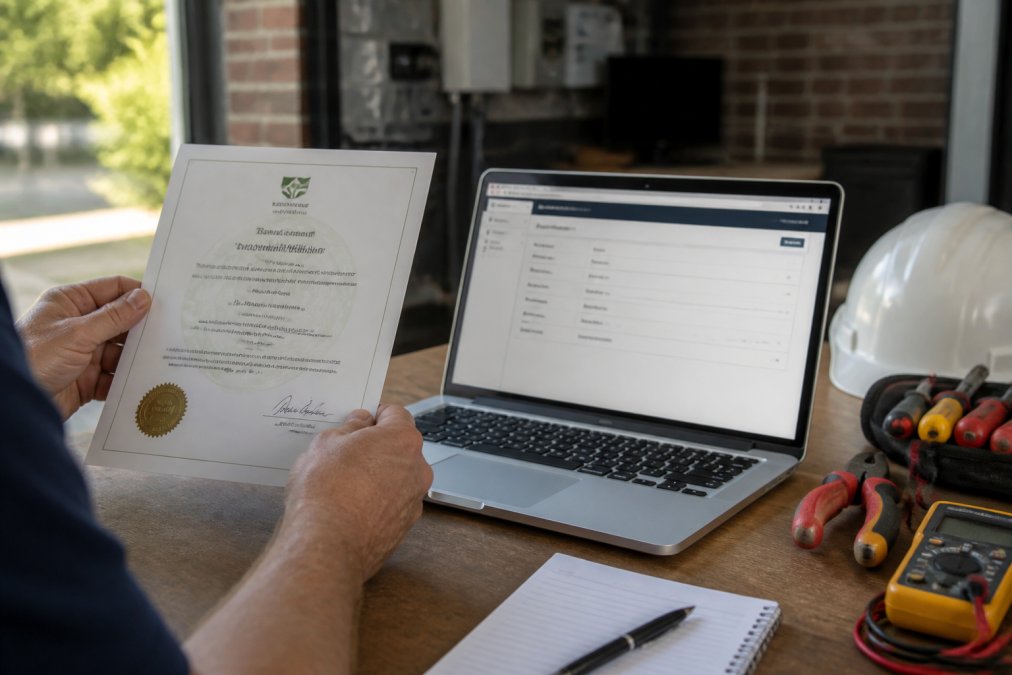
A legitimate accredited installer will provide their accreditation number without hesitation. If they seem evasive or claim “the system is down,” that’s a red flag. The register updates in real time and is accessible to anyone.
Check the expiry date carefully. An accreditation that expired six months ago is no longer valid. Accreditation requires annual renewal and ongoing professional development. Some installers hold multiple accreditations, design, installation, and battery storage, for example. Verify that the specific service you’re contracting for matches their current accreditation.
Request Proof of Accreditation
Ask the installer for a copy of their current accreditation certificate before signing any contract. This should be a document issued by the Clean Energy Council showing their accreditation number, scope, and expiry date. A professional installer will provide this without hesitation.
Request references from previous installations. Ask those customers whether the installer provided a copy of their accreditation upfront. If the installer is part of a larger company, verify that the individual technician assigned to your project holds their own accreditation.
Key Questions to Ask Solar Installers
Before committing to any installer, ask these questions. The answers reveal whether they understand your site, your needs, and industry standards.
“How will you design this system for my specific roof and shading conditions?” A quality installer conducts a detailed site assessment, checking roof orientation, pitch, shading patterns, structural capacity, and electrical service. They won’t give you a quote based on a postcode and a phone call.
“What standards will this installation comply with?” The answer should reference AS/NZS 3000 (electrical safety) and AS/NZS 5139:2019 (battery storage systems) (standards.org.au). Vague responses suggest they may not understand specific regulatory requirements.
“Will you help me claim STCs and other government rebates?” A knowledgeable installer guides you through the Small-scale Renewable Energy Scheme rebate process, explains your system’s STC eligibility, and handles the paperwork.
“What warranty covers the installation work, and for how long?” Accredited installers typically offer a workmanship warranty of 5-10 years covering defects in installation, not equipment failure. Get warranty terms in writing.
“How will you connect my system to the grid, and what approvals are required?” Grid connection involves your local network operator and may require permits. The installer should explain timelines and costs upfront.
“Will you monitor my system after installation?” Ask whether they provide remote monitoring, how you’ll report issues, and what response times to expect.
Checking STC Rebate Eligibility and Compliance
The Small-scale Renewable Energy Scheme (STC) rebate is the main government incentive for residential solar. Your system’s eligibility depends entirely on using an accredited installer and compliant equipment.
Only CEC accredited installers can create STCs on your behalf. If you hire an unaccredited installer, you forfeit thousands of dollars in rebates. The Clean Energy Regulator cross-checks every STC claim against the CEC register, rejecting claims from non-accredited installers (cleanenergyregulator.gov.au).
Your installer should explain how many STCs your system qualifies for based on capacity and location. They’ll either pass the STC value to you as an upfront discount or sell the STCs and credit your account. Get this arrangement in writing.
Compliance means your equipment meets standards. Solar panels and inverters must be on the Clean Energy Regulator’s approved list. Battery storage systems must comply with AS/NZS 5139:2019. An accredited installer knows these requirements and won’t source equipment that fails to meet them.
Before signing, ask your installer to provide a written estimate of your STC rebate value and explain how it will be applied to your quote.
Solar Quote Comparison Tips
Getting multiple quotes is essential, but comparing them requires looking beyond the bottom-line price. Three quotes at different prices might represent entirely different system designs, quality levels, and service commitments.
Compare system specifications, not just cost. One quote might propose a 6.6 kW system with premium panels and a hybrid inverter; another might offer 5 kW with budget panels and a string inverter. These aren’t equivalent. Look at panel wattage, inverter type, warranty terms, and battery capacity. A cheaper quote might mean fewer panels, lower efficiency, or a smaller battery.
Check the STC rebate calculation. A legitimate quote breaks down the STC value separately. If one installer quotes a much lower rebate than others, they may be underestimating your system’s eligibility. The Clean Energy Regulator publishes STC prices quarterly; compare quoted prices against current rates.
Verify accreditation across all quotes. Only compare quotes from accredited installers. An unaccredited quote won’t include STCs, making it incomparable to accredited quotes.
Ask about hidden costs. Some quotes omit council permits, electrical switchboard upgrades, roof repairs, or trenching for battery connections. A detailed quote itemises every cost. If a quote is suspiciously low, ask what’s excluded.
Check warranty coverage. Workmanship warranties vary from 5 to 10 years. Equipment warranties on panels typically run 25 years; inverters 10 years; batteries 10-15 years.
Review the payment schedule. Avoid paying in full before work begins. A standard arrangement is a deposit (20-30%), payment upon completion, and final settlement after grid connection approval.
Red Flags to Watch Out For
Certain warning signs indicate an installer isn’t trustworthy or doesn’t understand industry standards.

Pressure to sign quickly. A legitimate installer gives you time to review quotes and compare options. If someone pushes you to commit immediately, claiming a “limited-time offer,” they’re using high-pressure sales tactics.
Vague or inflated performance claims. An installer who promises your system will “pay for itself in three years” without conducting a site assessment is guessing. Real performance depends on your roof, shading, usage patterns, and local weather.
No mention of accreditation. If you ask about CEC accreditation and the installer downplays it or claims it’s “not necessary,” stop the conversation. Accreditation is non-negotiable.
Unwillingness to provide references. Ask for contact details of three recent customers. If they refuse, that’s suspicious.
Unclear contract terms. Your contract should specify system design, equipment model numbers, installation timeline, payment schedule, warranty terms, and what happens if the system underperforms. Don’t sign vague or jargon-filled contracts.
Cutting corners on site assessment. An installer who quotes your system without visiting your home or reviewing your electricity bills is working blind and likely to design a system that doesn’t suit your needs.
Pressure to upgrade to battery storage you don’t need. Battery storage is valuable but not essential for everyone. It makes sense if you want energy independence, have high peak-rate charges, or experience frequent outages.
No discussion of grid connection requirements. Grid connection can take weeks or months. An installer who doesn’t mention this timeline hasn’t managed many installations.
Post-Installation Verification and Support
Your relationship with the installer doesn’t end on completion day. Proper post-installation verification and ongoing support protect your investment.
After installation, your installer should provide:
- A Certificate of Electrical Safety (CES) confirming the work meets AS/NZS 3000 (aemo.com.au)
- Commissioning documentation showing the system has been tested and is operating correctly
- A copy of the accreditation certificate and warranty documents
- User manuals for the inverter, battery (if applicable), and monitoring app
- Instructions for monitoring system performance and reporting faults
Don’t accept the system as complete until you have these documents. The CES is especially important, it’s proof the electrical work is compliant and is required by your network operator for grid connection.
Grid connection typically takes 4-8 weeks after installation. Your installer should track this process and notify you when approval is received. Once connected, you can export excess solar to the grid and earn credits depending on your retailer’s export rate.
Monitor your system’s performance using the monitoring app provided. Compare actual energy output against the installer’s estimates. If output is significantly lower than predicted, contact the installer to investigate.
Ask your installer about post-installation support. Do they offer remote monitoring? Can you contact them if the system malfunctions? What’s their response time for service calls?
Choosing a CEC accredited installer is the single most important decision in your solar journey. It determines whether your system is safe, compliant, eligible for rebates, and performs as promised. Verify accreditation through the Clean Energy Council register, ask detailed questions about site assessment and compliance, compare quotes carefully across accredited installers only, and watch for red flags that signal inexperience or dishonesty. After installation, confirm you’ve received all documentation and support ongoing performance monitoring. GridFree Solar combines CEC accreditation with expert rebate guidance, compliance with AS/NZS standards, and comprehensive post-installation support to ensure your transition to renewable energy is seamless, safe, and financially rewarding. Connect Now to discuss your solar and battery needs with our accredited specialists.
Frequently Asked Questions
What is the difference between a CEC accredited installer and a solar retailer?
A CEC accredited installer has met the Clean Energy Council’s technical and competency standards and is authorised to install solar systems and claim Small-scale Technology Certificates (STCs) on your behalf. A solar retailer may sell solar products but may not have the same accreditation, technical qualifications, or ability to manage rebate claims. Using an accredited installer ensures compliance with installation standards, warranty protection, and eligibility for government incentives.
How do I verify if a solar installer is CEC accredited?
Visit the Clean Energy Council’s online register and search for the installer by name or accreditation number. Request their accreditation certificate directly and check that it covers solar panel installation and design. Verify the certificate is current and ask about their accredited designer status if they’re handling system design. Always cross-reference the name and number on their quote with the register to confirm legitimacy.
Why is CEC accreditation mandatory for solar rebates?
The Small-scale Renewable Energy Scheme requires CEC accredited installers to design and install systems before you can claim Small-scale Technology Certificates (STCs). Without accreditation, your installer cannot lodge the rebate claim, and you’ll lose access to thousands of dollars in government incentives. This requirement also ensures your system meets safety and performance standards set out in AS/NZS 5139:2019 and AS/NZS 3000.
What should I do if my installer is not CEC accredited?
Do not proceed. An unaccredited installer cannot claim STCs on your behalf, meaning you’ll forfeit government rebates worth thousands. You may also face safety compliance issues, warranty complications, and grid connection delays. Always verify accreditation before signing a contract or paying a deposit. If you’ve already engaged an unaccredited installer, seek a second opinion from an accredited professional before installation begins.
This article was written using GrandRanker