
Table of Contents
- What Is Residential Battery Storage Installation
- Choosing the Right Battery Capacity and System Type
- AS/NZS 5139 Standards and Electrical Safety Compliance
- Finding a CEC Accredited Installer
- Battery Location, Installation Method, and Environmental Factors
- Understanding Solar Battery Installation Costs
- Integration with Your Existing Solar PV System
- Post-installation: Maintenance, Monitoring, and Performance Verification
- Frequently Asked Questions
Last Updated: August 15, 2026
What Is Residential Battery Storage Installation
Residential battery storage installation integrates a battery system into your home’s energy setup to store electricity generated by solar panels or drawn from the grid. This stored energy can be used during peak demand periods, at night, or during grid outages, giving you greater control over energy consumption and costs.
A properly installed battery storage system works alongside your existing solar PV system, maximising self-consumption of solar energy rather than exporting it all back to the grid at lower rates. Battery storage installation requires careful assessment of your home’s energy patterns, proper electrical integration with AS/NZS 5139 compliance, thermal management considerations, and ongoing monitoring. The process demands CEC accreditation and a thorough understanding of how your system will interact with your existing solar setup, inverter, and household load profile.
At GridFree Solar, we approach battery storage installation as a comprehensive energy upgrade, understanding your specific energy needs, designing a system that matches your consumption patterns, ensuring full regulatory compliance, and providing the monitoring and support needed to maximise your investment.
Choosing the Right Battery Capacity and System Type
Selecting the correct battery capacity is critical. An undersized system won’t capture enough solar energy or provide adequate backup power during outages. An oversized system wastes capital on unused capacity. Review your electricity bills from the past 12 months to establish your average daily consumption in kilowatt-hours. Most Australian homes use between 15-25 kWh daily, though this varies significantly based on family size, climate, and appliance efficiency. Your battery capacity should typically cover 50-100% of your daily consumption, depending on your solar generation and grid reliability in your area.
Consider also your peak demand periods. If most consumption occurs in the evening (6-9pm), a smaller battery sized to cover those hours might suffice. If usage is spread throughout the day with significant afternoon consumption, you’ll need larger capacity to capture and store midday solar generation.
Lithium-ion vs. Other Battery Chemistry Options
Lithium-ion chemistry dominates the residential market for good reason. These batteries offer superior depth of discharge (typically 90-95%), meaning you can use almost all the stored energy rather than keeping a reserve. They also deliver higher round-trip efficiency, typically achieving 85-95%.
Lead-acid batteries, while cheaper upfront, suffer from lower depth of discharge (50-60%) and significantly lower efficiency. For most Australian homes, the total cost of ownership strongly favours lithium-ion despite the higher purchase price.
Lithium iron phosphate (LFP) chemistry has emerged as the preferred lithium variant for residential systems. It offers superior safety characteristics, longer cycle life (8,000+ cycles is common), and better thermal stability. GridFree Solar systems use CEC-approved lithium batteries meeting UN38.3 transport safety standards and IEC 62040-1 electrical safety specifications.
Grid-connected vs. Off-grid Systems
Grid-connected (or grid-tied) systems remain the most common choice for Australian residential installations. Your battery stores solar energy during the day, you use that stored energy in the evening, and if your battery depletes, you draw from the grid. This approach eliminates the need for oversized battery capacity and provides unlimited backup power via the grid connection.
Off-grid systems must be sized to handle your entire energy needs independently, including several days of poor solar weather. This requires significantly larger (and more expensive) battery capacity, backup generators, and careful energy management. For most Australian homeowners, grid-connected battery storage installation offers the best balance of cost, reliability, and energy independence.
AS/NZS 5139 Standards and Electrical Safety Compliance
AS/NZS 5139:2019 is the Australian and New Zealand standard for energy storage systems connected to low-voltage installations. Compliance with this standard is a legal requirement for any grid-connected battery storage installation. The standard covers safety, performance, testing, and commissioning requirements to protect both your home and the broader electricity network.
The standard mandates specific electrical safety measures, including proper isolation devices, surge protection, and fault detection systems. Your installer must verify that all components meet required safety specifications and that the entire system prevents dangerous conditions like unintended islanding (where your system continues supplying power to the grid during an outage, potentially endangering line workers).
Compliance requires a Certificate of Electrical Safety (CES) to be issued upon completion of installation. This certificate confirms that a licensed electrician has tested the system and verified it meets all applicable standards. Without this certificate, your system may not be recognised by your energy retailer, you may not be eligible for export payments, and your insurance may not cover damage related to the battery system.
Finding a CEC Accredited Installer
The Clean Energy Council (CEC) accreditation system exists to protect consumers and maintain installation quality across Australia. A CEC accredited installer has demonstrated competency in solar and battery system design, installation, and safety compliance. They’re required to maintain professional development, follow a code of conduct, and carry appropriate insurance.
What CEC Accreditation Means for Your Installation
CEC accreditation signals several important commitments. The installer has completed formal training in renewable energy systems design and installation, is bound by a code of conduct that includes warranty obligations and consumer protection requirements, and their work is backed by CEC’s consumer dispute resolution scheme. Accredited installers are required to maintain their knowledge as standards and technologies evolve.
Verifying Installer Credentials and Safety Records
Before committing to any installer, visit the CEC website and search the accredited installer database directly. Check their accreditation status, any disciplinary history, and the specific areas they’re accredited for. Ask for references from recent installations in your area and call these references to ask about installation quality, timeline adherence, issue resolution, and whether they’d hire the same installer again.
Request proof of insurance, both public liability and professional indemnity. Reputable installers carry this insurance as standard.
Battery Location, Installation Method, and Environmental Factors
Where you place your battery has profound implications for safety, performance, and longevity. The location must provide adequate ventilation, maintain appropriate temperature ranges, protect the system from moisture and physical damage, and allow safe access for maintenance and monitoring.
Most residential batteries generate some heat during charging and discharging cycles. Poor ventilation can cause thermal buildup, reducing efficiency and battery lifespan. The ideal installation location maintains ambient temperatures between 15-25°C and allows free air circulation around the unit.
Wall-mounted vs. Floor-standing Units
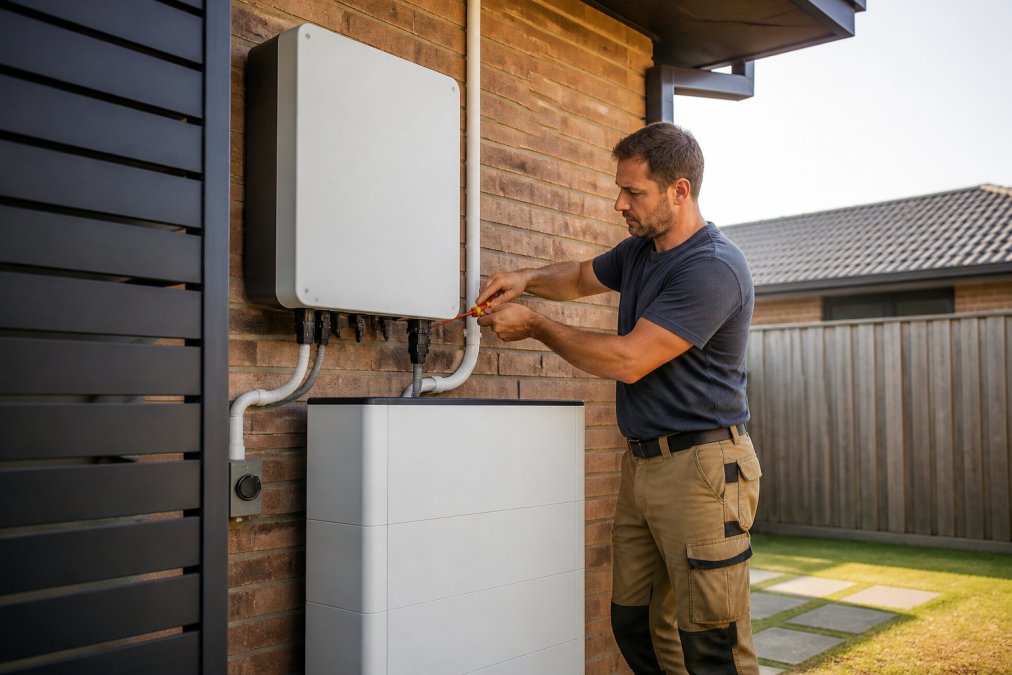
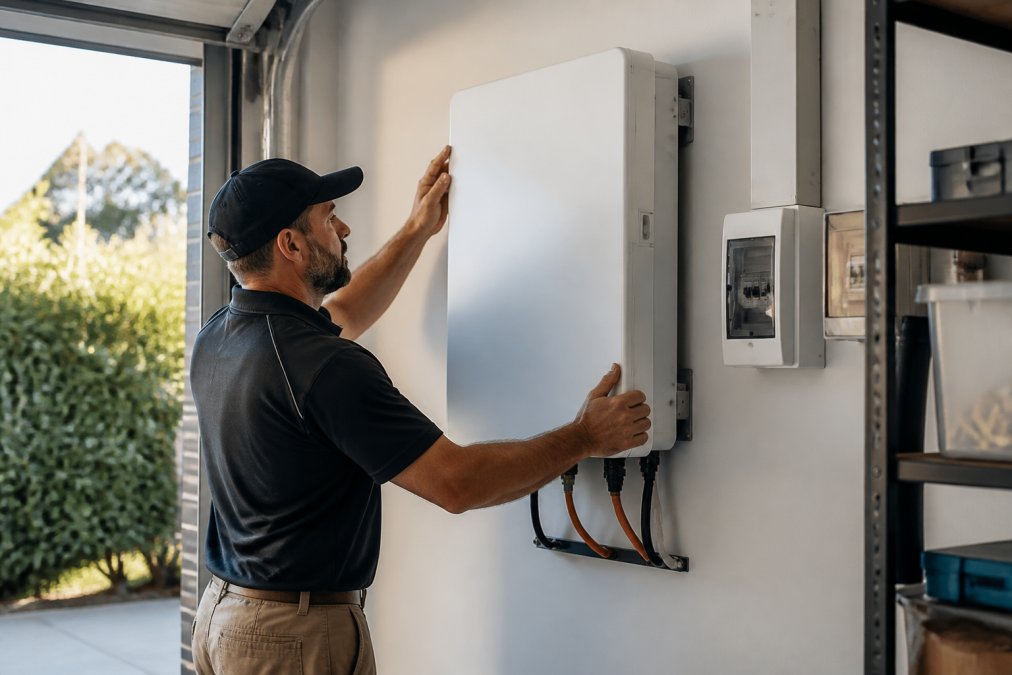
Wall-mounted battery units save floor space and are often aesthetically preferable. They’re typically lighter (under 100kg) and designed for secure wall attachment with proper structural support. Wall mounting also improves ventilation by allowing air to circulate freely around the unit.
Floor-standing units offer greater flexibility in placement and typically accommodate larger capacity systems. They’re ideal for homes with limited wall space or where you’re planning future expansion.
Thermal Management and Ventilation
Lithium-ion batteries operate most efficiently within specific temperature ranges. Most systems are rated for continuous operation between 0-45°C, with optimal performance in the 15-25°C range. Proper ventilation is non-negotiable. Your installation location must allow air to circulate freely around the battery unit, typically maintaining at least 10-15cm clear space on each side and above the unit. Never install a battery in a confined cupboard, sealed cabinet, or tightly enclosed space.
In hot climates, consider installation in the coolest available location. Garages with good ventilation, shaded external walls, or basement areas often provide better thermal conditions than sun-exposed rooms.
Retrofitting Existing Systems vs. New Build Installation
Retrofitting a battery into an existing solar installation presents different challenges than installing as part of a new system design. Your existing inverter may or may not be compatible with battery storage. A retrofit installation requires careful assessment of your current setup. Your CEC accredited installer will evaluate your existing inverter, solar array configuration, electrical switchboard, and cabling to determine what upgrades are necessary. New build installations offer the advantage of designing the entire system cohesively from the start, typically resulting in better overall system performance and fewer compatibility issues.
Understanding Solar Battery Installation Costs
Battery storage installation costs vary widely based on system capacity, battery chemistry, installation complexity, and your location. System capacity is the primary cost driver. A 5 kWh system costs significantly less than a 15 kWh system, both in battery hardware and installation labour. However, the cost-per-kWh actually decreases with larger systems.
Battery chemistry affects price substantially. Lithium-ion systems cost more upfront than lead-acid alternatives, but deliver better value over their lifespan through superior efficiency, longer cycle life, and usable capacity. Installation complexity matters significantly. A straightforward retrofit into a compatible existing system costs less than a complete electrical upgrade.
Government Rebates and the Cheaper Home Batteries Program
The Cheaper Home Batteries Program provides rebates to eligible Australian households for battery storage systems. Eligibility criteria and rebate amounts vary by state.
GridFree Solar provides expert guidance navigating rebate applications and eligibility requirements. Many homeowners find the rebate process complex, with detailed documentation requirements and specific system specifications that must be met to qualify. Our team helps ensure your chosen system meets rebate criteria and that your application is submitted correctly, maximising your financial benefit.
Integration with Your Existing Solar PV System
Your battery must integrate seamlessly with your existing solar PV system, inverter, electrical switchboard, and household loads. Poor integration compromises performance and creates safety risks.
Inverter Compatibility and System Monitoring
Your solar inverter is the critical interface between your solar panels, battery, and home electrical system. Not all inverters support battery integration. Older string inverters designed purely for grid-connected solar operation lack the necessary control functions and communication protocols.
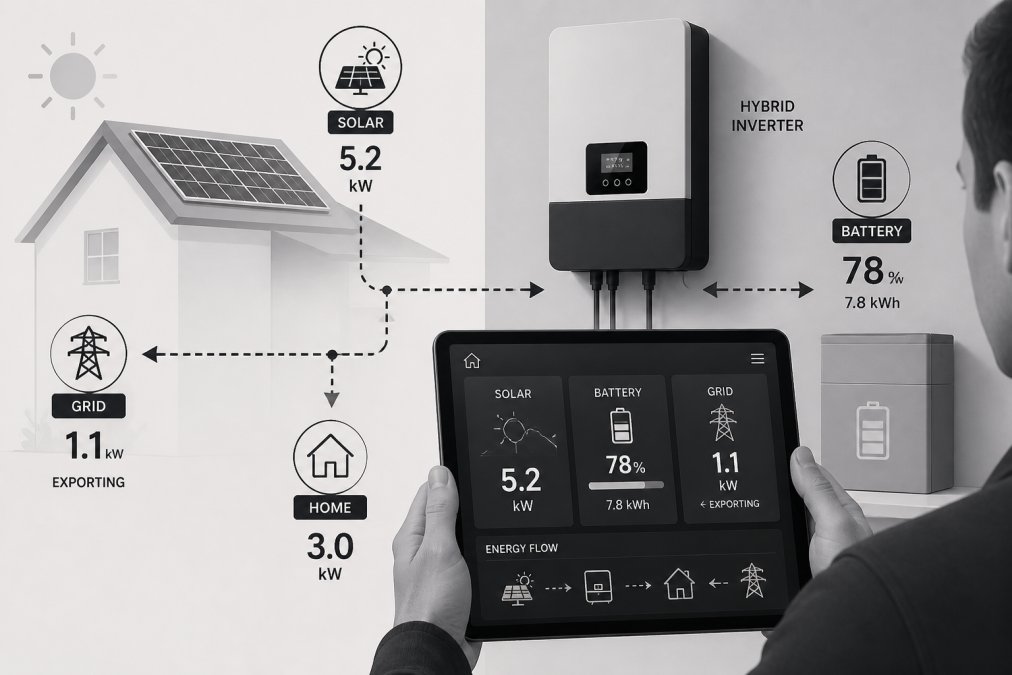
Modern hybrid inverters combine solar and battery management functions in a single device. They intelligently manage energy flow: charging the battery when solar generation exceeds household consumption, discharging the battery to cover peak demand, and drawing from the grid only when necessary. System monitoring is essential for optimising performance, providing real-time visibility into solar generation, battery charge level, household consumption, and grid import/export.
Self-consumption and Feed-in Tariff Optimisation
Self-consumption means using your own solar energy rather than exporting it to the grid. Battery storage dramatically increases self-consumption rates by allowing you to use midday solar generation in the evening when consumption peaks.
Feed-in tariffs vary by state and retailer. Some tariffs offer premium rates for exports during specific periods (such as 6-8pm peak demand). GridFree Solar helps you understand your specific feed-in tariff and design a battery strategy that maximises your financial returns.
Post-installation: Maintenance, Monitoring, and Performance Verification
Your battery storage installation doesn’t end when the installer leaves your property. Ongoing monitoring, maintenance, and performance verification ensure your system continues delivering expected benefits for its entire lifespan.
Most modern lithium-ion batteries require minimal maintenance, as they have no moving parts and no electrolyte to check. However, regular monitoring is essential to catch any performance degradation early. Performance verification involves comparing actual system output against design expectations. If your system is underperforming, the cause might be suboptimal battery settings, inverter configuration issues, or solar panel degradation.
GridFree Solar provides comprehensive post-installation support including system monitoring, performance analysis, and maintenance recommendations. We track your system’s performance over time, identify any issues, and help optimise settings to maximise your energy savings and system longevity.
Residential battery storage installation represents a significant investment in your home’s energy future. The complexity of system selection, regulatory compliance, installer qualification, and integration with existing infrastructure means that rushing the decision or choosing based purely on price creates unnecessary risk. A properly designed and installed system, combined with ongoing expert support, delivers reliable energy independence, substantial cost savings, and peace of mind knowing your installation meets all safety standards. GridFree Solar’s CEC-accredited team brings expertise in navigating rebates, ensuring AS/NZS 5139 compliance, and optimising your system for maximum performance. Connect with us to discuss how battery storage installation can transform your home’s energy management and reduce your reliance on grid power.
Frequently Asked Questions
What safety standards must a residential battery storage installation meet?
All installations must comply with AS/NZS 5139:2019, which governs energy storage systems, and AS/NZS 3000 for electrical safety. A CEC accredited installer ensures your system meets these standards and receives a Certificate of Electrical Safety (CES) upon completion. These standards cover lithium-ion battery chemistry, thermal management, fire rating, ventilation requirements, and weatherproofing. Non-compliant installations pose serious fire and electrical hazards.
How much does a residential battery storage installation typically cost?
Solar battery installation costs depend on system capacity (measured in kilowatt-hours), battery chemistry, installation method (wall-mounted or floor-standing), and site-specific factors like retrofitting versus new build. The Cheaper Home Batteries Program provides subsidies to eligible households, significantly reducing upfront costs. For accurate pricing tailored to your home, contact an accredited installer for a detailed quote that accounts for your specific energy storage needs and site conditions.
Do I need council approval before installing a home battery system?
Most residential battery installations require council approval or building permit clearance, particularly for wall-mounted units, retrofits, or systems exceeding certain capacity thresholds. An accredited installer handles this process as part of commissioning. They’ll also ensure your system meets local planning requirements and electrical safety standards. Skipping this step can void warranties and create compliance issues when selling your home.
Can I install a residential battery storage system myself?
Residential battery storage installation must be performed by a CEC accredited installer due to electrical safety requirements under AS/NZS 5139 and AS/NZS 3000. DIY installation is dangerous, voids warranties, fails compliance checks, and may breach local electrical codes. High-voltage lithium-ion systems require specialist knowledge of inverter compatibility, thermal management, and commissioning. Always engage a licensed, accredited professional.
This article was written using GrandRanker