Table of Contents
- Solar Homes Program Eligibility for 2026
- Household Income Thresholds and Property Requirements
- Finding an Approved Solar Retailers List
- Step-by-Step Solar Victoria Rebate Application Process
- How to Claim Your Rebate: Point-of-Sale vs. Reimbursement
- Interest-Free Loans and Battery Storage Rebates
- Troubleshooting Common Application Rejections
- New Build vs. Existing Home Application Nuances
- Frequently Asked Questions
Last Updated: August 13, 2026
Solar Homes Program Eligibility for 2026
The Solar Homes Program is one of the most accessible pathways for Victorian homeowners to claim solar rebates in 2026. Eligibility hinges on three core requirements: your property must be in Victoria, you must own the home (or be the primary occupant with the owner’s consent), and your household income must fall within specified thresholds. The program explicitly excludes investment properties, rental properties where you don’t live, and properties already receiving rebates under competing schemes.
A common mistake is assuming eligibility based on income alone. The program also assesses your property’s suitability for solar installation. If your roof receives significant shading, has structural issues, or faces other installation barriers, you may be declined even if your income qualifies. GridFree Solar’s accredited installers assess these factors during the initial consultation.
Start by verifying your property address against the program’s service area map. Some regional boundaries have been refined. If your address is on the edge of a service zone, contact the program administrator directly, postcode-based assumptions often miss eligible properties.
Household Income Thresholds and Property Requirements
Your household income threshold determines which rebate tier you qualify for and whether you’re eligible for an interest-free loan. Generally, households earning below a specified annual income threshold qualify for the full rebate and loan package. Households above that threshold but below a secondary limit may qualify for a reduced rebate or loan only. Households exceeding the upper threshold are typically ineligible for the program’s core incentives.
Income verification requires documentation: recent tax returns, payslips, Centrelink statements, or financial institution records. Self-employed applicants need tax returns covering the last two financial years. The program cross-references your declaration against tax office records, so discrepancies will trigger delays or rejection.
Your property must be an established residential home with a valid certificate of title and current council rates notice. You cannot be in arrears on council rates. Roof condition matters significantly, your roof must structurally support a solar photovoltaic system and battery storage without requiring major repairs beforehand. If your roof needs replacement within the next five years, many assessors will decline your application.
Overstating your property’s condition or understating your household income during application is a common rejection trigger. The program conducts compliance audits on approved applications. False declarations can result in rebate clawback and potential legal consequences. Always provide accurate information.
Finding an Approved Solar Retailers List
Claiming your rebate requires working with an authorized solar retailer, you cannot install a system independently and apply for the rebate afterwards. The official program portal maintains a searchable database of accredited installers. Filter by your postcode to find retailers operating in your area.
Accreditation matters because it signals compliance with industry standards. CEC-accredited installers follow AS/NZS 5139:2019 (battery storage safety) and AS/NZS 3000 (electrical safety). They hold current liability insurance and are bound by a code of conduct.

When evaluating retailers, cross-reference their listing on the program portal with independent reviews. Contact at least three retailers for quotes. Each should provide a detailed installation quote, system design diagram, and an estimate of your annual energy savings. Legitimate retailers will conduct a site assessment before quoting. Ask about warranty offerings, maintenance support, and post-installation monitoring. GridFree Solar includes comprehensive battery upgrade and replacement services as part of their offering.
The authorized retailer you choose doesn’t just install your system, they guide your entire rebate claim process. Choose someone who explains the application steps clearly, not just someone offering the lowest price.
Step-by-Step Solar Victoria Rebate Application Process
The application process unfolds in distinct phases: pre-application preparation, portal submission, assessment, and approval.
Phase 1: Gather Your Documentation
Before logging into the rebate application portal, assemble all required documents. You’ll need proof of identity, proof of property ownership, current council rates notice, proof of household income, installation quote from your approved retailer, and a roof condition report if requested. Scan all documents into PDF format with legible text and all pages included.
Phase 2: Create Your Portal Account
Visit the official rebate application portal and create an account using your email address. Verify your email immediately, set a strong password, and enable two-factor authentication if available. Once logged in, you’ll see a dashboard showing your application status and rebate eligibility estimate.
Phase 3: Submit Your Application
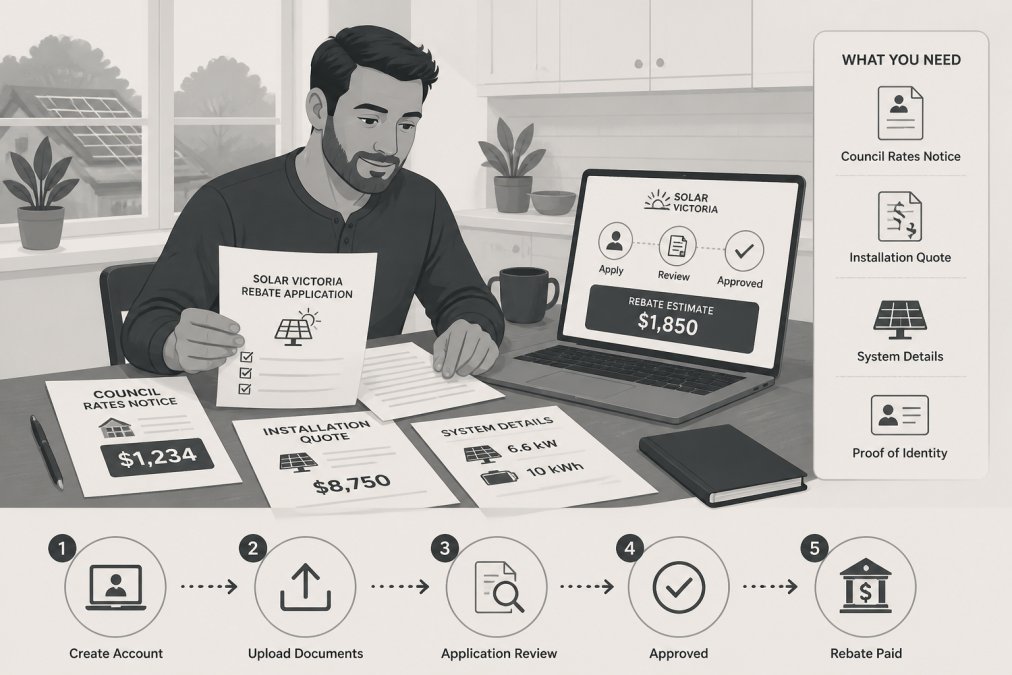
Complete the application form section by section, providing your personal details, property address and ownership status, household income, current electricity usage, details of the solar system you’re installing, and your approved retailer’s details. Upload your supporting documents as prompted. Before final submission, review your entire application for accuracy. Once you submit, you’ll receive a confirmation email with your application reference number.
Phase 4: Wait for Assessment
The program typically assesses applications within 10-15 business days. You can check your status anytime in the portal. If the assessor needs clarification or additional documents, respond within the specified timeframe (usually 5-10 days) or your application may be rejected.
Phase 5: Receive Your Approval
Once approved, you’ll receive a rebate approval letter via email and portal confirming your rebate amount, loan eligibility, and any conditions. Your approved retailer receives a copy simultaneously. Your approval is typically valid for 12 months.
How to Claim Your Rebate: Point-of-Sale vs. Reimbursement
The rebate claim process depends on your retailer’s preferred method.
Point-of-Sale Discount
Your approved retailer deducts your rebate amount from the final invoice. You pay only the balance. The retailer then submits the rebate claim to the program on your behalf. This is the most common method and simplest because you don’t need to manage a separate reimbursement claim. GridFree Solar uses point-of-sale for all eligible customers.
Reimbursement Method
Some retailers don’t participate in point-of-sale arrangements. You pay the full invoice, installation completes, and you submit a reimbursement claim to the program. The program processes your claim and deposits the rebate into your nominated bank account, typically taking 4-8 weeks.
Ask your retailer which method they use before signing a contract. If they offer point-of-sale, take it, the financial and administrative advantages are clear.
If your retailer offers reimbursement only, request an invoice breakdown showing the rebate amount separately. This clarity helps when you submit your reimbursement claim and prevents disputes about what the program will reimburse.
Interest-Free Loans and Battery Storage Rebates
Beyond the solar panel rebate, the program offers interest-free loans for battery storage and hot water systems.
Battery Storage Loans
If your household income qualifies, you can access an interest-free loan to finance battery storage. Loan terms typically span 10 years, with repayment beginning after installation completion. Battery storage amplifies your energy independence by storing solar energy for use at night or during peak demand periods, reducing your grid reliance and lowering your electricity bill.
GridFree Solar’s battery systems comply with AS/NZS 5139:2019 and carry CEC approval. The batteries support free grid charging from 11am-2pm and earn 15¢/kWh by exporting power back to the grid from 6-8pm, accelerating your return on investment.
Hot Water Rebates
Some households qualify for separate rebates on solar hot water systems. If your household income qualifies and you’re installing a compliant solar hot water system, you can claim this rebate simultaneously with your panel rebate. Hot water systems account for roughly 20-30% of household energy consumption, so switching to solar hot water reduces that burden substantially.
Application for battery or hot water rebates follows the same portal process as the panel rebate. Specify your interest in these products during the initial application.
Troubleshooting Common Application Rejections
Application rejections are usually fixable. Understanding common rejection reasons helps you avoid them.
Income Verification Failure
The program cross-references your declared income against tax office records. If your recent tax return shows significantly lower income than you’ve declared, the program flags this as a discrepancy. Request a review and provide additional documentation: recent payslips, Centrelink correspondence, or a letter from your employer confirming current income.
Property Ineligibility
Your property fails the structural or location assessment. Common triggers include roof too shaded for effective solar generation, roof requiring replacement within 5 years, property on a heritage register with installation restrictions, postcode outside the program’s service area, or property not classified as primary residence. If rejected for property reasons, the program should explain specifically why. Address the issue and reapply if possible.
Documentation Incomplete or Illegible
Missing pages, blurry scans, or unsigned documents force rejection. Resubmit complete, legible copies with all pages included and any required signatures.
Retailer Not on Approved List
You’ve selected a retailer not listed as approved. Verify your retailer’s CEC accreditation status on the program portal before signing any contract. Don’t proceed with a non-approved retailer, you’ll forfeit your rebate.
Conflicting Rebate Claims
You’ve previously claimed a rebate for a different solar system at the same property, or you’re claiming through multiple programs simultaneously. Check your rebate history before reapplying.
Don’t attempt to circumvent rejection reasons by reapplying with false information. The program maintains records of all applications. Reapplying with corrected documentation is acceptable; reapplying with fabricated information is not.
New Build vs. Existing Home Application Nuances
New build properties and established homes follow different pathways through the rebate program.
Existing Home Applications
Most households apply through the existing home pathway. You own or occupy an established residential property and are installing a new solar system. Existing homes have the advantage of simpler property verification, your council rates notice and certificate of title confirm ownership and property status immediately.
New builds, homes constructed within the last 12 months or still under construction, follow a modified pathway. Instead of a council rates notice, you’ll provide a copy of your settlement statement or construction contract proving ownership. New builds may have higher rebate amounts because the program encourages renewable energy adoption at the point of construction.
If your new build is still under construction, you may need to delay your application until settlement is imminent. The program requires proof of current ownership; pre-settlement contracts don’t qualify. If your builder has already begun installation, clarify whether this affects your rebate eligibility. Some pre-installed systems don’t qualify for rebates if they weren’t installed by an approved retailer.
Claiming solar rebates in Victoria requires attention to detail, but the process is straightforward once you understand the steps. Start by verifying your eligibility, income, property status, and location are the primary gates. Gather your documentation thoroughly. Select an approved retailer who can guide you through the application and installation process. Submit your application through the official portal, respond promptly to any requests for additional information, and track your approval status.
The rebate you receive significantly reduces your upfront system cost, and the interest-free loan (if you qualify) makes battery storage accessible. GridFree Solar’s CEC-accredited installers handle the technical complexity, ensure compliance with AS/NZS 5139:2019 and AS/NZS 3000 standards, and provide post-installation monitoring and maintenance support.
Connect Now with GridFree Solar and let our accredited specialists guide you through every step of your rebate claim, from eligibility assessment to final installation.
Frequently Asked Questions
What are the eligibility criteria for the Solar Homes Program in 2026?
To qualify for solar rebates in Victoria, you must own your home, live in it as your primary residence, and meet the household income threshold set for 2026. Your property must have a valid certificate of title and current council rates notice. The home must not have received a rebate under this scheme previously. Rental properties and properties with existing solar systems installed after a certain date may have different eligibility rules. Check the official Solar Victoria portal to confirm your specific circumstances before applying.
What documentation do I need to claim a solar rebate?
You’ll need proof of ownership (certificate of title), a recent council rates notice showing your property address, proof of household income from the last financial year (payslips or tax return), and a valid installation quote from an accredited installer. If applying for a battery rebate alongside solar, you may need additional documentation confirming energy savings calculations. Keep all receipts and installation certificates once work is completed. The rebate application portal will specify exactly which documents to upload for your application.
Can I claim both a solar panel rebate and a battery storage loan at the same time?
Yes, you can combine solar panel rebates with interest-free battery loans under the Cheaper Home Batteries Program. However, your eligibility for each scheme is assessed separately based on income thresholds and property requirements. Applying for both simultaneously can streamline your process, but ensure you meet the criteria for each program. The rebate application portal will guide you through whether you qualify for one, both, or neither. An accredited installer can advise which combination suits your energy needs and financial situation.
How long does it take to receive approval and payment for a solar rebate?
Processing times vary depending on application completeness and current portal workload. Most applications are assessed within 4-8 weeks of submission if all required documentation is correct. Point-of-sale rebates may be applied immediately at installation if you use an approved retailer, while reimbursement claims take longer to process. Once approved, payment is typically transferred within 2-4 weeks. Incomplete applications or missing documents can significantly delay approval, so ensure everything is correct before submitting. Check your application status regularly via the Solar Victoria portal.
This article was written using GrandRanker