
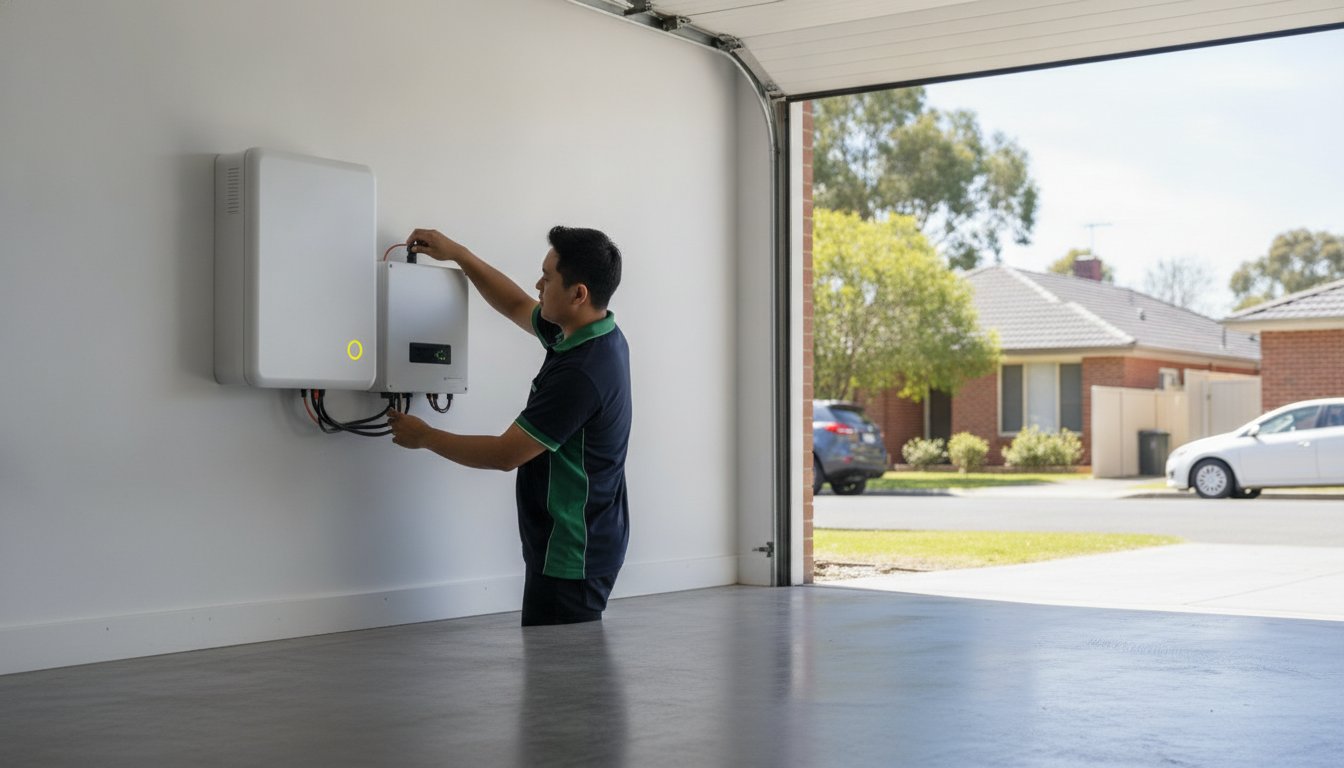
Your solar panels are likely sending free energy back to the grid while your retailer charges you peak rates every single evening. It’s a frustrating reality in 2026. With Victorian feed-in tariffs now deregulated and some rates dropping to absolute zero, the old way of doing solar is broken. You recognise that storage is the only path to genuine energy independence, yet the solar battery upgrade cost Victoria remains a complex puzzle of shifting incentives and technical jargon.
We understand the frustration of navigating eligibility rules that seem to change every season. This guide cuts through the noise to provide the financial clarity you deserve. You’ll discover how the Federal Cheaper Home Batteries Program changes the math for Melbourne households and why the new “solar soak” tariffs make timing everything. We’ll break down the exact factors that drive ROI and explain how to seamlessly retrofit modern storage to your existing system. It’s time to stop donating power to the grid and start owning your energy future.
Key Takeaways
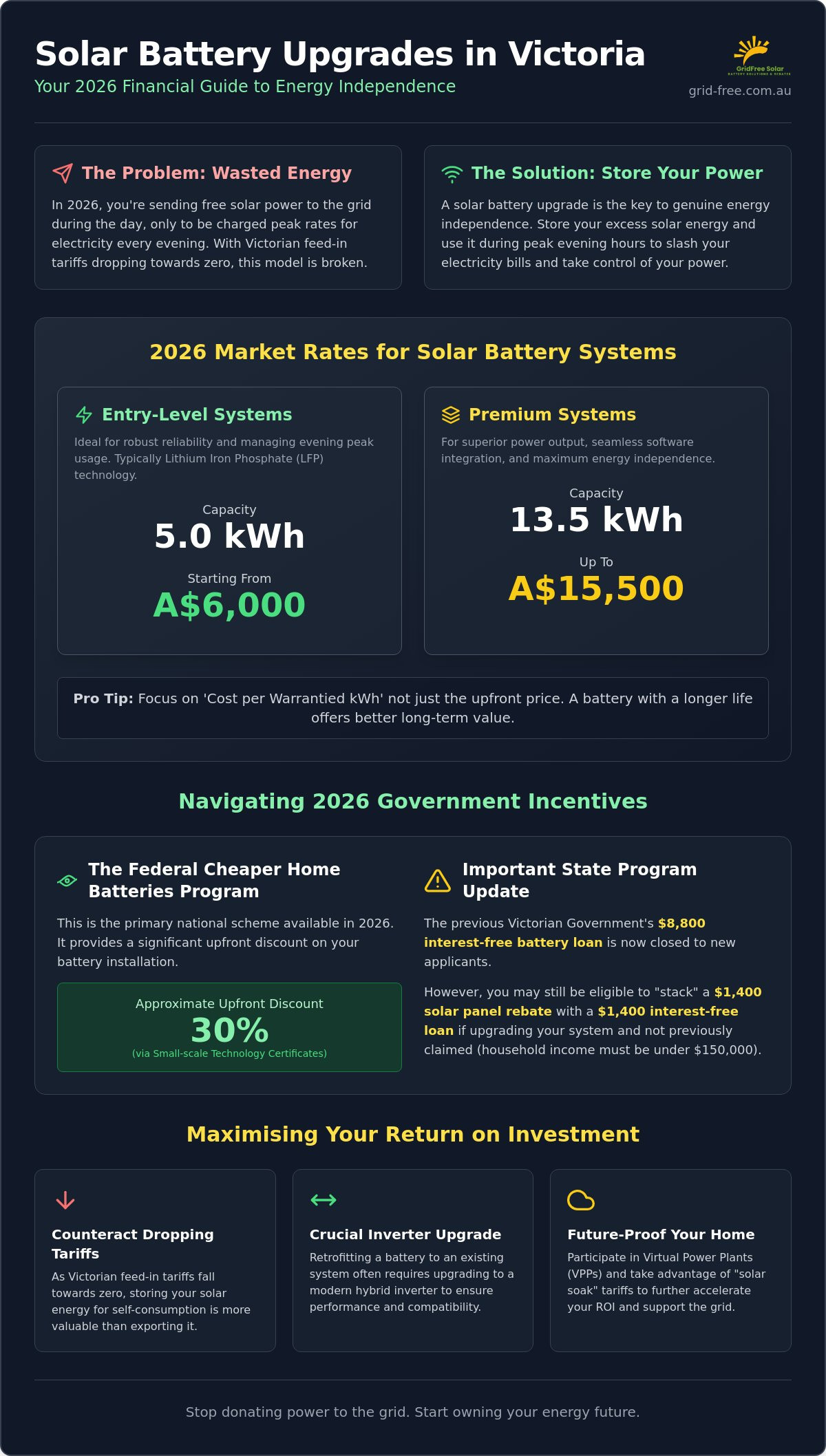
- Master 2026 market rates for lithium storage. Entry-level 5.0 kWh systems start near A$6,000, while premium 13.5 kWh units range up to A$15,500 before incentives.
- Slash your solar battery upgrade cost Victoria using the Federal Cheaper Home Batteries Program. This national scheme provides a discount of approximately 30% on upfront costs via Small-scale Technology Certificates.
- Navigate technical retrofit challenges with ease. Understand why upgrading your existing inverter to a modern hybrid model is crucial for supporting high-performance battery technology.
- Maximise financial returns in a deregulated market. As Victorian feed-in tariffs drop toward zero, storing your own solar energy for evening peak periods is the most effective way to lower bills.
- Future-proof your investment with Virtual Power Plants. Learn how VPP participation and “solar soak” tariffs can further accelerate your path to energy independence.
Current Market Rates for Solar Battery Installation in Victoria
The financial landscape for energy storage in 2026 is defined by precision and performance. While hardware costs have stabilised, the total solar battery upgrade cost Victoria homeowners face is now heavily influenced by technical integration and localised labour standards. Understanding the market requires looking beyond the initial sticker price. You must evaluate the total investment based on the synergy between your existing solar array and the new storage technology. High-performance home energy storage systems are no longer just an add-on; they’re the central intelligence of the modern Victorian home.
Smart buyers now focus on the ‘cost per warrantied kWh’ rather than just the upfront outlay. This metric provides a true reflection of value by dividing the total system price by the total energy throughput guaranteed over the battery’s lifespan. A cheaper unit might seem attractive today, but if its cycle life is half that of a premium alternative, your long-term costs will skyrocket. In Melbourne’s competitive market, the distinction between a ‘Battery Only’ installation and a ‘Full System’ upgrade is also critical. Retrofitting storage to an older system often requires specific compliance checks and component synchronisation that a fresh installation avoids.
Entry-Level vs. Premium Storage Costs
The Victorian market is currently split between budget-conscious Lithium Iron Phosphate (LFP) units and high-end integrated systems. Entry-level LFP batteries offer robust reliability and are perfectly suited for Victoria’s variable climate. However, premium brands like Tesla or Enphase command a higher price point due to their seamless software integration and superior power output capabilities. When comparing these tiers, pay close attention to capacity ratings. Usable capacity refers to the actual amount of energy you can extract from the unit without compromising its lifespan, whereas total capacity is merely the theoretical limit of the cells. Don’t pay for energy you can’t actually use.
Installation Complexity and Site Factors
Your property’s layout dictates a significant portion of the final quote. Victorian fire safety regulations for battery installations have become more stringent in 2026, often requiring specific heat shielding or external mounting locations that can add to the labour tally. Distance dictates dollars. If your switchboard is at the opposite end of the house from your preferred battery location, the cost of heavy-duty cabling and conduit will rise. Furthermore, many older Melbourne homes require a switchboard mandate to meet current AS/NZS standards before a battery can be commissioned. These essential safety upgrades ensure your home energy ecosystem remains secure and efficient for decades.
Maximising Victorian Government Rebates and Interest-Free Loans
The incentive landscape for Victorian energy storage has undergone a massive transformation in 2026. You need to understand that the old rules no longer apply. While the state-level battery-specific loan has closed to new applicants, the Federal “Cheaper Home Batteries Program” has stepped in to fill the gap. This shift means the solar battery upgrade cost Victoria residents pay is now primarily offset by national incentives rather than state-specific loans. Navigating these changes requires a specialist who understands the current administrative landscape and the strict eligibility criteria enforced by the Victorian Government’s Solar Homes Program.
To qualify for any remaining state-level support, such as the solar panel rebate, your combined household taxable income must be under $150,000. This cap is a hard limit as of July 2026. If you’re upgrading an older system, you can still stack the $1,400 solar panel rebate with a $1,400 interest-free loan if you haven’t previously claimed them. This “stacking” strategy effectively lowers the barrier to entry for a complete system overhaul. It’s about being savvy with the available pools of funding and acting before thresholds shift again.
The $8,800 Interest-Free Loan Explained
Many homeowners are still searching for the previous $8,800 interest-free battery loan. It’s vital to recognise that this specific state program is now closed to new applicants as of 2026. However, the Federal “Cheaper Home Batteries Program” provides a comparable, if not superior, advantage. By offering a discount of approximately 30% on the upfront cost for systems between 5 kWh and 100 kWh, this program scales with your needs. A larger 13.5 kWh battery now receives a more significant discount than it would have under the old capped loan system. We handle the complex paperwork to ensure these national discounts are applied directly to your quote.
Federal STCs and Their Role in 2026
The Small-scale Technology Certificate (STC) scheme remains a cornerstone of solar affordability, but the clock is ticking. Every year, the “deeming period” for STCs reduces, meaning the total incentive value drops on January 1st. In 2026, the benefit is still substantial, but waiting until 2027 will lead to a forced price increase as the multiplier decreases. This is a non-negotiable federal phase-out. By acting now, you lock in the 2026 certificate value and the 30% federal battery discount before further scheduled reductions occur. It’s a matter of timing your investment to maximise the government’s contribution.
If you’re unsure which incentives apply to your specific postcode, our team can assess your eligibility and provide a transparent breakdown of all available 2026 credits.
Factors Influencing Your Total Quote: Retrofitting vs. New Systems
Retrofitting storage is rarely a “plug and play” affair. Your existing hardware’s age and architecture dictate the final quote. In many cases, adding a battery to an ageing array costs more than a fresh, integrated installation. This technical reality often catches homeowners off guard. When calculating your solar battery upgrade cost Victoria, you must account for the “Hybrid Inverter hurdle.” Standard string inverters installed five years ago cannot communicate with modern lithium cells. You’ll likely need a full inverter swap or an AC-coupled solution to bridge the gap.
Choosing between AC and DC coupling is a pivotal financial decision. DC-coupling is the gold standard for efficiency in new systems. It routes power directly to the battery with minimal conversion loss. However, for a Victorian retrofit, AC-coupling is often the pragmatic choice. It allows your new battery to sit alongside your old solar inverter without a total teardown. While AC-coupling involves a slight efficiency trade-off, it saves thousands in labour and hardware replacement. The Australian Government’s Cheaper Home Batteries Program provides the essential financial buffer needed to manage these technical complexities by subsidising the upfront hardware costs.
Beware the “Battery Ready” marketing trap. Many systems sold as “ready” still require expensive communications cards, energy meters, or switchboard modifications to actually function with storage. These hidden components can add A$500 to A$1,500 to a standard quote. Distance also dictates dollars. If your battery must be installed far from your inverter or switchboard, the cost of heavy-duty conduit and specialised wiring will rise. Precision planning is the only way to avoid these budget blowouts.
Upgrading Older Melbourne Systems
Melbourne’s solar boom in the early 2010s left many homes with legacy technology that isn’t compatible with 2026 standards. Retrofitting a modern battery to a decade-old array is often a losing game. If your panels are nearing the end of their warrantied life, a full solar battery replacement Melbourne and panel refresh often delivers a better ROI than trying to patch an obsolete system. Modern LiFePO4 cells require smart management that older hardware simply can’t provide.
Commercial Storage Considerations
Victorian businesses face a different set of variables. For industrial sites, the goal isn’t just self-consumption; it’s “peak shaving.” By using stored energy to dampen demand spikes, businesses can slash their network demand charges significantly. Our commercial solar installation Melbourne specialists focus on high-capacity storage designed for these heavy-duty cycles. Scaling your storage correctly ensures that your business remains resilient against the price volatility of the 2026 energy market.
Calculating ROI: When Does a Battery Pay for Itself in Victoria?
The math behind your solar battery upgrade cost Victoria has shifted from passive saving to active energy management. In 2026, relying on feed-in tariffs (FiT) is a losing strategy. With Victorian retailers now free to set export rates as low as zero cents per kWh, your solar panels are essentially working for free during the day. A battery flips this script. By storing that excess generation, you avoid paying peak retail rates that can exceed 40 cents per kWh during the evening. The true ROI is the delta between the zero-value export and the high-cost import you’ve successfully eliminated.
Self-consumption is the metric that matters most. Most Victorian homes without storage only use about 30% of their generated solar energy. Adding a battery can push this figure above 80% almost immediately. When you factor in the federal discounts and the removal of peak-hour charges, the annual cash flow often becomes positive within the first few years of operation. You aren’t just buying a hardware unit. You’re pre-purchasing a decade of power at a fixed, significantly lower rate than the grid can offer.
Virtual Power Plants (VPP): The 2026 Game Changer
Joining a Virtual Power Plant is the most aggressive way to accelerate your ROI in the current market. In exchange for allowing the grid to occasionally tap into your stored energy during peak stress events, VPP providers offer significant financial kickbacks. This can manifest as a direct upfront discount on your hardware or ongoing monthly credits on your power bill. Top Victorian VPP providers in 2026 are offering sign-up bonuses that can shave over A$1,000 off the initial system price. You must balance these credits against your backup reserve requirements, but for most suburban Melbourne homes, the financial upside is undeniable.
The Value of Blackout Protection
Financial spreadsheets often ignore the intangible value of resilience. During Dandenong storms or regional grid failures, a battery ensures your fridge stays cold and your home remains functional. There is a distinct cost difference between backing up ‘essential circuits only’ versus a full-home backup solution. Essential circuits are more budget-friendly and ensure critical appliances remain powered without draining your storage too quickly. For the Victorian reader, EPS (Emergency Power Supply) refers to the battery’s ability to automatically disconnect from the grid and provide power to your home during a blackout.
Ready to see the exact numbers for your specific property? Request a custom ROI breakdown from our Melbourne specialists today and stop donating your solar energy to the grid.
Future-Proofing Your Home with GridFree Solar
Energy independence in 2026 requires more than just high-end hardware. It demands a partnership with a specialist who understands the unique friction points of the Victorian energy market. The solar battery upgrade cost Victoria homeowners pay is an investment in long-term resilience. At GridFree Solar, we ensure that investment is protected through precision engineering and local accountability. We don’t just install batteries. We design intelligent energy ecosystems tailored to your specific household consumption patterns and the volatile 2026 tariff environment.
The administrative burden of securing federal and state incentives is a significant hurdle for most. Our team takes full control of the process. We manage the entire application for the Federal Cheaper Home Batteries Program and ensure all compliance documentation for Solar Victoria is handled with absolute accuracy. This “heavy lifting” ensures you receive every dollar of the 30% federal discount without the stress of navigating government portals. We believe your transition to modern storage should be seamless, professional, and financially transparent.
Longevity is the ultimate measure of value. While budget installers may cut corners on thermal management or switchboard integration, GridFree Solar prioritises the safety and cycle life of your LiFePO4 cells. Professional installation is non-negotiable for maintaining manufacturer warranties and ensuring your system operates safely in Victoria’s extreme summer heat. Our CEC Accredited Installers deliver a level of craftsmanship that generic providers simply cannot match. We are your long-term partners in Melbourne’s energy transition.
Why Experience in Melbourne Matters
Every Victorian distribution network has its own set of technical hurdles. Whether you are on the CitiPower, Powercor, or United Energy grid, the rules for export limits and grid protection vary significantly. A non-local installer might miss these critical nuances, leading to system delays or performance throttling. Our deep understanding of energy storage solutions Melbourne ensures your system is compliant from day one. We navigate local council requirements and grid-specific engineering rules so you don’t have to.
Next Steps: Getting Your Precise Quote
A generic online estimate is never enough for a 2026 battery upgrade. To provide an accurate quote, we conduct a comprehensive site audit of your existing solar array, switchboard capacity, and mounting locations. Before your consultation, have your latest energy bill and any original solar installation paperwork ready. This data allows us to model your exact ROI with surgical precision. Stop guessing about your energy future and start securing it with a data-backed strategy.
Don’t let another peak-rate evening drain your household budget. Request a tailored Victoria solar battery quote today and take the first step toward genuine grid independence.
Secure Your Energy Independence Today
The transition to a deregulated Victorian energy market is a clear signal that the old solar model is obsolete. To protect your household budget, you must pivot from exporting power to storing it. By understanding the solar battery upgrade cost Victoria residents face in 2026, you’ve taken the first step toward genuine grid independence. You now know that federal incentives and VPP participation are the primary drivers of modern ROI. Waiting only increases the risk of missing out on current certificate values and scheduled discount rates. It’s time to act while the financial landscape is in your favour.
Don’t let your excess solar generation go to waste while retail peak prices continue to climb. Maximise your savings with a professional Victoria solar battery installation. Our team provides expert Victorian rebate and loan assistance to ensure you secure every available credit. As CEC Accredited Installers and specialists in battery upgrades and replacements, we handle the technical complexity so you can enjoy the reliability of a future-proof home. Take control of your energy destiny and join the thousands of Victorians already outsmarting the grid. Your modern energy journey starts now.
Frequently Asked Questions
How much does a 10kWh solar battery cost in Victoria in 2026?
Market rates for a 10kWh unit typically range between A$9,500 and A$11,500 for hardware and installation. This benchmarks the standard solar battery upgrade cost Victoria households should expect before federal incentives are applied. Final figures depend on your site’s technical requirements and the complexity of your existing inverter setup.
Can I still get a battery loan if I already claimed the solar panel rebate?
Yes, you can still access financial support. While the state-specific battery loan is closed, the Federal Cheaper Home Batteries Program remains available to Victorians who have previously claimed a solar panel rebate. This national scheme operates independently of past state-level incentives, allowing you to further enhance your system’s efficiency without being disqualified by previous state claims.
Is the $8,800 Solar Victoria battery loan really interest-free?
The Solar Victoria battery loan program was interest-free, but it is now closed to new applicants as of 2026. Homeowners should now look toward the Federal Cheaper Home Batteries Program. This national initiative offers an upfront discount of approximately 30% rather than a loan, providing immediate capital relief instead of a long-term debt obligation.
What is the best solar battery for a Melbourne home this year?
The best choice for Melbourne’s variable climate is a battery utilising Lithium Iron Phosphate (LiFePO4) technology. This chemistry offers superior thermal stability during heatwaves and maintains high performance during cold winter nights. High-integration units like the Tesla Powerwall 3 or Enphase IQ are popular for their robust software and seamless Victorian grid interaction.
How long will a solar battery last in Victoria’s climate?
Most modern solar batteries are warrantied for 10 years or a specific number of cycles. In Victoria’s climate, a well-installed unit in a shaded, ventilated area can reliably serve a household for 12 to 15 years. Longevity depends heavily on depth of discharge settings and professional commissioning to manage Melbourne’s specific temperature swings.
Does a solar battery work during a power outage in Melbourne?
A solar battery only works during a blackout if it is equipped with an Emergency Power Supply (EPS) or a backup gateway. Standard installations often shut down during outages to protect grid workers. If backup is a priority, we must configure your system to isolate essential circuits like lighting and refrigeration during a local network failure.
Is it worth getting a battery if my feed-in tariff is low?
A low feed-in tariff actually makes a battery more financially viable. When retailers pay you next to nothing for your exports, every kilowatt-hour you store and use yourself saves you the full retail import price. This strategy maximises your self-consumption rate and protects you from the deregulation of Victorian export rates.
How much can I save on my power bill with a battery in Victoria?
Savings vary based on your energy profile, but many Victorian households reduce their grid reliance by 70% to 90% after adding storage. By avoiding peak evening rates and participating in a Virtual Power Plant, you can significantly lower your quarterly bills. The focus is on eliminating the need to buy power from the grid when it is most expensive.