As of 1 July 2026, a combined household income of just $150,000 is the new line in the sand for Victoria’s solar rebates. If you are planning a construction project, the window for maximum financial support is narrowing while the regulations for all-electric living are tightening. Integrating solar panels for new build homes Victoria is no longer an optional extra for the eco-conscious. It is the essential infrastructure required to meet 7-star NatHERS standards and avoid the high costs of retrofitting later.
Building a home is complex enough without worrying if your solar installer and builder are on the same page. You’re likely concerned about under-sizing your system for future EV charging or missing out on the A$1,400 rebate due to shifting eligibility rules. We understand the urgency of getting these technical details right before the first brick is laid. This guide unlocks the blueprint for a seamless, battery-ready installation that slashes your energy bills from the moment you move in. We will explore the latest 2026 rebate changes, the mandatory shift away from gas, and how to design a system that thrives in a market with low feed-in tariffs.
Key Takeaways
- Prepare for the 1 January 2027 mandate that requires all new Victorian homes to be all-electric, making high-performance solar infrastructure a day-one necessity.
- Secure a significant financial advantage by integrating solar panels for new build homes Victoria during the construction phase to avoid expensive future retrofits.
- Navigate the 2026 Solar Homes Program updates, including the A$1,400 rebate and the critical A$150,000 household income threshold for eligibility.
- Future-proof your property with N-Type panel technology and battery-ready pre-wiring designed to meet 7-star NatHERS energy efficiency standards.
- Discover how seamless coordination between your builder and solar specialist ensures a high-performance system that supports an all-electric lifestyle and future EV needs.
Why Solar Panels for New Build Homes in Victoria are Mandatory in 2026
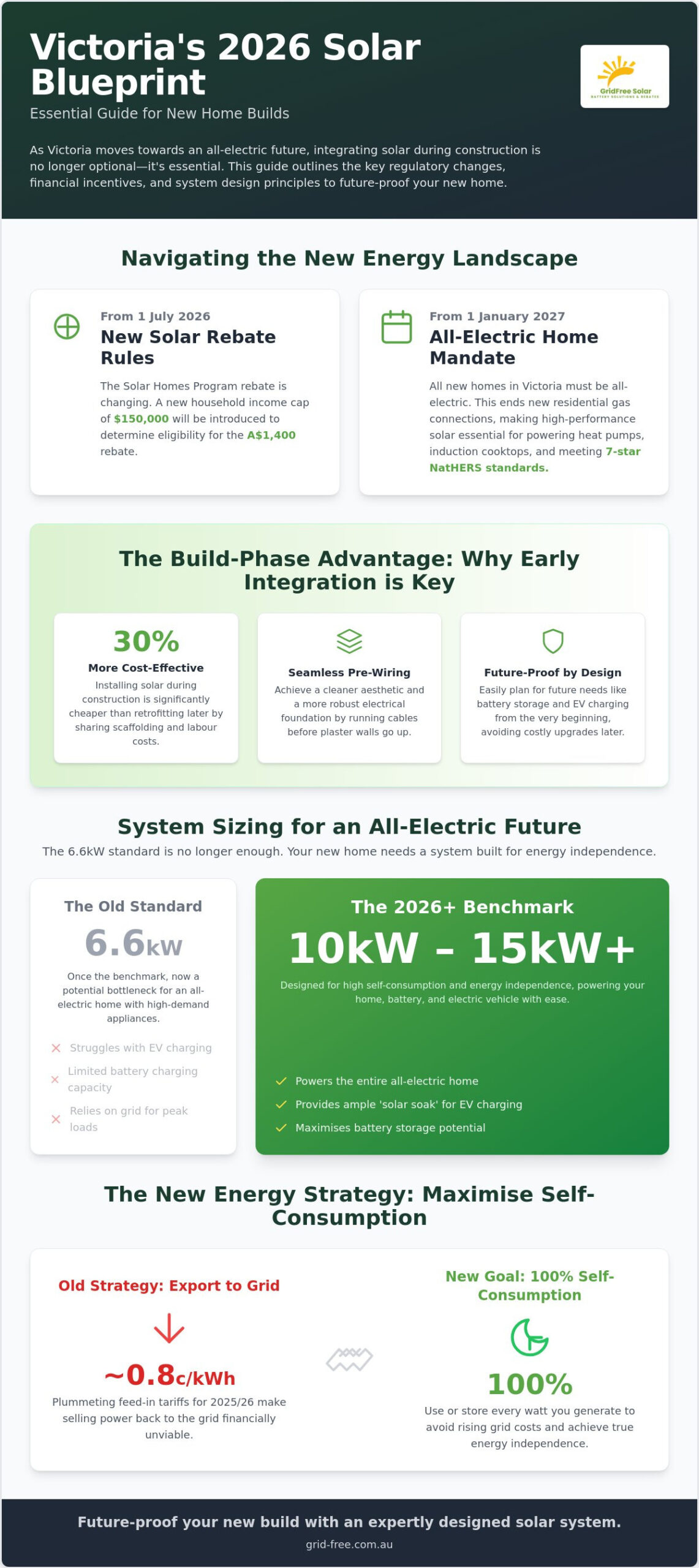
The regulatory clock is ticking for Victorian property owners. Under the Building and Plumbing Amendment Regulations 2025, every new home must be all-electric from 1 January 2027. This means the gas network is effectively closed to new residential developments. If you are building now, you are constructing a home for a post-gas era. Choosing to install solar panels for new build homes Victoria during the design phase is no longer just a smart financial move; it’s a regulatory necessity. Your home requires a high-performance energy engine to power induction cooktops, heat pumps, and climate control systems without sending your utility bills into orbit.
The financial logic is undeniable. Installing solar during the build phase is approximately 30% more cost-effective than retrofitting. You save significantly by sharing scaffolding costs already on-site and allowing installers to pre-wire the home before the plaster goes up. This creates a cleaner aesthetic and a more robust electrical foundation. With feed-in tariffs in Melbourne plummeting to an average of 0.8c/kWh for the 2025/26 period, the old strategy of “selling power back” is dead. The new goal is 100% self-consumption. You must capture every watt you generate to avoid the rising costs of the Victorian grid.
The 2027 All-Electric Mandate
Victoria is leading the nation in the shift away from fossil fuels. New houses must meet 7-star NatHERS standards, which demand superior thermal performance and energy efficiency. Solar serves as the primary driver for these requirements. It powers high-efficiency heat pumps that provide hot water and space heating at a fraction of the cost of traditional gas units. As Solar power in Australia continues to break records, Victorian builds are becoming localised power stations. By eliminating gas connection fees and daily supply charges, you simplify your utility stack and protect your investment from future policy shifts.
Future-Proofing for EV Charging
Your 2026 build must account for the inevitable transition to electric vehicles. Modern homes now face a dual load: powering the household and refuelling a car. A standard, undersized solar array won’t cut it. You need a system designed for high-capacity throughput to ensure your car charges from the sun rather than the expensive evening grid. Energy Independence in Victoria means your home generates and manages enough power to sustain your lifestyle without relying on an increasingly expensive and volatile centralised grid. By designing for this load today, you avoid the technical headaches of upgrading your switchboard and cabling in three years’ time. Secure your energy future now while the builders are still on-site.
Designing the Ultimate 2026 Solar System: Beyond the 6.6kW Standard
The 6.6kW solar array was once the gold standard for Victorian rooftops. In 2026, this size is often a bottleneck. An all-electric home with a heat pump, induction cooktop, and an electric vehicle in the garage consumes significantly more power than a gas-connected property. Choosing solar panels for new build homes Victoria requires a shift toward higher capacity. You need a system that doesn’t just cover your base load but generates a surplus to feed your battery and car. We recommend N-Type monocrystalline panels for Melbourne’s erratic weather. These panels offer superior performance in low-light conditions and a slower degradation rate than older P-Type technology. They ensure your investment remains high-yielding for decades.
Your inverter is the brain of this operation. A smart, hybrid inverter is now a non-negotiable component. It allows for seamless Virtual Power Plant (VPP) participation, where you can earn credits by supporting the grid during peak events. This intelligence is critical for managing 2026 energy prices. By selecting hardware with battery-ready architecture, you ensure your home can scale. Your family’s energy needs will grow. Your solar system must be ready to grow with them. You can optimise your system design during the planning phase to ensure every component is perfectly matched to your architectural drawings.
Sizing Your System for 2026 Loads
A 10kW or 15kW system is the new benchmark for energy independence. These larger arrays provide the “solar soak” required to charge an EV during the day while simultaneously running high-draw appliances like laundry and climate control. When you apply for the Victorian solar panel rebate, consider the long-term ROI of a larger footprint. The table below outlines expected daily yields in typical Victorian conditions.
| System Size (kW) | Average Daily Yield (kWh) | Best For |
|---|---|---|
| 6.6kW | 20 – 25 kWh | Small households, minimal daytime load |
| 10.0kW | 30 – 38 kWh | All-electric families, moderate heating/cooling |
| 15.0kW | 45 – 55 kWh | High-usage homes, EV charging, pool pumps |
The Necessity of Battery Storage
Daytime generation is only half the battle. Because feed-in tariffs are at historic lows, energy storage solutions Melbourne are now the core of any high-performance new build. We prioritise LiFePO4 (Lithium Iron Phosphate) technology for its thermal stability and 10,000-cycle lifespan. A battery acts as your primary tool for peak-shaving. It stores the midday sun and deploys it between 4 PM and 9 PM when grid prices are highest. This strategy transforms your home from a passive consumer into an active, resilient energy hub.
Maximising Victorian Solar Rebates and Incentives for New Builds
Timing is everything when securing government support for your energy infrastructure. The 2026 Solar Homes Program offers a significant financial head start, providing an A$1,400 rebate for eligible solar panels for new build homes Victoria. This incentive is frequently paired with an interest-free loan of an equal amount, effectively doubling your upfront savings. However, the window for eligibility has tightened. As of 1 July 2026, the combined household taxable income threshold was reduced to A$150,000 per year. If your household exceeds this limit, you must act before further policy shifts occur or explore other commercial incentives that may apply to your specific build type.
The “Home Under Construction” pathway is the secret weapon for savvy builders. Unlike retrofits for existing properties, you don’t have to wait for a Certificate of Occupancy to begin your application. You can apply for the Victorian Government solar panel rebate as soon as you have a signed building contract and a confirmed address. This allows your solar specialist to coordinate directly with your builder, ensuring the system is fully operational the day you receive your keys. It’s a proactive approach that avoids the administrative bottlenecks often found at the end of a construction project.
Eligibility and Income Thresholds
To qualify for the 2026-27 cycle, your property must meet specific criteria. The property value must be under A$3 million, a threshold that protects most residential builds even in Melbourne’s premium suburbs. You must also be an owner-occupier. For those building in growth corridors or established inner-city blocks, the application process requires:
- A valid 2025-26 or 2026-27 taxable income statement showing under A$150,000.
- A quote from a Solar Victoria authorised retailer.
- Verification that the property has not previously received a solar PV rebate.
Calculating Your ROI with Rebates
The Solar Homes Program is a strategic financial vehicle for Victorians looking to eliminate their electricity bills. By stacking incentives, you can drastically reduce your payback period. For example, combining the PV rebate with the Victorian battery rebate allows you to build a self-sustaining energy hub for thousands of dollars less than a standalone installation. When you factor in the interest-free loan, which is repaid over four years, the system often pays for itself through monthly energy savings alone. You aren’t just buying panels; you’re securing a fixed energy price for the next 25 years.
The Build-Phase Advantage: Seamless Integration and Pre-Wiring
The build-phase advantage is about precision. Coordinating your solar panel installation Melbourne with your builder transforms a standard construction project into a high-performance energy hub. When solar is treated as a core utility rather than an afterthought, the results are superior. You avoid the unsightly external conduits that plague retrofit installations. Instead, all cabling is hidden within the wall cavities during the frame stage. This doesn’t just look better; it protects your electrical infrastructure from the elements and reduces long-term maintenance costs. Integrating solar panels for new build homes Victoria at this stage ensures your energy system is part of the home’s DNA.
Structural integrity is another critical factor often overlooked in the volume building market. A standard 10kW solar array, combined with a mounting rail system, adds significant weight to your roof. Your builder must ensure that roof trusses are engineered to accommodate this dead load. Similarly, if you are planning a wall-mounted battery in the garage, the internal studs must be reinforced to support units that can weigh over 100kg. By involving a solar specialist during the design phase, these requirements are baked into your architectural plans, avoiding expensive structural variations later.
Working with Your Builder
A professional installation follows a strict three-stage process that aligns with your building timeline. First is the “Rough-in” stage. This occurs before the plaster goes up, allowing us to run DC strings and communications cables. Second is the “Fit-off,” where panels are mounted once the roof covering is complete. Finally, “Commissioning” happens after the main switchboard is live. We manage the “Notice to Market” standards required by Solar Victoria, ensuring all safety documentation is lodged correctly on a live site. This methodical approach guarantees that your system is ready to generate power the moment you move in. You can contact our technical team to coordinate directly with your site supervisor.
Avoiding the “Solar Cowboy” Trap
The 2026 Victorian market is strictly regulated, yet many builders still rely on “preferred sparkies” who lack specialized solar credentials. To secure your rebate and ensure safety, your installer must be a Clean Energy Council (CEC) Accredited professional. Low-quality subcontractors in the new build sector often cut corners on rail earthing or cable management to meet tight builder deadlines. These shortcuts lead to system failures within five years. We prioritise high-authority expertise and long-term reliability. When vetting an installer, ensure they offer a comprehensive workmanship warranty that matches the 25-year performance life of your panels. Don’t settle for a generalist when your home’s energy future is on the line.
Achieving Grid Independence with GridFree Solar
Grid independence isn’t a luxury. It’s a strategic necessity. GridFree Solar delivers custom-engineered systems specifically for the Victorian climate. We don’t use generic templates. We use data. By integrating solar panels for new build homes Victoria into your architectural plans, we transform your property into a self-sustaining power station. This includes high-resolution, real-time monitoring. You’ll see exactly how your energy flows from roof to battery to appliance. This transparency allows for aggressive system optimisation and maximum financial returns from day one.
Your new home can also become an active revenue stream. By joining a Virtual Power Plant (VPP), your smart inverter can support the Victorian grid during high-demand events. You receive credits or direct payments for this service. It’s a sophisticated way to turn your energy surplus into a tangible asset. We specialise in setting up these intelligent connections, ensuring your system is fully compliant with 2026 “Notice to Market” requirements. The transition from a passive consumer to an active energy producer is seamless when the right technology is baked into the build.
The Roadmap to 100% Self-Consumption
The goal for any 2026 build is clear: use every watt you produce. Intelligent load shifting is the primary tool for this. You should program your heat pump, laundry, and dishwasher to run when your panels are peaking at midday. This reduces reliance on the grid and shields you from high evening peak rates. While you’re building fresh today, the technical logic behind solar battery replacement Melbourne homeowners eventually face is already factored into our designs. We utilise high-cycle LiFePO4 batteries with modular architectures. This means your storage can be easily maintained or expanded as your energy needs evolve. A battery-first strategy ensures you aren’t vulnerable to the continued collapse of feed-in tariffs.
Lock in Your 2026 Energy Strategy
The 1 January 2027 all-electric mandate is approaching fast. 2026 represents the final window to secure your rebate and coordinate with your builder before the inevitable rush of the mandatory electrification era. The GridFree process is designed for efficiency. We manage the builder consultation, the technical rough-in, and the fast-track rebate application. Don’t wait for your Certificate of Occupancy to start thinking about your power bills. Taking action now secures your place in the 2026-27 rebate cycle and ensures your home meets the highest standards of energy resilience. Request your custom Melbourne new build solar quote today and secure your energy future.
Secure Your 2026 Energy Future Today
The shift to all-electric living in Victoria isn’t a choice; it’s the new building standard. By integrating solar panels for new build homes Victoria during the construction phase, you lock in structural efficiency and maximum financial returns before the 2027 gas ban takes effect. Early coordination with your builder prevents technical bottlenecks and ensures your roof is engineered for high-performance storage from day one.
GridFree Solar provides Melbourne-based expertise with deep build-phase experience. We maintain a 100% success rate in Victorian Solar Homes rebate applications, navigating the complex A$150,000 income threshold changes on your behalf. Our installations utilise premium, battery-ready hardware designed for full 2026 compliance and long-term reliability. Don’t wait for your utility bills to arrive to start saving.
Secure Your Energy Independence – Get a Bespoke Victorian New Build Quote
Take control of your home’s energy profile before the first brick is laid and enjoy a future of zero-carbon, low-cost living.
Frequently Asked Questions
Is solar still worth it for new builds in Victoria with lower feed-in tariffs?
Yes, solar remains a critical investment because the financial return is now driven by self-consumption rather than grid exports. With the average Victorian feed-in tariff sitting at approximately 0.8c/kWh for the 2025/26 period, the goal is to use your own generation to power high-draw all-electric appliances. This strategy offsets the rising cost of grid electricity, which is far higher than any tariff you would receive. By using your own power for heating and cooking, you maximise your daily savings.
Can I apply for the Victorian solar rebate while my house is still under construction?
You can absolutely apply for the rebate before your home is complete. The Victorian Solar Homes Program provides a specific pathway for homes under construction. You simply need a signed building contract and a confirmed address to start the process. This ensures your solar panels for new build homes Victoria are ready for installation before the hand-over date, allowing you to move into a fully powered property.
What is the income threshold for the Victorian Solar Homes rebate in 2026?
As of 1 July 2026, the combined household taxable income threshold for the Solar Homes Program is A$150,000 per year. This is a reduction from the previous A$210,000 cap. Eligibility is determined using your most recent Notice of Assessment from the ATO. If your household income exceeds this amount, you won’t qualify for the state-funded rebate or interest-free loan, making it vital to check your eligibility before signing a solar contract.
Do I need a battery for my new build solar system to be compliant in Victoria?
While a battery isn’t a legal requirement for basic building compliance, it’s often the most practical way to meet 7-star NatHERS energy efficiency standards. An all-electric home requires significant power during evening peaks when solar isn’t generating. Without storage, you’ll be forced to buy expensive grid power, undermining the 2027 all-electric mandate’s cost-saving potential. A battery-ready system is the minimum benchmark for any modern Victorian construction.
How much does a typical 10kW solar installation cost for a new build in Melbourne?
System costs vary based on component quality and installation complexity on a new site. For a high-performance 10kW array in Melbourne, you should expect to pay more than the 6.6kW standard due to the increased panel count and larger inverter capacity. We recommend requesting a detailed site assessment to understand how scaffolding and pre-wiring requirements influence the final investment for your specific architectural design. Investing in premium hardware now prevents expensive technical upgrades in the future.
What is a Virtual Power Plant (VPP) and should I join one with my new build?
A Virtual Power Plant (VPP) is a network of decentralised home solar and battery systems that work together like a single power plant. By joining one, you allow a provider to briefly access your battery’s stored energy during grid stress events. In exchange, you receive financial credits or lower electricity rates. It’s an excellent way to turn your new build into a revenue-generating asset while supporting the stability of the Victorian energy grid.
How do I coordinate the solar installation with my builder and roof tiler?
Successful coordination requires your solar specialist to engage with the builder during the frame stage. We perform a rough-in before the plaster is installed to hide all cabling. The fit-off occurs after the roof tiles or metal sheets are laid. This phased approach ensures the tiler can complete their work without obstruction while guaranteeing a clean, conduit-free finish for your home. Clear communication between all trades is the key to a seamless integration.
What happens to my solar rebate if my build is delayed beyond 2026?
Solar Victoria rebate tokens typically have an expiry date, often around 120 days from approval. If your build faces significant delays, you may need to re-apply or request an extension through your authorised retailer. It’s vital to monitor the 2027 regulatory shift. Any home completed after 1 January 2027 must be all-electric to meet the mandatory Victorian plumbing and building amendments, making your solar infrastructure even more critical.