
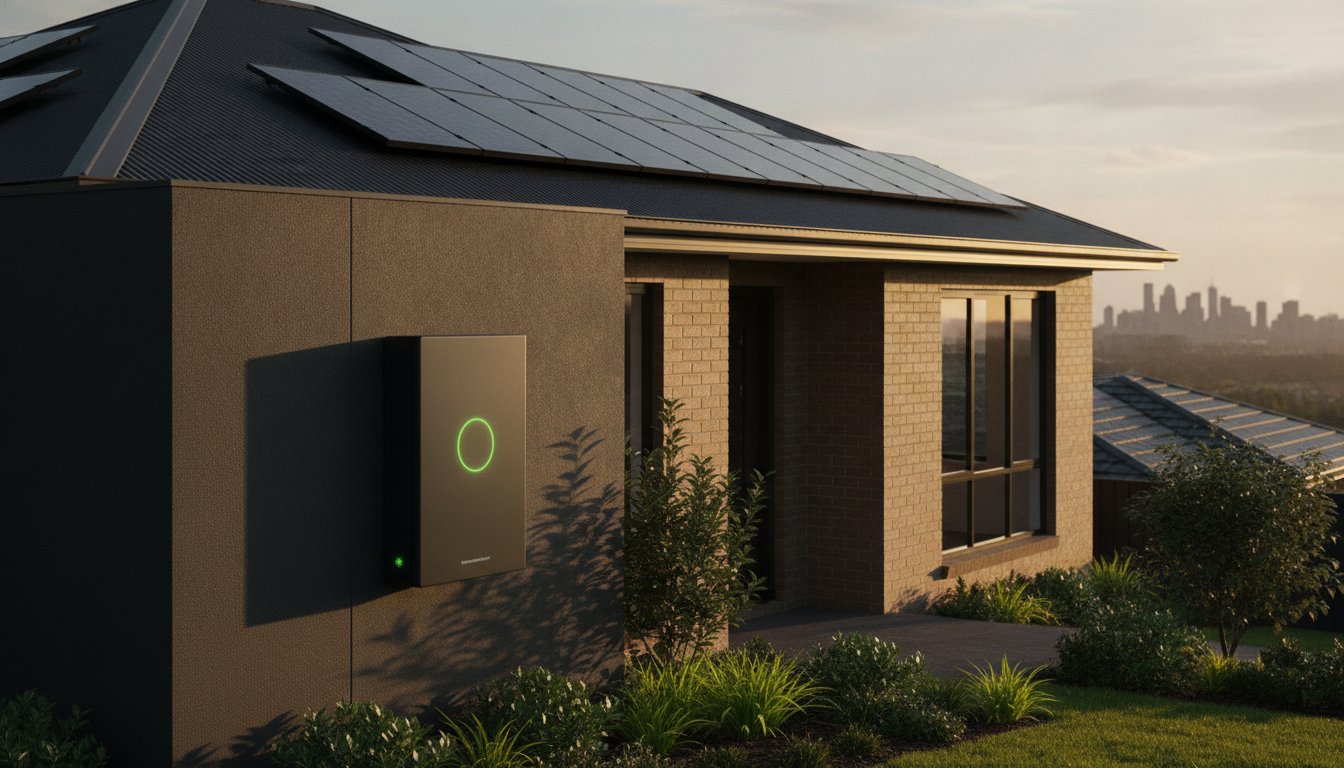
Exporting solar power to the grid in 2026 isn’t just a missed opportunity. It’s a financial drain. With Victorian feed-in tariffs plummeting to near-zero, sending energy back to the wires is a losing game. You’ve likely noticed your quarterly bills remain stubborn despite your rooftop investment. It’s a common frustration for those looking into residential solar battery systems Melbourne. You want to stop subsidising retailers. You want to power your own life. This guide delivers the expert insights required to master the 2026 market.
We’ll cut through the noise of the federal Cheaper Home Batteries Program and the closing Victorian rebate windows. You will learn to select VPP-ready storage that provides total blackout protection and effortless integration with your EV charging setup. We’re breaking down the 1 July income threshold shifts and the latest storage tech to ensure your system is future-proof. Stop fearing the ‘solar cowboys’. Start building your own energy independence today.
Key Takeaways
- Master the difference between usable and nominal capacity to ensure you aren’t overpaying for storage you can’t actually access.
- Identify why a 100% Depth of Discharge (DoD) has become the 2026 benchmark for high-performance residential solar battery systems Melbourne.
- Compare the streamlined efficiency of all-in-one systems against the scalability of modular battery stacks to find your home’s perfect fit.
- Learn how to navigate the 2026 federal rebate landscape and VPP incentives to maximise your return on investment and slash payback periods.
- Understand why local grid expertise is non-negotiable for a safe, compliant installation that guarantees reliable blackout protection.
Why 2026 is the Turning Point for Melbourne Residential Solar Battery Systems
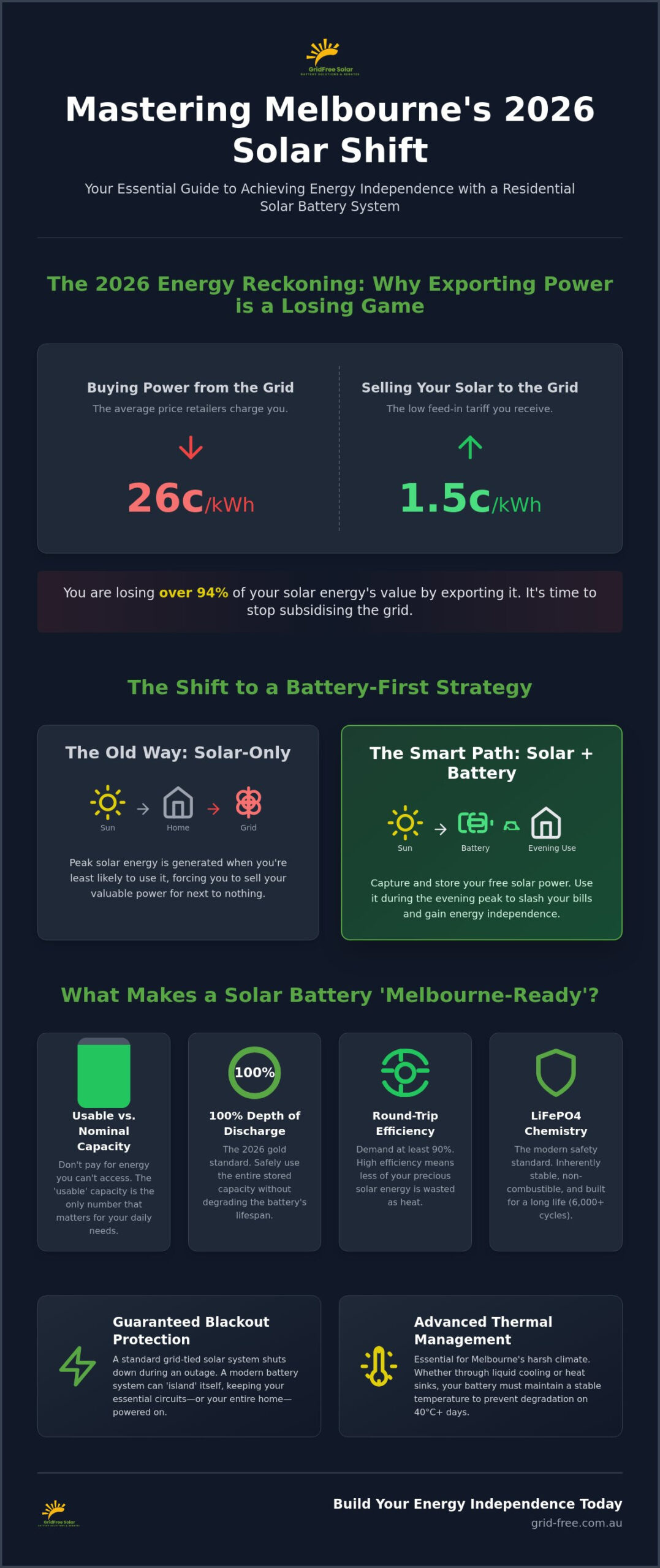
2026 marks a definitive reckoning for Victorian energy users. The old solar model of “export and earn” has collapsed. It’s a hard truth. Selling power back to the grid is now a losing game. While retailers charge you roughly 26c/kWh for electricity, many are offering as little as 1.5c/kWh for your excess solar. You’re effectively subsidising the grid with your own roof. This massive price gap is why residential solar battery systems Melbourne have transitioned from luxury upgrades to essential financial assets.
Melbourne’s grid is evolving rapidly. We are moving toward a decentralised network where the most resilient homes are those that act as independent power stations. By integrating home energy storage systems, you stop being a victim of volatile market rates. You take control. Future-proofing your home means ensuring you aren’t reliant on a 100-year-old grid that is struggling to keep pace with modern demand. It’s about security. It’s about intelligence. It’s about making your infrastructure work for you, not the energy companies.
The Shift from Solar-Only to Battery-First
Solar panels without storage are only doing half the job. They generate peak energy while you’re at work, only to bleed that value back to the grid for a pittance. A battery-first approach changes the priority to self-consumption. This is the defining metric for 2026. You capture the harsh midday sun and store it for the evening peak, when electricity rates are at their highest. To further reduce your home’s cooling demand during these peaks, you can check out Aussie Online Blinds for effective solar heat management. It’s about using your own energy on your own terms. If you aren’t storing it, you’re losing it. Stop donating your power. Start keeping it.
Blackout Protection in Victoria
Victorian network outages are an unfortunate reality. Most homeowners don’t realise that a standard grid-tied solar system shuts down during a blackout. It’s a safety feature, but it leaves you in the dark. Modern residential solar battery systems Melbourne offer backup-enabled functionality. This allows your home to “island” itself from the grid during a failure. Whether you choose to back up essential circuits like your fridge and Wi-Fi or invest in whole-of-home protection, the result is the same. Security. Your lights stay on while the rest of the street goes dark. Reliability is no longer a luxury. It’s a requirement for the modern Melbourne home.
This reliability ensures your home remains secure during an outage. For homeowners looking to maintain the safety and functionality of other entry points, you can learn more about We Do Garage Doors for professional maintenance.
Key Technical Specs: What Makes a Solar Battery ‘Melbourne-Ready’?
Technical literacy is your best defence when selecting residential solar battery systems Melbourne. Don’t get blinded by the big numbers on a glossy brochure. You need to understand what those figures mean for your daily power usage. Usable capacity is the only metric that truly matters. While nominal capacity represents the total energy a battery can hold, usable capacity is the actual amount you can draw without damaging the unit. If a system claims 13.5kWh but only allows for 90% discharge, you’re effectively paying for energy you can’t use.
Depth of Discharge (DoD) has evolved significantly. In 2026, 100% DoD is the gold standard. This means you can use the entire stored capacity every single night without shortening the battery’s lifespan. Pair this with a round-trip efficiency of at least 90%. This figure tracks how much energy is lost during the conversion from DC to AC and back again. High efficiency ensures that the power your panels generate actually makes it to your appliances, rather than being wasted as heat.
Melbourne’s climate presents unique challenges. Our 40-degree summer days can be brutal on sensitive electronics. Effective thermal management is non-negotiable. Whether it’s liquid cooling or advanced passive heat sinks, your system must maintain a stable internal temperature to prevent degradation. You can find more on foundational standards in the Victorian Government’s Solar Battery Buyers Guide, but local performance requires a system designed for our specific temperature swings.
LiFePO4 Chemistry: The Modern Safety Standard
Lithium Iron Phosphate (LiFePO4) is now the preferred chemistry for residential storage. It’s significantly more stable than older lithium-ion variants. It doesn’t suffer from thermal runaway. It’s built for the long haul. You should expect a cycle life of at least 6,000 charges. Over a 10-year period, this chemistry maintains its integrity far better than traditional alternatives. LiFePO4 offers superior chemical and thermal stability, making it the safest choice for installation inside or near a family home.
Smart Inverter Integration
The inverter is the brain of your energy ecosystem. For residential solar battery systems Melbourne, a hybrid inverter is essential. It manages the flow of electricity between your panels, your battery, and the grid simultaneously. You must ensure your hardware matches your home’s electrical architecture. Single-phase and three-phase homes require different configurations to operate at peak efficiency. Your system must also be VPP-ready. This ensures you can participate in Virtual Power Plants, turning your battery into an active income-generating asset during peak demand events. If you’re unsure which configuration fits your switchboard, it’s worth exploring options for tailored battery upgrades with a specialist.
Comparing the Best Residential Solar Battery Systems for Melbourne Homes
Selecting the right architecture is a high-stakes decision. In 2026, the Melbourne market is split between sleek, all-in-one units and flexible modular stacks. All-in-one systems integrate the battery and inverter into a single chassis. They look great. They perform consistently. However, modular systems offer a distinct advantage for homeowners who anticipate changing energy needs. You can start with a smaller base and stack additional modules as your budget or demand increases. It’s about scalability. It’s about future-proofing your investment against rising costs.
High-voltage systems are quickly becoming the industry preference for residential solar battery systems Melbourne. By operating at a higher voltage, these systems reduce current flow, which minimises energy loss during discharge. They are inherently more efficient than older low-voltage alternatives. This efficiency translates directly into lower power bills. When reviewing options, scrutinise the warranty beyond the 10-year headline. You need a performance guarantee that specifies at least 70% capacity retention at the end of the term. Equally critical is a labour warranty. If a unit fails, you don’t want to be stuck paying for the technician’s time to swap it out. Demand total protection.
Fixed Capacity vs. Modular Systems
Large families in Melbourne often find that a fixed 13.5kWh unit provides the best upfront value. It covers the heavy evening load of multiple appliances, heaters, and home entertainment systems. But for smaller households, a modular 5kWh or 10kWh setup is often the smarter financial move. It lowers the entry cost while maintaining an clear upgrade path. A cost-per-kWh analysis usually reveals that while larger units have a lower unit price, modular systems prevent you from over-investing in capacity you won’t actually use during the shorter winter days.
AC-Coupled vs. DC-Coupled Upgrades
The path you take depends on your existing infrastructure. If you’re upgrading an existing solar battery or adding storage to an older solar-only system, AC-coupling is the standard. It connects the battery to the AC side of your home, making it highly versatile for retrofits. For new installations, DC-coupling is superior. It allows the solar energy to move directly into the battery without multiple conversion steps. This preserves more of your generated power. Choose the architecture that aligns with your property’s specific requirements to ensure maximum efficiency for your residential solar battery systems Melbourne.
Maximising ROI: Victorian Rebates and Virtual Power Plants (VPPs)
The financial logic of solar has fundamentally changed. In 2026, the “New Math” of solar focuses on the massive gap between retail prices and feed-in tariffs. With Melbourne electricity averaging 26c/kWh and retailers offering a median export rate of just 1.5c/kWh, every kilowatt-hour you send to the grid is a missed opportunity. Residential solar battery systems Melbourne allow you to capture that value. You’re no longer playing the retailer’s game. You’re winning it. By storing your own generation, you are effectively “buying” power from yourself at 0c/kWh instead of 26c/kWh. That 26-cent difference is your direct profit margin.
Government incentives remain the most powerful tool to slash your initial outlay. The federal Cheaper Home Batteries Program now provides an upfront discount of approximately $252 per usable kWh of capacity. This is applied directly at the point of sale by your installer. For a standard 10kWh system, this represents a significant reduction in your capital investment. While the Victorian state battery loan has closed, the Solar Homes Program still offers a $1,400 rebate for solar panels. However, you must act with urgency. The household income threshold for this rebate will drop from $210,000 to $150,000 on 1 July 2026. You can check your eligibility for the Victorian rebate and federal incentives to ensure you don’t miss this window. Securing these discounts can bring your payback period down to as little as 5 to 7 years.
Claiming the Victorian Battery Rebate
The application process is streamlined but strict. First, you must obtain a formal quote from an authorised retailer. Second, verify your household income and property value against the current Solar Victoria limits. Finally, submit your application through the official portal before the 1 July threshold change. Precision matters here. Ensure your system meets the VPP-ready requirement to qualify for the federal discount. If you want to see how these numbers apply to your home, request a customised ROI assessment today.
VPPs: The Secret to Faster Payback
Virtual Power Plants (VPPs) are the high-tech shortcut to grid independence. When you join a VPP, you allow the grid to tap into a small portion of your stored energy during periods of extreme demand. In return, you receive generous credits on your Melbourne power bill. It transforms your battery from a passive storage tank into an active income generator. While this does add extra cycles to your battery, the financial rewards often outweigh the slight increase in wear. It is the smartest way to turn your infrastructure into an asset that pays for itself.
Professional Installation: Why GridFree Solar is Melbourne’s Trusted Choice
Hardware is only half the battle. A high-performance battery requires precision installation to reach its theoretical peak. A Melbourne solar panel installation isn’t just about mounting units to a wall. It’s about deep technical integration. Poorly configured residential solar battery systems Melbourne suffer from communication errors, reduced efficiency, and shortened lifespans. GridFree Solar eliminates these risks. We don’t deal in cookie-cutter kits. Every system we deploy is an “Integrated Solution” designed for your specific property and energy goals. We use only Tier 1 components and certified installers who understand the high stakes of Victorian energy infrastructure.
Our commitment doesn’t end when the last bolt is tightened. We provide comprehensive post-installation support. This includes active monitoring of your system’s health to ensure it delivers the ROI we projected. If there’s a dip in performance or a communication fault with the grid, we know about it. We use intelligent software to track your self-consumption metrics in real time. This proactive approach protects your investment for the full decade of its warranty and beyond. Don’t settle for “solar cowboys” who disappear after the invoice is paid. Demand a partner that stays the course.
The GridFree Difference in Melbourne
Melbourne’s electrical grid is complex. Different distribution networks like United Energy, Citipower, and Powercor have unique export limits and technical requirements. We understand these nuances. We ensure your energy storage solutions in Melbourne are fully compliant and optimised for your specific local network. Our quoting process is transparent. We provide honest ROI projections based on your actual usage data. No hidden fees. No inflated promises. Just professional expertise tailored to the Victorian landscape.
Start Your Journey to Grid Independence
The path to total energy control begins with a professional site assessment. Our experts look at more than just your switchboard. We evaluate your roof’s structural integrity, shading profiles, and potential for future electrification. Whether you are preparing for a full EV charging setup or want to transition your heating to high-efficiency heat pumps, we design with the future in mind. It’s time to stop being a passive consumer. Get a tailored solar battery quote from GridFree Solar today and take command of your home’s energy future.
Take Command of Your Energy Future
The window for maximising your solar investment is closing fast. You’ve seen how 100% Depth of Discharge and LiFePO4 chemistry have become the non-negotiable technical standards for 2026. You also know that waiting past the 1 July rebate threshold could cost your family thousands in lost incentives. Transitioning to residential solar battery systems Melbourne is no longer just an environmental choice. It’s a strategic financial move designed to protect your household from a volatile grid and predatory retail rates. You have the knowledge. Now you need the right partner.
GridFree Solar delivers the precise local expertise required to navigate this complex energy shift. We provide expert Victorian rebate guidance and deploy only certified Tier 1 component installers. Our team are specialists in Melbourne-specific system design, ensuring your hardware handles everything from overcast winter gloom to 40-degree summer heatwaves. We don’t just install batteries. We build energy security.
Secure your Melbourne energy independence—get a professional solar battery quote from GridFree Solar.
Your home is ready to become its own intelligent power station. Take the final step toward total grid independence today and enjoy the peace of mind that comes with reliable, self-generated power.
Frequently Asked Questions
Is a solar battery worth it in Melbourne in 2026?
A solar battery is absolutely worth the investment in 2026 because the gap between retail electricity prices and export tariffs has reached a breaking point. With Melbourne retailers charging roughly 26c/kWh while offering as little as 1.5c/kWh for your exports, you lose money every time you send power back to the grid. Storing that energy for evening use is the only way to claw back your ROI. It’s about self-consumption. You stop donating power and start owning it.
How much does a residential solar battery system cost in Australia?
Typical costs for a high-quality battery installation in 2026 range between $9,000 and $15,000 depending on the capacity and technical specs. This initial outlay is significantly offset by the federal Cheaper Home Batteries Program, which currently provides a discount of approximately $252 per usable kWh. Payback periods for residential solar battery systems Melbourne have now compressed to between 5 and 12 years as grid prices continue to escalate.
Can I add a battery to my existing solar system in Victoria?
You can certainly add storage to an existing setup using an AC-coupled configuration. This method allows the battery to function alongside your current solar inverter without requiring a total system replacement. It’s an ideal path for Victorian homeowners who installed solar-only systems years ago and now want to eliminate their evening power bills. We specialise in these upgrades to ensure seamless integration with your existing panels.
What happens to my solar battery during a blackout?
Your battery will only provide power during a blackout if it has been installed with backup or “islanding” capabilities. Standard grid-tied systems are designed to shut down during outages to protect technicians working on the lines. For true energy security, you need a backup-enabled system that can automatically disconnect from the grid and power your essential circuits, such as refrigeration, lighting, and Wi-Fi, until the fault is cleared.
How long do modern solar batteries last in Melbourne’s climate?
Modern LiFePO4 batteries are engineered to last at least 10 years or roughly 6,000 cycles while retaining 70% of their original capacity. Melbourne’s volatile climate requires systems with robust thermal management to handle 40-degree heatwaves and freezing winter nights. High-quality units installed in shaded, well-ventilated areas will maintain their integrity far better than cheaper alternatives. Reliability is a product of both chemistry and professional placement.
Do I still get a feed-in tariff if I have a solar battery?
You still receive a feed-in tariff for any excess energy sent to the grid once your battery has reached 100% capacity. However, with tariffs at historic lows, the financial gain is minimal. A smarter strategy for residential solar battery systems Melbourne is joining a Virtual Power Plant (VPP). This allows you to earn significantly higher credits by discharging your stored power to support the grid during rare peak demand events.
What is the best solar battery for a 4-bedroom home in Melbourne?
A typical 4-bedroom home usually requires a battery with 10kWh to 13.5kWh of usable capacity to cover a standard evening load. This size ensures you can run climate control, appliances, and home entertainment without drawing expensive peak power from the grid. If you are planning for an electric vehicle or have a high-draw pool pump, we recommend a modular system that allows you to stack additional storage as your needs grow.
Are there still government rebates for solar batteries in Victoria?
Yes, the federal Cheaper Home Batteries Program is currently the primary incentive, providing an upfront discount based on your battery’s usable capacity. While the Victorian state battery loan is closed, the $1,400 solar panel rebate remains available for eligible households. You must act before 1 July 2026 to take advantage of the higher $210,000 household income threshold before it drops to $150,000. These incentives are designed to accelerate your path to grid independence.