
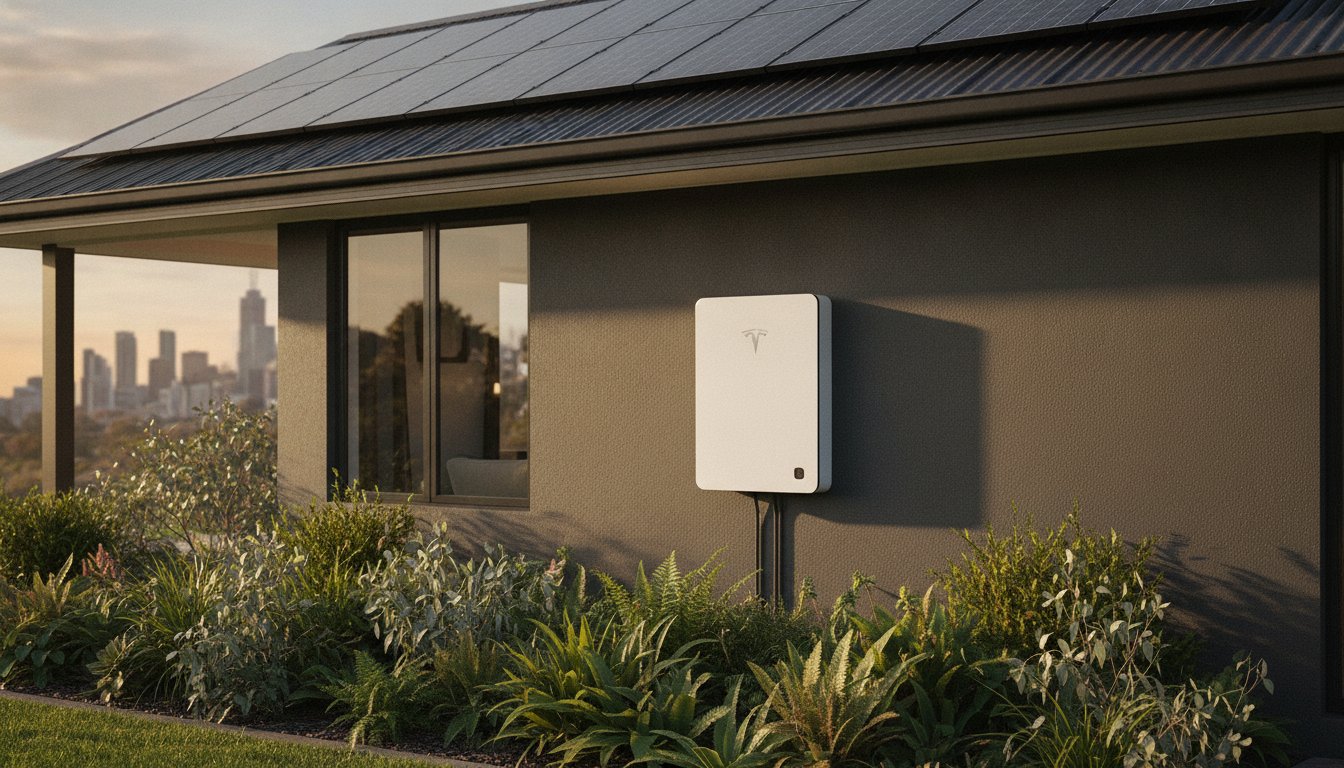
Most Melbourne homeowners are still paying for a grid that fails them exactly when the storms hit and the prices spike. You’ve likely watched your Victorian power bills climb while the reliability of the network drops. It’s a common frustration. You have solar panels on your roof, yet you still feel tethered to an expensive energy market. Integrating a tesla powerwall 3 changes that dynamic instantly by giving you total control over your generated power.
This guide reveals how this system transforms your home into a high-performance private utility. You’ll discover how to slash your bills to near-zero and gain total security during the next big Melbourne outage. We will break down the 2026 federal rebate structures, including how the 6.8 STC factor impacts your savings. You’ll also learn how to secure the $750 Tesla manufacturer incentive before the June 30 deadline. We explain exactly why this hardware, with its massive 11.04 kW continuous power output, is the smartest upgrade for your existing solar array in the current climate.
Key Takeaways
- Superior backup power. The tesla powerwall 3 delivers a massive 11.04 kW output, allowing you to run heavy appliances like air-con during a blackout.
- Financial optimisation. Use time-of-use arbitrage and self-consumption strategies to slash your electricity costs and achieve near-zero bills.
- Time-sensitive savings. Lock in the federal “Cheaper Home Batteries” rebate and the $750 manufacturer incentive before the 2026 deadlines expire.
- Expert Victorian design. Ensure your solar and battery installation is tailored for Melbourne’s climate and meets all local rebate eligibility requirements.
What is the Tesla Powerwall 3 and Why is it Dominating the 2026 Australian Market?
The tesla powerwall 3 represents the most significant shift in residential energy storage since the original Tesla Powerwall first hit the market. It is a fully integrated unit. This means the battery and the solar inverter live in a single, streamlined chassis. In 2026, Melbourne homeowners are choosing this system because it solves the complexity of old-school solar setups. It is the definitive choice for those seeking true grid independence.
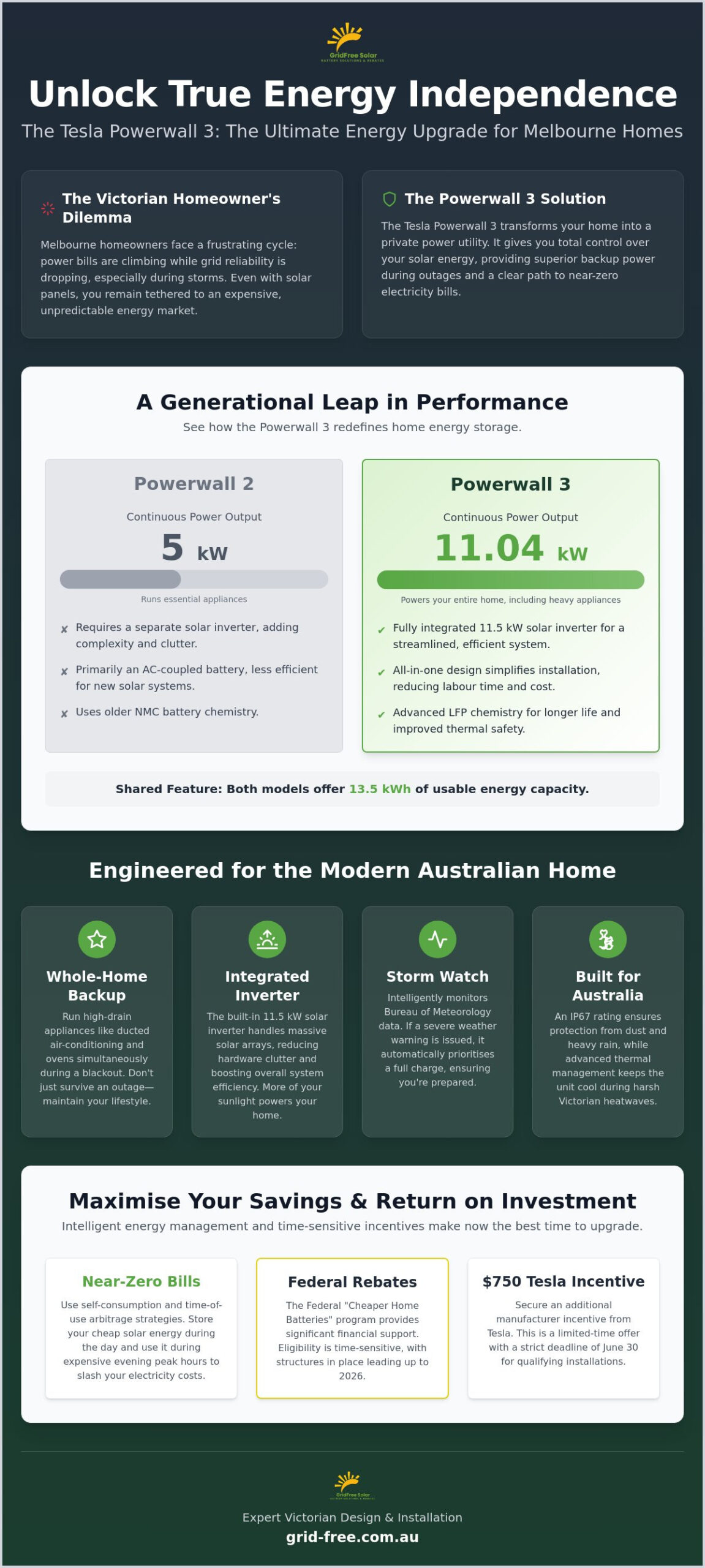
The transition from Powerwall 2 to this new model isn’t just an incremental update. It is a total redesign. The previous generation was primarily an AC-coupled battery. While it was excellent for adding storage to existing systems, it often required a separate solar inverter to function alongside it. The new model eliminates this requirement. It simplifies the entire electrical architecture of your home. By housing everything in one enclosure, the installation process is faster and more reliable. This is critical for Victorian households looking to upgrade their energy systems before the next rebate deadline.
The Integrated Inverter Advantage
The built-in 11.5 kW solar inverter is a powerhouse. It handles massive solar arrays with ease. You no longer need a separate, bulky inverter mounted next to your battery. This reduces hardware clutter on the side of your home significantly. Efficiency gains are real. Converting DC to AC once instead of multiple times means more of your harvested sunlight actually powers your fridge or charges your car. It’s a cleaner, smarter way to manage energy.
Built for the Australian Climate
Melbourne’s weather is notoriously unpredictable. One day it is a 40-degree scorcher; the next, a wild storm rolls in from the bay. This unit is ready. It features advanced thermal management to keep the cells cool during Victorian heatwaves. An IP67 rating ensures it is completely dust-tight and protected against heavy rain. The intelligent “Storm Watch” feature is a standout. It monitors Bureau of Meteorology data and automatically prioritises a full charge if a severe weather warning is issued for your suburb. You stay powered while the rest of the street goes dark.
Tesla Powerwall 3 vs Powerwall 2: A Technical Comparison
Choosing between the older generation and the latest tesla powerwall 3 isn’t just about aesthetics. It’s about raw performance. While both units share a 13.5 kWh usable capacity, the internal architecture has evolved completely. The most significant change is the shift to Lithium Iron Phosphate (LFP) chemistry. This move ensures a longer life cycle and better thermal stability. It’s a pragmatic choice for the harsh Australian sun. You can find more technical details in this in-depth review of the Powerwall 3.
Power Output and Backup Performance
The Powerwall 2 was limited to a 5 kW continuous output. That was enough for lights and a fridge, but it often struggled when you turned on the kettle or the oven. The tesla powerwall 3 obliterates that ceiling with an 11.04 kW continuous output. This is more than double the strength of its predecessor. It means you can run high-drain appliances like ducted air-conditioning, pool pumps, and electric ovens simultaneously during a blackout. You aren’t just surviving an outage; you’re maintaining your lifestyle. It provides a true whole-home backup experience that previous models simply couldn’t match.
Installation Efficiency for Melbourne Retrofits
If you’re considering a solar battery replacement Melbourne homeowners should note the reduced labour time. The integrated design means fewer components to mount and wire. It connects directly to your existing solar array, bypassing the need for a separate solar inverter. This streamlined approach cuts down on installation complexity and minimises the footprint on your wall. It is a faster, cleaner process that gets your system online with minimal disruption.
For those wondering about mixing generations, the answer is nuanced. While you can’t “stack” a PW2 and PW3 in a single DC string, they can often coexist on the same property through AC coupling. This allows you to expand your storage without discarding your existing investment. If you’re unsure if your current setup is ready for an upgrade, you can assess your home’s compatibility with our specialist team. The goal is a seamless transition to modern energy independence.
Maximising ROI: How the Powerwall 3 Saves You Money in Melbourne
Installing a tesla powerwall 3 is a strategic financial move, not just a tech purchase. In Melbourne, where retail electricity prices often dwarf feed-in tariffs, sending your excess solar back to the grid is a losing game. You’re effectively selling your power for cents and buying it back for dollars. Self-consumption changes this. By storing every kilowatt your panels produce, you ensure your home runs on “free” energy long after the sun sets over Port Phillip Bay. This protection extends to your wallet during wild Victorian weather. The Storm Watch feature ensures your battery is charged before a blackout, preventing the significant financial loss associated with spoiled food or home office downtime.
The system’s intelligence shines through Time-of-Use (ToU) arbitrage. The Tesla App monitors Victorian energy market fluctuations in real time. It automatically charges your battery from the grid when rates are at their lowest, typically in the middle of the night, and discharges that power during expensive evening peaks. This automation ensures you are always using the cheapest possible electricity without lifting a finger. To make the most of these savings, staying updated on current Victorian battery rebates and incentives is essential for reducing your initial outlay and accelerating your break-even point.
Virtual Power Plants (VPP) in Victoria
Participating in a VPP is a powerful way to accelerate your return on investment. When you join a VPP, you allow your tesla powerwall 3 to provide tiny bursts of support to the grid during periods of extreme demand. In exchange, you receive ongoing credits on your power bill. It turns your battery into a passive income generator while it sits on your wall. For a deeper look at how this fits into a broader strategy, check our guide on energy storage solutions Melbourne homeowners are using to break free from the big retailers.
The “Charge on Solar” Feature
For Melbourne commuters, the “Charge on Solar” feature is a game-changer. It allows your Powerwall to communicate directly with your Tesla EV. The system ensures your car only charges using excess solar energy that would otherwise be wasted. It effectively eliminates your “fuel” costs. You can set smart schedules to avoid peak grid charges entirely. It is a seamless, closed-loop system. It works to maximise the value of every photon hitting your roof.
Victorian Battery Rebates and Incentives in 2026
The incentive landscape for the tesla powerwall 3 in 2026 is complex but rewarding for those who act with urgency. You must navigate both state-level eligibility and federal programmes to maximise your return. While the dedicated Victorian battery loan has concluded, homeowners can still access significant savings through the federal “Cheaper Home Batteries” programme and the state’s solar panel rebate. For a deep dive into the specific state-level changes, consult our Victorian battery rebate 2024 to 2026 guide. Timing is everything this year.
Eligibility criteria have tightened significantly. A major shift occurs on July 1, 2026, when the combined household income threshold for the Victorian solar panel rebate drops from $210,000 to $150,000. If your household income sits between these figures, you must submit your application before 5 pm on June 30 to secure your $1,400 rebate. Additionally, Tesla’s “Next Million Powerwall Rebate” offers an immediate $750 cashback per unit. This manufacturer incentive requires you to place your order by June 30, 2026, and complete the installation by the end of the year. Delaying your decision by even a few weeks could cost you thousands in lost incentives.
Solar Victoria Requirements
To qualify for any state-based support, you must use a Solar Victoria authorised retailer. This is non-negotiable. The hardware itself must also appear on the Solar Victoria “Approved Product List” (APL). As a leading specialist, we ensure every component of your system meets these rigorous standards. The process begins with a formal quote, followed by a rebate eligibility check through the Solar Victoria portal. We guide you through each step to ensure your documentation is flawless and your approval is fast-tracked.
Small-scale Technology Certificates (STCs)
Federal STCs provide the largest upfront discount on your tesla powerwall 3. For the remainder of 2026, the STC factor is set at 6.8. This applies to the first 14 kWh of capacity, meaning the 13.5 kWh Powerwall 3 qualifies for the full Tier 1 benefit. This factor is scheduled to drop to 5.7 on January 1, 2027. Acting now locks in the higher certificate value before the scheduled phase-out reduces your savings. GridFree Solar manages the entire STC creation and trading process for you. We apply the value as an upfront discount on your quote, so you don’t have to wait months for a refund.
Don’t leave your savings to chance while the 2026 deadlines approach. You can lock in your 2026 rebates and incentives by speaking with our Victorian installation experts today.
Professional Tesla Powerwall 3 Installation by GridFree Solar
Precision matters when you’re integrating the world’s most advanced energy hardware into your home. A tesla powerwall 3 is only as effective as the electrical engineering behind its installation. Choosing a local Melbourne specialist ensures your system is configured for our specific network conditions and volatile weather patterns. We understand the nuances of Victorian grid connection requirements. Our team doesn’t just bolt a box to your wall; we design a high-performance energy engine tailored to your household’s unique consumption profile. This local expertise is the difference between a battery that simply sits there and one that actively slashes your bills.
Safety remains our absolute priority. Every GridFree Solar installer is Clean Energy Council (CEC) and Solar Accreditation Australia (SAA) accredited. This isn’t just about compliance. It’s about ensuring your tesla powerwall 3 operates at peak efficiency for its entire decade-plus lifespan. We handle the complex technicalities of the integrated 11.04 kW inverter, ensuring your solar strings are optimised for maximum harvest. By choosing an accredited specialist, you also guarantee your eligibility for the 2026 federal STC discounts and the $750 Tesla manufacturer rebate. We take the technical burden off your shoulders.
For homeowners and businesses in Western Australia seeking this same level of professional care for their electrical infrastructure, Inlightec Electrical Solutions delivers expert residential and commercial services across the Perth region.
The GridFree Installation Process
Our journey begins with a comprehensive site assessment. We don’t believe in “one size fits all” solutions. Melbourne’s architecture varies from classic weatherboards to modern brick builds, and each requires a bespoke mounting strategy. We identify the optimal location for thermal management and accessibility. Once the hardware is secured, we manage the entire grid connection process with your distributor. We don’t leave until your Tesla App is fully configured. You’ll walk away with real-time visibility into your energy production, storage levels, and cost savings. Our post-installation support ensures you remain confident in your new energy independence.
Future-Proofing Your Home
Energy needs change as families grow or as you transition to a fully electric lifestyle. The modular nature of this system allows for seamless expansion. If your 13.5 kWh capacity needs to increase in the future, we can “stack” additional units to meet that demand. This scalability is vital for long-term security. For business owners, this logic extends to your workplace. We specialise in commercial solar installation Melbourne companies use to shield themselves from rising operational costs. Whether it’s your home or your business, we build systems that grow with you.
The 2026 rebate deadlines are approaching quickly. Don’t risk missing out on thousands of dollars in savings by delaying your decision. Take the final step toward total energy independence and contact GridFree Solar for a custom Powerwall 3 quote today. Let’s get your Melbourne home off the grid and into the future.
Take Control of Your Energy Future Today
Integrating a tesla powerwall 3 into your home is a declaration of independence from rising energy costs and grid instability. You’ve seen the technical superiority of the integrated inverter. You understand the massive power output that keeps your whole home running through the worst Melbourne storms. The financial logic is undeniable. Storing your own solar harvest and participating in VPPs turns a passive rooftop asset into a high-yield energy engine.
Timing is critical. The June 30 deadline for the $750 Tesla incentive and the Victorian income threshold shift is fast approaching. As a Tesla Certified Installer and Victorian Government Approved Retailer with over 1,000 Melbourne installations completed, GridFree Solar ensures you lock in every available cent of savings. We take the complexity out of the paperwork. We remove the guesswork from the engineering.
Don’t wait for the next price hike or blackout to act. Secure Your Tesla Powerwall 3 with GridFree Solar Melbourne and start your journey toward near-zero bills today. You deserve the security and freedom of a home that powers itself.
Frequently Asked Questions
Is the Tesla Powerwall 3 compatible with my existing solar panels?
Yes, it integrates seamlessly with almost any existing solar array. You can choose to AC-couple the battery to your current system or replace your aging inverter entirely to take advantage of the built-in 11.5 kW solar inverter. This flexibility makes it the premier choice for Melbourne homeowners looking to upgrade their current energy setup without starting from scratch.
How long does a Tesla Powerwall 3 last in Melbourne conditions?
You should expect 10 to 15 years of reliable service. The unit is specifically engineered for the volatile Victorian climate. It features an IP67 rating for superior dust and water resistance. Its advanced liquid cooling system manages 40-degree summer days effortlessly, ensuring the internal cells remain at an optimal temperature for longevity.
Can I go completely off-grid with a single Powerwall 3?
Unlikely for a standard household. While the 11.04 kW output is massive, the 13.5 kWh capacity is designed to cover a typical home’s overnight usage. True off-grid independence in Melbourne usually requires stacking two or three units. This provides enough storage to bridge the gap during consecutive cloudy winter days when solar harvest is low.
What is the difference between the Powerwall 2 and Powerwall 3?
The tesla powerwall 3 features an integrated solar inverter and more than double the continuous power output of its predecessor. The Powerwall 2 offered 5 kW of output, while the new model delivers 11.04 kW. Additionally, the newer version utilises Lithium Iron Phosphate (LFP) chemistry, which offers superior durability and a longer life cycle than the older NMC cells.
How much can I save with the Victorian battery rebate in 2026?
You can reduce your upfront costs by over $5,500 by combining available incentives. This includes approximately $3,367 from the federal “Cheaper Home Batteries” rebate, based on the current 6.8 STC factor. You can also claim the $750 Tesla manufacturer rebate and the $1,400 Victorian solar panel rebate if you meet the specific 2026 eligibility criteria.
Does the Tesla Powerwall 3 work during a blackout?
Yes, it provides near-instantaneous backup power when the grid fails. Unlike many older batteries, the high output of this system allows you to run heavy appliances like ducted air-conditioning and electric ovens during an outage. It switches over so fast that your digital clocks won’t even flash.
How many Powerwall 3 units do I need for a 4-bedroom home?
One unit is usually sufficient for a standard 4-bedroom home focusing on solar self-consumption. If your goal is total grid independence or you need to run high-load items like a heated pool pump and multiple air-con units overnight, we often recommend installing two units. This ensures you don’t exhaust your 13.5 kWh capacity before dawn.
What is the warranty period for a Tesla Powerwall 3 in Australia?
The system comes with a comprehensive 10-year warranty. This cover protects the battery cells, the integrated solar inverter, and the management electronics. Tesla guarantees that the unit will maintain at least 70% of its original 13.5 kWh capacity by the end of the warranty period, providing long-term security for your investment.