

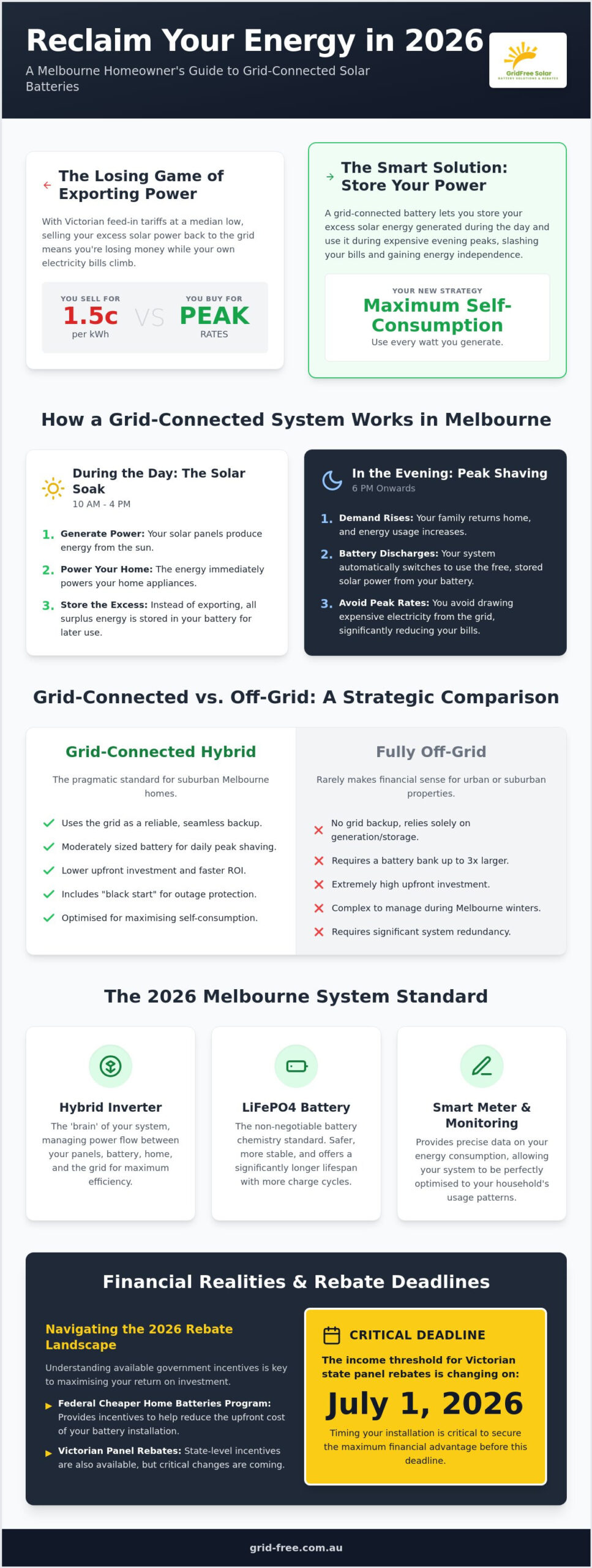
With Victorian solar feed-in tariffs hitting a median low of just 1.5c per kilowatt hour, exporting your excess energy is now a losing game. You’re essentially subsidising the grid while your own peak electricity rates continue to climb. It’s time to stop the waste. Integrating a grid connected solar battery Melbourne homeowners can rely on is the definitive strategy to reclaim your energy independence and protect your financial future in 2026.
We understand the frustration of watching your solar investment’s value eroded by low export rates. This guide promises to show you how to flip the script, transforming your home into an intelligent energy hub that keeps your power where it belongs. You’ll discover how to slash quarterly bills and secure a reliable backup without the prohibitive upfront costs of a full off-grid system.
We’ll dive into the latest federal Cheaper Home Batteries Program incentives and explain why the July 1, 2026 income threshold change for state panel rebates makes timing critical. You’ll learn the technical differences between hybrid and off-grid setups and see exactly how to navigate Melbourne’s shifting energy landscape with confidence. It’s time to stop donating your solar and start owning it.
Key Takeaways
- Master the hybrid standard to store your ‘solar soak’ and eliminate reliance on the grid during expensive evening peaks.
- Secure your financial advantage by understanding how a grid connected solar battery Melbourne system bypasses record-low feed-in tariffs.
- Navigate the 2026 rebate landscape, including critical income threshold changes for Victorian homeowners before the July 1 deadline.
- Compare the pragmatic benefits of grid-connected storage against complex off-grid systems to find the right fit for your suburban postcode.
- Learn how customised energy modelling ensures your hardware is optimised for Melbourne’s unique weather patterns and peak demand cycles.
What is a Grid-Connected Solar Battery? Defining the 2026 Standard
The Melbourne energy landscape has shifted. Installing a grid connected solar battery Melbourne system means you’re no longer at the mercy of fluctuating spot prices. This technology allows you to store the energy your panels generate during the day while remaining tied to the city’s electricity network. It functions as a bridge between solar generation and grid reliability. You gain the autonomy of a private power plant without the risks of total isolation.
In 2026, the term “Hybrid” is what you’ll hear most from Victorian installers. It refers to a system where a single inverter manages both your solar panels and your battery storage. This is the new standard for efficiency. It eliminates the need for multiple expensive components and streamlines your home’s power flow. Understanding what is a battery energy storage system is the first step toward energy mastery. For most Melbourne households, the goal isn’t total independence; it’s maximum self-consumption. You want to use every watt you generate rather than selling it back for a pittance.
Hybrid vs. Off-Grid: The Critical Distinction
Going fully off-grid is a romantic notion that rarely makes financial sense in the suburbs. Off-grid systems require massive redundancy to account for Melbourne’s unpredictable winters. You’d need a battery bank three times larger just to survive a week of overcast weather. This drives the upfront investment into the stratosphere. A grid-connected system uses the network as a permanent safety net. You use your stored energy first. If your demand exceeds your storage, the grid provides a seamless backup. Modern 2026 hardware also includes “black start” capabilities. This ensures your solar panels can still charge your battery during a local network outage, keeping your essential appliances running when the neighbourhood goes dark.
Key Components of a Modern Melbourne Setup
A high-performance system relies on three core technologies. The first is the Hybrid Inverter. This is the brain of your home. It directs traffic, deciding in milliseconds whether to send power to your air conditioner, your battery, or the grid. In 2026, Lithium Iron Phosphate (LiFePO4) has become the non-negotiable battery chemistry standard. It offers superior thermal stability and a significantly longer lifespan than older lithium-ion variants. It’s safer for your home and lasts for thousands more cycles. Finally, smart meters provide the data. These devices track your consumption patterns with precision. They ensure your grid connected solar battery Melbourne setup is always optimised to minimise your reliance on expensive peak-period electricity.
How Grid-Connected Storage Operates in the Melbourne Climate
Melbourne’s weather is notoriously fickle. A grid connected solar battery Melbourne system must do more than just store power; it must anticipate change. During the day, your panels perform what we call the “solar soak.” This captures every available watt of excess energy while you’re away from home. Instead of exporting that power for a median feed-in tariff of just 1.5c/kWh, you bank it for your own use. It is a simple equation of retention over waste.
The real magic happens at 6 PM. As Melbourne families return home and electricity rates skyrocket into peak territory, your battery takes over. This process, known as “peak shaving,” ensures you never pull high-tier energy from the grid. Modern 2026 software now integrates directly with local weather feeds. If the Bureau of Meteorology predicts a “four seasons in one day” event, your system adjusts its charging logic in real-time. It prioritises storage during sunny spells to ensure you’re covered when the clouds inevitably roll in over Port Phillip Bay.
Winter Performance: Charging from the Grid
Winter in Victoria presents a unique challenge. Grey skies and shorter days mean solar yields naturally drop. However, a smart 2026 setup doesn’t sit idle. Your system can be programmed to perform “grid-charging” during off-peak windows, typically in the early hours of the morning when rates are lowest. By filling your battery with cheap overnight power, you can still discharge it during the expensive morning and evening peaks. Sizing your system correctly for these winter yields is vital. You can request a professional system audit to ensure your capacity matches your household’s winter demand profile.
Smart Monitoring and App Integration
Control is now at your fingertips. High-tech energy storage solutions Melbourne homeowners prefer now come standard with AI-driven mobile apps. These platforms learn your household’s “energy fingerprint” by tracking when you use the most power. They provide real-time data on your self-sufficiency levels and send automated alerts if a grid outage is detected. While you can still check the latest Victorian Government solar rebates to help offset initial costs, the long-term value lies in this intelligent automation. The software does the heavy lifting. You simply enjoy the lower bills. It is energy management for the modern Victorian era.
Grid-Connected vs. Off-Grid: A Strategic Comparison
Choosing between full autonomy and strategic integration is the most significant decision you’ll make. For the vast majority of suburban postcodes, a grid connected solar battery Melbourne system is the only logical choice. The Victorian grid acts as your ultimate safety net. It is essentially an infinite battery that never runs dry. While an off-grid setup requires massive over-engineering to handle consecutive days of winter cloud, a grid-connected system allows for a leaner, more efficient hardware profile.
Maintenance remains a deciding factor. Off-grid systems demand constant oversight. You become the technician, managing deep-cycle health and backup generators. In contrast, grid-connected simplicity offers a “set and forget” experience. Your system manages itself, prioritising your stored solar and only tapping into the network when it makes financial sense. If your roof space is limited, as is common in inner-city Melbourne, a hybrid approach is far more viable. You don’t need a massive array to survive; you just need enough to cover your daily peak.
When Does Off-Grid Actually Make Sense?
Total independence comes with a heavy premium. Off-grid systems typically carry a price tag three times higher than their hybrid counterparts due to the sheer volume of storage and redundancy required. This path only makes sense for remote Victorian properties where the cost of running a new line to the grid is astronomical. If you’re in Brunswick or Glen Iris, the infrastructure is already there. Paying for total independence is often an emotional choice rather than a financial one. On the semi-rural fringes of Melbourne, the calculation changes slightly, but the grid usually wins on ROI.
The ‘Best of Both Worlds’ Approach
You don’t need to choose between security and savings. An integrated solar battery solution delivers the protection of a backup during outages without the massive capital outlay of an off-grid bank. This modular approach is the gold standard for 2026. It allows you to start with a standard capacity and scale up as energy prices fluctuate or your household demand grows. Installing a grid connected solar battery Melbourne households can scale ensures you aren’t overpaying for unnecessary hardware today. Future-proofing your home for 2027 and beyond requires this level of flexibility. You maintain the reliability of the grid while aggressively targeting a zero-dollar power bill.
Financial Realities: ROI and Rebates in 2026 Melbourne
The 2026 feed-in tariff reality is stark. With a median export rate of just 1.5c per kilowatt hour in Victoria, sending power back to the grid is effectively a donation to your energy retailer. Even the highest available rate of 8c/kWh fails to compete with the cost of drawing power during peak times. This massive price gap has fundamentally changed the ROI for a grid connected solar battery Melbourne homeowners install. You’re no longer looking for a cheque from the power company; you’re looking to stop writing them one.
Calculating the payback period for modern lithium storage involves looking at this price delta. When you avoid a 30c per kWh peak charge by using stored solar, the savings compound daily. Most high-quality lithium systems now offer a lifespan exceeding 10 years, meaning the battery continues to generate profit long after it has paid for itself. Understanding how to maximise solar savings relies on pushing your self-consumption rates toward 100%. The more of your own power you use, the faster the system pays for itself.
Victorian Battery Rebates and Incentives
The financial landscape has shifted from state to federal support. While the original state-run battery rebate closed on May 15, 2025, the federal Cheaper Home Batteries Program remains the primary incentive. This program provides an upfront discount based on the battery’s usable capacity using the STC system. Be aware that these certificates are scheduled for a value reduction on January 1, 2027. Timing is critical. If you’re also considering panel upgrades, the household income eligibility threshold for the $1,400 Victorian solar panel rebate drops from $210,000 to $150,000 on July 1, 2026. Review our guide on eligible batteries for Victorian rebate claims to ensure your hardware qualifies for these incentives.
VPPs: Turning Your Battery into a Revenue Stream
A Virtual Power Plant (VPP) is the most effective way to accelerate your ROI in 2026. By joining a VPP, you allow your retailer to briefly tap into your battery during extreme grid stress. In exchange, you receive ongoing credits or premium feed-in rates during these specific events. Selecting VPP compatible solar batteries Victoria ensures you have the right software interface to participate without draining your essential backup reserves. Installing a grid connected solar battery Melbourne households can link to a VPP turns a passive storage unit into an active financial asset. Most Melbourne providers now offer “backup protection” settings, ensuring you always keep a set percentage of power for your own home during an outage.
Secure your financial advantage today. You can view our range of solar and battery installation options to start your custom ROI calculation and reclaim control of your power bills.
Implementing Your Grid-Connected System with GridFree Solar
Choosing the right hardware is only half the battle. Successful integration of a grid connected solar battery Melbourne requires a partner who understands the local network’s intricacies. At GridFree Solar, we don’t believe in “off-the-shelf” solutions. Every Victorian home has a unique energy profile. We use advanced energy modelling specific to your postcode to ensure your storage capacity matches your actual consumption. This precision prevents you from over-investing in unused capacity or falling short during peak periods.
Our SAA-accredited installers are specialists in 2026-spec technology. We prioritise hardware with high discharge rates and superior thermal management. Being Melbourne-based means we’re here for the long haul. We understand the specific administrative landscapes of CitiPower, Powercor, and United Energy. We don’t just bolt boxes to walls. We build smart energy hubs designed for localized reliability. From the initial site assessment to the final rebate submission, we manage the complexity so you don’t have to.
Our Professional Installation Process
Efficiency is our benchmark. Our process is designed to be seamless and transparent, moving you from high bills to high independence quickly.
- Step 1: Data Analysis. We scrutinise your last 12 months of Melbourne power bills to identify your true peak demand windows and seasonal variations.
- Step 2: Custom Design. We engineer a system that balances your current solar yield with your 2026 household goals, ensuring the hardware is sized for maximum ROI.
- Step 3: Execution. Our team handles the physical installation and all grid-connection paperwork. We manage the rebate submission process to ensure you receive every dollar of federal and state incentive you’re entitled to.
Future-Proofing Your Melbourne Home
Energy needs change. Your system should too. We focus on modular scalability, allowing you to add extra battery modules as your family grows or your consumption patterns shift. Our systems receive regular software updates to stay optimised for the latest VPP protocols and shifting Victorian grid requirements. Don’t settle for a static system. Invest in a dynamic energy asset that evolves with the market. Contact GridFree Solar today for a tailored Melbourne energy assessment and take the first step toward total bill control.
Secure Your Energy Future Today
The window of opportunity for Victorian homeowners is narrowing. As export rates continue to plummet and rebate thresholds shift, waiting is no longer a viable financial strategy. You’ve now seen how a grid connected solar battery Melbourne system transforms your home from a passive consumer into an active energy hub. By prioritising self-consumption and leveraging VPP opportunities, you effectively insulate your household against the volatility of the national energy market. It’s about taking back the power you generate.
GridFree Solar stands ready to lead your transition. Our SAA-accredited Melbourne installers specialise in Victorian battery rebate claims and provide custom 2026 energy modelling for every home. We don’t just install hardware; we deliver long-term reliability and absolute bill security. The technology is proven. The financial incentives are clear. It’s time to stop subsidising the grid and start powering your life on your own terms. Don’t let another expensive peak period pass you by.
Maximise your Melbourne energy independence with a GridFree Solar battery solution today.
Let’s build a smarter, more resilient home together. Your future energy savings start with a single expert assessment.
Frequently Asked Questions
Is a grid-connected solar battery worth it in Melbourne in 2026?
Yes, a battery is now essential for financial viability due to record-low feed-in tariffs. With the median Victorian export rate at just 1.5c/kWh, selling power back to the grid offers almost no return. A grid connected solar battery Melbourne homeowners install allows you to store that energy and avoid peak electricity rates, which provides far greater savings than exporting ever could. It is the only way to maximise the value of your solar investment.
What is the difference between a hybrid battery and an off-grid battery?
A hybrid battery remains connected to the Victorian electricity network, using the grid as a permanent safety net. Off-grid systems are entirely isolated and require massive hardware redundancy to ensure power during consecutive days of bad weather. Hybrid systems are the pragmatic choice for Melbourne suburbs because they offer the benefits of storage without the extreme costs and maintenance of a totally independent setup. You get the best of both worlds.
Can I still use my solar battery during a grid outage in Melbourne?
You can use your battery during an outage if your system includes a backup gateway or “black start” functionality. Modern 2026 hybrid inverters are designed to automatically isolate your home from the grid during a fault, allowing your essential appliances to run on stored solar power. Not all systems include this by default. You must ensure your installer specifies backup capabilities during the design phase to maintain power when the local network fails.
How much does a grid-connected solar battery cost in Victoria?
The total investment depends on the usable capacity and the battery chemistry you choose. While prices for lithium technology have stabilised, the final cost is influenced by your existing solar setup and whether you need a hybrid inverter upgrade. Federal incentives like the Cheaper Home Batteries Program can reduce the upfront cost. It’s best to focus on the long-term ROI and self-consumption rates rather than just the initial sticker price.
Do I need to upgrade my solar panels to add a grid-connected battery?
You don’t always need new panels, but your inverter must be compatible with battery storage. If you have an older string inverter, you’ll likely need to replace it with a modern hybrid inverter to manage the grid connected solar battery Melbourne weather requires. We often recommend a system audit to check if your current panel array generates enough excess energy to actually fill a battery during the day.
How long do modern solar batteries last in the Melbourne climate?
Modern Lithium Iron Phosphate (LiFePO4) batteries typically last between 10 and 15 years. This chemistry is the 2026 standard because it handles Melbourne’s temperature fluctuations better than older lithium-ion variants. Most high-quality units are rated for 6,000 to 10,000 cycles. This means they’ll continue to provide significant storage capacity well beyond their initial payback period, making them a reliable long-term asset for your home.
Are there still solar battery rebates available in Victoria for 2026?
Federal incentives are currently the primary source of savings for Victorian battery buyers. While the original state-run battery rebate ended in May 2025, the federal Cheaper Home Batteries Program provides upfront discounts based on system capacity. Be mindful of the July 1, 2026 deadline for the Victorian solar panel rebate income threshold change. If your household income is between $150,000 and $210,000, you must act before this date to secure state panel incentives.
What is a Virtual Power Plant (VPP) and should I join one?
A VPP is a network of home batteries that work together to support the grid during periods of extreme demand. Joining one allows your energy retailer to briefly tap into your stored power in exchange for bill credits or higher feed-in rates. You should join a VPP if you want to accelerate your ROI. Most 2026 programmes allow you to set a “reserve” limit, ensuring you always have enough power kept aside for your own household needs.