
Victorian homeowners are currently sitting on a A$3,300 opportunity that many don’t realise exists. While the original state-run battery rebate officially closed in May 2025, the federal “Cheaper Home Batteries Program” has stepped in to provide aggressive upfront discounts. You’re likely feeling the pressure of rising electricity costs in Melbourne. The constant flux in government policy only makes the path to energy independence feel more complex. It’s frustrating to track shifting income thresholds and technical STC calculations while trying to make a smart financial decision for your home.
We’ve designed this guide to cut through the administrative noise and help you identify eligible batteries for Victorian rebate savings under the current 2026 framework. You’ll learn how to maximise your return on investment before the federal STC factor drops in January 2027. We will also clarify the critical July 2026 income cap changes that could lock you out of additional solar savings if you don’t move quickly. This is your definitive roadmap to securing a more affordable, self-sufficient energy future through high-performance storage solutions.
Key Takeaways
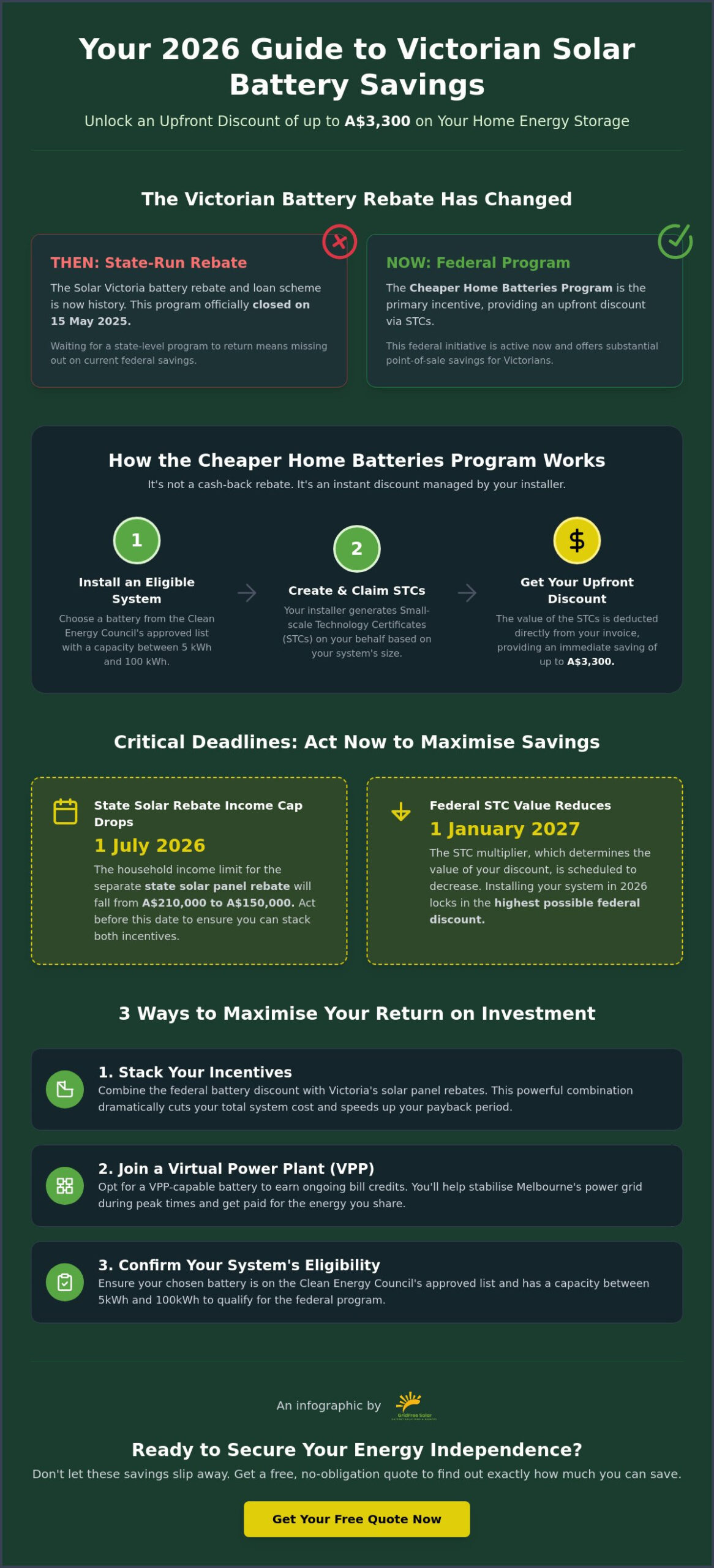
- Understand the shift from the closed state-level scheme to the federal Cheaper Home Batteries Program. This transition offers Victorian residents up to A$3,300 in upfront savings on energy storage.
- Identify eligible batteries for Victorian rebate savings. Systems must be between 5 kWh and 100 kWh capacity and appear on the Clean Energy Council approved product list to qualify.
- Act before 1 July 2026 to secure higher income eligibility. The household income threshold for state solar rebates will drop from A$210,000 to A$150,000, making early application essential.
- Maximise your return on investment by stacking federal battery discounts with state solar panel rebates. Combining these incentives can drastically reduce your net system cost and accelerate your payback period.
- Leverage Virtual Power Plants (VPPs) for ongoing financial benefits. Choosing a VPP-capable battery allows you to earn additional credits while supporting Melbourne’s energy grid stability.
The Evolution of the Victorian Battery Rebate: 2024 to 2026
The Victorian energy landscape has undergone a radical transformation. What worked in 2024 is no longer the standard. Homeowners often get stuck searching for state-level grants that no longer exist. The reality is blunt. State-funded battery rebates are history. We’ve entered a federal-first era. Understanding this shift is the only way to protect your ROI in 2026. The transition from state-run incentives to federal-backed certificates has changed how you save, when you save, and which systems you should choose.
What Happened to the 2024 Rebate?
Solar Victoria officially closed its battery rebate and interest-free loan scheme on 15 May 2025. It was a popular program that helped thousands of Melburnians transition to storage, but that tap has run dry. Many residents are still waiting for a “reboot” of state funding. This is a tactical error. Every month you wait for a non-existent state grant is another month of paying peak-hour electricity rates. The state has pivoted its focus toward solar PV rebates and VPP support, leaving battery discounts to the federal government.
The Shift to the Cheaper Home Batteries Program
On 1 July 2025, the federal government launched the Cheaper Home Batteries Program. This initiative now serves as the primary financial engine for Victorian storage. It’s managed by the Clean Energy Regulator (CER). This isn’t just a minor update. It’s a complete structural change. Instead of a state cheque, you receive an upfront discount via Small-scale Technology Certificates (STCs). This market-driven approach ensures that incentives remain sustainable while pushing for higher technology standards across the board.
Finding eligible batteries for Victorian rebate savings now means looking at the federal list of approved products. The CER oversees this process to ensure high standards of safety and performance. As Solar power in Australia continues to break records, the focus has shifted to grid stability. This is why the federal program prioritises VPP-capable systems. It’s about more than just your back pocket. It’s about a smarter, more resilient grid that rewards proactive homeowners.
The 2026 landscape is defined by urgency. The STC system is designed to phase out over time. The first major reduction in value is scheduled for 1 January 2027. If you want to maximise your upfront savings, the window is closing. You need to act before the multiplier drops. Procrastination is expensive. Secure your technology now while the federal incentives are at their peak and the income thresholds for secondary state solar rebates remain favourable.
Understanding the Cheaper Home Batteries Program in Victoria
The federal Cheaper Home Batteries Program is the new heavyweight in Victorian energy storage. It bypasses the old state-based application queues. Instead, it delivers a direct point-of-sale discount. As of May 2026, STC factors have been recalibrated to reflect current market dynamics. The program’s objective is transparent: slash peak demand on the Victorian grid. By incentivising residential storage, the government reduces the burden on Melbourne’s ageing infrastructure. This discount isn’t a permanent fixture. It’s scheduled to decrease annually until 2030. Procrastination will cost you.
How STCs Lower Your Upfront Battery Cost
Small-scale Technology Certificates (STCs) function as a tradeable currency for renewable energy. When you install a qualifying system, you generate certificates based on the battery’s usable capacity. The STC factor is a numerical multiplier that represents the total renewable energy contribution your battery provides to the grid over a set period. For a standard 10 kWh unit, this often results in a net discount between A$3,300 and A$3,500. You don’t wait for a tax return. Your authorised installer claims these certificates on your behalf and subtracts the value from your total quote. It’s immediate financial relief.
System Size and Capacity Requirements
Capacity limits are strict but generous. To access the program, your battery must fall between 5 kWh and 100 kWh. This spectrum supports both residential villas and large-scale commercial operations. Note that the rebate value is only calculated on the first 50 kWh of usable capacity. Identifying eligible batteries for Victorian rebate savings requires checking the Clean Energy Council’s (CEC) approved list. If the model isn’t on that list, the discount is void.
Selecting the right size is a balancing act. Your battery should complement your solar PV array’s daily generation. A battery that’s too large will rarely reach 100% charge during Melbourne’s winter. One that’s too small will leave you drawing expensive power from the grid by 8:00 pm. Efficiency is the goal. We recommend a solar and battery installation that is professionally modelled to your specific consumption patterns. This ensures you maximise your STC yield while securing the fastest possible payback period.
Eligibility Check: Do You Qualify for Victorian Incentives?
Eligibility isn’t static. It’s a moving target. While the federal battery discount is accessible to most, the state-level solar rebates you’ll likely want to “stack” with it have strict, changing boundaries. You need to verify your status now before the rules tighten. Owner-occupier status is a non-negotiable requirement for most residential schemes. Additionally, your property must not have previously benefited from a state-funded battery rebate or loan. These are the baseline hurdles you must clear to secure your energy independence. For a definitive “Yes or No” on your specific situation, review the complete battery rebate eligibility Victoria qualification checklist before proceeding with any application.
The July 2026 Income Cap Deadline
Time is running out for middle-income households. Currently, you can qualify for Victorian solar incentives with a combined household taxable income of up to A$210,000. This changes on 1 July 2026. The threshold will plummet to A$150,000. This is a significant A$60,000 drop. If your household earns between these two figures, you have a hard deadline. You must submit your application by 5:00 pm on 30 June 2026 to be assessed under the more generous current rules. Use our detailed guide on how to claim solar rebate Victoria to ensure your paperwork is flawless and submitted on time.
Property and System Eligibility Criteria
Hardware choice is just as critical as your financial status. To secure the federal discount, you must select from a specific list of eligible batteries for Victorian rebate approval. These units are vetted by the Clean Energy Council (CEC) for safety and grid compatibility. The property itself must be valued at under A$3 million. This covers the vast majority of Melbourne homes but excludes high-value luxury estates. We use your previous financial year’s taxable income to determine eligibility, so have your ATO notice of assessment ready.
Rental properties aren’t entirely locked out of the transition. The Solar for Rentals scheme offers a pathway for landlords and tenants to share the benefits of renewable energy. However, the requirements for these agreements are distinct from owner-occupier applications. Whether you’re a homeowner or a landlord, your system must either be a new installation or an upgrade to a pre-existing solar array. You can’t claim incentives for unapproved components or DIY setups. Professional installation by a CEC-accredited technician is a mandatory requirement for all Victorian and federal incentives. Don’t risk your savings on uncertified labour.
Maximising Your ROI: Stacking Rebates, STCs, and VPPs
Strategic stacking is the most effective way to drive down your capital expenditure. While the dedicated state battery grant is officially closed, the A$1,400 Solar Victoria panel rebate remains a powerful tool for those installing new solar or upgrading an existing array. When you layer this state incentive with the approximately A$3,300 federal battery discount, the financial barrier to entry drops significantly. You could potentially remove nearly A$5,000 from the upfront cost of a comprehensive energy solution. This isn’t just a suggestion; it’s a blueprint for maximising your ROI. We strongly advise using a solar rebate calculator Victoria to model these combined savings against your current quarterly bills.
The Power of Virtual Power Plants (VPPs) in Victoria
The 2026 market rewards interaction. A Virtual Power Plant (VPP) transforms your energy storage from a passive backup into an active revenue stream. During peak events on the Melbourne grid, your provider can orchestrate a discharge from your battery to support local infrastructure. In return, you receive financial incentives that standard feed-in tariffs simply cannot match. While major retailers like EnergyAustralia, AGL, and ENGIE are offering standard feed-in tariffs around 8c/kWh, VPP participants often access higher reward tiers or upfront sign-on bonuses. These credits are vital for recouping your initial investment faster. Joining a VPP is one of the smartest ways to lower the long-term solar battery cost Australia, turning your hardware into a high-performance financial asset.
Avoiding Common Application Pitfalls
Administrative errors are the quickest way to lose your discount. The Clean Energy Regulator and Solar Victoria maintain strict compliance standards for every installation. You must ensure your quote explicitly lists the STC discount and that your installer provides a valid Certificate of Electrical Safety (COES). Many homeowners fall victim to common mistakes applying for solar rebate Victoria, such as failing to provide a recent council rates notice or an accurate taxable income statement. Precision is your best defence against a rejected claim.
Hardware choice is equally paramount. Selecting eligible batteries for Victorian rebate status means verifying the specific model on the Clean Energy Council’s approved product list before signing any contract. If your installer isn’t on the authorised list, your eligibility vanishes instantly. Always confirm that your chosen technician is CEC-accredited and familiar with the specific reporting requirements of the federal program. We specialise in high-performance solar and battery installation tailored to the Victorian landscape, ensuring your paperwork is as robust as your technology.
Secure Your Energy Independence with GridFree Solar
The transition to federal incentives has increased the administrative burden on Victorian homeowners. You shouldn’t have to spend your weekends deciphering Clean Energy Regulator spreadsheets or technical compliance codes. We provide the authoritative expertise required to ensure your investment is secure from day one. Our team conducts rigorous, customised energy audits to match your household consumption with the perfect storage capacity. This isn’t just about picking a model from a list. It’s about engineering a system that delivers genuine energy independence. We focus exclusively on eligible batteries for Victorian rebate compliance to guarantee your upfront discount is processed without delay.
Why Professional Installation is Non-Negotiable
The Melbourne market has seen a rise in “solar cowboys” offering cut-price installations that fail to meet strict safety or rebate standards. A single documentation error or the use of unapproved components can void your entire STC claim. We take full responsibility for the administrative process. GridFree Solar manages every facet of the STC paperwork on your behalf. We handle everything from certificate generation to the final trade. This ensures the federal discount is applied accurately to your invoice. Beyond the financial relief, our professional installation provides the security of comprehensive warranties. You’re investing in decades of reliable performance and dedicated local support.
Ready to Claim Your 2026 Savings?
The clock is ticking on the current income thresholds. If your household income is between A$150,000 and A$210,000, you must act before 30 June 2026. Failing to lodge your application by this deadline will lock you out of the state solar PV rebate once the new A$150,000 cap takes effect. This state incentive is the critical partner to the A$3,300 federal battery discount. Waiting until late 2026 risks missing out on thousands in combined savings. We recommend booking a site assessment immediately to determine your home’s specific solar potential and storage requirements.
Take control of your energy future before the scheduled incentive decreases. Our local Melbourne experts are ready to lead you through the transition from rising utility costs to total energy self-sufficiency. We ensure your system meets every regulatory hurdle while maximising your return on investment. Contact GridFree Solar for a professional battery quote today and secure your home with the most intelligent energy technology available in 2026.
Secure Your Future Energy Independence
The transition from state-run grants to federal STC discounts has created a unique, time-sensitive opportunity for Melbourne households. You have a clear path to energy self-sufficiency, but the current A$210,000 income threshold for state-level stacking won’t last beyond June 2026. Securing your system now allows you to lock in peak federal certificate values before the scheduled reduction in January 2027. By selecting from the list of eligible batteries for Victorian rebate savings, you ensure your home is equipped with high-performance technology that pays for itself through grid-interactive rewards and reduced utility reliance.
Success in this evolving landscape requires more than just hardware. It demands a partner with deep local knowledge and technical precision. We are CEC Accredited Installers and specialists in STC and rebate compliance. Our local Melbourne expertise ensures your installation meets every regulatory standard while maximising your financial return. Don’t let administrative complexity or shifting policy deadlines stand between you and a smarter home. Maximise your battery savings with a professional GridFree Solar quote and take the first step toward a more resilient, cost-effective energy future today.
Frequently Asked Questions
Is there still a battery rebate available in Victoria for 2026?
Yes, Victorian residents can access the federal “Cheaper Home Batteries Program” throughout 2026. While the original Solar Victoria state-run rebate officially closed to new applicants in May 2025, this national initiative has stepped in to provide substantial upfront discounts. It ensures that Melbourne homeowners can still reduce the capital cost of storage despite the closure of state-level funding pools.
How much can I save with the Cheaper Home Batteries Program?
You can typically save approximately A$3,300 on a standard 10 kWh battery system. The incentive is calculated at roughly A$372 per usable kilowatt-hour of capacity before administrative fees. This results in a net reduction of between A$330 and A$350 per kWh. These savings are applied directly to your quote, significantly accelerating your return on investment.
What is the income limit for the Victorian solar battery incentives?
The federal battery discount does not currently enforce a strict household income cap for applicants. This differs from the Victorian state solar panel rebate, which requires a combined household taxable income of less than A$210,000. If you’re stacking both incentives, you must meet the state’s income criteria to secure the additional A$1,400 solar panel rebate.
Can I get a battery rebate if I already have solar panels installed?
Yes, you can secure eligible batteries for Victorian rebate savings as a retrofit to your existing solar array. The program is designed to support both new installations and upgrades to pre-existing systems. Your battery must have a capacity between 5 kWh and 100 kWh and appear on the Clean Energy Council approved product list to qualify for the discount.
How do I apply for the battery discount in Melbourne?
You don’t need to lodge a direct application with the government. Your accredited installer handles the entire process by applying the discount at the point of sale. This “upfront” model means the value of the Small-scale Technology Certificates (STCs) is subtracted from your final invoice. It removes the administrative burden and provides immediate financial relief without waiting for approval queues.
What happens to the rebate if the income cap changes in July 2026?
The federal battery discount remains unaffected by the July income cap changes. Only the state-level Victorian solar panel rebate is subject to the income threshold drop from A$210,000 to A$150,000 on 1 July 2026. If your household income exceeds A$150,000, you must submit your solar panel rebate application by 30 June 2026 to remain eligible for that specific state funding.
Are businesses eligible for the Victorian battery incentives?
Yes, the federal program extends to both residential households and Victorian businesses. The incentive covers systems up to 100 kWh, which is particularly beneficial for commercial sites looking to mitigate peak demand charges. Selecting eligible batteries for Victorian rebate status is vital for businesses to ensure their storage solution meets the rigorous safety and performance standards required by the Clean Energy Regulator.
How long does the application process take for Victorian residents?
The process is instantaneous because the financial benefit is integrated into your installer’s quote. There’s no longer a multi-week waiting period for a state eligibility token. Once you sign a contract with an authorised retailer, the discount is locked in. This streamlined approach allows for much faster installation timelines compared to the previous state-run battery rebate schemes.