By 5 pm on 30 June 2026, the eligibility window for many Melbourne households to claim peak solar rebates will slam shut. The Victorian government is dropping the income threshold from $210,000 to $150,000, meaning your opportunity to save is on a strict countdown. If you’re fed up with soaring Victorian electricity tariffs, delay is your biggest expense. Investing in a premium solar panel and battery package Melbourne families can rely on is the definitive move for energy independence. You need a system that delivers results, even when the clouds roll in.
It’s natural to feel cautious about the shifting 2026 landscape. You want a system that pays for itself in under five years and connects effortlessly with Virtual Power Plants (VPPs) to generate extra income. This guide provides the technical clarity you need. We’ll explain the new 1 May battery rebate tiers and show you how to choose hardware optimised for self-consumption. Get ready to master the Victorian grid and secure a future of intelligent, low-cost power.
Key Takeaways
- Secure your eligibility before the 1 July 2026 income threshold drop from $210,000 to $150,000 to maximise your upfront savings.
- Learn why a 10kW+ solar panel and battery package Melbourne residents are now opting for is essential to offset rising Victorian electricity tariffs.
- Discover how to calculate your household’s “night-time floor” to ensure your battery capacity provides true energy independence during Melbourne’s winter.
- Identify the technical advantages of N-type solar cells and LiFePO4 battery chemistry for superior performance in overcast conditions.
- Master the 2026 financial landscape by combining federal STCs with state rebates to achieve a system payback period of under five years.
Why 2026 is the Critical Year for Melbourne Solar and Battery Packages
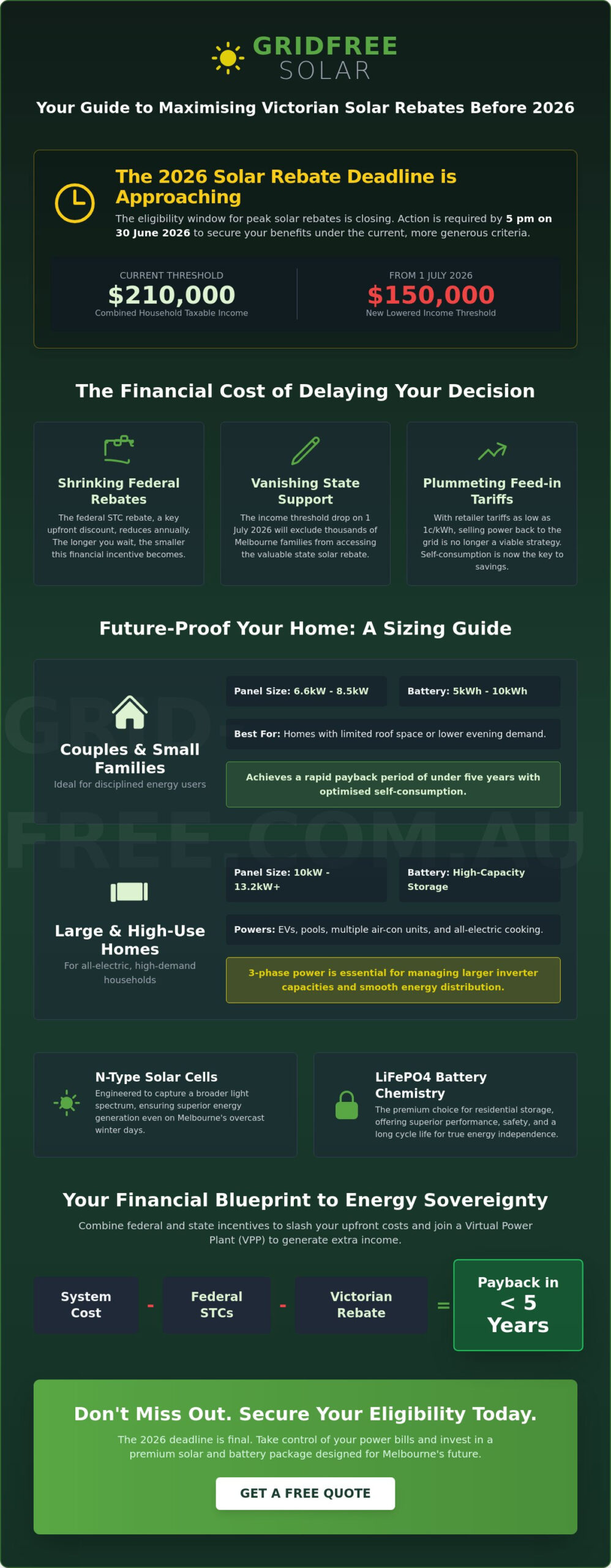
2026 is a line in the sand for Victorian homeowners. The energy transition in Melbourne has shifted from a gradual trend to a high-speed sprint. If you’ve been waiting for the “perfect time” to invest, your window of opportunity is closing fast. On 1 July 2026, the combined household taxable income threshold for the solar panel rebate drops from $210,000 to $150,000. This policy change will exclude thousands of Melbourne families from state support overnight. To secure your eligibility under the current higher threshold, your application must be submitted by 5 pm on 30 June 2026. There are no extensions.
Delaying your decision also carries a direct financial penalty. The federal STC rebate continues its scheduled annual reduction, meaning the upfront discount on a solar panel and battery package Melbourne residents can access is lower today than it was twelve months ago. With electricity retailers now setting their own feed-in tariffs, some as low as 1 c/kWh, the old model of “selling back to the grid” is effectively dead. You can no longer rely on the grid to be your bank. You must become your own power station. True energy sovereignty requires moving from a passive consumer to a proactive producer, much like how modern social apps like Truemeet encourage people to transition from virtual connections to active, in-person group activities.
The Shift in Victorian Energy Policy
Victoria is a central player in the growth of solar power in Australia, representing over 5.5GW of collective capacity by the start of 2026. The state’s aggressive phase-out of residential gas connections has fundamentally changed how we use power. Electrical demand is surging as we transition to all-electric heating and cooking. Modern Melbourne households now require sophisticated smart meters and integrated storage to manage this increased load. A “battery-ready” system is no longer a viable strategy; it’s an incomplete project that leaves you vulnerable to peak-hour tariff hikes.
Melbourne’s Climate Advantage
Don’t let the myth of “grey skies” hold you back. High-efficiency panels are specifically engineered to thrive in diffuse light. Melbourne’s overcast winters still provide ample energy for systems equipped with N-type cells that capture broader light spectrums. Solar irradiance in Melbourne refers to the total solar radiation energy received per unit area at our specific latitude of 37.8°S, which provides a robust foundation for year-round generation. Optimising your array for the lower winter sun ensures your battery stays charged when your heating demands are highest. By prioritising self-consumption, you ensure your system pays for itself regardless of the weather forecast.
Sizing Your System: Finding the Perfect Melbourne Bundle
The 6.6kW system was once the industry standard. Not anymore. With the shift toward all-electric homes, a 10kW+ solar panel and battery package Melbourne homeowners select is now the baseline for true resilience. You need to account for your “night-time floor,” which is the minimum power your home draws while you sleep. If your battery isn’t sized to cover this baseline plus your evening peak, you’re still tethered to high retailer rates. Don’t build a system for your needs today; build it for the electrical demands of 2030.
Electric vehicles are the biggest variable in 2026 energy modelling. Charging an EV at home can double your daily consumption. Sizing your array to include surplus generation for your vehicle ensures you’re driving on sunshine, not expensive grid power. Check your eligibility for the Victorian solar panel rebate to see how these larger configurations fit within the current subsidy frameworks. A system that is too small will eventually cost you more in upgrades and lost savings.
Small to Medium Households (The 6.6kW to 8.5kW Tier)
This tier suits couples or small families with disciplined energy habits. It pairs perfectly with 5kWh to 10kWh storage units. While smaller, these systems still offer a rapid ROI in Melbourne’s climate if you prioritise daytime appliance use. You can expect a payback period of under five years when the system is optimised for self-consumption. It’s an efficient entry point for those with limited roof space or lower evening demand.
Large Families and High Users (The 10kW to 13.2kW Tier)
High-demand homes with pools, multiple split-systems, or EVs require serious hardware. 3-phase power is the game-changer here. It allows for larger inverter capacities and smoother energy distribution across your home’s circuits. Investing in a high-capacity solar panel and battery package Melbourne families trust, paired with a 13kWh+ battery, ensures you remain powered through consecutive overcast days. This configuration is the gold standard for achieving total energy sovereignty.
Efficiency matters for your physical footprint. Modern N-type panels produce more power per square metre, but a 10kW system still requires significant roof real estate. You need a professional assessment to determine if your Victorian cottage or modern townhouse can host the necessary panels. Before committing to hardware, consider a site-specific energy audit to map your roof’s actual potential and identify shading risks.
The 2026 Financial Blueprint: Rebates, VPPs, and ROI in Victoria
Maximising your investment in a solar panel and battery package Melbourne requires a multi-layered financial strategy. You aren’t just buying hardware; you’re engineering a portfolio of subsidies. Federal Small-scale Technology Certificates (STCs) provide the first layer of relief. For a 6.6kW system in 2026, the STC discount is approximately $1,400. This value drops every January as the program nears its 2030 phase-out. Delaying your installation by even six months can cost you hundreds in lost federal incentives. Stack these with Victorian solar panel rebates to slash your initial capital outlay.
Smart owners look beyond the upfront cost. Virtual Power Plants (VPPs) have matured into a reliable revenue stream for Melbourne households. By joining a VPP through providers like AGL, Origin, or Powershop, you allow the grid to briefly tap into your battery during peak demand events. In exchange, you receive ongoing credits or higher feed-in rates. This turns your battery from a storage unit into an active income generator. When combined with an interest-free loan of up to $1,400 from Solar Victoria, the path to zero-dollar bills becomes a mathematical certainty. Business owners looking to apply the same self-consumption principles at scale should explore commercial solar quotes Melbourne businesses are using to eliminate volatile tariff exposure and maximise Victorian energy rebates before the July deadline.
Maximising the Victorian Battery Rebate
Eligibility is the first hurdle. Your property must be valued under $3 million, and your combined household income must currently sit below $210,000. Remember, this threshold drops to $150,000 on 1 July 2026. You must use a Solar Victoria Authorised Retailer to access these funds. Fast-track your application by having your recent council rates notice and taxable income documentation ready before the June rush. Decisive action now prevents you from being locked out by the incoming tighter income restrictions.
The ROI of Grid Independence
Stop focusing on feed-in tariffs. With some retailers offering as little as 1 c/kWh, selling power is a losing game. The real value is “Levelised Cost of Energy” (LCOE), which measures the total cost of your system against the total power it will produce over its lifespan. Storing your own energy for evening use is roughly five times more valuable than exporting it. In 2026, a 10kW solar and battery system in Melbourne typically achieves a full return on investment in under five years when optimised for high self-consumption and VPP participation. It’s a high-yield asset that protects your household budget from the volatility of the Victorian energy market.
Hardware Selection: Tier 1 Panels and Battery Tech for 2026
Hardware selection determines if your system is a temporary fix or a 25-year legacy. In 2026, the technical benchmark has shifted toward N-type solar cells. These high-efficiency modules offer superior temperature coefficients and significantly lower degradation rates than older P-type technology. When you invest in a premium solar panel and battery package Melbourne households trust, you’re paying for hardware that captures more light in the early morning and late afternoon. This extended generation window is exactly what keeps your battery topped up during the shorter days of a Victorian winter.
Your inverter is the brain of the operation. String inverters remain the cost-effective workhorse for unshaded roofs. However, if you live in Melbourne’s leafy eastern suburbs, micro-inverters are non-negotiable. They allow each panel to operate independently, ensuring a single stray shadow from a gum tree doesn’t crash your entire system’s output. Before signing any contract, look closely at the warranty fine print. A “25-year performance guarantee” only promises the panels will produce power; it doesn’t always cover the labour or shipping costs to replace a faulty unit. Demand a comprehensive solar panel and battery package Melbourne residents can rely on that includes a full 25-year product and labour warranty.
Top-Performing Solar Panels for Victorian Roofs
Melbourne’s diverse geography demands specific hardware ratings. If you’re located in bayside suburbs like Brighton or St Kilda, your panels must carry a high salt-mist corrosion rating to survive the coastal air. For those in heritage-listed areas, the rise of “all-black” panels has been a game-changer. These sleek, high-efficiency modules provide a modern aesthetic that blends seamlessly with traditional slate or terracotta roofs. They don’t just perform better; they look better.
Advanced Battery Storage Solutions
Lithium Iron Phosphate (LiFePO4) is the dominant chemistry for 2026. It’s non-combustible, thermally stable, and offers a cycle life that far exceeds older lithium-ion variants. Prioritise systems with a 100% Depth of Discharge (DoD). This means you can use every kilowatt-hour you’ve paid for without damaging the battery’s health. If you want the lights to stay on during a grid failure, ensure your system includes dedicated blackout protection wiring. Modular systems are often the smartest choice for Melbourne garages, allowing you to stack extra capacity as your energy needs grow.
Don’t settle for generic hardware that wasn’t designed for our local conditions. Secure a custom hardware specification for your home today to ensure maximum 2026 efficiency.
The GridFree Solar Advantage: Your Path to Energy Sovereignty
Local knowledge is the foundation of high-yield energy systems. National “sales-only” companies often outsource their labour to the lowest bidder. These firms don’t understand the specific shading profiles of Northcote or the unique coastal wind loads of Mordialloc. Choosing a local specialist for your solar panel and battery package Melbourne ensures your design reflects actual Victorian conditions. GridFree Solar manages every technical hurdle. We handle the site audit, the complex Solar Victoria rebate approval, and the final commissioning. You aren’t just a number in a CRM. You’re a partner in the Victorian energy transition.
Our process is built for speed and precision. We know the 30 June deadline is looming. GridFree Solar synchronises with the latest Clean Energy Regulator requirements, including the mandatory 1 March 2026 photo documentation rules for battery compliance. We don’t just bolt panels to your roof. We engineer a solution that integrates with 2030 technology. This includes future-proofing for bi-directional charging and advanced grid participation. Join the thousands of Melbourne households already bypassing the traditional bill-cycle and generating their own wealth.
Professional Installation and Support
Quality control is our obsession. Every GridFree Solar project is executed by Clean Energy Council (CEC) Accredited installers. We don’t cut corners on wiring, safety standards, or mounting hardware. Once the system is live, our post-installation monitoring begins. We track your generation data to ensure your hardware hits its projected savings targets. If you’re looking to scale these benefits to your workplace, see our commercial solar solutions for Melbourne businesses to protect your bottom line from rising commercial tariffs.
Ready to Minimise Your Bills?
The era of passive energy consumption is over. Sovereignty is within reach. Book your bespoke site assessment with a Melbourne solar expert to map out your 2026 savings plan. If you already have an older system, it might be lagging behind modern efficiency standards. Learn when it is time to replace your existing solar battery to restore your home’s storage capacity and efficiency. Don’t wait for the next price hike to force your hand. Take control of your energy future today.
Secure Your Energy Independence Before the July Deadline
The window for maximum Victorian subsidies is closing fast. By 1 July 2026, the income threshold drop will fundamentally change which households can access state support. You’ve seen the data. A high-performance solar panel and battery package Melbourne homeowners install today is the only definitive hedge against volatile electricity tariffs. Move beyond the 6.6kW entry-level mindset. It’s time to secure a 10kW+ system engineered specifically for Melbourne’s unique irradiance levels and winter demands.
GridFree Solar brings over 10 years of Melbourne-specific experience to your project. As a Solar Victoria Authorised Retailer with CEC Accredited Installers, we ensure your transition to energy sovereignty is technically sound and financially optimised. We don’t just install hardware; we build long-term, high-yield assets that pay for themselves. Don’t let the 30 June deadline pass you by while retailer rates continue to climb. Intelligent energy management is no longer a luxury; it’s a necessity for the modern Victorian home.
Get Your Custom Melbourne Solar & Battery Quote
The grid won’t wait for you. Take the first step toward a bill-free future and claim your energy independence today.
Frequently Asked Questions
Is a solar and battery package worth it in Melbourne in 2026?
A solar panel and battery package Melbourne is absolutely worth the investment because the financial model has shifted from selling power to saving it. Retailer feed-in tariffs have plummeted, with some providers offering as little as 1 c/kWh. By storing your energy, you avoid buying power at peak rates of 30 c/kWh or higher. This creates a much faster return on investment than a solar-only system.
How much does a 10kW solar system with a battery cost in Victoria?
Total costs vary based on your choice of Tier 1 hardware and the complexity of your roof. Federal STC rebates and state subsidies can reduce the upfront price by several thousand dollars. While we don’t provide fixed pricing here, a high-quality 10kW system is a significant asset that typically pays for itself in under five years through bill elimination and VPP participation.
Can I still get the solar battery rebate if I already have panels?
You can still access Victorian battery subsidies even if your home already has solar panels installed. The Solar Homes Program allows for battery-only applications to help existing solar owners achieve energy independence. You must still meet the standard eligibility criteria, including the income threshold and property value limits.
What is the best solar battery for Melbourne’s climate?
Lithium Iron Phosphate (LiFePO4) batteries are the gold standard for Melbourne’s variable weather. This chemistry is exceptionally stable and handles the temperature swings of Victorian winters and summers without significant degradation. Look for units with a high IP rating if the battery is being installed on an external wall.
How long will my solar battery last before it needs replacing?
Modern solar batteries are designed to last between 10 and 15 years. Most Tier 1 manufacturers provide a 10-year warranty that guarantees at least 60% to 70% of the original capacity remains. Proper sizing ensures the battery doesn’t cycle too frequently, which extends its operational life.
What happens to my solar battery during a Melbourne blackout?
Your battery will only provide power during a blackout if your system includes a “backup” or “blackout protection” gateway. Standard solar systems are designed to shut down during a power failure to protect workers on the grid. We can configure specific “essential circuits” like your fridge, lights, and Wi-Fi to remain active during a grid outage.
How do I qualify for the Victorian interest-free solar loan?
Eligibility requires you to be an owner-occupier with a property valued at less than $3 million. Your combined household taxable income must be under $210,000 per year, though this threshold drops to $150,000 on 1 July 2026. The loan currently matches the rebate amount up to $1,400 and is repaid over four years.
Can I charge my electric vehicle with my solar battery package?
You can certainly use your battery to top up your EV, but smart energy management is essential. A standard 10kWh home battery won’t fully charge a 60kWh EV battery. Instead, the system prioritises your household appliances first and uses surplus solar generation to charge your vehicle during the day.