Table of Contents
- Quick Performance Comparison: Solar Inverter vs Microinverter
- How String Inverters and Microinverters Convert Power
- Efficiency and Energy Yield: Which System Wins?
- The Impact of Shade on Solar Panel Performance
- Solar Inverter Lifespan and Warranty Compared
- Solar System Monitoring and Maintenance Services
- Installation Costs and Return on Investment
- Battery Compatibility and Future Scalability
- Frequently Asked Questions
Last Updated: September 18, 2026
Quick Performance Comparison: Solar Inverter vs Microinverter
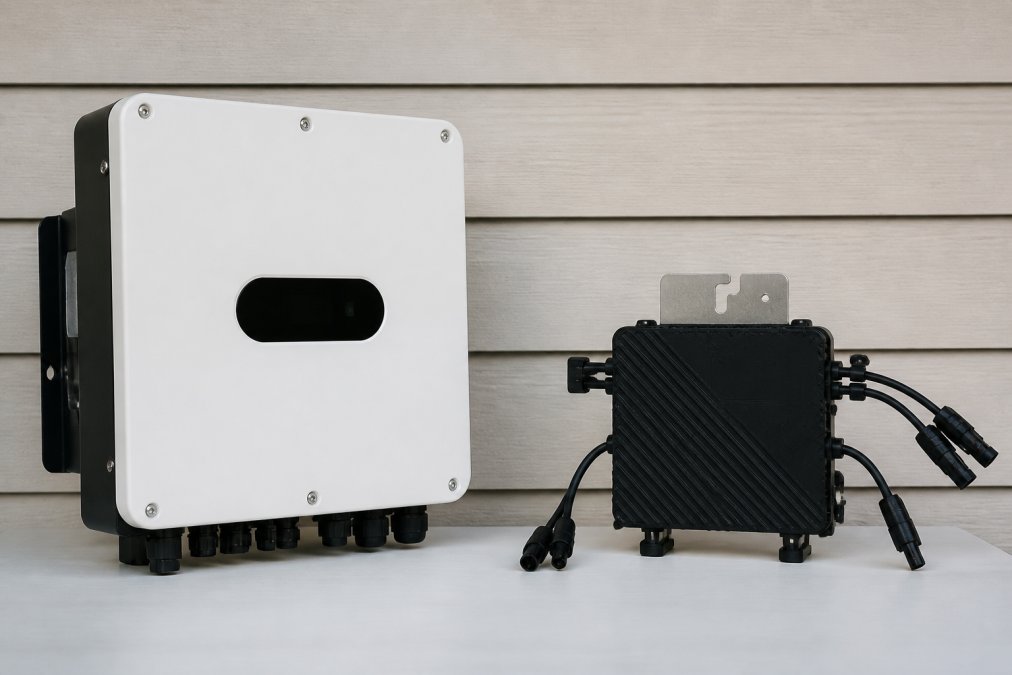
A solar inverter vs microinverter performance comparison comes down to one question: do you want power conversion handled once, centrally, or at every individual panel? String inverters convert DC to AC in a single box, usually in a garage or utility area. Microinverters do the same job on the roof, one unit per panel.
At GridFree Solar, we design and install both architectures across Victorian rooftops, and neither wins outright. The right choice depends on your roof, shading, battery plans and how long you intend to stay.
Here is the short version before we get into the engineering:
| Factor | String Inverter | Microinverter |
|---|---|---|
| Upfront cost | Lower | Higher |
| Shade tolerance | Poor to moderate | Excellent |
| Panel-level monitoring | No (unless optimisers added) | Yes, standard |
| Single point of failure | Yes | No |
| Battery integration | Straightforward DC coupling | Often AC-coupled |
| Best for | Simple, unshaded roofs | Shaded or complex roofs |
The rest of this comparison explains why each row reads the way it does, and where the standard advice falls short.
How String Inverters and Microinverters Convert Power
Both technologies convert the direct current your panels produce into the alternating current your home and the grid use. The difference is where and how often that conversion happens.
String Inverter Architecture and Voltage Regulation
A string inverter takes panels wired in series and converts the combined output at one central point. Panels must be matched for voltage, and the inverter tracks a single maximum power point for the whole array.
That single tracking point is the weakness: if one panel underperforms, the whole string shifts to compensate. Central voltage regulation keeps the hardware simple and installation labour low.
Microinverter Topology and Module-Level Electronics
Microinverters move the conversion electronics onto the roof, one unit per panel or pair. Each runs its own maximum power point tracking, so every module operates independently.
This is module-level electronics in practice: a shaded or dirty panel drags down only itself. Low-voltage DC stays on the roof, improving electrical safety, and rapid shutdown compliance is easier with no high-voltage DC circuit running to a central box.
Efficiency and Energy Yield: Which System Wins?
On paper, the efficiency gap is small. In the real world, energy yield diverges sharply once shading, roof orientation, panel mismatch or heat enters the picture.
Conversion Efficiency: The Lab Numbers
Modern string inverters typically achieve peak conversion efficiencies around 97-98%, while microinverters sit slightly lower, usually 96-97%. That gap is real but small: roughly 1-2% in total generation on an unshaded array, often less than weather variation.
The more important number is weighted efficiency, which reflects performance across real operating conditions, not just at the sweet spot. A unit with a slightly lower peak but a flatter curve can outperform one with a higher headline figure.
Where Yield Actually Diverges
Three mechanisms drive the real-world gap:
Mismatch loss. In a string, if one panel produces less, due to shade, soiling, tolerance or ageing, the entire string shifts to its level. Microinverters track per panel, so mismatch loss is effectively eliminated. On a well-matched, unshaded array it is typically 1-2%; on a mismatched array it can exceed 10%.
Shading loss. This is the dominant factor. A shadow across one panel can reduce output across the whole string, because the inverter only optimises for combined voltage. Microinverters isolate the loss to the shaded module, and the gap widens in winter when low sun angles throw longer shadows.
Orientation and tilt. A string inverter performs best when all panels share the same orientation and tilt. Panels facing north, east and west in one string underperform because the inverter cannot optimise for three peak points at once. Microinverters handle mixed orientations natively.
Heat: The Climate-Specific Factor Most Comparisons Miss
This angle matters enormously in Australian conditions.
Microinverters sit under the panels, where summer temperatures can exceed 70°C in the gap between module and roof surface. Electronics degrade faster at sustained heat, which historically shortened microinverter life. Modern units derate intelligently, but the environment remains harsher than a garage-mounted string inverter.
String inverters are usually mounted in a garage, carport or shaded wall, a far cooler location. That thermal advantage helps them carry long warranties despite being a single point of failure.
In hot climates, microinverter longevity depends on roof ventilation and mounting clearance. Ask your installer how units will be spaced and whether the roof cavity is ventilated: a well-ventilated install can add years to service life, a tightly packed one can subtract them.
What This Means for Your Decision
For a clean, north-facing roof with no shade, a quality string inverter captures close to everything the panels produce. For a roof with multiple orientations, a chimney, afternoon tree shade or heavy soiling, microinverters typically harvest measurably more, often enough to close the upfront cost gap over the system’s life.
Ask your installer for a shading analysis before choosing hardware. A roof that looks clean in summer can lose significant yield in June and July when the sun sits low and a neighbouring tree or vent pipe casts a shadow across a whole string.
The Impact of Shade on Solar Panel Performance
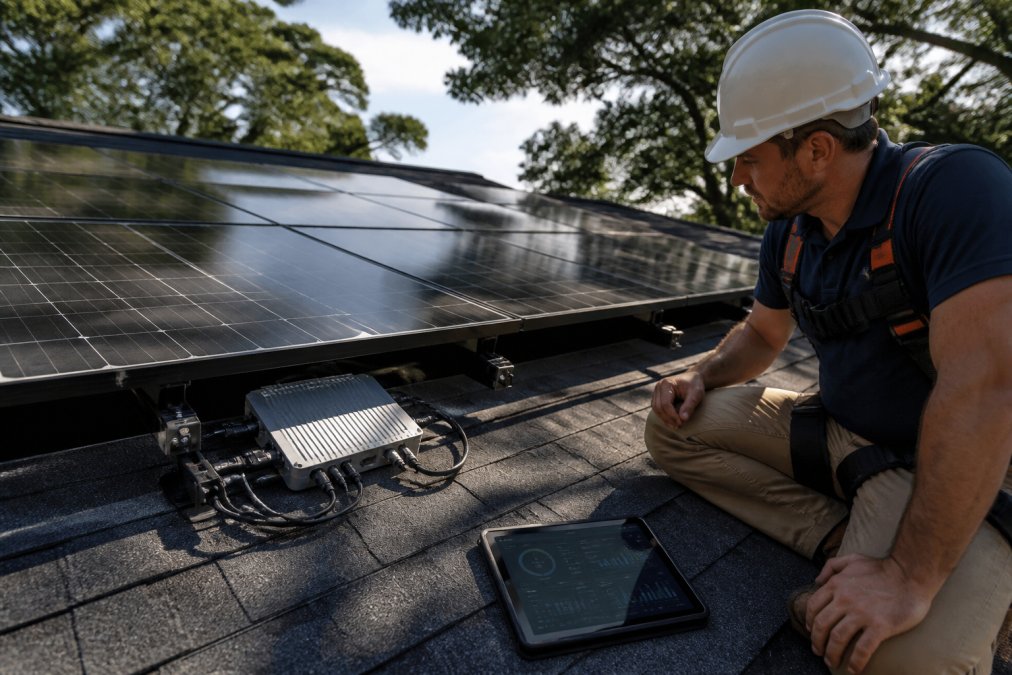
Shade is the single biggest factor separating these two technologies. The impact of shade on solar panel performance is disproportionate in string systems: a shadow across one panel can reduce output across the entire string, because the inverter only optimises for combined voltage.
Solar Inverter Lifespan and Warranty Compared
Solar inverter lifespan and warranty is where the two technologies genuinely diverge, and it is the factor most buyers underestimate.
Whichever hardware you choose, confirm who covers the labour for a warranty claim, not just the part. A 25-year microinverter warranty means little if removal and refitting costs fall to you.
Solar System Monitoring and Maintenance Services
Solar system monitoring and maintenance services look different depending on your inverter topology, and this shapes long-term operating costs more than most buyers expect.
Panel-level monitoring is not a luxury feature. It is the difference between spotting a fault in days and discovering it in a quarterly bill.
Installation Costs and Return on Investment
Upfront capital expenditure favours string inverters. Microinverters cost more per unit, and you need one per panel or pair, so the hardware bill rises with array size.
Battery Compatibility and Future Scalability
Battery compatibility is where the choice gets more consequential than most buyers realise. The architecture you choose now shapes how efficiently you can store solar energy later, and how resilient your home is during a grid outage.
DC-Coupling vs AC-Coupling: The Mechanism
String inverters pair naturally with DC-coupled batteries. DC power from your panels flows into the battery before conversion, then a single inverter stage converts it to AC for your home, avoiding a double conversion loss. DC-coupled storage can be 3-8% more efficient round-trip than AC-coupled, depending on hardware.
The Hybrid Inverter Path
A hybrid inverter is a string inverter with a built-in battery interface. It lets you add DC-coupled storage later without a separate battery inverter, keeping the system simpler and more efficient, often the most flexible choice for homeowners who want storage but are not ready to buy it yet.
Grid-Forming vs Grid-Following: The Emerging Battleground
This capability matters if energy resilience is a priority.
Grid-following inverters synchronise to the grid’s voltage and frequency and shut down when the grid fails. This is the default for most residential solar inverters, and why a standard solar system does not provide backup power during an outage.
Scalability: Adding Panels and Storage Later
Adding panels to a microinverter system is usually simpler, because you add a unit per new panel without resizing a central inverter. Expanding a string system can mean replacing the inverter entirely if the new array exceeds its capacity.
Homeowners with shaded or multi-orientation roofs, or anyone planning battery storage and backup power, get the most from microinverter or optimiser-based systems.
Frequently Asked Questions
Are microinverters more efficient than string inverters in shaded conditions?
Microinverters consistently outperform string inverters when shade is a factor. Because each microinverter performs maximum power point tracking at the panel level, shading on one panel does not drag down the output of the rest of the array. A string inverter, by contrast, can lose a significant portion of total energy yield when even a single panel is shaded. For homes with chimneys, trees or complex roof shapes, the performance gap can be substantial.
Do microinverters last longer than string inverters?
Microinverters typically carry 25-year warranties, while string inverters usually offer 5 to 12 years. That said, microinverters are exposed to harsher rooftop conditions, so their real-world lifespan can vary. String inverters are easier and cheaper to replace when they fail, often costing less than a microinverter swap. When comparing solar inverter lifespan and warranty, factor in both the warranty length and the cost of replacement labour over the system’s life.
What are the maintenance differences between string and microinverter systems?
String inverters are mounted at ground level, making inspections and replacements straightforward. Microinverters sit under each panel, so a fault means removing panels to access the unit, which increases labour. However, microinverters have no single point of failure, so one fault only affects one panel. Solar system monitoring and maintenance services can alert you to underperformance quickly, but the physical access differs significantly between the two designs.
Is the higher upfront cost of microinverters justified by performance gains?
It depends on your roof. For unshaded, north-facing roofs with a simple layout, a string inverter delivers excellent return on investment at a lower upfront capital expenditure. For shaded or complex roofs, microinverters or DC optimisers recover much more energy over the system’s life, often offsetting the higher hardware cost within a few years. Ask your installer to model both options using your actual roof data before deciding.
Can I add more panels later if I choose a microinverter system?
Yes, microinverter systems are highly scalable. Because each panel has its own inverter, you can add panels without resizing a central inverter or worrying about string sizing. This makes microinverters a good fit if you plan to expand capacity or add a battery down the track. String inverter systems can also be expanded, but you need to stay within the inverter’s voltage and current limits, which sometimes means upgrading the inverter itself.