Table of Contents
- Why Shaded Roofs Still Work With Solar Battery Storage
- Solar Power Optimisers vs Microinverters for Shaded Roofs
- AC-Coupled vs DC-Coupled Solar Batteries: Which Suits Shaded Systems?
- How to Calculate Solar Battery Capacity for Intermittent Shading
- Roof Orientation, Pitch and Array Configuration: Planning Around Shade
- Battery Storage Benefits, ROI and Maintenance for Shaded Roofs
- Choosing an Installer for a Shaded System
- Frequently Asked Questions
Last Updated: September 12, 2026
Why Shaded Roofs Still Work With Solar Battery Storage
Shade does not disqualify a roof from solar. It changes the design. Solar battery storage for shaded roofs works because the battery decouples when energy is used from when it is generated: panels collect what they can across the whole day, the battery banks it, and the home draws on that stored energy in the evening regardless of whether the array was producing at full output at midday. At GridFree Solar, we design shaded systems around that principle rather than treating shade as a dealbreaker.
The honest version: a shaded array generates less than an unshaded one, and no battery changes that. What a battery changes is how much of the reduced generation you actually keep and use, instead of exporting it for a few cents and buying it back at peak rates.
How Shading Cuts Solar Panel Efficiency
Shading reduces photovoltaic efficiency in two ways. First, it lowers solar irradiance reaching the cells, so less energy is generated in the first place. Second, and more damaging, it can drag down output across a whole string of panels, not just the shaded ones.
That second effect catches people out. In a conventional string inverter setup, panels are wired in series, so the current flows through every panel in the chain. One panel in hard shadow acts like a kink in a hose: it restricts the flow for the entire string. A single shaded panel can pull a string’s output down far more than the shade’s physical footprint suggests (pv-magazine-australia.com).
Partial Shading vs Hard Shadows: What Changes
Partial shading is intermittent: a chimney, a TV antenna, a powerline, or a tree that casts moving shadow across part of the array at certain times of day. Hard shadow is solid and predictable: a neighbouring building, a fixed structure, or dense canopy blocking a defined area for hours.
Partial shading is usually the easier problem, because the array still produces at full tilt outside the shaded window, and modern electronics can work around small losses. Hard shadow demands a design response: repositioning panels, splitting them across multiple maximum power point tracking inputs, or accepting a lower-yield array and sizing the battery to match.
The distinction that matters is not how much shade you have, but when it falls. Shade between 9am and 3pm costs real generation. Shade after 4pm barely touches output, because the array was tapering anyway.
Solar Power Optimisers vs Microinverters for Shaded Roofs
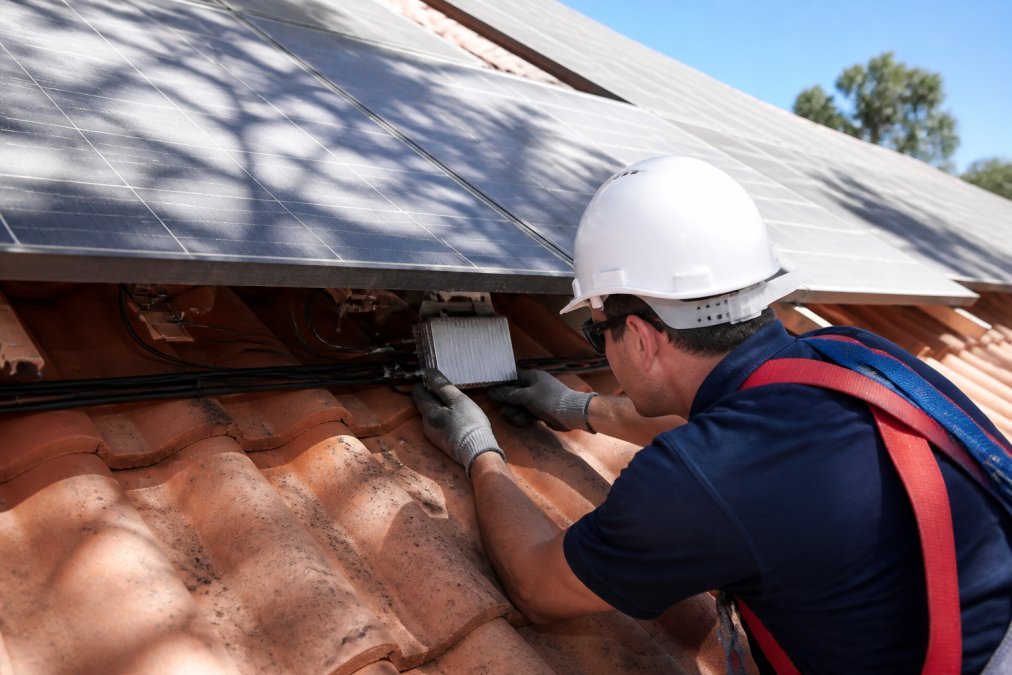
Solar power optimisers vs microinverters is the central hardware decision on a shaded roof, and the two solve the problem differently. Optimisers are DC devices fitted behind individual panels that regulate each panel’s voltage and current before power reaches a central string inverter. Microinverters convert DC to AC at each panel, so every panel operates independently.
The practical difference: optimisers keep a string inverter in the system, which is cheaper and easier to service, while microinverters remove the single point of failure entirely. Microinverters also suit complex roofs with panels facing several directions, because there is no string to compromise.
DC Optimisers, String Inverters and Bypass Diodes
Bypass diodes are the built-in safety valve in every panel. When a cell group is shaded and its current drops, the diode routes current around that group so the rest of the panel keeps working. They limit damage, but they are crude: they protect whole cell groups, not individual cells, and they do nothing about mismatch between panels.
DC optimisers go further, performing maximum power point tracking at panel level so each panel contributes its best available power to the string. String inverters then handle the conversion centrally. The combination is often the most cost-effective answer for a roof with moderate, predictable shade.
| Hardware | How It Handles Shade | Best For | Trade-off |
|---|---|---|---|
| String inverter alone | Relies on bypass diodes only | Unshaded, uniform arrays | Worst performance under shade |
| DC optimisers + string inverter | Panel-level MPPT, central conversion | Moderate partial shading | Slightly higher component count |
| Microinverters | Full panel independence, AC at roof | Complex roofs, heavy shade | Higher upfront cost |
A common mistake is buying optimisers to fix a shading problem that is really a layout problem. If two panels sit under a hard shadow for four hours a day, no optimiser will make them productive. Move the panels first, then optimise.
AC-Coupled vs DC-Coupled Solar Batteries: Which Suits Shaded Systems?
The AC-coupled vs DC-coupled solar batteries choice comes down to whether your battery shares a DC bus with the panels or connects on the AC side of the inverter. DC-coupled systems run panels and battery through one inverter, which suits new builds where everything is specified together. AC-coupled systems add a separate battery inverter, which suits retrofits onto an existing solar setup.
For shaded roofs, the coupling decision interacts with your inverter choice. If you have already fitted microinverters, an AC-coupled battery is the natural pairing, because the panels are already producing AC. If you are building new with optimisers and a string inverter, DC coupling keeps the conversion path shorter and avoids a second conversion loss.
Retrofit or New Build: Matching the Coupling to Your Roof
Retrofitting onto a shaded roof usually points to AC coupling, because the existing inverter and array stay untouched and the battery bolts on alongside. New builds give you the freedom to choose, and DC coupling often wins on efficiency when the array is already optimised.
One caveat worth stating plainly: adding a battery does not increase what a shaded array generates. It increases how much of that generation you use on site. That is a real financial gain, but it is a self-consumption gain, not a generation gain.
How to Calculate Solar Battery Capacity for Intermittent Shading
Calculating solar battery capacity for intermittent shading starts with evening consumption, not array size. Work out how many kilowatt-hours your household uses between the end of solar production and the following morning, then size the battery to cover that figure, adjusted for depth of discharge.
Three inputs do the work:
- Peak sun hours at your location, which set how much the array can realistically produce on a shaded roof
- Depth of discharge, the usable share of the battery’s nominal capacity, which is why a battery rated at a given figure delivers less than that in practice
- Load shifting, the share of evening consumption you can move into the battery’s discharge window
A shaded array produces less across the day, so the battery fills more slowly and may not reach full charge in winter. Sizing for the shoulder seasons, rather than the best month, avoids a battery that sits full in summer and empty in June.
Size for your winter evening load, not your annual average. A shaded roof in the southern states can lose a large share of its output in the cooler months, and a battery sized on summer numbers will underdeliver exactly when you need it most.
Roof Orientation, Pitch and Array Configuration: Planning Around Shade
Roof orientation and pitch determine how much sun the array receives before shade is even considered. In the southern hemisphere, panels perform best facing north, with east and west orientations trading peak output for a wider production window. Azimuth, the compass direction the array faces, matters more on a shaded roof than an unshaded one, because a west-facing array may miss morning shade entirely while catching afternoon shade.
Array configuration is the lever most homeowners never hear about. Splitting panels across two or three maximum power point tracking inputs lets you group shaded and unshaded panels separately, so shade on one group does not drag the other. On a roof with a persistent afternoon shadow, this single decision can matter more than the brand of inverter.
Battery Storage Benefits, ROI and Maintenance for Shaded Roofs
Battery storage benefits on a shaded roof centre on self-consumption and grid independence. Stored energy covers the evening peak, when grid electricity is most expensive, and keeps essential loads running through an outage. Shifting consumption into your own stored generation is where the return comes from, not from exporting.
ROI calculation for a shaded system needs honest inputs. A shaded array exports less, so feed-in revenue is lower than an unshaded system’s. The return has to come from avoided peak-rate imports and any grid-charging or demand-response incentives your retailer offers. Model the system on its actual modelled production, not a generic figure for your postcode, or the payback estimate will flatter the result.
Maintenance of shaded systems deserves more attention than it usually gets. Shaded roofs collect debris: leaf litter, bird droppings, and organic matter that holds moisture against panels and frames. Panels under trees need cleaning more often, and gutters above the array need clearing so overflow does not run across the glass. System monitoring catches the slow decline before it becomes a repair.
Tree Trimming vs Technology: The Trade-Off
Trimming is free generation and costs you nothing but a saw and an afternoon. Technology costs money and recovers only part of what shade removes. If a tree can be trimmed legally and safely, trim it first, then design the system around what remains.
The trade-off is not always available. Significant trees may be protected, may belong to a neighbour, or may be the reason you want the shade. In those cases, optimisers or microinverters plus a well-sized battery are the sensible response. The right answer is usually a blend: trim what you can, design for what you cannot.
Households with a persistent afternoon shadow and a protected tree they cannot remove. Panel-level electronics plus a battery sized to the winter evening load deliver the most usable energy from a compromised roof.
Choosing an Installer for a Shaded System
Shaded design is where cheap quotes fall apart. An installer who sizes on panel count rather than modelled production will overstate your yield, and you will only find out after the first winter bill. Ask for the shading analysis, the string layout, and the modelled monthly production figures before you sign.
GridFree Solar designs shaded systems as a matter of course, pairing Clean Energy Council approved batteries with panel-level electronics and sizing the storage to your actual evening load. Our CEC accredited installers work to AS/NZS 5033 and AS/NZS 5139:2019, and we handle the rebate paperwork, including the Small-scale Renewable Energy Scheme and the Cheaper Home Batteries Program, so you are not left navigating it alone. You can read the current program rules at Australian Government energy rebate information.
What Happens After Installation
Monitoring is not an afterthought on a shaded system. Because output varies more than on a clean roof, you need to see it: daily generation, battery state of charge, and export volumes. A system that underperforms for a month should show up in the data, not on your next bill.
GridFree Solar provides ongoing monitoring support so you can spot a drop in energy yield and act on it before it compounds. That is the difference between a system that was designed for shade and one that merely tolerates it.
Shade is a design constraint, not a disqualification, and the installers who treat it that way are the ones worth hiring. GridFree Solar designs shaded systems around Clean Energy Council approved batteries, CEC accredited installation, and compliance with AS/NZS 5139:2019 and AS/NZS 3000, with rebate guidance covering both the Small-scale Renewable Energy Scheme and the Cheaper Home Batteries Program. Connect with GridFree Solar to find out what your roof can actually produce and how much of it you can keep.
Frequently Asked Questions
Do solar panels still charge batteries effectively in the shade?
Yes, but expect lower output. Shade reduces energy yield, so panels produce less current to send to the battery. DC optimisers or microinverters with maximum power point tracking help each panel work independently, limiting losses from partial shading. A correctly sized solar battery storage system then stores whatever is generated, and can top up from the grid during off-peak windows. Diffused light on cloudy days still contributes, though hard shadows have a bigger impact.
What is the best solar battery capacity for a system with limited sunlight?
There is no single best figure. Match capacity to your evening and overnight use, not to the array size. Use the formula: daily kilowatt-hours used after sunset divided by the battery’s usable depth of discharge. If you use 8 kWh overnight and the battery allows 90% depth of discharge, aim for roughly 9 kWh. For shaded roofs, a slightly larger battery helps cover intermittent production days.
Can I install solar panels on a roof with partial tree shade?
Yes. Design matters more than the shade itself. Installers can split the array into multiple strings, use optimisers or microinverters, and position panels to catch the strongest sun windows. Roof orientation and azimuth also shape output. In many cases, trimming selected branches is cheaper than adding hardware, but the right mix depends on your site. A CEC accredited installer can model both options before you commit.
How does shading affect the overall efficiency of a home battery?
The battery itself is not affected by shade; the panels are. Shade lowers photovoltaic efficiency and energy yield, so less power reaches the battery each day. A battery with smart system monitoring and time-of-use scheduling can still shift cheap grid charging into peak periods, protecting savings. Over years, intermittent shading can slightly accelerate system degradation through thermal stress on bypassed cells, so maintenance matters.