
Table of Contents
- Why Solar Battery Integration Pays Off in 2026
- How Solar Battery Integration Actually Works
- Smart Home Energy Management Systems: The Control Layer
- Retrofitting Solar Batteries to an Existing System
- Choosing the Right Solar Battery Storage Capacity
- Maximising Self-Consumption, Feed-In Tariffs and Payback
- Cybersecurity and Firmware Updates for Home Energy Systems
- Conclusion
- Frequently Asked Questions
Last Updated: September 16, 2026
Why Solar Battery Integration Pays Off in 2026
Integrating solar batteries with smart home systems is the practice of connecting battery storage to a home automation platform so generation, storage and consumption are coordinated automatically rather than managed by hand. A battery that simply sits on the wall saves money, while a battery that talks to your home saves considerably more.
The reason is timing. A battery only earns its keep when it charges from your own solar and discharges when grid electricity is expensive. Without coordination, appliances run on schedule rather than on price. With it, your home shifts load automatically.
That is the core argument of this guide: hardware gets you a battery, integration gets you the savings.
Below, we break down how integration actually works, what to buy, and where most installations go wrong.
A battery without smart coordination is a storage box. A battery with it is an energy strategy.
How Solar Battery Integration Actually Works
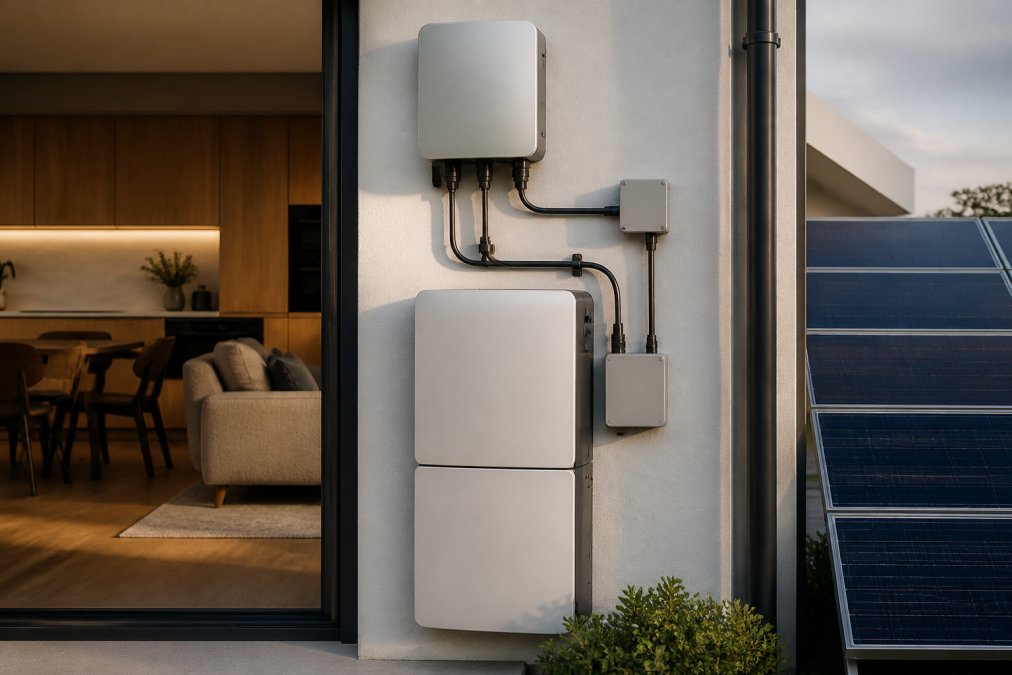
A grid-tied solar battery system works by converting DC electricity from your panels into usable AC power, storing the surplus in a battery, and releasing it when your home needs it. The smart layer sits above this, deciding when that release happens.
The basic chain looks like this:
- Panels generate DC power during daylight hours.
- A solar inverter converts DC to AC for your appliances, or to DC for battery charging depending on the architecture.
- The battery stores surplus energy that would otherwise be exported.
- A smart home hub reads real-time data from the inverter, battery and major appliances.
- Automation rules trigger appliances, EV charging or battery discharge based on price, time and generation.
That fifth step is where the money is. It is also where most systems fall short, because the hub and the battery often come from different manufacturers.
AC Coupling vs DC Coupling: Which Suits Your Home
AC coupling means the battery connects to your home’s existing AC wiring through its own inverter. DC coupling means the battery connects directly to the solar array on the DC side, sharing one inverter.
For retrofitting solar batteries onto an existing system, AC coupling is usually the practical choice. It lets you keep your current inverter and add storage alongside it, which keeps the job simpler and avoids replacing working equipment.
DC coupling suits new builds where you are specifying panels, inverter and battery together. It typically delivers slightly higher round-trip efficiency because there is one fewer conversion step, but it locks you into a single manufacturer’s ecosystem.
| Factor | AC Coupling | DC Coupling |
|---|---|---|
| Best for | Retrofits | New builds |
| Existing inverter | Kept | Replaced |
| Efficiency | Slightly lower | Slightly higher |
| Brand flexibility | High | Low |
| Installation complexity | Lower | Higher |
Protocols and Interoperability: Making Devices Talk
Interoperability is the biggest gap in most home energy advice. A battery, an inverter, an EV charger and a smart hub will only cooperate if they speak a common language.
In practice, this means checking two things before you buy. First, whether the battery and inverter support a shared communication standard such as Modbus or SunSpec. Second, whether the hub you want supports that same protocol natively, rather than through a third-party bridge that may break on the next firmware update.
Buying a battery and a hub from brands that do not publish their protocol support is the most common cause of a system that never automates properly. You end up with two apps and no coordination.
Smart Home Energy Management Systems: The Control Layer
A smart home energy management system is the software and hardware layer that monitors generation, storage and consumption in real time and acts on that data automatically. It is the difference between watching your energy use and controlling it.
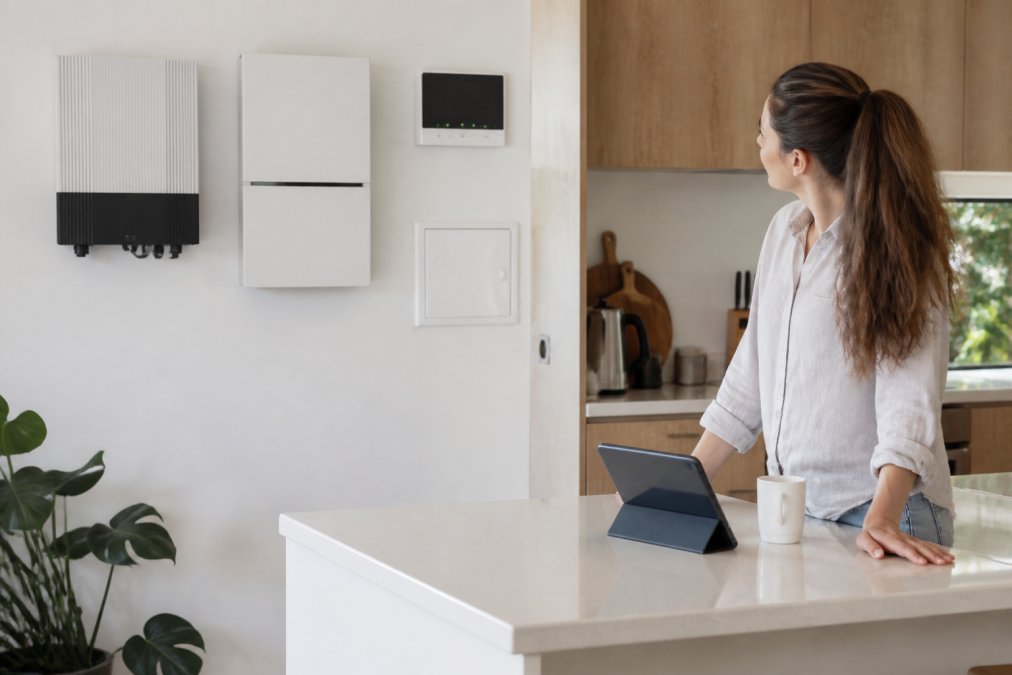
What a good system does day to day:
- Reads real-time data from the inverter, battery and metering
- Runs load shifting so heavy appliances operate during peak generation
- Applies peak shaving to cut draw from the grid during expensive windows
- Offers remote control of smart appliances and the battery itself
- Handles load balancing so you do not trip circuits when several loads run together
Retrofitting Solar Batteries to an Existing System
Retrofitting solar batteries is usually straightforward, provided your existing inverter and switchboard can accommodate the addition. Most homes with an installed photovoltaic system can add storage without replacing the panels.
- Switchboard capacity. Older boards may need upgrading to support the battery circuit.
- Inverter compatibility. Some older inverters do not expose the data a hub needs.
- Physical space and ventilation. Batteries need a compliant location, and installation must meet AS/NZS 5139:2019 and AS/NZS 3000.
Choosing the Right Solar Battery Storage Capacity
Solar battery storage capacity is measured in kilowatt-hours and should be sized to your evening consumption, not to your roof size. Oversizing wastes money; undersizing means you still buy grid power at night.
A workable approach:
- Pull your last four electricity bills and note daily usage.
- Estimate how much of that usage happens after sundown.
- Match battery capacity to that evening figure, allowing for round-trip losses.
- Confirm the battery can charge fully from your solar on a typical day.
Ask for the cycle rating at a stated depth of discharge, not just a cycle number. A figure quoted at shallow discharge looks impressive and delivers less usable energy over the battery’s life.
Maximising Self-Consumption, Feed-In Tariffs and Payback
Self-consumption is the share of your solar generation used on site rather than exported. Every kilowatt-hour you use yourself avoids a retail rate; every kilowatt-hour you export earns a feed-in tariff, which is usually lower. That gap is why integration matters financially, and why the difference between a manually managed system and an automated one is measurable.
The self-consumption gap in practice
Consider a household with a 6.6 kW solar array and a 10 kWh battery. On a typical day the array might generate 26 kWh, the home might consume 18 kWh, and the battery might cycle 8 kWh. Without automation, a common pattern is that the battery charges and discharges on a fixed schedule, the pool pump runs in the morning, and the dishwasher runs after dinner, all drawing from the grid at peak rates.
How to work out your own payback
Rather than quote a figure that will not match your household, work through it directly:
- Baseline your usage. Pull your last four electricity bills and note daily consumption and the split between peak and off-peak.
- Estimate self-consumption without automation. Look at how much of your usage already happens during daylight hours.
- Estimate self-consumption with automation. Assume load shifting moves a realistic share of evening usage into the solar window, be conservative.
- Value the difference. Multiply the shifted kilowatt-hours by the retail rate you avoid.
- Add feed-in tariff income from remaining exports.
- Add any applicable rebate benefit.
- Divide total system cost by the annual figure.
Tariff mechanisms that reward automation
Ask your installer to model payback with and without automation using your actual bill data. If they cannot show the difference, the smart layer is being sold on features rather than on savings.
Rebate eligibility depends on your circumstances and current program rules. Check the [Clean Energy Council guidance on home batteries(/home-batteries-worth-it-australia/) | cleanenergycouncil.org.au] and the Australian Government energy rebate information for current details, and confirm specifics with your installer before relying on any figure.
Cybersecurity and Firmware Updates for Home Energy Systems
A connected battery is a networked device, and it deserves the same attention as any other. Poorly secured home energy systems can expose usage data and, in the worst cases, control interfaces.
Practical steps that cost nothing:
- Change default passwords on the inverter, battery and hub at installation
- Put energy devices on a separate network or guest VLAN where your router supports it
- Enable automatic firmware updates, or diarise them monthly
- Remove app access for anyone who no longer needs it
A battery left on its original firmware for years can lose compatibility with a hub that has since updated. The symptom looks like a hardware fault and is usually just a version mismatch.
Conclusion
The hard part of solar storage is not buying a battery. It is making the battery, inverter, hub and appliances work as one system, and keeping them that way through firmware changes and shifting tariffs.
Frequently Asked Questions
Do I need a specific inverter to integrate solar batteries with smart home devices?
Not always, but it helps. Battery-ready hybrid inverters handle both solar and battery connections natively, which simplifies solar battery integration. If you already have a standard grid-tied solar inverter, you can add an AC-coupled battery instead. Check that your inverter supports open protocols like Modbus or SunSpec, because that determines whether smart home energy management systems can read your data and control charging. Your installer can confirm compatibility before you commit.
Can a solar battery be added to an existing system?
Yes. Retrofitting solar batteries is common for homes that installed panels years ago. An AC-coupled battery sits alongside your existing inverter, so you keep the panels and inverter you already own. The installer adds a battery inverter, connects it to your switchboard, and configures monitoring. Costs depend on battery size, switchboard condition and whether your old inverter can share data. Ask for a site assessment first, since shading and switchboard capacity affect what is possible.
How long will a 10kWh battery last for an average household?
Most homes use roughly 15 to 20kWh per day, so a 10kWh battery covers overnight demand in many cases. If you shift heavy loads like hot water, pool pumps and EV charging to daylight hours, the battery stretches further. Usable capacity is often less than the nameplate figure because manufacturers reserve a buffer to protect the cells. GridFree Solar’s battery is rated for 8,000+ cycles.
What are the main benefits of connecting solar storage to smart home automation?
Automation turns your battery into a working asset rather than a passive one. Smart home energy management systems can schedule loads, such as running the dishwasher or charging an EV, when solar generation peaks. During peak tariff windows, automation switches to battery power and avoids importing from the grid. Some programs pay a daily bonus for avoiding grid use during peak hours, and feed-in tariffs reward exports at specific times. Real-time data also shows whether your system performs as quoted.