
Last Updated: October 25, 2026
Quick Summary
To qualify for solar battery rebates in Victoria in 2026, you mostly apply through the federal Cheaper Home Batteries Program, which gives an upfront discount on an eligible battery’s installed cost. You must own the property, have or add solar PV, be grid-connected, use an approved battery and an accredited installer.
- The old Victorian Solar Homes Program battery rebate is closed to new applicants.
- The discount is applied at the point of sale, so your installer deducts it from your quote.
- An unapproved battery or unaccredited installer can cost you the entire discount.
- Renters cannot claim the discount themselves; the property owner must apply.
- Ask for the discount as a visible line item showing gross price, discount and net price.
Table of Contents
- What Victorian Solar Battery Rebates Look Like in 2026
- Victorian Solar Battery Rebate Eligibility: A Self-Check
- Solar Battery Rebate With Existing Solar Panels
- Solar Battery Rebate Approved Products and Capacity Limits
- The Solar Battery Rebate Application Process, Step by Step
- How Battery Size Affects Your Rebate: Worked Examples
- Book Your Eligibility Check With GridFree Solar
- Frequently Asked Questions
What Victorian Solar Battery Rebates Look Like in 2026
The landscape for solar battery rebates in Victoria has changed. In 2026, most households qualify through the federal Cheaper Home Batteries Program, not a standalone state rebate.
It doesn’t. Here is the current picture.
The Federal Cheaper Home Batteries Program Explained
The Cheaper Home Batteries Program is the main federal support for home battery storage, providing an upfront discount on an eligible battery’s installed cost.
The discount is applied at the point of sale, so you do not wait for a cheque. Your installer deducts it from your quote.
Key points:
- It covers battery storage added to a home with, or alongside, solar
- The battery must be on the approved products list
- Installation must be done by an accredited installer
The program rules are detailed, and they change. For the full eligibility rules, see our guide to eligibility for the Cheaper Home Batteries Program.
What Happened to the Old Victorian Battery Rebate
The old Solar Homes Program battery rebate is closed to new applicants. It offered a fixed rebate plus an interest-free battery loan, but the battery component reached its cap.
What remains relevant in Victoria:
- The federal Cheaper Home Batteries discount
- Any state programs that open from time to time
- Network and retailer offers that vary by area
This is why a current eligibility check matters, old guides still describe a scheme that has moved on.
If you want to see how federal support and any remaining state incentives combine for your situation, our page on the home battery scheme in Victoria and how incentives combine lays out the current rules.
Victorian Solar Battery Rebate Eligibility: A Self-Check
Victorian solar battery rebate eligibility now runs mostly through the federal program. Work through this decision path, each branch tells you whether to proceed, what to fix first, or where to get a definitive answer.
How to use this self-check: Answer each question in order. A “no” does not always mean ineligible, it often means a prerequisite step. Stop at the first “fix first” branch and resolve it before requesting quotes.
Branch 1: Property and occupancy
Do you own the property where the battery will be installed?
- Yes → go to Branch 2.
- No, I rent → the property owner must be the applicant. Go to the renters note below.
- No, it is a shared or strata property → go to the shared-property note below before assuming a no.
Is the battery for your principal place of residence?
- Yes → go to Branch 2.
- No, it is a business, holiday home or investment property → confirm the current definition of an eligible premises first.
Branch 2: Solar and grid connection
Do you have, or will you add, solar PV at the same property?
- Yes, existing solar → go to Branch 3. Existing panels are not a barrier.
- Yes, adding solar with the battery → go to Branch 3.
- No solar and no plan to add it → the program is built around pairing storage with PV. Check the current rules for battery-only eligibility before committing.
Is the home grid-connected?
- Yes → go to Branch 3.
- No, off-grid → off-grid setups sit outside the standard rules. Seek a definitive answer from the program administrator before quoting.
Branch 3: Electrical and physical readiness
Can your switchboard and wiring take a battery?
- Yes, or an upgrade is straightforward → go to Branch 4.
- No, or unsure → a “fix first” branch. An electrician must confirm switchboard capacity, spare ways and cable sizing. Older homes sometimes need an upgrade, so budget for it before comparing quotes.
Is there a suitable wall or ground location with clearance and access?
- Yes → go to Branch 4.
- No → installation logistics, not program rules, decide the outcome. See the shared-property note below.
Branch 4: Product and installer
Is the battery on the approved products list?
- Yes → go to the installer check.
- No, or unsure → an unapproved unit attracts no discount. Confirm the model against the current list before signing.
Will installation be done by an accredited installer?
- Yes → you are likely in the running. Proceed to quotes.
- No, or unsure → the work must be done by an accredited installer and signed off with a Certificate of Electrical Safety. Confirm accreditation before committing.
The two failures that cannot be fixed after the fact: an unapproved battery and an unaccredited installer. Both can cost you the entire discount, and neither can be corrected by paperwork. Verify both before you sign.
Renters, apartments and shared properties
- Renters: You cannot claim the battery discount yourself; the property owner must apply. Propose the upgrade with a quote showing the discount applied, so the owner sees the net cost.
- Apartments and units: A battery needs a suitable location and installation access, and strata approval is often needed. Start with the owners corporation before requesting quotes.
- Shared or multi-unit properties: Wiring, metering and ownership arrangements decide whether a battery is workable. Often the program rules are satisfied but installation logistics decide the outcome.
What to confirm before you request a quote
Use this short verification list:
- Confirm the current program name and status on the official government page, older articles often describe historical state rebates and loans as current.
- Confirm the battery model against the current approved products list.
- Confirm the installer’s accreditation number covers battery storage.
- Confirm whether your switchboard needs an upgrade and get that priced separately.
- Ask the installer to show the discount as a line item on the quote, not buried in the total.
If you want to see how federal support and any remaining state incentives combine for your situation, our page on the home battery scheme in Victoria and how incentives combine lays out the current rules.
Solar Battery Rebate With Existing Solar Panels
You do not need a brand-new solar system to claim support. A solar battery rebate with existing solar panels is a normal case, and most of our battery-only jobs start this way.
The battery simply needs to work with what you already have. Check:
- Your inverter type and age
- Whether the battery is AC- or DC-coupled
- Your switchboard capacity
Older panels are not a barrier. The battery stores whatever your panels generate, so the pairing still works.
What most guides miss is the inverter question. If your existing inverter is near the end of its life, pairing a new battery with it can create problems later.
Solar Battery Rebate Approved Products and Capacity Limits
The battery must be on the approved products list to attract support. An unapproved unit gets no discount, no matter how good it is.
Approved products must meet safety and performance standards, including AS/NZS 5139:2019 for battery energy storage installation and AS/NZS 3000 for electrical wiring.
Capacity limits matter too.
A few terms worth knowing:
- Nominal capacity: the total rated capacity of the battery
- Usable capacity: what you can actually draw, after reserves
- Eligible capacity: the portion the program will support
For the full installation requirements, including product and capacity rules, see our guide to solar battery installation requirements.
The Solar Battery Rebate Application Process, Step by Step
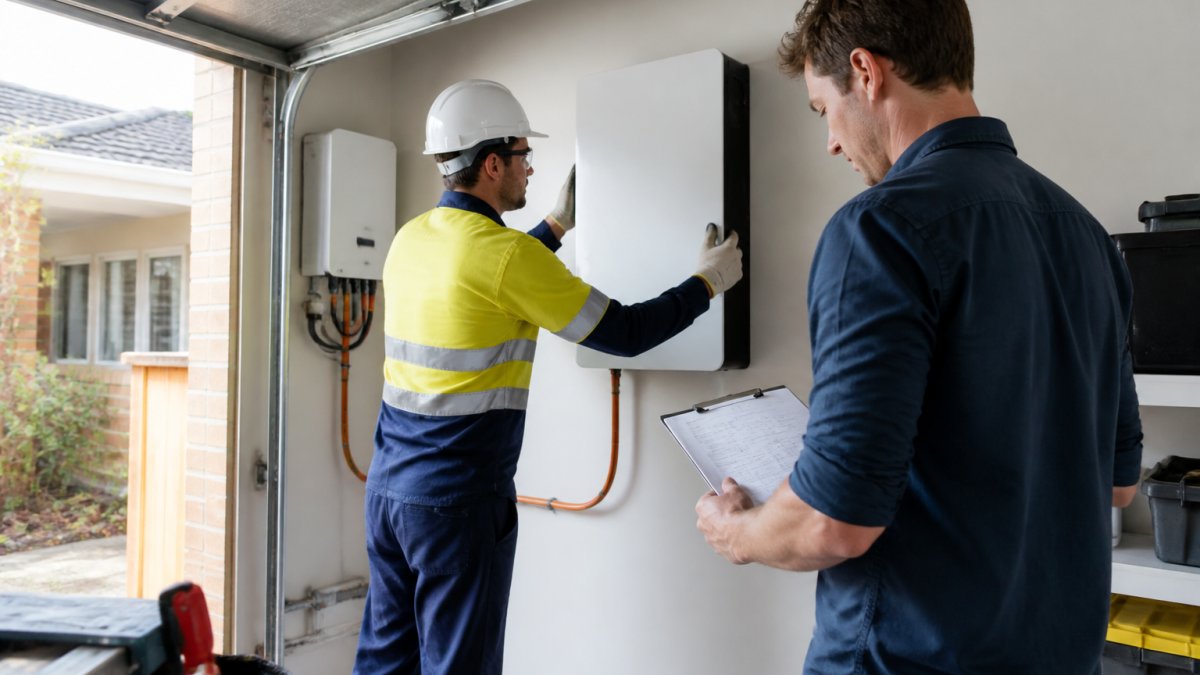
The application process runs through your installer, but the household still owns several steps. Here is how it works, with who does what and when eligibility is checked.
Stage-by-stage: who does what, and when
| Stage | Who leads | What the household provides | When eligibility is checked |
|---|---|---|---|
| 1. Eligibility self-check | Household | Proof of ownership, address, confirmation of solar and grid connection | Before any quote is requested |
| 2. Product selection | Installer advises | Energy use details, evening and overnight usage patterns | Product checked against approved list at selection |
| 3. Quote with discount applied | Installer | Approval to proceed | Discount shown as a line item on the quote |
| 4. Installation | Accredited installer | Site access, safe working clearance | Installer accreditation confirmed before work starts |
| 5. Sign-off and paperwork | Accredited installer | Signed forms, confirmation of details | Certificate of Electrical Safety issued on completion |
| 6. Claim lodgement | Installer | Nothing further unless queried | Claim lodged with supporting documents |
The household’s real job is front-loaded. Most delays trace back to stages 1 and 3, an unresolved switchboard question or a quote that does not show the discount clearly. Resolve both before you compare installers.
Step 1: Eligibility check
Confirm ownership, residence, solar and grid connection using the self-check above, so you reach the quote stage with prerequisites settled.
Step 2: Product selection
Choose an approved battery that fits your usage and switchboard. The installer should confirm the model against the current approved products list now, not after installation.
Step 3: Quote with discount applied
Your installer builds the federal discount into the quote. Ask for it as a visible line item showing gross price, discount and net price, a net-only figure makes it impossible to verify the support you receive.
Step 4: Installation by an accredited installer
The work must be done by an accredited installer and signed off with a Certificate of Electrical Safety. Confirm the accreditation covers battery storage, not just general electrical work.
Step 5: Paperwork and claim
Your installer lodges the claim and supporting documents. Keep your own copy of the quote, the signed forms and the Certificate of Electrical Safety.
What happens when an application or installation fails requirements
Applications fail for predictable reasons: an unapproved battery, an unaccredited installer, capacity outside the limits, incomplete paperwork, or a switchboard that could not take the load. When that happens, the discount is refused. The recovery path depends on the cause:
- Incomplete or incorrect paperwork: usually correctable. The installer can amend and resubmit, but it adds time.
- Capacity outside the limits: sometimes correctable by changing the battery model before installation. After installation, it is usually not.
- Unapproved product or unaccredited installer: generally not correctable. There is no appeal that fixes a product that was never eligible, and replacing an installed battery is costly.
Verify before you commit, not after. An unapproved battery or an unaccredited installer can cost you the entire discount. Check the product against the approved list and the installer’s accreditation before signing, and ask for both in writing on the quote.
A realistic timeline
Timelines vary by installer availability, switchboard work and strata approval. A common pattern:
- Self-check and quote comparison: days to a few weeks.
- Switchboard upgrade, if needed: scheduled before installation.
- Installation: typically a day for a standard wall-mounted system.
- Sign-off and claim lodgement: completed around installation.
Strata approval adds time before stage 2; a switchboard upgrade adds time before stage 4.
For a dedicated walkthrough, see how to apply for a solar battery rebate in Victoria.
How Battery Size Affects Your Rebate: Worked Examples
Battery size drives your support, so understand the maths before you choose. The discount is calculated on eligible usable capacity, up to a cap: a small battery earns a smaller discount, a larger one more, up to the maximum.
Two households, same street:
- Household A picks a small battery for evening use only. Lower upfront cost, smaller discount, shorter backup.
- Household B picks a larger battery sized to their evening and overnight use. Higher upfront cost, larger discount, more stored energy.
Neither is wrong. The right size depends on your evening usage and whether you want backup during outages.
For real pricing and rebate figures to model your own costs, see our solar battery installation cost guide.
Book Your Eligibility Check With GridFree Solar
Rebate rules reward preparation. Homeowners who get the full discount check eligibility, choose an approved product, and use an accredited installer from the start.
That is where we come in. GridFree Solar installs CEC approved batteries using CEC accredited installers.
We also help you get more from the system after it is running, from free grid charging windows to export earnings.
Get started with GridFree Solar and claim the support your home qualifies for.
Frequently Asked Questions
Who is eligible for a solar battery rebate?
Eligibility centres on the property and the system, not just the person. The battery must be installed at a home that is your principal place of residence, paired with a grid-connected solar PV system, and use an approved battery and accredited installer. Capacity limits apply, and the property must meet the program’s ownership and connection rules. Renters and apartment owners usually need the owner’s consent and may face metering or shared-property complications, so confirm your situation before signing anything.
Can I get a battery rebate if I already have solar panels?
In most cases yes, and this is the common path. The solar battery rebate with existing solar panels works by adding storage to a system you already own, provided the panels are grid-connected and the inverter and battery are compatible. Your installer will check the age and condition of the existing system, confirm the battery can be added safely under AS/NZS 5139:2019, and verify the approved products list before lodging the application.
Do I need an approved installer and approved battery to claim?
Both are mandatory. The battery must appear on the approved products list, and installation must be carried out by a Clean Energy Council accredited installer working with a licensed electrician. Work must comply with AS/NZS 5139:2019 and AS/NZS 3000, and you should receive a Certificate of Electrical Safety. Installing first and applying later is a common reason claims fail, because the paperwork and product checks are tied to the installation date.
Can I combine a federal battery discount with a state rebate?
Stacking rules change, so verify current program guidelines before you commit. The federal Cheaper Home Batteries Program provides an upfront discount on eligible batteries, while Victorian support has shifted over time and some older schemes are closed to new applicants. Ask your installer to confirm in writing which incentives apply to your address, what documents are needed, and whether any loan or rebate you are relying on is still open when your installation is scheduled.
