
Table of Contents
- Cost Effective Alternatives to Full Solar Systems: An Overview
- How to Reduce Electricity Bills Without a Full System
- Energy Efficiency Upgrades for Homes That Cut Bills
- Government Energy Efficiency Rebates and Solar Subsidies
- Plug-and-Play Balcony Solar Systems for Renters
- Ground-Mounted Solar Arrays and Solar Sheds
- Battery Storage and Smart Monitoring: Add-Ons to Consider
- Conclusion: Choosing the Right Path for Your Home
- Frequently Asked Questions
Last Updated: October 3, 2026
Cost Effective Alternatives to Full Solar Systems: An Overview
Cost effective alternatives to full solar systems cut electricity bills without a complete rooftop array and battery.
The upfront hardware cost of a full system is the main barrier, so the smartest move is often to attack demand first, then add generation where it makes sense.
A smaller, well-placed system that matches your actual usage often beats a large one you never fully use.
How to Reduce Electricity Bills Without a Full System
Reducing electricity bills without a full system starts with cutting waste before adding generation. The cheapest kilowatt-hour is the one you never use. Two levers do most of the work: behaviour and monitoring.
Behavioural Changes and Load Management
Load management means shifting heavy appliances to cheaper times. Run the dishwasher, washing machine and pool pump during the day when solar or off-peak rates apply.
A common mistake is leaving standby loads running. Entertainment units, chargers and older fridges quietly draw power around the clock. Small changes, repeated daily, add up faster than most people expect.
- Shift laundry and dishwashing to daytime or off-peak
- Set hot water and pool pumps to avoid peak windows
- Switch off standby loads at the wall
Smart Home Energy Monitors
Smart home energy monitors track real-time usage so you can see exactly where power goes, flagging the appliances driving your bill.
For anyone planning solar later, a monitor shows your true consumption pattern, which informs system sizing and helps you avoid an oversized, overpriced install. Expect to pay for the hardware only, with no ongoing generation cost.
Install a monitor for at least a month before you request any solar quote. The usage data lets an installer size the system to your real load instead of guessing from your bill.
Energy Efficiency Upgrades for Homes That Cut Bills
Energy efficiency upgrades for homes reduce demand permanently, so every future dollar of generation goes further. Insulation and draught-proofing usually deliver the fastest payback.
Insulation and Draught-Proofing
Ceiling and wall insulation keep heat where you want it. Draught-proofing seals gaps around doors, windows and vents that leak conditioned air.
Start with the ceiling, which loses the most heat in winter, then seal obvious draughts before spending on bigger projects. These are low-cost, high-impact fixes.
Glazing and Window Treatments
Double-glazing retrofits cut heat transfer through glass. Where full replacement is too costly, heavy curtains, pelmets and external shading do a surprising amount of work.
Efficiency upgrades do not generate electricity, they reduce what you need, which is why they pair so well with any generation option below.
Government Energy Efficiency Rebates and Solar Subsidies
Government energy efficiency rebates and solar subsidies can cover a meaningful share of upgrade costs. Schemes change often, so confirm current eligibility and amounts on the official source before committing. Beyond these initial incentives, exploring diverse energy cost alternatives provides a more comprehensive strategy for managing household utility expenses throughout the year.
Federal and State Programs for 2026
Several national schemes support households. The Small-scale Renewable Energy Scheme provides incentives for eligible small-scale generation, and the Cheaper Home Batteries Program supports battery installation. Eligibility, amounts and deadlines are set by government and updated regularly.
Because these figures change, we will not quote them here. Check the Clean Energy Regulator’s official scheme pages for the Small-scale Renewable Energy Scheme, and the Department of Climate Change, Energy, the Environment and Water for the Cheaper Home Batteries Program.
| Scheme | What it supports | Where to confirm |
|---|---|---|
| Small-scale Renewable Energy Scheme | Eligible small-scale generation | Clean Energy Regulator |
| Cheaper Home Batteries Program | Battery installation | Federal energy department |
| State efficiency rebates | Insulation, glazing, appliances | Your state government |
Never accept a quote that promises a specific rebate amount without checking it yourself. If a scheme closes or your property does not qualify, you carry the shortfall.
Plug-and-Play Balcony Solar Systems for Renters
Plug-and-play balcony solar systems let renters generate a small amount of power without a permanent install. A compact panel and micro-inverter plug into a standard power point, and the kit moves with you when you leave, the closest thing to solar for people who will never own their roof.
What You Can Realistically Expect
A single balcony panel typically sits in the 300W to 450W range, and a two-panel kit doubles that. A well-angled kit on an unshaded north-facing balcony can offset a meaningful slice of a small household’s daytime base load, fridge, standby loads, router and a laptop, rather than a whole bill.
Most kits use a micro-inverter that converts DC to 230V AC at the panel, then feed a standard power point, no roof penetration, no cable through the ceiling, and no fixed wiring alteration in most cases.
Strata, Tenancy and Regulatory Hurdles
This is the part that decides whether a balcony kit is actually viable for you.
- Strata and owners corporations. By-laws commonly restrict fixtures on common property, external appearance, and anything drilled into a balcony wall or ceiling. A freestanding, weighted-base kit is usually easier to justify than a bolted mount, but you still need written approval in most schemes. Check your by-laws and put the request in writing before you buy.
- Tenancy agreements. Your lease may prohibit alterations or additions without the landlord’s consent. A portable kit that leaves no damage is a stronger case, but get consent in writing so there is no dispute at bond time.
- Electrical safety. Any plug-in generation must not back-feed a live power point during an outage. Reputable kits include anti-islanding protection in the micro-inverter. Avoid unbranded imports with no compliance documentation, and check that the inverter carries the relevant electrical safety certification for use here.
Do not assume a plug-and-play kit is exempt from strata or tenancy rules just because it is portable. The rules often turn on whether the installation is fixed, visible, or on common property, not on whether it plugs into a wall.
Where It Fits in the Wider Picture
For renters, a balcony kit is a genuine first step rather than a token gesture. It builds the habit of watching generation and load, pairs naturally with the behaviour changes and monitoring covered earlier, and can come with you if you later buy a home.
- Best for renters and small-space residents
- Portable, so it relocates on moving day
- Low initial investment versus a full system
If your balcony is heavily shaded or your strata scheme is rigid, put the money into efficiency and load shifting first. Those measures work regardless of tenure and make any future generation go further.
Ground-Mounted Solar Arrays and Solar Sheds
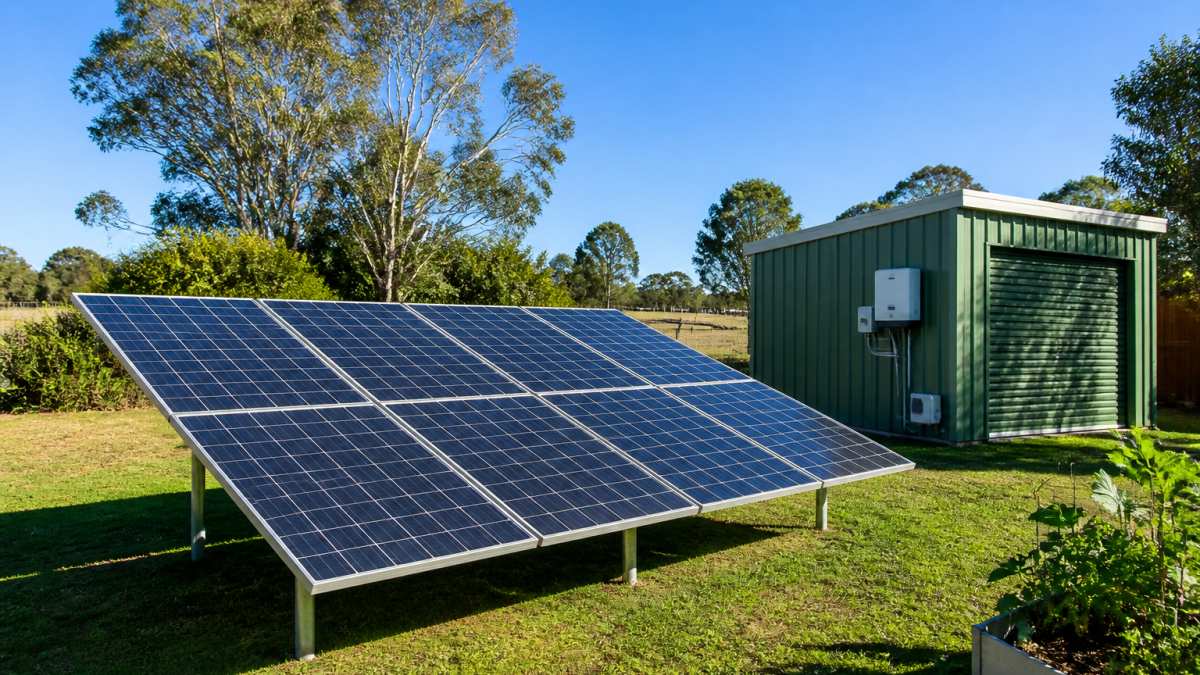
Ground-mounted solar arrays suit properties with spare land and often outperform roof systems. You can set the ideal tilt and orientation, panels are far easier to clean and service, and there is no roof load or penetration risk.
Why Ground Mounts Often Beat Roof Mounts
On a roof, you inherit the roof’s pitch, orientation and any shading from chimneys, vents or nearby trees. On the ground, you choose. That control is the whole point.
- Orientation. In the southern hemisphere, panels perform best facing true north. A north-facing ground array will generally outproduce the same panels on an east- or west-facing roof.
- Tilt. A fixed tilt roughly equal to your latitude is a common starting point, but the optimum shifts depending on whether you want maximum annual yield or a better match to your evening load. Steeper tilts favour winter production; shallower tilts favour summer.
- Shade management. You can position the array away from the tree that shades your roof for half the day. This is the single biggest advantage for shaded properties, and it is the reason a ground mount can be the right answer when a rooftop system is not.
Solar Sheds and Hybrid Structures
A solar shed goes a step further: a dedicated structure carries the panels and doubles as storage, keeping roof penetrations off the main dwelling and positioning the array purely for sun access rather than the house footprint.
The catch is scale and approvals. You need land, and structures usually require council planning approval; in many areas a shed over a certain floor area or height also needs a building permit, and boundary setbacks apply.
The Cost Drivers Nobody Mentions
Ground mounts are not automatically cheaper than roof mounts. The panels may be the same, but the balance of system changes:
- Mounting hardware. Ground frames use more steel and concrete than roof rails, and the frame must be engineered for wind and soil conditions.
- Trenching and cable runs. DC cable has to get from the array to the inverter, often underground. Trenching, conduit and cable protection add cost and labour.
- Inverter placement. The inverter needs a shaded, ventilated spot close enough to the array to keep voltage drop within limits. That sometimes means a second small structure or a longer AC run to the switchboard.
Against that, you gain easier maintenance access, the option to expand later without touching the roof, and better performance on shaded or poorly oriented blocks. For rural and acreage homes the trade-off usually favours ground mount; for a standard suburban block with a good roof, it often does not.
| Option | Space needed | Best for | Watch out for |
|---|---|---|---|
| Ground-mounted array | Large block | Rural and acreage homes, shaded roofs | Higher mounting, trenching and approval costs |
| Solar shed | Moderate yard | Extra storage plus generation | Council planning and building approval |
If shade is your main problem, get a shade study done before you decide between roof and ground mount. A simple sun-path check across the seasons will tell you whether moving the array ten metres actually solves the problem.
For anyone with the land and sun access, a ground mount is often the most flexible generation option available, but budget for the civil works, not just the panels.
Battery Storage and Smart Monitoring: Add-Ons to Consider
Battery storage and smart monitoring are add-ons that make any generation option work harder.
For grid-tied homes, a battery changes the economics. It lets you use your own generation at night instead of buying from the grid.
This is where accredited installation matters. Batteries must comply with AS/NZS 5139:2019 for battery energy storage systems and AS/NZS 3000 wiring rules.
Generation and storage only pay off when they are sized to your real usage. Monitoring is what tells you whether they are.
Conclusion: Choosing the Right Path for Your Home
The right option depends on your roof, tenure and budget. Renters should look at balcony systems, shaded or land-rich properties should weigh ground-mounted arrays and sheds, and everyone should fix efficiency and load management first, because it makes every other dollar work harder.
If you want the full picture, GridFree Solar can help. We provide expert rebate guidance, CEC accredited installation, and battery storage built to AS/NZS 5139:2019 and AS/NZS 3000.
Frequently Asked Questions
Are there effective alternatives to installing a full solar system?
Yes. You can reduce electricity bills without a full rooftop system. Options include plug-and-play balcony solar systems, ground-mounted arrays, solar sheds, energy efficiency upgrades, and smart home energy monitors. These cost effective alternatives to full solar systems suit different budgets and property types. For example, balcony systems work for renters, while ground-mounted arrays benefit rural homeowners. Each option has trade-offs in upfront cost and output, so assess your energy use and available space first.
How can I reduce my electricity bills without solar panels?
Focus on energy efficiency upgrades for homes and behavioural changes. Add insulation, draught-proofing, and double glazing to cut heating and cooling costs. Use smart home energy monitors to identify high-use appliances. Shift heavy loads to off-peak times and use timers. These steps lower demand. Government energy efficiency rebates may offset some upgrade costs, making them more affordable.
What government energy efficiency rebates are available in 2026?
Federal and state programs offer rebates for energy efficiency upgrades for homes and solar alternatives. The Small-scale Renewable Energy Scheme provides certificates for small-scale systems. The Cheaper Home Batteries Program supports battery storage. State-based rebates may cover insulation, glazing, and smart meters. Eligibility varies by location and household income. Check official government websites or consult an accredited installer for current details. Rebates can significantly reduce upfront costs for cost effective alternatives to full solar systems.
Is a portable power station a viable alternative to rooftop solar?
A portable power station can supplement your energy needs but rarely replaces a full rooftop system. It’s best for small devices, camping, or backup during outages. Capacity ranges from 500Wh to 2kWh, enough to charge phones, laptops, and small appliances. For whole-home backup, you’d need a battery storage system paired with solar. Portable generators are a cost effective alternative to full solar systems only for very limited use cases, not for ongoing bill reduction.
What role do smart home devices play in reducing energy consumption?
Smart home devices like energy monitors, smart thermostats, and smart plugs give you real-time data on electricity use. They help identify vampire loads and optimise heating and cooling schedules. For example, a monitor might show your pool pump uses 20% of your bill, prompting you to run it during off-peak hours. Integration with smart home ecosystems allows automation, further cutting waste. These devices are a low-cost step toward energy independence.