

A solar battery can do more than store power for the evening. With suitable backup equipment and wiring, it can supply selected circuits during an outage, including power for a home office laptop. For a solar battery to power my home office in Melbourne, the important step is matching usable capacity and backup configuration to the equipment you need to keep running. The federal Cheaper Home Batteries Program offers an indicative discount of around 30 percent off installed costs at common residential capacities, according to the Australian Government Department of Climate Change, Energy, the Environment and Water.
It makes sense to want dependable power for work without choosing a system larger than you need. Battery capacity, solar generation and the circuits connected for backup all affect what your solar battery can run in your Melbourne home office and for how long.
This guide explains the available incentives for Victorian households, how batteries can power office equipment, and what to consider when choosing a system. You’ll also learn how professional installation and battery upgrades fit into the decision, so you can assess the practical next step for your Melbourne home.
Key Takeaways
- Size battery capacity around evening electricity use and the office equipment you need to run, not solar-system size alone.
- Understand how federal battery support and Victorian solar incentives apply before deciding whether to add a battery or install solar and storage together.
- Plan backup around essential appliances and suitable equipment, as the battery’s capacity and inverter output affect what can run during an outage.
- GridFree Solar offers solar and battery installation, plus battery upgrades and replacements, to help match a system to your home office needs.
Section 2: What incentives are available to Victorians for solar battery systems?
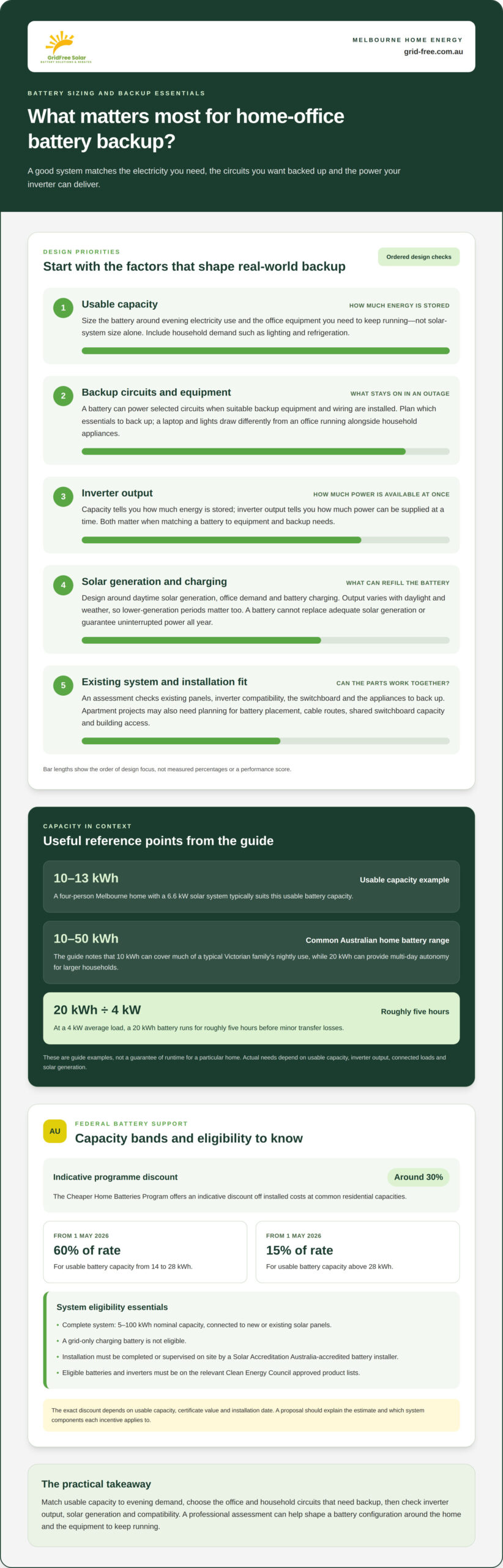
The federal Cheaper Home Batteries Program offers an indicative discount of around 30 percent off installed costs at common residential capacities, according to the Australian Government Department of Climate Change, Energy, the Environment and Water. From 1 May 2026, it pays 60% of the per-kWh rate for usable battery capacity from 14 to 28 kWh, according to the same department. From 1 May 2026, capacity above 28 kWh receives 15% of the per-kWh rate, according to the department. The exact discount depends on usable capacity, certificate value and installation date.
For a home office, system design needs to account for daytime solar generation, office demand and battery charging. There’s no single panel or inverter size for every Melbourne property. Solar output varies with daylight and weather, so the design should account for lower-generation periods. A battery stores surplus electricity, but cannot replace adequate solar generation or guarantee uninterrupted power throughout the year.
An assessment considers your existing panels, inverter compatibility, switchboard and the appliances you want backed up. The installer can then propose a battery configuration, explain applicable rebate assistance and plan the installation. For a combined residential solar and battery system, panels, inverter and storage can be designed together. Review the battery’s manufacturer-backed warranty and the installation terms separately, as they cover different parts of the system.
For Australian Government battery support, the complete system must have between 5 and 100 kWh of nominal capacity and connect to new or existing solar panels. A grid-only charging battery isn’t eligible. The installation must be completed or supervised on site by a battery installer accredited by Solar Accreditation Australia. Eligible batteries and inverters must appear on the relevant Clean Energy Council approved product lists.
Apartment projects require assessment of battery placement, cable routes, shared switchboard capacity and building access. Owners corporation or building manager approval arrangements can also affect the installation plan. GridFree Solar can assess these constraints before preparing a proposal, whether you have existing panels or are considering a combined solar and battery system.
How a professional chooses battery capacity based on evening electricity use
Battery sizing starts with how much electricity you use after solar generation falls. The design should also balance home-office backup needs with household demand, particularly in the evening.
How a professional assesses evening electricity use to size a battery
A professional reviews evening electricity use, including lighting, refrigeration and devices that remain on after work. A four-person Melbourne home with a 6.6 kW solar system typically suits 10 to 13 kWh of usable battery capacity. Usable capacity is the stored electricity available to the home, which can be lower than a battery’s stated total capacity.
Capacity, configurations and product comparisons
Australian home batteries commonly range from 10 kWh to 50 kWh. A 10 kWh battery can cover much of a typical Victorian family’s nightly use, while 20 kWh can provide multi-day autonomy for larger households. Compare usable capacity, inverter output, coupling configuration and whether the system can expand. A 20 kWh battery supplying a 4 kW average load runs for roughly five hours before minor transfer losses.
Capacity is measured in kilowatt-hours (kWh), while inverter output is measured in kilowatts (kW). Capacity indicates stored energy; output indicates how much power is available at once.
Capacity and electricity bill savings
System design considers how much daytime solar generation is available to store and how much electricity the household uses later. A larger battery can hold more surplus, but savings depend on using stored energy instead of buying electricity from the grid. Suitable capacity depends on evening demand, solar exports, system costs and rebate eligibility.
Home battery options for office backup
The right home battery depends on office equipment, the backup duration you need and household demand. A professional matches usable capacity to inverter output, then considers whether suitable backup equipment can keep selected circuits running during a blackout. A laptop and lights, for example, have different power demands from a home office running alongside household appliances.
For a tailored capacity assessment, explore battery upgrade and replacement options for an existing system.
Federal battery support and Victorian solar rebates
In Victoria, federal battery support and solar incentives address different parts of an installation. The Australian Government’s Small-scale Renewable Energy Scheme (SRES) reduces the upfront cost of eligible solar panels through Small-scale Technology Certificates (STCs). Under the Cheaper Home Batteries Program, battery support also uses STCs. These certificates can be assigned to a retailer or installer, then deducted from the upfront battery price.
That process changes the amount payable upfront, not the battery’s actual capacity or future electricity savings. A proposal should separate the solar credit from the battery discount, explain which system components each applies to, and show how the estimate is calculated. The final certificate value and installation date affect the federal battery discount, so an estimate can differ from the final credit.
Victoria’s Solar Homes PV rebate supports eligible solar panel installations, not battery-only installations. This matters if a household already has panels and wants to add storage: the solar rebate doesn’t apply to a battery installed on its own. Solar Victoria’s former battery rebate ended in 2023, and its interest-free battery loan closed to new applications in May 2025.
For a new combined solar and battery installation, the federal battery program requires a battery installed with new or existing solar panels. A battery that only charges from the electricity grid isn’t eligible. The complete system must have between 5 and 100 kWh of nominal capacity; the installation must be completed or supervised on site by an installer accredited by Solar Accreditation Australia. Eligible batteries and inverters must appear on the relevant Clean Energy Council approved product lists.
Use these distinctions when reviewing a Victoria proposal:
- Identify the solar-panel rebate and federal battery support as separate credits.
- Confirm the estimate reflects eligible equipment, installation date and certificate value.
- Assess the battery’s usable capacity and expected household savings independently of the rebate.
A rebate can lower upfront costs, but it doesn’t determine whether a battery suits your household. Consider the remaining cost alongside your evening electricity use and how you expect stored energy to reduce grid consumption.
Appliances powered by solar batteries
A solar battery can store surplus generation for later use by appliances in a Melbourne household, such as lights, a fridge, laptop, television or freezer. To use a solar battery to power your home office in Melbourne, consider whether storage can support work equipment as well as household essentials. The answer depends on usable capacity, inverter output and which circuits are backed up.
Capacity and output do different jobs. Usable capacity describes stored electricity available to the home; inverter output limits how much power appliances can draw at once. For example, a 5 kW battery inverter cannot supply a combined 7 kW demand from a 3 kW oven and 4 kW clothes dryer. The home draws the remaining 2 kW from the grid, so simultaneous appliance demand matters. A professional considers those loads when planning office backup.
Backup depends on system design. Suitable backup equipment and wiring can keep selected circuits powered during a blackout. This lets your household prioritise an office laptop, lights and a fridge rather than expecting every appliance to run. The circuit plan should reflect which devices matter most during an outage.
Battery size provides useful context, not a promise about runtime. A 5 kWh battery is described as providing essential-circuit backup for smaller Victorian households. A 13.5 kWh battery is described as capable of full-home backup. Actual performance depends on appliance demand, usable capacity and inverter limits. Choosing a solar battery to power my home office in Melbourne means weighing work needs against household loads, not relying on capacity alone.
A battery rebate can affect upfront cost, but it doesn’t determine which appliances the system can power. Match storage to work equipment, household essentials and expected use. Ask for a clear explanation of backed-up circuits and system limits so you understand how the design will serve your home office.
Plan solar battery backup around the appliances your household needs during an outage.
GridFree Solar
GridFree Solar can assess how a battery system could support your Melbourne home office, considering your existing solar setup, daytime generation, office equipment and the household circuits you want backed up. This gives you a clearer basis for choosing a suitable system instead of sizing storage around office use alone.
If your panels are already installed, a battery upgrade or replacement may suit your property. For a new system, GridFree Solar can design solar generation and storage together. The right option depends on your household’s energy use and installation requirements.
Contact GridFree Solar to discuss a solar battery setup for your home office.
Make your next energy decision with confidence
Think beyond keeping a laptop charged. A well-planned system should suit how your home operates, including the equipment you rely on and how you want to use stored electricity. This practical brief gives a professional a clearer starting point for assessing a solar battery to power your home office in Melbourne.
GridFree Solar offers residential solar panel installation, battery upgrades and replacements, and commercial solar solutions. The right option depends on whether you’re starting fresh, adding storage to existing panels or planning a business system. Identify the outcome you need, then design the system around it.
Contact GridFree Solar to discuss your battery needs. Take the next step towards a setup designed around the way you work.
Frequently Asked Questions
How are panels and a battery connected?
Solar panels connect to a battery system through an inverter arrangement. In an AC-coupled setup, the battery connects through its own inverter; in a DC-coupled setup, panels and battery share a hybrid inverter. The suitable configuration depends on whether the Melbourne home already has solar, the existing inverter and how the system needs to operate. A professional assesses compatibility and system design before installation.
How does battery storage work?
Battery storage keeps surplus electricity from solar panels for later use, such as after sunset or during a grid outage if suitable backup equipment is installed. The inverter manages electricity flow between panels, battery, household circuits and the grid. For example, daytime solar can charge the battery while your home office uses electricity, leaving stored energy available for later.
Is the system efficient?
Efficiency depends partly on the system configuration and energy lost during charging and discharging. An AC-coupled retrofit battery is estimated to have roughly 90 percent round-trip efficiency, while a hybrid inverter is estimated at around 96 to 98 percent. These figures describe energy conversion, not the proportion of your electricity bill saved. Household use, solar generation and battery operation also affect the practical result.
Retrofit or hybrid: which path suits your Melbourne home?
A battery upgrade may suit a Melbourne home with an existing solar system that’s working well, subject to inverter compatibility. A hybrid system combines solar and battery management through a hybrid inverter, making it an option for a new installation. The choice depends on existing equipment, system condition and household electricity use.
What are grid and off-grid setups?
A grid-connected system links your property to local electricity lines. An off-grid system operates independently using solar panels, charge controllers and an inverter. Grid-connected homes can draw electricity when solar generation and stored energy don’t meet demand. Off-grid systems need to balance generation and storage with the property’s usage. For a Melbourne home office, this distinction affects how the system handles periods of low solar generation.
What happens in a blackout?
A standard grid-connected solar system may stop supplying power during an outage. A battery system needs suitable backup equipment and wiring to keep selected circuits operating. In a backup-capable setup, a transfer switch disconnects the system from the grid within milliseconds during an outage. Your office will receive backup power only if its circuit is included and the battery has enough stored energy for the connected load.