
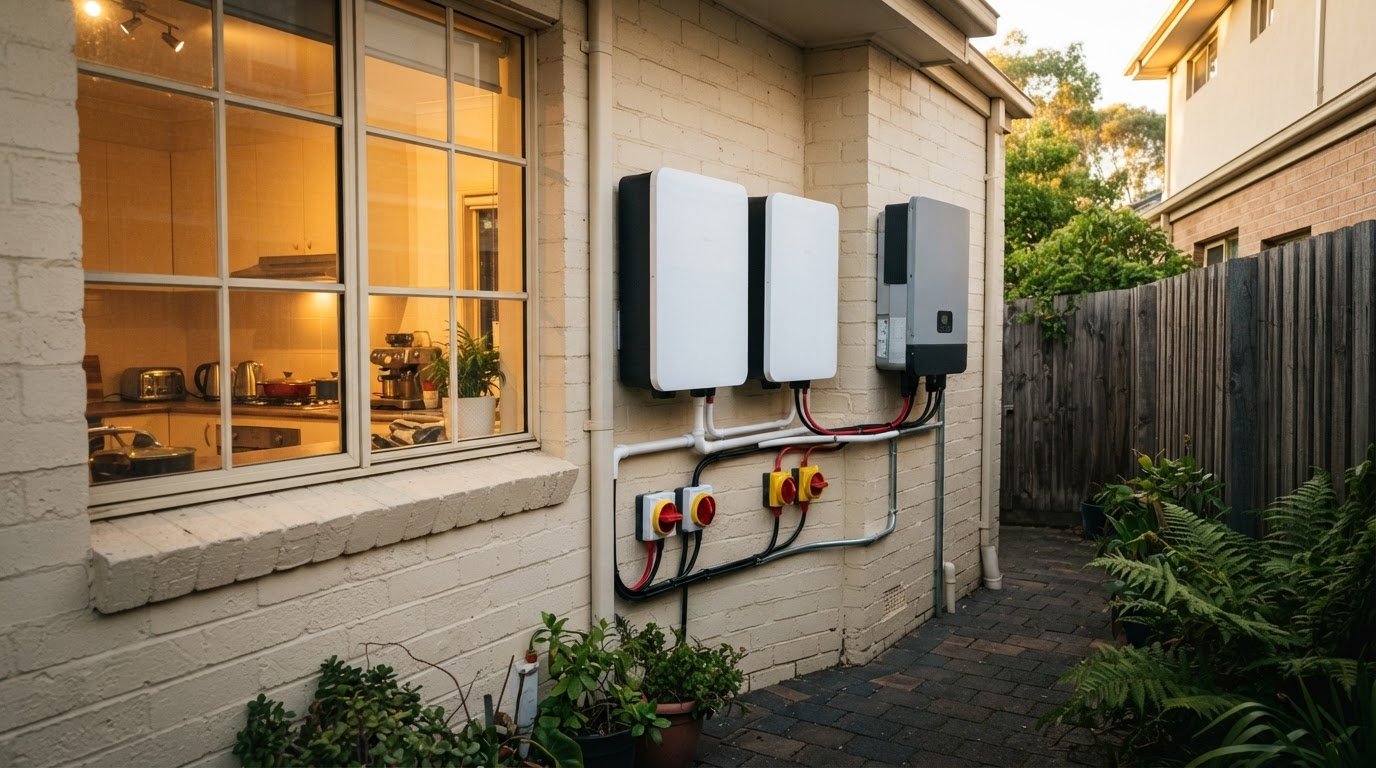
A battery’s value isn’t measured by capacity alone. For a solar battery for reducing reliance on the grid in Melbourne, the costs and potential savings depend on usable storage, your solar setup, electricity tariff and rebate eligibility.
It makes sense to want a clear picture before investing. A battery can store surplus solar power, but its impact depends on when your household uses electricity and how the system is configured. The right size also affects how long stored energy may power your home, especially in the evening or during a grid outage.
This guide explains what affects battery costs and value, how storage can reduce grid imports and electricity bills, and what influences backup duration. Monitoring solar generation, battery charge and household loads also helps you see how the system performs in everyday conditions and when stored solar is being used.
Key Takeaways
- Match battery capacity to your household’s energy use to understand how long stored power may last.
- Learn which factors shape battery value, including the changing STC calculation and your system’s design.
- See how storing solar power for later use can help reduce grid imports and make better use of your electricity tariff.
- Understand the key grid-connection requirements in Victoria and when professional battery installation or an upgrade may suit your home.
How long will a solar battery power my home?
Battery runtime depends on usable capacity and household demand; an average Australian home uses around 15 to 20 kWh of energy per day. A battery can provide backup during a Melbourne blackout if configured for backup, with available circuits depending on its switchboard connection.
Battery Capacity and Household Energy Use
Battery capacity is the amount of energy storage available, measured in kilowatt-hours (kWh). To estimate runtime, compare usable capacity with the energy demand of appliances running at the same time. A home using power steadily through the evening will draw down its battery faster than one powering only essential loads. Choose a system size to suit those patterns, not just daily household consumption.
Battery Chemistry and Product Features
Battery chemistry describes the materials used to store and release energy, while product features affect how much stored power a home can use. Usable capacity, reserve settings and discharge capability all shape runtime. A 30% charge reading, for example, means less energy is available than a full battery, so the same household demand will receive less backup time.
Battery System Capacity Limits
A battery system’s capacity limit is the amount it can store, either as one unit or through an expandable design. Alpha ESS lists the Smile G3 as expandable from 10.1 kWh to 60.6 kWh, the Smile B3 Plus from 5.04 kWh to 30.24 kWh, and the Smile T10-HV from 8.2 kWh to 49.2 kWh. Australia’s battery program covers nominal capacity from 5 to 100 kWh.
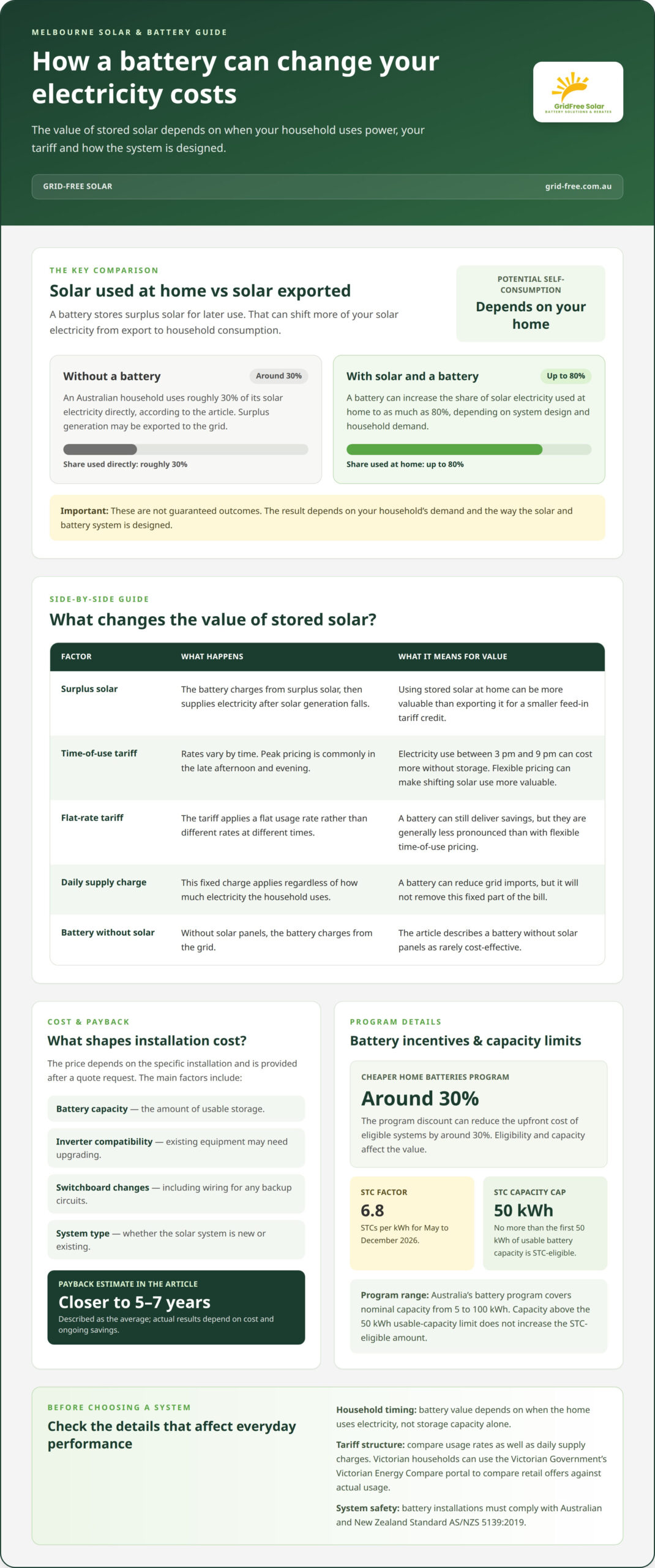
STCs can be claimed for no more than the first 50 kWh of usable battery capacity. Capacity greater than that limit does not increase the STC-eligible amount.
Backup Power During a Melbourne Blackout
Backup power is electricity a battery supplies when the grid fails. A solar battery configured for backup can keep essential circuits, such as a fridge, lights and Wi-Fi, running during an outage. Switchboard wiring determines which circuits receive power, so backup doesn’t automatically keep the whole home running.
For homeowners, practical runtime depends on which appliances remain connected and their combined demand. Prioritising essential circuits can stretch stored energy further than running high-demand appliances at the same time.
What Determines the Cost and Value of Solar Battery Systems in Melbourne?
Battery value depends on upfront installation costs, usable storage and potential bill savings. In Melbourne, system design and government incentives also shape the financial picture.
Installation Costs and Payback Factors
Installation cost is the total price of equipment and work needed to add a battery to a home. It depends on capacity, inverter compatibility, switchboard changes and whether the solar system is new or existing. The price depends on the case and is given after a quote request. Payback compares upfront cost with ongoing savings from using stored solar power rather than buying electricity. Battery payback is described as closer to 5-7 years on average.
Battery Installation and System Design
System design configures the battery, inverter and solar panels to meet household demand. A compatible inverter can simplify integration, while existing equipment may need upgrading if it cannot support the planned battery. Good design also accounts for when the home uses power, how much solar can charge the battery and whether backup circuits are needed.
STCs are certificates calculated from eligible battery capacity and used in the Australian Government’s Cheaper Home Batteries Program. For May to December 2026, the battery STC factor is 6.8 STCs per kWh, according to the Clean Energy Regulator. The program discount can reduce eligible systems’ upfront cost by around 30%; eligibility and capacity affect the value.
Accreditation is formal recognition that a product or installer meets applicable requirements. Eligible products and installation arrangements matter for accessing program support. Battery installations must comply with Australian and New Zealand Standard AS/NZS 5139:2019, which covers battery installation safety. System placement, wiring and connection design also influence safe operation and the final installation scope.
To assess how a tailored solar and battery system design could balance capacity, inverter compatibility and potential savings, consider the details that shape your home’s installation.
How Can Solar and Battery Storage Reduce Electricity Costs in Melbourne Homes?
Solar self-consumption is the share of solar electricity a household uses rather than exports. An Australian battery can increase that share from roughly 30% to as much as 80%, depending on system design and household demand. The value depends on when your home uses power, not storage capacity alone.
A feed-in tariff is the credit paid for excess electricity exported to the grid. As Victorian feed-in tariffs decline, using stored solar at home can be more valuable than exporting it for a smaller credit. A battery charges from surplus solar, then supplies electricity after generation falls. A battery without solar panels is rarely cost-effective because it charges from the grid.
An electricity tariff is the pricing structure applied to household energy use. Time-of-use tariffs charge different rates at different times, with peak pricing commonly in late afternoon and evening. Electricity use between 3 pm and 9 pm can cost more under these plans without storage. Flat-rate tariffs can still deliver savings, but they’re generally less pronounced than under flexible time-of-use pricing.
Supply charges are fixed daily costs that apply regardless of electricity consumption. A battery can reduce grid imports, but it won’t remove this fixed part of your bill. Melbourne households can use the Victorian Government’s Victorian Energy Compare portal to compare retail offers against actual usage. Check the full tariff structure, including usage rates and supply charges.
Home electrification means shifting more household energy needs to electricity, such as by adding an electric vehicle (EV). An EV can increase evening demand, so include its charging pattern when planning storage alongside existing solar. Running heavy appliances while panels produce power can leave more battery charge for later. A solar battery for reducing reliance on the grid in Melbourne should account for current loads and planned changes.
A Virtual Power Plant (VPP) connects eligible batteries so stored energy can support the grid. Participation may let eligible Victorian owners earn revenue by exporting during peak demand. Consider this alongside your tariff: exporting power can affect how much storage remains for household use.
Solar battery grid connection rules in Victoria
A grid-connected battery can exchange electricity with the electricity network while charging or supplying a home. In Victoria, installations must meet Australian Standards and network requirements. For a battery to meet the Australian program requirement, it must be technically capable of participating in a Virtual Power Plant (VPP) if connected to the grid or installed within 1 km of it.
A VPP is a network of batteries that can coordinate energy supply. A battery can be VPP-capable without its owner joining a program. When choosing a system, consider whether its configuration supports VPP participation, then weigh the program arrangements separately. Consider the solar PV system alongside the battery when planning a grid-connected installation.
Off-grid properties have specific distance-based provisions. A property more than 1 km from the grid doesn’t need a VPP-capable battery under the program. These conditions make distance and connection circumstances relevant to eligibility.
Program eligibility also depends on the battery and site. The battery must be new, created within 12 months of installation, and not previously installed or claimed. Only one battery is eligible at each premises. Eligibility also depends on pairing the battery with a solar PV system and meeting the applicable capacity conditions.
For a grid-connected installation, the installer’s design must account for the solar PV system, battery capability and network requirements. That coordination helps align eligibility with the home’s electrical setup. Discuss a grid-connected solar and battery installation with GridFree Solar to plan a system around these requirements.
GridFree Solar
GridFree Solar helps Melbourne households turn questions about battery costs and grid reliance into a practical system plan. Whether you’re considering storage for an existing solar setup or a solar and battery installation, good design starts with your household’s energy use, current system and priorities for stored power.
GridFree Solar can assess whether a battery upgrade or replacement suits your existing system, or whether a new residential solar installation is a better fit. This helps you weigh battery capacity, system compatibility and how you want to use stored energy before deciding on the next step.
For advice on a solar and battery solution for your home, contact GridFree Solar.
Plan your next step with confidence
Before settling on a battery plan, decide what you want your home’s energy system to do. You might want to shift more daily use away from the grid, prepare for changing household demand or find out whether your current setup can support storage. A solar battery for reducing reliance on the grid in Melbourne should fit your priorities now and allow you to reassess as your household’s needs change.
Monitoring solar generation, battery charge and household loads helps you see how the system performs in everyday use. Use those insights to guide decisions about energy use and system settings, rather than relying on capacity alone to judge whether the setup suits your home.
For a conversation about your options, contact GridFree Solar to discuss options. A clear plan is a practical first step towards making your solar energy work harder for your home.
Frequently Asked Questions
Are there government rebates for solar batteries in Australia?
Australian households may qualify for federal battery support, and eligible Victorian households may also access Solar Victoria rebates or interest-free loans when programs are available. Each form of assistance has its own eligibility conditions. GridFree Solar helps customers navigate and claim solar and battery rebates, including the paperwork for eligible installations.
How Can Melbourne Homeowners Prepare for Future Energy Needs?
List likely changes to household energy use, such as replacing gas appliances with electric alternatives, adding an electric vehicle or changing work-from-home routines. Share these plans during system design, even if they’re not immediate. This helps ensure the proposed solar and battery setup accounts for future demand, not just today’s usage. Review your actual energy patterns as household needs evolve.
How Can a Solar Professional Help Melbourne Households Choose the Right Strategy to Lower Electricity Bills?
A solar professional can assess household energy use and the existing system, then design a plan around your priorities. GridFree Solar’s process includes site assessment and custom design, followed by installation and system integration. Activation and after-care include remote performance monitoring and lifetime support, helping homeowners understand how their system operates after installation.
How Much Can a Solar Battery Retrofit Help You Save in Melbourne?
The example gives a payback period of under 2 years. It describes a specific usage and price scenario, rather than a fixed saving for every Melbourne household. Your tariff, solar generation and energy use shape the result.
How much can I really expect back from the rebate?
The stated amount is tied to that battery capacity, so it isn’t a universal rebate figure for every system. Eligible battery installations must also meet the program requirements, including connection with a solar PV system.
How much does a home solar battery cost in Melbourne, installed?
The installed price depends on the system and is provided after a quote request. Key factors include battery capacity, inverter compatibility, the existing solar setup, switchboard work and installation design. These determine the equipment and work required at your property. A tailored quote gives you a price for your system, rather than a broad figure that may not match your home.