
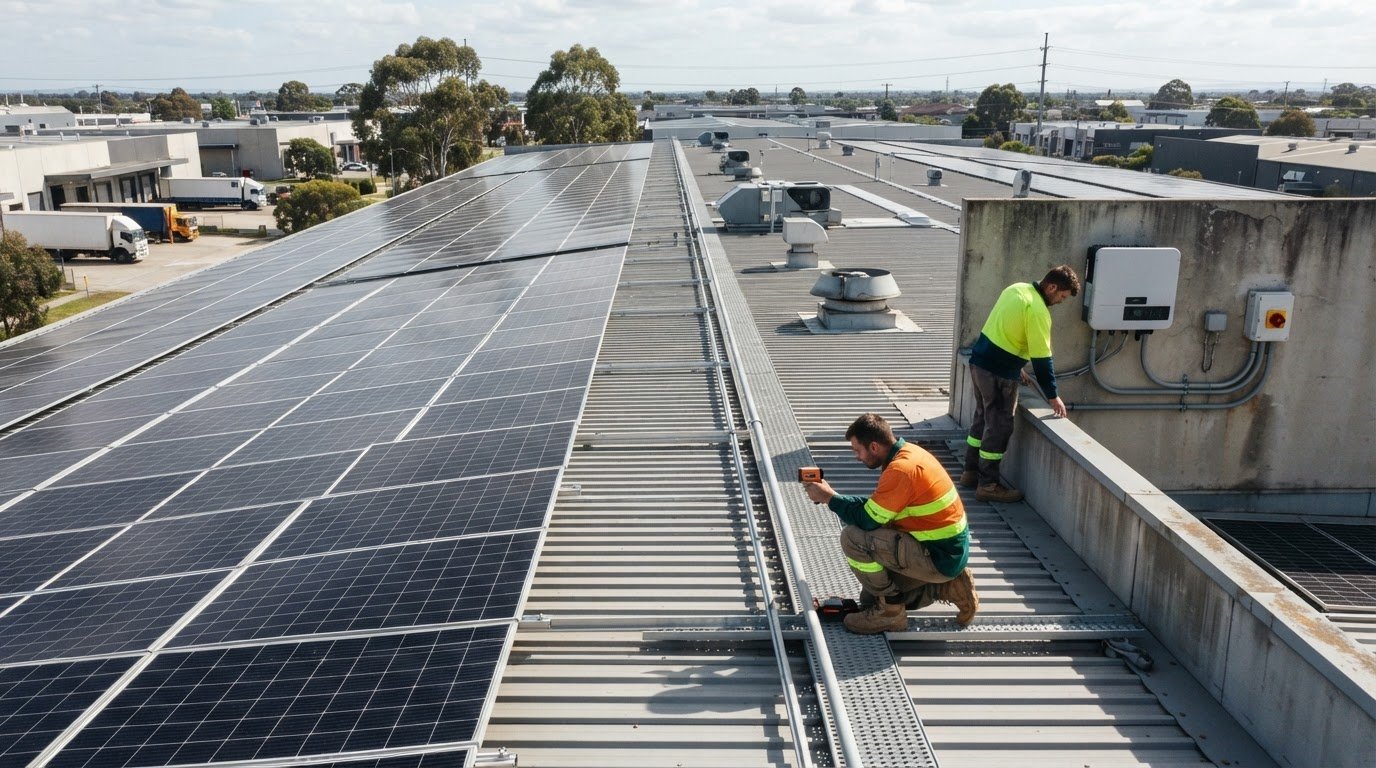
The best commercial solar system isn’t automatically the largest one. For businesses in Melbourne, Victoria, the right capacity depends on electricity use, suitable roof space, shading and network limits. This commercial solar system sizing guide starts with your business’s electricity profile, then considers site conditions and budget.
Annual consumption is only part of the picture. Timing matters too: solar power used on site can reduce purchased electricity, while generation above demand may be exported. Twelve months of electricity data provides a useful starting point for identifying seasonal patterns and daily demand. A professional assessment considers interval data, roof space, shading, network constraints and budget to shape a system around your business. A fixed system size won’t suit every operation, so accurate information helps make the proposed design relevant.
Key Takeaways
- A 100 kW system won’t suit every medium business; sizing depends on its load profile and whether battery storage or backup is needed.
- Panel orientation can help align solar generation with morning or afternoon demand, making the timing of your electricity use a key part of the assessment.
- Usable roof area, shading and network connection limits all shape the system design, not just your annual electricity consumption.
- Twelve months of electricity data can reveal seasonal patterns, weekend demand and short peaks that help a professional size a system around your operations.
Is a 100 kW system suitable for every medium business?
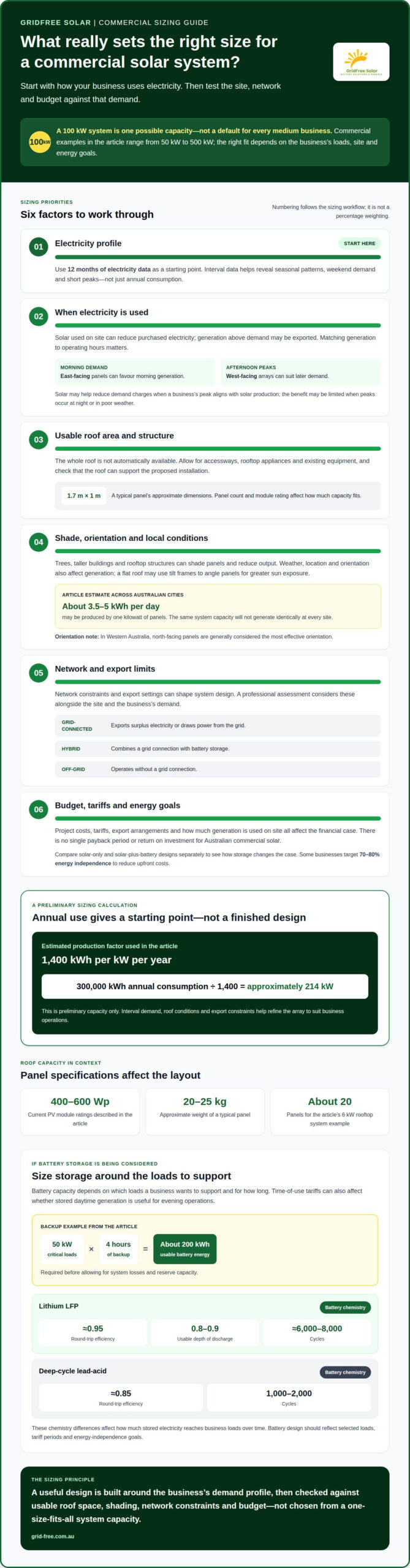
No. A 100 kW array is one possible capacity, not a standard fit for every medium business. Commercial examples include 50 kW, 100 kW, 250 kW and 500 kW systems, but there isn’t a fixed size for each industry. Grid-connected systems export surplus electricity or draw power from the grid; hybrid systems combine grid connection with battery storage; off-grid systems operate without a grid connection.
Battery requirements depend on the loads a business wants to support and for how long. For example, 50 kW of critical loads needing four hours of backup requires about 200 kWh of usable battery energy before system losses and reserve capacity. That differs from installing a larger solar-only system to generate more renewable electricity during the day.
Battery chemistry changes available capacity and replacement assumptions. Lithium LFP batteries have approximately 0.95 round-trip efficiency and 0.8-0.9 usable depth of discharge, with a cycle life of approximately 6,000-8,000 cycles. Deep-cycle lead-acid batteries have approximately 0.85 round-trip efficiency and 1,000-2,000 cycles. These differences affect how much stored electricity reaches business loads over time.
Time-of-use tariffs also matter. A battery can shift excess daytime generation into evening operations or support selected loads during an outage when configured for that purpose. Solar may reduce demand charges when a business’s demand peak aligns with solar production; the benefit may be limited when peaks fall at night or during poor weather. Professionals size battery capacity around chosen loads, tariff periods and energy-independence goals. Some businesses target 70-80% energy independence to reduce upfront costs.
There’s no single payback period or return on investment for Australian commercial solar systems. Results depend on factors such as how much generation the business uses on site, its tariffs, export arrangements and project costs. Comparing solar-only and solar-plus-battery designs separately helps show how storage affects the financial case.
There is no fixed system size for each industry. Commercial examples range from 50 kW to 500 kW, with the right capacity depending on a business’s loads and energy goals.
Which size solar system is best?
The right capacity reflects your business’s electricity demand, site conditions and the times when solar generation is useful. Professionals assess annual output alongside the roof layout and operating profile. This commercial solar system sizing guide organises those factors around your site’s actual needs.
Matching solar generation to usage
Panel orientation can shift generation towards the times your business uses electricity. East-facing panels can favour morning demand, while west-facing arrays can suit afternoon peaks. This matters because solar electricity used while panels are generating generally offsets more purchased power than exported generation. A business with early operations may value morning output; later shifts may benefit from generation extending into the afternoon. The load profile helps identify which roof areas best support onsite use.
Sizing modules with the generation factor
A panel generation factor estimates annual energy output per installed kilowatt, giving professionals a preliminary way to relate consumption to PV capacity. Using an estimated production factor of 1,400 kWh per kW per year, annual consumption of 300,000 kWh indicates preliminary capacity of approximately 214 kW. This calculation is a starting point, not a finished design. Interval demand, site conditions and export constraints refine the array so its generation can align with business operations.
Location and orientation effects on generation
Location, weather, shading and orientation influence how much electricity each installed kilowatt generates. Across Australian cities, one kilowatt of panels may produce an annual average of about 3.5 to 5 kWh per day. In Western Australia, north-facing panels are generally considered the most effective orientation. Professionals factor in local conditions when estimating annual output, rather than treating the same system capacity as delivering identical generation at every site.
Roof space, panel dimensions and capacity
Available roof area influences panel count and the total system capacity that can fit. A typical panel measures about 1.7 m by 1 m and weighs 20-25 kg; current PV modules are rated at 400-600 Wp. A 6 kW rooftop system requires about 20 panels, illustrating how module rating affects array layout. For Australian businesses, a commercial solar system sizing guide connects roof dimensions and electricity needs to a practical design. A professional assessment can shape that design around the site through commercial solar system sizing.
Roof space, shading, network limits and budget
A commercial array needs to fit usable roof space and the site’s connection conditions, not just annual demand. Shading, roof structure and export settings all affect output and potential savings.
Having a professional assess usable roof space
A professional measures the roof and identifies suitable panel areas, rather than treating the entire roof as available. The layout must allow for accessways, rooftop appliances and existing equipment. Structural suitability matters too: the roof needs to support the proposed installation. This assessment shows how much capacity can fit and whether the usable area can meet the business’s generation goals.
Roof shading and obstacles
Trees, taller buildings and rooftop structures can shade panels and reduce solar output. The timing and extent of shade help identify which roof sections are more productive throughout the day. Vents and other appliances can interrupt panel placement, so the design needs to account for obstacles rather than assume a continuous array. On a flat roof, tilt frames can angle panels for greater sun exposure.
Roof angle, orientation and structural suitability
Roof angle and orientation affect how much sunshine panels can capture. Roofs angled between 15 and 35 degrees have the best chance of catching the most sunshine, while an angle below 10° starts to affect system output. A professional considers these conditions alongside structural suitability and shade, then locates panels to make effective use of the roof. Network connection agreements also shape the design, as inverter capacity and exports can face site-specific limits.
Commercial system costs
There is no single commercial solar cost per kilowatt for Australia in 2026. The price depends on the case and is given after a quote request; system capacity, roof layout, electrical work and grid connection requirements affect the project cost. Connection limits matter too: where a limit is 10 kW per phase, a three-phase property could install a three-phase inverter up to 30 kW. Some distributors may allow a 10 kW single-phase inverter while limiting exports to 5 kW. Export restrictions can affect how much generation is used on site, shaping the savings the system can deliver.
Factors affecting commercial and household system size
For an Australian business, system size depends on electricity use, operating hours and future demand. Twelve months of interval data helps professionals identify seasonal changes, weekend loads and short peaks. Smart meters record electricity use every 15 or 30 minutes, revealing patterns an annual total on an electricity bill can hide. Planned fleet or customer EV charging can also change demand and affect switchboard, inverter and solar capacity.
Australian incentives and tax treatment depend on system size and eligibility. Scheme figures current as of June 2020 stated that systems under 100 kW could receive certificates under the Small-scale Renewable Energy Scheme, while systems above 100 kW could claim under the Large-scale Renewable Energy Target. Small businesses with annual turnover below $50 million were eligible to write off depreciable assets valued up to $30,000, including solar PV systems.
Household demand gives context, but it can’t determine a commercial design. A small Australian household typically uses 8-12 kWh daily; a medium household uses 14-20 kWh. A residential guide suggests 3-4 kW for small households, 6.6-10 kW for many family homes, and 13.3 kW or larger for homes with a pool, EV or ducted air conditioning. Business loads need their own assessment.
An off-grid household example shows how storage changes capacity planning. The worked daily load is 2,100 Wh. Applying a 1.3 sizing factor gives a preliminary array energy target of 2,730 Wh daily. For two days of autonomy, the example calculates a 48 V LFP battery at 108 Ah, or about 5.2 kWh. Battery efficiency, usable capacity and inverter demand affect the final design.
For commercial savings, professionals use interval demand, planned changes and connection conditions, rather than household averages. Plan your commercial solar system around the loads your business needs to serve.
GridFree Solar: Commercial Solar Solutions
GridFree Solar provides commercial solar solutions for Melbourne and Victorian businesses planning a system around their electricity use, roof space and network conditions. Its professional assessment connects the site’s demand profile with practical design considerations, helping businesses understand how solar capacity can align with operating hours, shading and export limits.
If you’re considering storage alongside solar, GridFree Solar also provides solar and battery installation. For businesses with an existing battery, battery upgrade and replacement can address changing storage needs. The right next step depends on whether you’re planning a new commercial system or reviewing battery capacity as your energy use changes.
Share your business requirements and contact GridFree Solar to discuss commercial solar solutions for your site.
Make your next energy decision with confidence
Plan for more than the system you need today. Changes to operating hours, equipment or business growth can alter when and how your site uses electricity, so connect solar planning with your wider operational plans. A commercial solar system sizing guide is most useful when it helps turn those plans into a practical design decision.
Before moving ahead, consider what matters most to your business: using more solar power on site, managing evening demand or supporting selected loads with storage. Those priorities help shape a system that fits your operation, rather than pursuing capacity for its own sake. GridFree Solar’s Commercial Solar Solutions can turn your requirements into a tailored system design, with no cookie-cutter plans.
Take the next step when you’re ready to explore a system for your site. Discuss your commercial solar system with GridFree Solar and move forward with a design shaped around your business.
Frequently Asked Questions
Can solar reduce demand charges?
Yes, solar can reduce demand charges when a business’s demand peak coincides with solar generation. The benefit may be limited if the peak occurs at night or during poor weather. Compare your demand pattern with the tariff’s peak measurement periods: reducing total electricity use alone doesn’t necessarily lower demand charges if the highest power draw remains unchanged.
How many solar panels do I need?
Panel count depends on the system’s total PV capacity and each panel’s rated output. As an illustration, a 100 kW array using 600 W panels requires approximately 167 panels. A different panel rating changes the count, while roof layout can affect how many fit in usable areas. Treat the example as a capacity calculation, not a final panel schedule for your site.
How much electricity will my system generate?
Generation depends on installed capacity, location, weather, orientation and shading, so a system’s rated capacity isn’t its annual energy output. As a simplified Australian example, a 100 kW system could theoretically produce 140,000 kWh per year using an estimated production factor of 1,400 kWh per kW annually. Actual site estimates account for local conditions and the proposed array layout.
How do professionals size a commercial solar system in Australia using electricity consumption and load profiles?
Professionals compare your business’s electricity consumption with the timing of its loads, then assess a PV capacity suited to those needs. They examine daytime baseload, seasonal patterns, weekend operations and short demand peaks. This distinction matters: two businesses with similar annual consumption can need different designs if one operates mostly during daylight and the other uses more power outside solar hours.
How do peak demand, demand charges and time-of-use tariffs affect commercial solar sizing in Australia?
Peak demand shows when your business draws its highest power, while time-of-use tariffs assign different rates to different periods. Solar generation may help with daytime peaks; a battery can shift surplus electricity into selected later periods. Sizing needs to account for when the peak is measured and when energy is used, because stored power only helps with a demand peak if the system is configured to serve it.
What are the Australian rules and approvals for commercial rooftop solar, including DNSP connection limits?
Commercial connection conditions depend on the site and its distribution network service provider (DNSP). Connection agreements may limit inverter capacity, electricity exports, or both, so don’t assume one site’s settings apply elsewhere. Grid Connection Approval is part of project planning; the proposed inverter and export settings need to account for the relevant network conditions before the system design is finalised.