
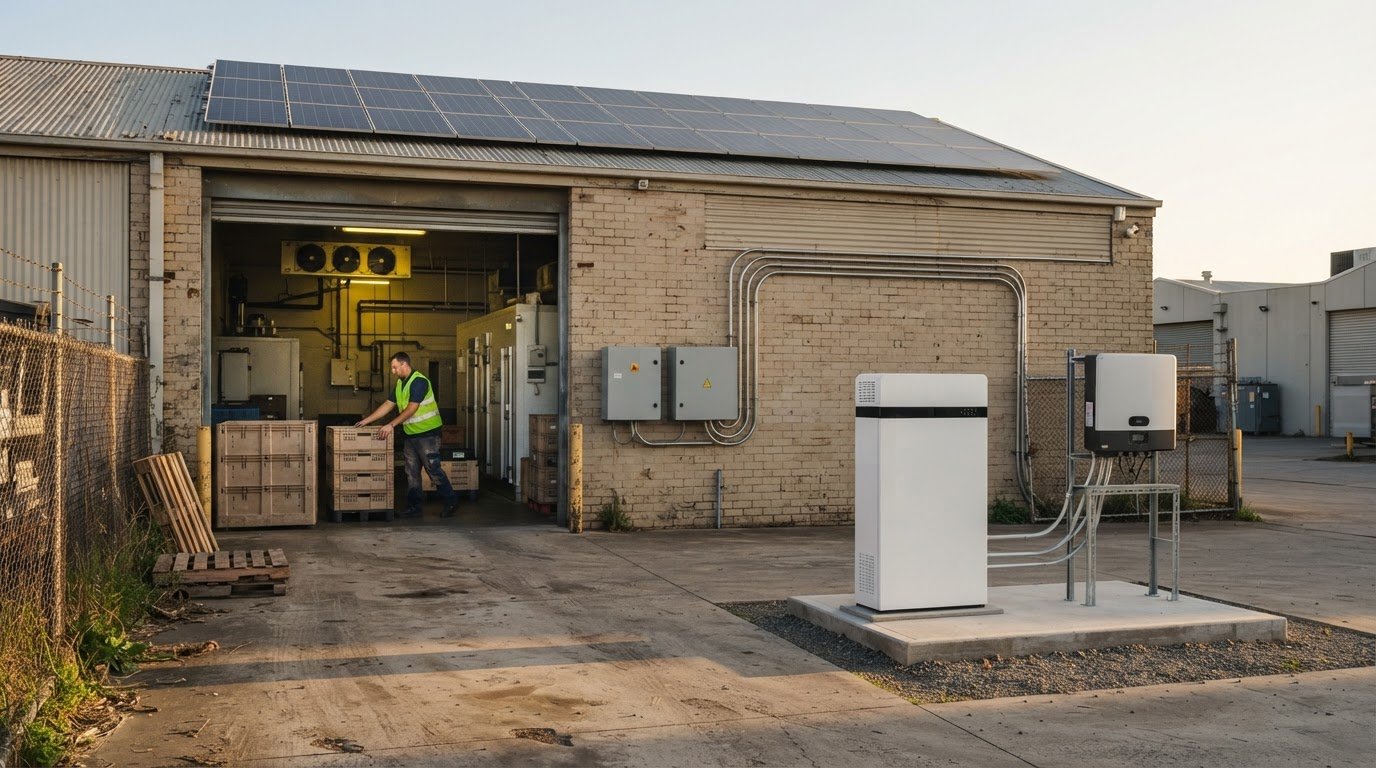
A solar battery can reduce a peak-demand charge, but it won’t remove time-of-use rates. Demand tariffs measure your highest electricity draw during defined intervals; time-of-use tariffs charge different rates depending on when you use electricity. A solar battery for reducing peak demand charges in Melbourne supplies power when your grid demand peaks.
If your bill combines a demand charge with time-based usage rates, it’s easy to confuse the two. Both make the timing of electricity use matter, but they measure different things. A battery’s impact depends on how your tariff calculates demand.
This guide explains demand tariffs versus time-of-use rates, which households may benefit from flexible energy use, and how battery storage can help manage a peak. It also explains why the timing of your household’s demand, solar generation and battery discharge matters when assessing potential benefits.
Key Takeaways
- Demand tariffs charge for your highest power draw, while time-of-use tariffs apply different rates to electricity used at different times.
- Look at when your household uses electricity and whether flexible usage or stored solar could help shift demand away from costly periods.
- A battery can reduce grid demand during a peak, but its impact depends on the tariff and the timing and size of your household’s load.
- For businesses, understanding peak intervals and how demand is calculated is essential to assessing potential savings and certificate calculations.
Can a battery eliminate peak charges?
No. A battery can reduce grid demand during a peak, but it won’t automatically remove a demand charge. The result depends on your tariff and when the battery can discharge.
Commercial electricity demand charges
A commercial demand charge is based on a site’s highest electricity draw during defined peak periods, even if that peak lasts briefly. It matters because a short burst of consumption can influence the bill beyond the electricity used in that moment. Demand charges can make up 30-50% of a commercial power bill.
For a commercial battery, the relevant Victorian requirements centre on electrical safety and connection to the grid. Distributor approvals depend on the installation’s design and connection conditions, so there isn’t one approval pathway for every site.
Solar self-consumption and electricity purchases
Solar self-consumption means using electricity from your system on site instead of exporting it. Each kilowatt-hour used on site replaces a kilowatt-hour you would otherwise buy from your retailer. This can lower electricity bills, while solar generation may also reduce grid demand when it coincides with the site’s peak.
Solar Victoria’s $1,400 PV rebate applies to homeowners installing or expanding solar alongside storage. It shouldn’t be treated as a commercial battery incentive. Commercial eligibility for other grants or incentives depends on the specific program and its terms.
Household tariffs and battery sizing
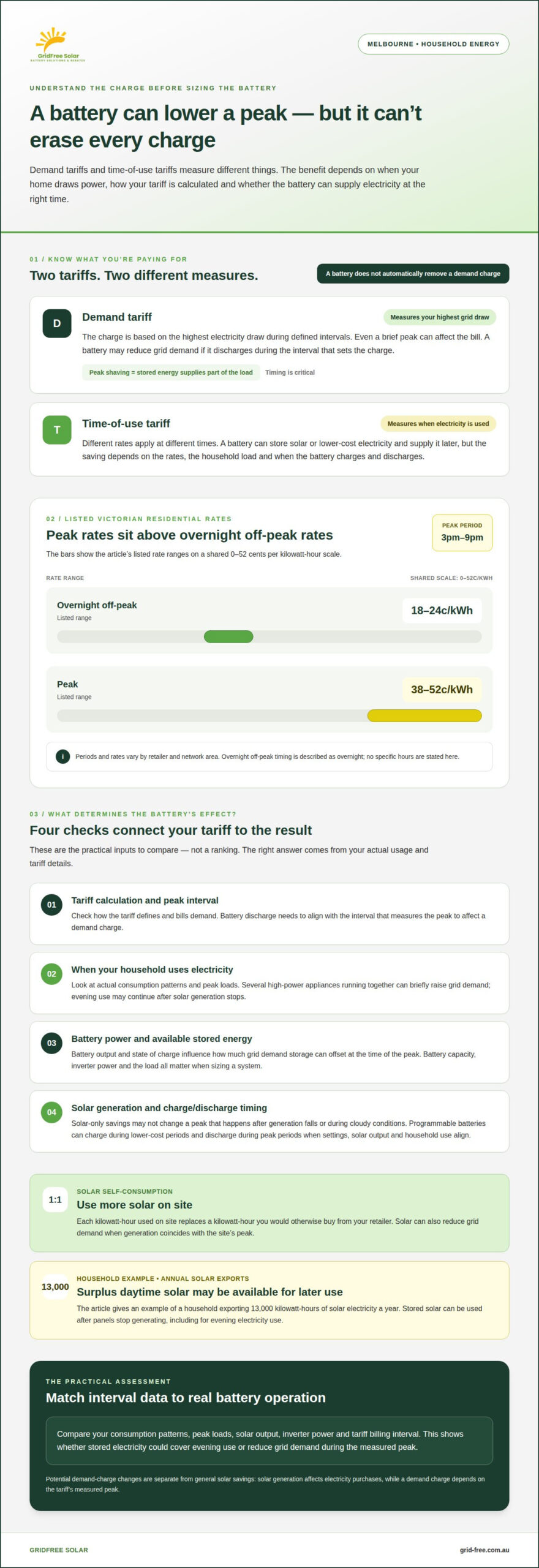
A time-of-use tariff charges different rates according to when electricity is used; a demand tariff charges for the highest rate of grid draw during defined intervals. In Victoria, listed residential time-of-use peak rates are 38c-52c per kilowatt-hour from 3pm-9pm, compared with off-peak rates of 18c-24c per kilowatt-hour overnight. Periods and rates vary by retailer and network area.
For household battery sizing, a professional assesses actual consumption patterns, peak loads, solar output, inverter power and how the tariff calculates demand. These factors show how much stored electricity could cover evening use or reduce a demand peak.
Melbourne buyers should consider warranty coverage, battery capacity degradation over time, and fire risks linked to the equipment and installation. The system design and installation controls matter alongside the battery’s stated warranty.
Households that may benefit from flexible energy use
Flexible energy use can suit households whose electricity demand shifts throughout the day. For Melbourne businesses, a battery can reduce peak demand by discharging when site consumption rises, including when solar output is low.
Battery peak shaving
Battery peak shaving means using stored energy to reduce the amount drawn from the grid during a demand peak. It matters when several high-power appliances run together and briefly raise a household’s grid demand.
Households with evening electricity use can draw on stored solar after panels stop generating. A household example exports 13,000 kilowatt-hours of solar electricity a year, illustrating how surplus daytime generation can be available for later use instead.
Battery management software controls charging and discharge according to settings and energy use. Programmable batteries can charge during lower-cost periods, then discharge during peak periods; the timing must align with the tariff’s demand interval to affect a demand charge.
For a home or business, compare actual consumption patterns with battery output. Battery power, state of charge and the timing of the peak all influence how much grid demand storage can offset.
Grid charging and energy arbitrage
Grid charging means storing electricity bought from a retailer rather than relying only on solar generation. Energy arbitrage uses that stored electricity later, aiming to shift purchases from higher-priced periods to lower-cost periods.
For a household on a time-of-use tariff, this approach depends on the gap between the charging rate and the rate avoided during discharge. The tariff’s periods, daily supply charge and household load all affect the comparison. A battery can also reserve capacity for solar generation or evening use, so the charging strategy matters.
Software can schedule charging and discharge around tariff periods, solar output and household consumption. A professional assessment of usage data helps match battery operation to those patterns. For a system designed around your home’s load, explore solar and battery installation options.
Peak-demand savings capacity and certificate calculations
Peak-demand savings depend on when a site reaches its highest grid draw and how the tariff measures it. For a Melbourne property, interval data helps distinguish potential bill reductions from any certificate calculations linked to a specific programme.
Limits of solar-only demand savings
Solar-only demand savings are limited when a site’s peak occurs after solar generation falls or during cloudy conditions. Panels may reduce daytime grid use without changing the interval that sets the demand charge.
A professional assesses interval data alongside solar output and the tariff’s billing period. If a business’s highest demand occurs in the evening, solar generation alone may not address that peak. A battery can discharge then, with its power and available stored energy shaping the reduction in grid draw.
Keep potential demand-charge changes separate from general solar savings. They arise from different measures: electricity generated and used on site affects purchases, while demand charges depend on the tariff’s measured peak.
Comparing peak charge reduction strategies
Batteries, load shifting and demand management target peaks in different ways. A battery supplies stored electricity; shifting flexible operations changes when equipment draws power, while staggering high-load equipment can smooth a site’s demand profile.
A tariff review can also change how electricity use is charged. A professional can compare tariff terms with interval data, then assess whether storage, operational changes or a tariff adjustment best addresses the site’s demand pattern.
Certificate calculations are separate from electricity-bill savings. Where an applicable programme awards certificates for demand reduction, its rules determine how a measured reduction translates into credits. Keep any potential credits separate from the battery’s effect on your retailer bill.
For households considering virtual power plant participation, programme rewards depend on participation terms and battery dispatch. The Australian Government’s SunSPOT tool estimates solar and battery payback, but doesn’t model virtual power plant benefits or charging a battery from the grid.
Battery storage for peak demand reduction
A battery reduces peak demand by supplying stored electricity when a site would otherwise draw heavily from the network. For a solar battery for reducing peak demand charges in Melbourne, discharge must align with the tariff’s demand interval. The key is matching battery output to the site’s actual peak, not simply maximising storage capacity.
Battery power and energy capacity serve different purposes. Power, measured in kilowatts, affects how much load the battery can support at once; capacity affects how long it can supply that load. A system sized for a short equipment surge may not cover a long evening peak. A certified installer assesses interval data, site loads, solar output and the tariff’s calculation method to shape the design.
Charging strategy matters, too. Solar can charge the battery during the day for later use, while programmed charging may use lower-cost electricity from a retailer. Discharging during the relevant peak can reduce grid draw; discharging too early may leave less stored energy when the site reaches its highest demand. Battery controls coordinate these settings with consumption patterns.
For businesses in Australia, model peak-demand savings separately from ordinary solar bill savings. Solar generation may reduce daytime purchases, while stored energy can support evening demand when panels aren’t generating. Treat any peak-demand reduction from solar alone as potential additional value, not a guaranteed part of the business case. A rebate may also affect project economics, but it doesn’t itself reduce the measured demand peak.
A professional design connects the tariff interval, battery output and operating schedule. For Melbourne sites, a solar battery for reducing peak demand charges should be assessed against the site’s demand profile. Explore commercial solar and battery options to consider a system suited to your operations.
GridFree Solar
GridFree Solar helps households and businesses in Melbourne and greater Victoria assess solar and battery systems for their energy needs. Its residential Solar Panel Installation, Commercial Solar Solutions, Battery Upgrade & Replacement, and solar and battery installation services can support different sites.
If your existing system doesn’t store enough solar electricity for later use, a battery upgrade or replacement may be relevant. For a new system, the design should reflect your site’s consumption, solar output and tariff, since those factors shape how stored energy can help manage peak demand.
Peak charges depend on the tariff’s measurement method and when electricity is drawn, so battery storage isn’t a universal fit. Contact GridFree Solar to discuss your solar and battery needs in Melbourne or greater Victoria.
Make your next energy decision data-led
The next step is to compare your tariff’s demand window with the times your home or business draws the most power. This gives you a practical basis for deciding whether battery storage, changes to energy use or a different tariff deserves closer consideration.
A solar battery for reducing peak demand charges in Melbourne should be assessed against your actual load profile, not chosen by capacity alone. The system’s output, discharge timing and available stored energy all affect how it fits your peak. Results depend on these factors and the tariff’s calculation method.
GridFree Solar can help you explore Battery Upgrade & Replacement, residential Solar Panel Installation or Commercial Solar Solutions for your energy needs in Melbourne and greater Victoria. Bring your priorities to the discussion, whether you’re planning a new system or considering storage for an existing one.
Contact GridFree Solar to discuss batteries and take a considered next step towards a system suited to your energy use.
Frequently Asked Questions
Are time-of-use and demand tariffs the same?
No. The distinction is what triggers the charge: time-of-use pricing applies to each unit imported during a rate period, while demand pricing responds to the measured power peak. A home can have both on one plan, so shifting a dishwasher to off-peak may lower usage charges without changing a separate demand peak created by cooking and heating together.
Can Solar Batteries Help?
Yes, a battery can help by supplying stored electricity when household demand rises. For example, a home with daytime solar surplus and evening cooking, heating and hot-water loads may use stored generation instead of importing as much electricity. The value depends on whether discharge coincides with the tariff’s costly period; storage can’t offset energy consumed after it has run low.
Can solar completely protect me from peak prices?
No. Solar output changes with daylight and weather, while a household’s peak-priced use can continue after sunset. A battery can cover some later consumption, but its available charge and discharge power limit what it supplies. Grid imports may still occur, and daily supply charges remain payable under the plan. Solar and storage can reduce exposure, but they don’t guarantee protection from every peak price.
Electricity Rates in Victoria: Can Home Batteries Reduce Costs?
Yes, a home battery can reduce costs in Victoria by storing solar electricity for use during higher-priced periods, reducing purchases from the retailer. Exporting surplus may earn a feed-in credit, but Australian feed-in tariffs are typically lower than retail import rates. Compare the plan’s daily supply charge as well as usage rates: a battery changes energy flows, not the fixed charge itself.
How Can Smart Energy Management Improve Battery Savings?
Smart energy management can improve battery value by coordinating charging with available solar or lower-cost periods and reserving energy for later household demand. A well-matched schedule avoids using stored electricity too early, before a more expensive period begins. Assess performance across weekdays, weekends, seasonal changes and work-from-home days, since household routines can shift the best charging and discharge times.
How can a professional help Victorian households decide if a home battery is worth it?
A professional can assess a household’s interval consumption, solar exports, tariff structure and expected battery operation. They can model how much daytime surplus is available, how much evening electricity the home imports, and whether storage capacity aligns with those loads. The assessment can also consider daily supply charges, export credits, system compatibility and applicable rebate eligibility to build a more complete picture of potential value.