
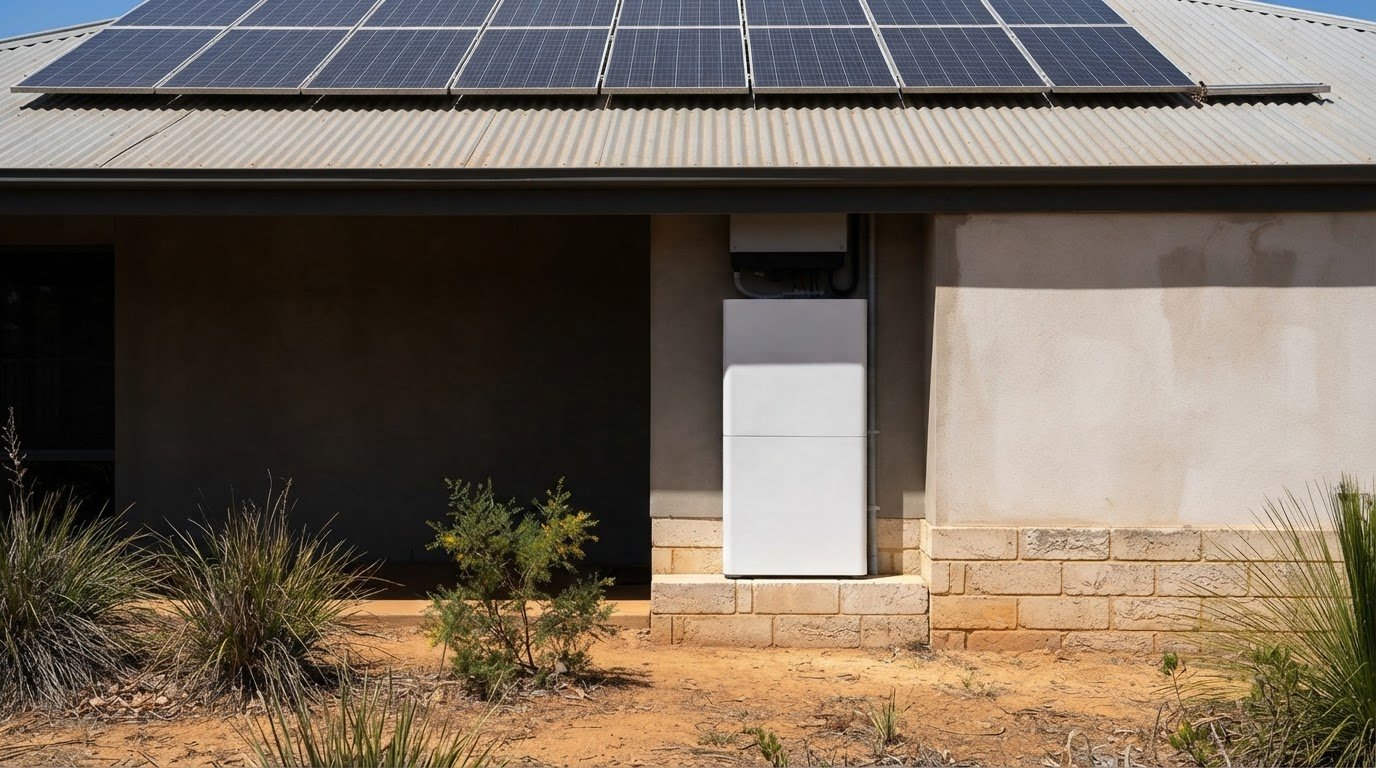
Desert heat can shorten a home battery’s life before it causes an immediate failure. A suitable operating range is 20-30°C, so solar battery temperature tolerance matters when choosing where a system will sit in an Australian home. The battery’s rated limits also matter, because operating ranges vary between models.
It’s reasonable to worry about extreme summer temperatures, especially if a battery is near a hot wall or in a poorly ventilated space. Ambient heat is only part of the picture: placement and airflow affect the heat reaching the battery, while prolonged high temperatures can accelerate chemical ageing and reduce capacity over time.
This guide explains the suitable operating temperatures for home solar batteries, how heat affects lithium-ion battery ageing, and how thoughtful placement can limit heat exposure. You’ll come away with a clearer way to assess desert conditions and understand which temperature figures matter for reliable home energy storage.
Key Takeaways
- Use the battery’s operating limits to assess whether its planned location suits local summer conditions.
- Understand why lithium-ion batteries can age faster when exposed to sustained heat.
- Consider shade, clearance and airflow when planning a battery’s position.
- Learn when a battery upgrade or a new solar and battery installation may help address your household’s needs.
What is the ideal operating temperature for a home solar battery?
A suitable operating range for a home solar battery is 20-30°C. Temperature management helps limit heat exposure and keep charging and discharging within the battery’s operating conditions.
Battery temperature management and cooling
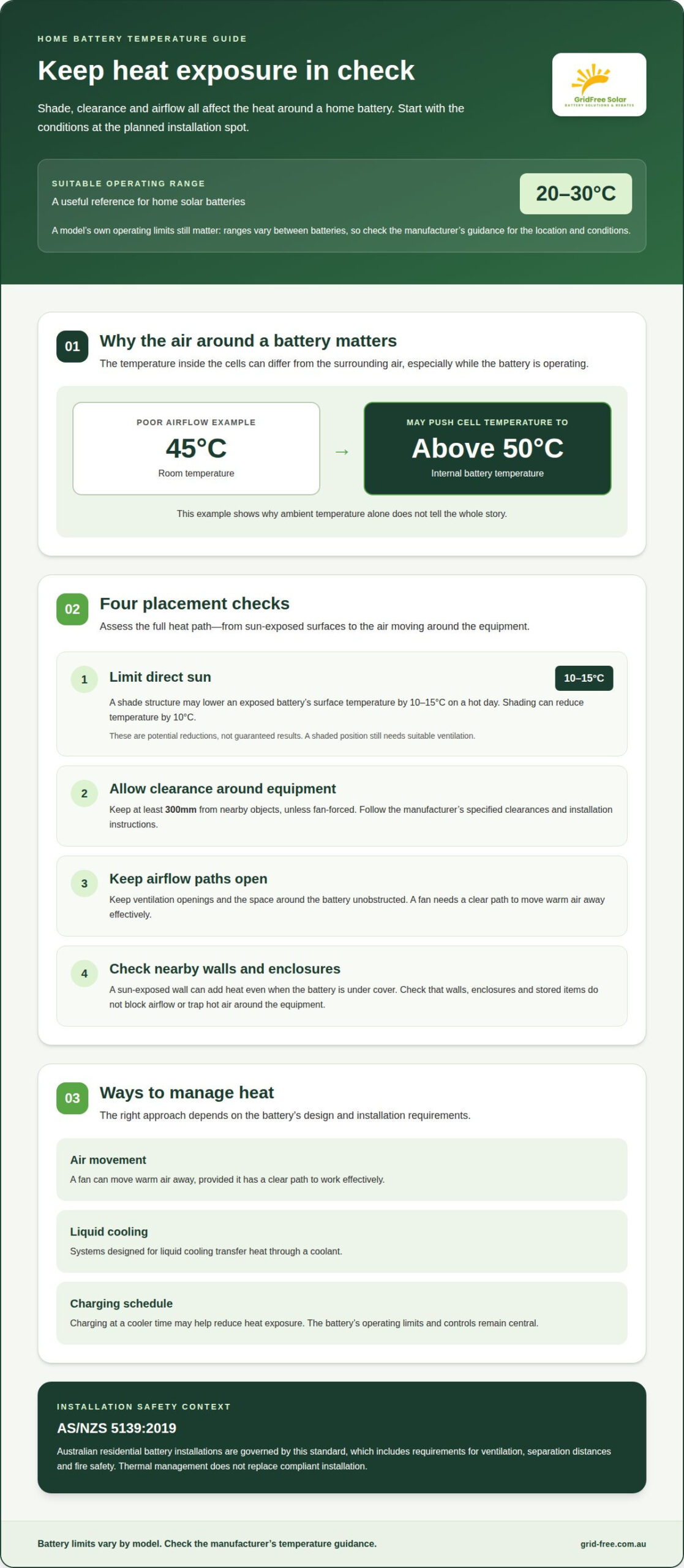
Battery temperature management means controlling heat around the cells so they operate within their intended range. It matters because a 45°C room with poor airflow can push internal cell temperatures above 50°C. The battery’s internal temperature can differ from the surrounding air, particularly during operation. Monitoring and managing that heat helps identify when the installation environment may be working against the battery.
Cooling strategies and charging schedules
Cooling strategies remove or move heat away from the battery, while charging schedules can avoid adding unnecessary heat during the hottest part of summer. Airflow is one straightforward approach: a fan moves warm air away, but it needs a clear path to work effectively. Liquid cooling transfers heat through a coolant in systems designed for it. Charging at a cooler time may help reduce heat exposure, though the battery’s operating limits and controls remain central.
Installation standards and temperature safety
Australian residential battery installations are governed by AS/NZS 5139:2019, which includes requirements for ventilation, separation distances and fire safety. These installation details matter for temperature management because airflow and clearances affect how heat moves around equipment. The standard is part of the safety context for positioning a home battery; thermal management cannot be treated as a substitute for compliant installation.
Cold-weather charging and performance
Cold can affect charging efficiency: temperatures below 5°C can reduce it, while charging below 0°C is advised against. This matters in colder Australian conditions, even though desert homes are more often concerned with summer heat. A battery’s controls and operating limits determine how charging responds to low temperatures. Check the manufacturer’s temperature guidance when assessing performance, rather than assuming that a battery’s behaviour in warm weather also applies on cold mornings.
Ideal operating temperature for lithium-ion home batteries
For lithium-ion home batteries, a suitable operating range is 20-30°C. The ideal point depends on the specific battery and whether it is operating or stored. Understanding solar battery temperature tolerance helps you assess whether a model’s operating limits suit its intended location.
Recommended and maximum operating temperatures
Recommended temperatures describe the conditions that support routine operation, while a maximum rating marks an upper operating limit. Most lithium-ion home systems perform best between 15°C and 25°C, with 20-30°C also identified as a suitable range. In hot conditions, check that a home battery system’s operating-temperature rating suits the local climate. A maximum rating is not a target for daily operation.
Operating and storage temperature ranges
Operating temperature applies while a battery charges or discharges; storage temperature applies while it is idle. The limits can differ because active use involves electrical and chemical processes that storage does not. Check each figure separately in the manufacturer’s documentation, especially when planning an installation exposed to Melbourne’s summer heat.
Temperature tolerance across battery chemistries
LFP, NMC and lead-acid batteries use different chemistries, so their temperature tolerance cannot be compared using one universal limit. The cited heat-runaway trigger points are approximately 230°C for an LFP cell and 160°C for an NMC cell. These are not normal operating temperatures or recommended maximum ratings. Lead-acid is a separate chemistry; its operating limits also depend on the battery model and manufacturer’s instructions.
Battery specifications and warranty limits
Temperature specifications and warranty conditions vary by product, so there is no single temperature limit for all home batteries in Australia. Product documentation should distinguish charging, discharging and storage temperatures, while warranty terms may set conditions for operation and installation. Compare a model’s recommended range and maximum rating with its warranty terms when assessing whether it suits your home.
Battery placement, shade and airflow
Yes. In hot Australian climates, shade and suitable airflow can limit heat exposure; active cooling depends on the battery’s design and installation requirements. Placement matters because a 45°C room with poor airflow can raise internal cell temperatures above 50°C.
Start by choosing a position that avoids direct sun and allows air to move around the equipment. Leave space around solar equipment to allow airflow, following the system’s installation requirements. This clearance helps prevent airflow from being blocked, but the manufacturer’s specified clearances and installation instructions take priority.
Shade can reduce solar heat reaching a battery’s surface. A shade structure may lower an exposed battery’s surface temperature by 10-15°C on a hot day, while shading can reduce temperature by 10°C. These figures describe potential reductions, not a guaranteed result for every site. A shaded position still needs suitable ventilation.
Consider the full heat path when assessing a battery location. A unit against a sun-exposed wall may absorb heat even under cover. Check whether walls, enclosures or stored items obstruct airflow, and whether hot air can escape rather than collect around the equipment.
- Allow clearance: Keep at least 300mm from nearby objects, unless fan-forced.
- Limit direct sun: Use a suitable shaded position or shade structure.
- Preserve airflow: Keep ventilation openings and the space around the battery unobstructed.
Fans can move warm air, while liquid cooling is used in systems designed for it. Neither should be improvised around a home battery: follow the product’s installation requirements. In summer, suitable placement can limit heat exposure that may otherwise contribute to a shorter battery lifespan.
How high temperatures affect battery ageing and capacity
Heat can shorten a battery’s usable life, even when it continues operating. In Australia’s hot climate, the key issue is how long cells remain above their optimal temperature.
Heat-related ageing and capacity changes
Heat-related ageing is the gradual chemical deterioration that reduces a battery’s capacity over time. It matters because a battery may still function while storing less energy than before. Consistent operation above 35°C accelerates cell degradation and reduces capacity and lifespan. Each 10°C rise above the optimal range can cut usable lifespan by as much as half.
Compare 25°C with 45°C: operating at 45°C can cause more than twice the damage of keeping a battery at 25°C. Batteries can operate above 40°C, but their lifespan may be reduced. These figures show why occasional hot weather differs from repeated exposure. The duration and frequency of heat, alongside the battery’s operating temperature, shape the ageing impact.
Exposure beyond rated temperature ranges
A rated temperature range defines the conditions for intended battery operation; exposure outside it puts performance and service life at risk. The consequence depends on the battery’s chemistry, controls and exposure. A rating is not a promise of unchanged performance beyond its limits. Sustained heat above 35°C can accelerate degradation, while 45°C can cause more than twice the damage associated with 25°C.
In a hot climate, focus on repeated cell temperatures, not just the hottest afternoon air reading. A battery’s internal temperature can differ from ambient conditions, particularly where heat builds up. Assess the rated range alongside the site’s exposure and the battery’s likely operating conditions. This gives a clearer picture than a single outdoor temperature.
To assess whether a battery upgrade suits your home’s energy storage needs, discuss a battery upgrade.
GridFree Solar
GridFree Solar helps households in Melbourne consider battery temperature alongside their solar and storage needs. For a new system, Solar Panel Installation and Solar Battery Installation can be planned together, including the battery’s location. For an existing system, Battery Upgrade & Replacement can help you review storage options as your household’s needs change.
Temperature is one part of the decision. Battery chemistry, the model’s rated operating range, installation position and airflow all affect how well a system suits your home and local climate. Weighing these factors together helps turn technical limits into a practical solar and battery decision.
For guidance on solar and battery installation or an existing system in Melbourne, contact GridFree Solar.
Plan for dependable storage through every season
Make battery temperature part of your energy plan, not an afterthought once equipment is in place. Your solar battery temperature tolerance decision should account for how your household uses stored energy and how the installation suits its setting. This helps align system design with the conditions your battery will experience over time.
GridFree Solar provides Battery Upgrade & Replacement, Residential Solar Panel Installation and Commercial Solar Solutions in Melbourne and greater Victoria. Whether you’re planning a new installation or reviewing existing storage, contact GridFree Solar to discuss how your energy needs and battery options fit together.
Contact GridFree Solar to discuss your battery and take a considered step towards a solar setup suited to your needs.
Frequently Asked Questions
Can a Home Battery Survive Desert Heat?
Yes, provided the installation conditions remain within the battery’s rated operating limits. Desert air temperature alone doesn’t reveal the temperature inside the cells, which can also be affected by the installation space and airflow. For a home exposed to extreme summer heat, compare the battery’s rating with conditions at its intended location. A battery that operates in those conditions may still age faster when exposed to heat.
Can I install a fan or air conditioner to cool my solar battery?
Don’t add a fan or air conditioner unless the battery’s installation requirements allow it. A fan can move warm air, but blocked vents or poor positioning can limit its effect. Air conditioning may cool the room without keeping battery cells within their operating range. Keep specified clearances and ventilation paths unobstructed, and use cooling equipment designed for the system.
How do I know if my solar battery has already been heat damaged?
Reduced usable energy or a battery fault can indicate a performance issue, but neither proves that heat caused it. Compare the system’s current usable capacity and charging behaviour with previous records and manufacturer information. Check the battery management system for temperature or fault records. A qualified assessment can help determine whether heat, another fault or normal ageing explains the change.
What operating temperature range do home solar batteries in Australia support?
There isn’t one operating range for every home battery sold in Australia. A suitable range for home solar batteries is 20-30°C, while most lithium-ion systems perform best between 15°C and 25°C. Some systems are recommended to operate safely up to at least 55°C. For Melbourne homes as well as desert properties, the specific model’s operating limits are the key reference.
What are the charging and discharging temperature limits for lithium-ion solar batteries?
Charging and discharging limits are model-specific, so a single range doesn’t apply to all lithium-ion batteries. The manufacturer’s specifications distinguish which temperatures are allowed for each activity. Charging below 0°C is advised against, but this shouldn’t be treated as a complete limit for every system. Use the battery’s own guidance for both charging and discharging, including any separate restrictions.
How does heat affect solar battery capacity, efficiency, and lifespan?
Sustained heat accelerates chemical ageing, which can reduce a battery’s capacity and usable lifespan. Each 10°C rise above the optimal range can cut usable lifespan by as much as half. Heat can also affect how efficiently a battery operates, while system controls may respond to temperature conditions. In practice, compare stored energy over time rather than judging battery health from one hot day.