
The lowest quote isn’t the clearest sign of a reputable installer. Choosing a solar installer in Melbourne starts with checking current Solar Accreditation Australia (SAA) accreditation before requesting a quote. New Energy Tech Consumer Code approval is another useful consumer-protection signal, but the code is voluntary. Make your decision using evidence you can compare, not a confident sales pitch alone.
It’s sensible to look beyond a sales pitch: the installer’s qualifications, written quote, warranty terms and approach to your property all matter. A system should suit your energy needs and site, whether you’re considering residential or commercial solar, a hybrid system or an off-grid setup. The decision also shapes how confidently you can plan for your property’s changing needs over time.
This guide explains how to assess reputation, credentials, warranties and sales practices, and how to judge whether an installer is the right fit for your project. Use the checks as a sequence: establish trust, understand the commitments, then assess the proposal as a whole. You’ll be better placed to make a considered decision for your home or business.
Key Takeaways
- Assess reputation through current Solar Accreditation Australia accreditation, consumer protections, local support and the quality of a company’s reviews.
- Review installer qualifications and warranty terms alongside the system design, so you understand what is covered and by whom.
- The Australian Competition and Consumer Commission says a 10-day cooling-off period applies when a contract arises from an unsolicited sale; read the contract terms before signing.
- Match the system type to your property and energy needs, whether you’re considering residential or commercial solar, a hybrid system or off-grid installation.
1. What Makes a Solar Installer “Reputable”?
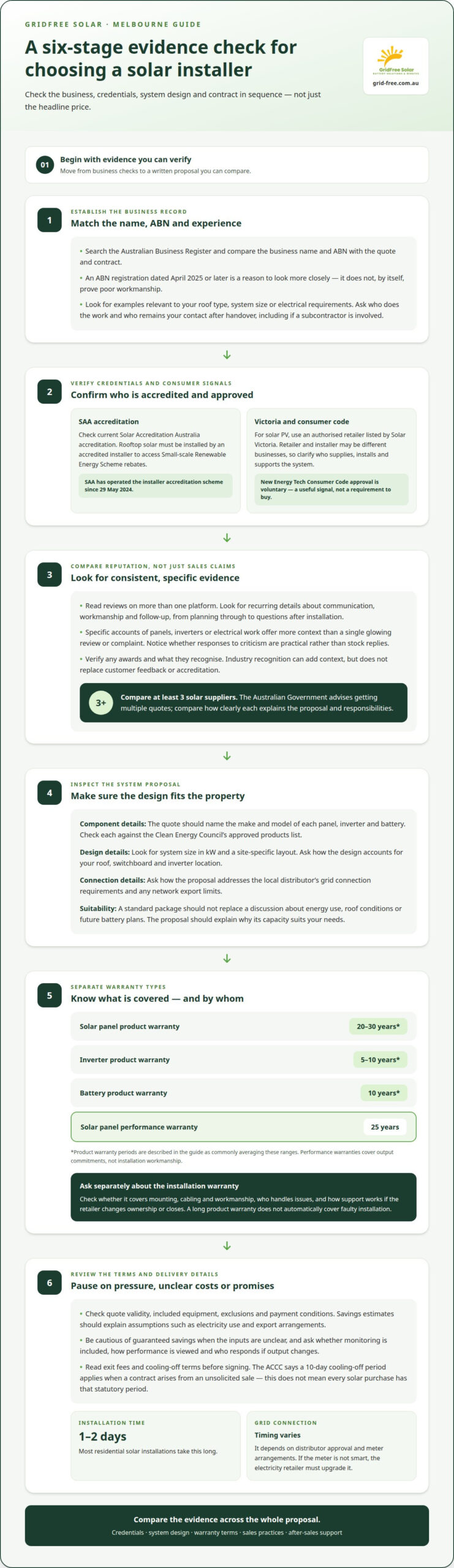
Start with evidence, not a polished sales pitch. Search the Australian Business Register for the business name and ABN, then compare those details with its quote and contract. An ABN registration date of April 2025 or later could be a red flag, so look more closely at the company’s track record and who will complete the work. A newer registration alone doesn’t establish poor workmanship, but it makes clear business history especially useful.
Experience matters most when it matches your project. Look for examples involving similar roof types, system sizes or electrical requirements, rather than relying on a broad claim about years in business. In Victoria, ask how the installer accounts for site conditions, coordinates installation and provides support after handover. Find out who responds to warranty concerns and whether the same business remains your contact if a subcontractor completes the work.
Read online reviews across more than one platform, and look for recurring details about communication, workmanship and follow-up. A single glowing review or complaint tells you little; specific accounts describing panels, inverters or electrical work offer more context. Notice whether reviewers describe the full experience, from initial planning to questions after installation. Check whether the business responds to criticism with practical information rather than a stock reply.
Installer recognition can add context, but it shouldn’t replace customer feedback or accreditation. Look for verifiable awards or industry recognition, and establish what the recognition covers. The New Energy Tech Consumer Code is voluntary, so approval is one useful signal rather than a requirement to buy. When comparing options, the Australian Government advises consumers to obtain quotes from at least 3 solar suppliers. Compare how clearly each explains its proposal and responsibilities. Together, these checks help distinguish a persuasive online profile from a reliable record of work.
2. Installer qualifications and installation warranty
Solar Accreditation Australia (SAA) has operated Australia’s installer accreditation scheme since 29 May 2024. Rooftop solar must be installed by an accredited installer to access Small-scale Renewable Energy Scheme rebates. Ask who will design and install your system, and who will handle electrical work.
In Victoria, use an authorised retailer listed by Solar Victoria for solar PV installations. The retailer and installer may be different businesses, so clarify who supplies the panels, manages installation and supports you afterwards. Ask how the proposal accounts for your roof, switchboard and inverter location.
Check that every panel, inverter and battery named in the quote appears on the Clean Energy Council’s approved products list. The quote should identify each component by make and model, state system size in kW and include a site-specific layout. Ask how the design addresses network connection and export limits.
Separate product, performance and workmanship warranties. Solar panel product warranties commonly average 20–30 years, inverter warranties 5–10 years, and battery product warranties 10 years. Most solar panels have performance warranties lasting 25 years; these cover output commitments, not installation workmanship. Read who provides each warranty and how to make a claim.
Ask what the installation warranty covers, including mounting, cabling and workmanship, and who handles issues. A long product warranty does not automatically cover faulty installation. Check how warranty support works if the retailer changes ownership or closes, and keep the contract, component details and handover documents together.
Approval requirements for a Melbourne property can vary. Ask the installer to identify applicable requirements and coordinate the grid connection with the local distributor. The quote should also disclose any network connection or export limits.
Most residential solar installations take 1–2 days. Grid connection timing depends on distributor approval and meter arrangements; if the meter isn’t smart, the electricity retailer must upgrade it.
A project-specific view of solar installation options should account for roof conditions, switchboard requirements and distributor limits, since these factors shape the system design and connection process.
3. Warning signs of cheap deals and dodgy sales tactics
A low headline price can hide a system that doesn’t suit your home. Be cautious of fixed packages, such as 6 kW, 9 kW or 12 kW systems, offered without discussing your energy use, roof or future battery plans. A suitable design should explain why its capacity fits your household, not simply present a standard bundle as the obvious choice.
Before signing, check the quote’s validity period, included equipment, exclusions and payment conditions. Savings estimates should explain their assumptions, including electricity use and export arrangements. Treat guaranteed-savings claims cautiously if those inputs are unclear. Ask whether system monitoring is included, how you can view performance and who responds if output changes.
Pressure to sign immediately is a reason to pause, especially if a salesperson won’t give you time to read the contract. Review any exit fees and the contract’s cooling-off terms before committing. According to the Australian Competition and Consumer Commission, a 10-day cooling-off period applies when a consumer signs a contract arising from an unsolicited sale. This rule concerns unsolicited sales; it doesn’t mean every solar purchase has that same statutory period.
After-sales support matters once your panels and battery are operating. Get the process in writing: who handles a fault, how to lodge warranty claims, and whether monitoring is included or optional. Your installer should explain the handover documents and how to report a performance concern, so you know where to start.
Plan for the system’s eventual replacement, too. Ask what end-of-life arrangements apply to the panels, inverter and battery, and whether removal or recycling is included in the contract. These components can have different replacement timelines and warranty terms, so clarify each separately. A transparent proposal makes inclusions, exclusions and support responsibilities clear before you sign.
4. Residential, commercial, hybrid and off-grid installations
Match the installer’s experience to the system you need. A Melbourne home with limited roof space needs a different design from a business with substantial daytime energy use. Residential proposals should account for household consumption, roof orientation, shading and switchboard conditions. Commercial designs should also reflect operating hours and how demand changes across the site.
A hybrid system combines solar panels with a battery, allowing stored energy to support your property when solar generation falls. Ask how the proposed battery capacity relates to your usage, which circuits it can supply and what happens during a grid outage. The quote should explain the design and the battery’s role, rather than presenting storage as a standard add-on.
Off-grid systems are designed to operate without a connection to the electricity network. The design must balance expected energy use, solar generation and storage, including periods of lower generation. Ask how the installer has modelled your site’s needs and which assumptions inform the system. A grid-connected home seeking lower bills has different priorities from a remote property requiring independent supply.
For any system, review the site-specific layout and the named panels, inverters and battery, if included. Confirm the system size in kW and how the proposal addresses shading, installation access and network export limits. The Clean Energy Council’s approved products list is a useful way to check products in Australia. Keep product warranties separate from workmanship coverage, especially when a project combines solar and battery components.
The right installer can explain why a residential design, commercial solution, hybrid system or off-grid arrangement fits your property. Choose one that can discuss those trade-offs in plain language and connect the proposed design to your actual energy needs. For a tailored solar or battery system design, discuss your installation options.
GridFree Solar
GridFree Solar helps you move from installer research to a solar solution suited to your property and energy needs in Melbourne and Victoria. Services include residential and commercial solar installation, solar and battery installation, and battery upgrades or replacements for existing systems.
Turn to GridFree Solar when you’re weighing a new solar system against adding storage, or planning solar for a business. The team also helps customers navigate and claim solar and battery rebates, which may reduce eligible upfront costs. Discussing your project helps connect the system design, installation requirements and rebate process.
For an informed next step on your solar project, contact GridFree Solar.
Make your next solar decision with confidence
Turn your priorities into a clear project brief. Consider how you use electricity, whether your needs may change and what you expect the system to do. This makes choosing a solar installer in Melbourne a practical decision, based on how your home or business operates.
GridFree Solar provides residential solar panel installation, commercial solar solutions and battery upgrades or replacements. If you’re ready to explore an option for your property, contact GridFree Solar to discuss your options. A considered conversation can help you move towards a system that fits your plans.
Frequently Asked Questions
What Makes a Solar Installer “Reputable”?
A reputable installer gives you a clear path from design to handover, with responsibilities and documents easy to understand. Your handover should identify the installed equipment and explain where to find system information after commissioning. Check that the business name on your paperwork matches the seller you dealt with, and that support arrangements are in writing. Specific, consistent customer feedback can help corroborate that experience.
What Is a “Cowboy Solar Company”?
“Cowboy solar company” is an informal label for a seller or installer whose conduct raises serious concerns, not a formal accreditation category. Warning signs include pressure to sign before reading a contract, vague equipment descriptions and savings promises without explained assumptions. Focus on specific conduct and documentation rather than the label alone. One missed appointment or negative review does not establish a pattern of poor practice.
What rebates are available for solar panels in Melbourne?
Eligible homeowners in Melbourne may be able to access additional solar panel rebates through Solar Victoria. Small-scale Technology Certificates can also reduce the upfront cost of solar panels. Eligibility and the applicable support depend on the relevant scheme requirements, so assess them against your property and proposed system. GridFree Solar helps customers navigate and claim solar and battery rebates, making rebate paperwork part of the project discussion.