
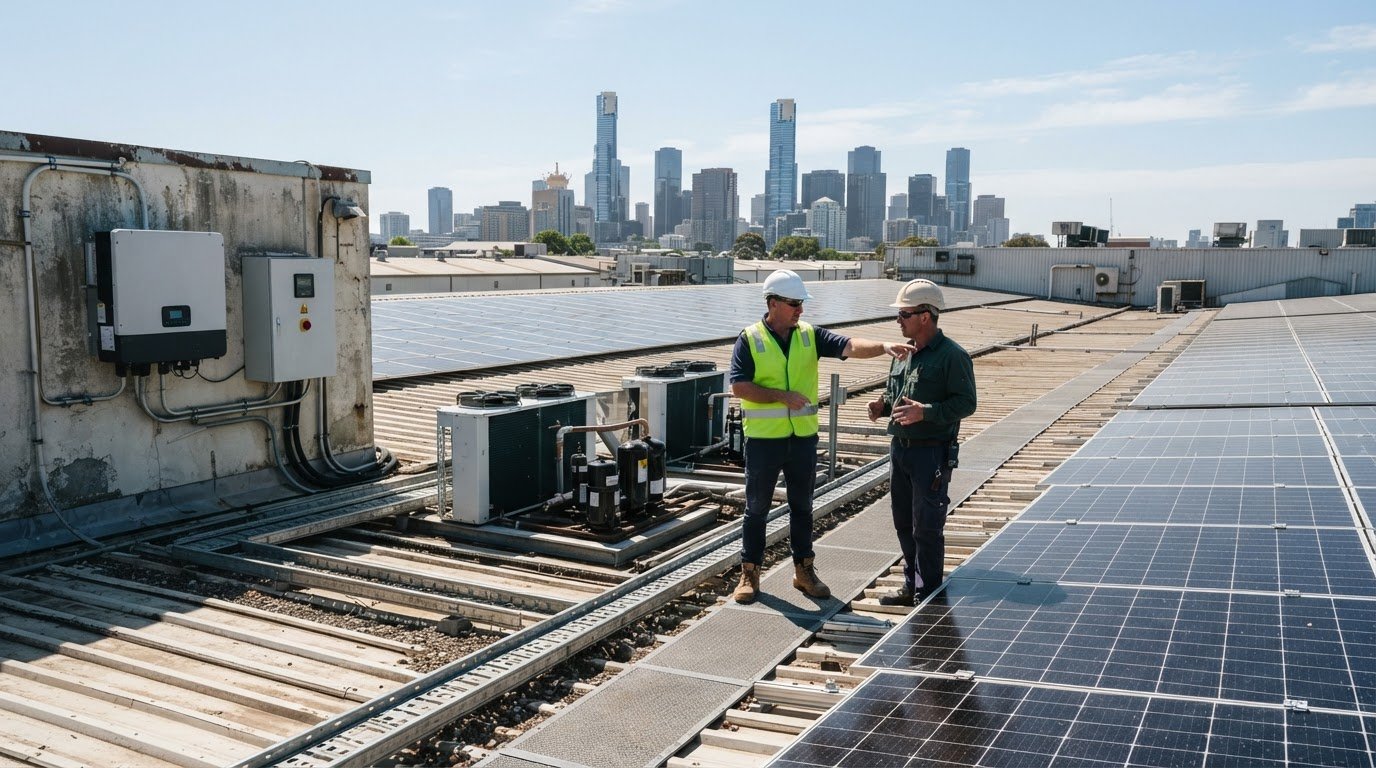
Getting buy-in for a commercial solar project starts with a clear business case. Connect expected savings and payback to the site’s electricity use, financing options and rooftop suitability. For a Melbourne business, build the proposal around its operating hours, energy profile and roof conditions.
Decision-makers need more than a headline savings figure. They need to understand how the assumptions fit their operations, what financing means for cash flow, and whether the roof and energy profile suit a solar system.
This article explains how to assess commercial solar returns and payback, compare financing options, and account for rooftop and grid requirements in Melbourne, Victoria. Use the framework to present the opportunity and decide whether it suits your business.
Key Takeaways
- Build a credible business case by matching projected solar output to your site’s energy use and timing, then assess savings alongside payback.
- Compare capital outlay, loans, power purchase agreements and asset finance to understand how each option affects cash flow and project returns.
- Explore which certificate incentives may apply to your project, as eligibility can depend on system size and location.
- Factor rooftop suitability, network export limits and connection requirements into the project plan before settling on a system design.
Business-case returns, payback and budget
A strong proposal links electricity use, system output, projected savings and payback in one financial model. Use interval data, roof orientation and expected self-consumption to make the assumptions clear.
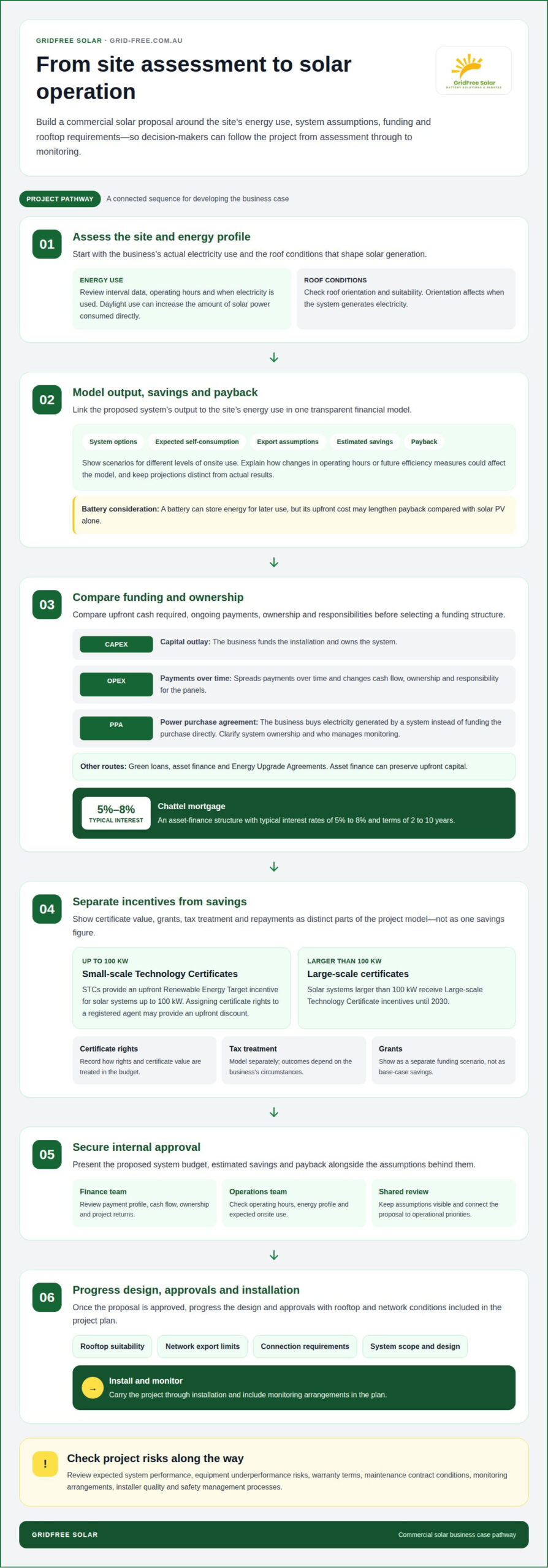
In Australia, develop the project by assessing the site and energy profile, modelling system options, securing internal approval, then progressing design, approvals and installation. Outline these stages so decision-makers can see how the proposal moves from assessment to operation.
Commercial solar business benefits
Commercial rooftop solar generates electricity onsite and can reduce reliance on grid power. Its value depends on matching generation with operating hours: businesses that use more electricity during daylight can consume more solar power directly. Roof orientation affects when the system generates electricity, while a battery can store energy for later use. These factors help decision-makers assess the benefits against the site’s actual needs.
Building the financial case
Show decision-makers the proposed system budget, estimated savings and payback, then explain how electricity use and export assumptions affect the model. For getting buy-in for a commercial solar project, make assumptions visible and connect them to operational priorities. Include the system scope and expected stages, from site assessment through installation and monitoring.
Keep projections separate from actual results. Present scenarios for different levels of onsite use, and explain how changes in operating hours or future efficiency measures could affect the model. This gives finance and operations teams a shared basis for reviewing the proposal.
Tax benefits and project budget
Separate energy savings, certificate incentives and tax treatment in the budget because each affects the financial case differently. According to the Clean Energy Regulator, eligible renewable energy systems can earn small-scale technology certificates. Assigning certificate rights to a registered agent may provide an upfront discount, which should be shown separately from projected savings. Tax treatment depends on the business’s circumstances, so model it separately rather than presenting it as guaranteed savings.
Commercial solar financing options
Australian businesses can fund commercial solar through a capital outlay, green loan, power purchase agreement (PPA), Energy Upgrade Agreement or asset finance. Compare the upfront cash required, ongoing payments and ownership arrangements before choosing.
Project risks include equipment underperformance, warranty conditions, maintenance obligations and installer quality. Review expected system performance, monitoring arrangements, warranty terms, maintenance contract conditions and the provider’s safety management processes.
CAPEX, OPEX and PPA options
Capital expenditure (CAPEX) means the business funds the installation and owns the system; operating expenditure (OPEX) spreads payments over time. This distinction matters because it changes cash flow, ownership and responsibility for the panels. Asset finance can preserve upfront capital, while green loans are another borrowing option. A chattel mortgage is one asset-finance structure, with typical interest rates of 5% to 8% and terms of 2 to 10 years.
A PPA lets a business buy electricity generated by a system instead of funding the purchase directly. Compare the payments with expected savings, and clarify who owns the system and manages monitoring. Adding a battery can also affect cash flow, as its upfront cost may lengthen payback compared with solar PV alone.
Government incentives and financing
Australian certificate incentives can affect the project’s upfront budget, but eligibility depends on system size and location. Small-scale Technology Certificates provide an upfront Renewable Energy Target incentive for solar systems up to 100 kW. Solar systems larger than 100 kW receive Large-scale Technology Certificate incentives until 2030. Businesses can also consider green loans, asset finance and Energy Upgrade Agreements; these are financing routes, not government rebates.
Separate certificate value from expected electricity savings in the proposal. Then compare each finance structure’s payment profile with projected cash flow, ongoing obligations and the system’s expected output. For a tailored commercial solar installation proposal, explore commercial solar options.
What Australian government rebates, grants, tax incentives, or financing options are available for commercial solar?
Commercial solar proposals may include certificate incentives, grants, tax considerations and finance, but each plays a different role in the project model. Present them as separate line items so decision-makers can distinguish certificate value from funding support, tax outcomes and repayments.
For Small-scale Technology Certificates (STCs), list the applicable certificate value as a distinct budget item. Don’t combine it with bill savings or describe it as a grant. Record how the certificate value is treated in the financial model so stakeholders can see its effect on the upfront investment.
Large-scale Generation Certificates (LGCs) may also be part of a project’s financial assessment. Show anticipated certificate proceeds separately from operational savings, and state how certificate rights are handled. This helps finance teams distinguish returns from electricity use from those related to certificates.
Victorian Energy Efficiency Certificates (VEECs) may be relevant to commercial solar projects depending on the location and system size. For a Victorian proposal, list any VEEC consideration separately from other certificate pathways. This helps decision-makers identify which incentive assumptions apply to the site instead of treating all certificates as interchangeable.
Present grants as a separate funding scenario, not as part of the project’s base-case savings. If a grant is relevant, show how it would affect the business contribution required and the project’s cash flow. Keep this scenario separate so the core proposal remains clear without grant support.
Present tax considerations and finance separately too. Show financing repayments in the cash-flow schedule, and leave tax effects to the business’s tax assessment. For approval, provide a concise incentives register that names each relevant mechanism, its role in the model and the assumptions used. This makes the proposal easier to review without conflating incentives, savings and funding.
What approvals, grid connection rules, and network requirements apply to commercial solar in Australia?
Commercial solar approval involves site suitability, local requirements and grid connection. In Australia, distribution network service providers set export limits, so connection planning can affect system design and projected returns.
Network protection equipment is required for Australian solar systems over 30 kW. This requirement makes system capacity relevant early: the design needs to account for protection equipment as well as panels, inverters and the site’s electrical configuration. Grid connection planning also needs to consider how much generated electricity the business will use onsite.
Export limits determine how much electricity a system can send to the grid. A business with high daytime demand may use more generation onsite, while a site that exports more must account for its network’s limit. Include the applicable export limit in the proposal rather than assuming all surplus electricity can be exported.
Local building codes and permit requirements also apply to commercial solar installations, and can vary with the site and proposed works. Include permits in the project plan and ensure the project partner manages the relevant approvals. This helps decision-makers understand the administrative steps between design approval and installation.
Assess rooftop suitability alongside electrical planning. A structural assessment should consider roof pitch and whether the structure can handle the additional wind loads from tilt frames. Ask the project partner to explain the recommended roof area. Shading, roof orientation, and dust or debris buildup can also affect the proposed layout and expected system performance.
Bring these checks together before finalising the proposal: document the site assessment, system design, network export constraints and permit pathway. That gives the business a clearer view of technical dependencies and approval stages. For a project-specific solar assessment, discuss your commercial solar project.
GridFree Solar: Commercial Solar Solutions
GridFree Solar provides Commercial Solar Solutions for businesses in Melbourne and across Victoria, assessing rooftop suitability, energy use and project returns. It’s a practical next step when you’re ready to turn your business case into a solar project designed for your site and operations.
Discuss your site’s energy profile, roof and project priorities as you consider system options. If storage is part of the plan, GridFree Solar also provides solar and battery installation, as well as Battery Upgrade & Replacement for existing systems. The right configuration depends on how your business uses electricity and when it needs power.
For a project-focused discussion about commercial solar, contact GridFree Solar.
Turn the proposal into a practical next step
Getting buy-in for a commercial solar project is easier when one person owns the proposal and there is a clear decision to make. Assign someone to bring finance, facilities and operations into the discussion. Then make the next meeting about a specific choice, such as progressing to a site assessment or refining the project scope.
Keep the decision focused on your business priorities. These might include reducing exposure to grid electricity costs, aligning investment with a planned site upgrade, or exploring how storage could support operations. Turn those priorities into a brief that captures the site, energy profile and outcomes your team wants to assess.
GridFree Solar can support commercial solar decisions, alongside its residential solar panel installation and battery upgrade and replacement services. To discuss moving your commercial project forward, talk with GridFree Solar. A clear, site-led discussion can help your team choose a confident path forward.
Frequently Asked Questions
What are the business benefits of commercial solar in Australia?
Commercial solar can reduce a business’s reliance on grid electricity and support emissions reporting. Its practical value depends on how the site operates: a warehouse with daytime refrigeration has a different energy profile from a business that runs mainly overnight. Solar can also make sustainability initiatives visible to staff and customers. Check how your ESG reporting framework treats solar generation and related certificates.
What are typical payback periods and returns for commercial solar projects in Australia?
Reported payback varies by project: a commercial solar project in Laverton North, Victoria, has a reported 3.9-year payback, while the Bungendore, New South Wales, project has a reported five-year payback. These examples show why one project’s result shouldn’t be used as another site’s forecast. Compare the proposed system’s generation, onsite use, export value and financing costs before estimating returns.
How can businesses calculate solar project savings using their electricity bills and load profiles?
Start with retailer interval data and electricity bills, then map usage against expected solar generation throughout the day. Separate electricity consumed onsite from surplus exported to the grid, as these quantities may have different values. For example, a business operating during daylight may use more generation directly than a site with mostly evening demand. Include planned changes to operating hours or equipment in the model.
How do rooftop solar, ground-mounted solar, PPAs, and solar leases compare for Australian businesses?
Rooftop solar uses existing building space, while ground-mounted systems require suitable land and a feasible electrical connection. A power purchase agreement (PPA) lets a business buy generated electricity under an agreed contract rather than fund system ownership directly. A lease provides use of the system for regular payments, with ownership set out in the agreement. Compare site constraints, cash flow and contract obligations side by side.
What concerns do CFOs, facility managers, and other stakeholders raise about commercial solar, and how can they be addressed?
CFOs often focus on cash flow, payback assumptions and contract commitments, while facility managers may prioritise roof suitability, operational disruption and system performance. Address each concern with relevant evidence: show finance the model assumptions, and give facilities the proposed layout and installation sequence. Involve operations and sustainability teams early, and explain how solar generation and certificates appear in the organisation’s ESG reporting.