
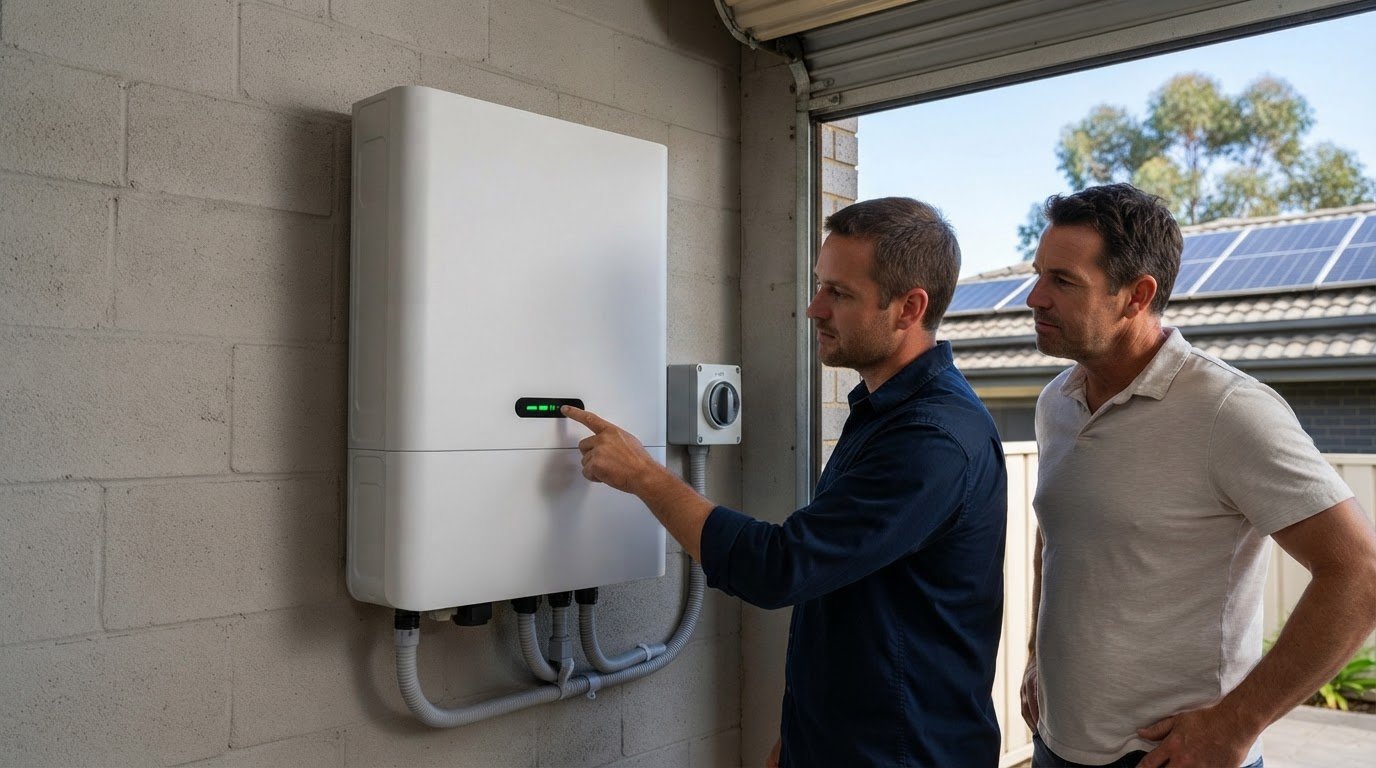
Depth of discharge (DoD) is the percentage of a battery’s capacity that has been used; state of charge (SoC) is what remains, and the two add up to 100%. Put simply, solar battery depth of discharge explained means knowing how much stored energy you’ve drawn from the battery. If a 100 Ah battery has 70 Ah remaining, its DoD is 30%.
Choosing a suitable depth of discharge (DoD) means balancing the energy available to your home against battery wear over time. A higher DoD makes more of the battery’s capacity available, but the operating limit should follow the battery’s specifications. This guide explains how to calculate DoD, how it differs from state of charge (SoC), and what to consider when choosing a level. You’ll also see how the calculation translates into usable energy, helping you understand what a battery’s stated capacity means in practice when planning solar storage in Melbourne, Victoria.
Key Takeaways
- Set your battery’s discharge limit according to its chemistry: lead-acid batteries generally need a shallower discharge than lithium batteries.
- Use the manufacturer’s recommended DoD to balance the energy available for daily use with battery cycle life.
- Calculate DoD by dividing the energy used by the battery’s rated capacity, then multiplying by 100.
- Compare batteries by usable capacity, not just the capacity printed on the label, to understand how much energy is available to your home.
How to Find the Ideal Depth of Discharge (DoD) for Your Battery Type?
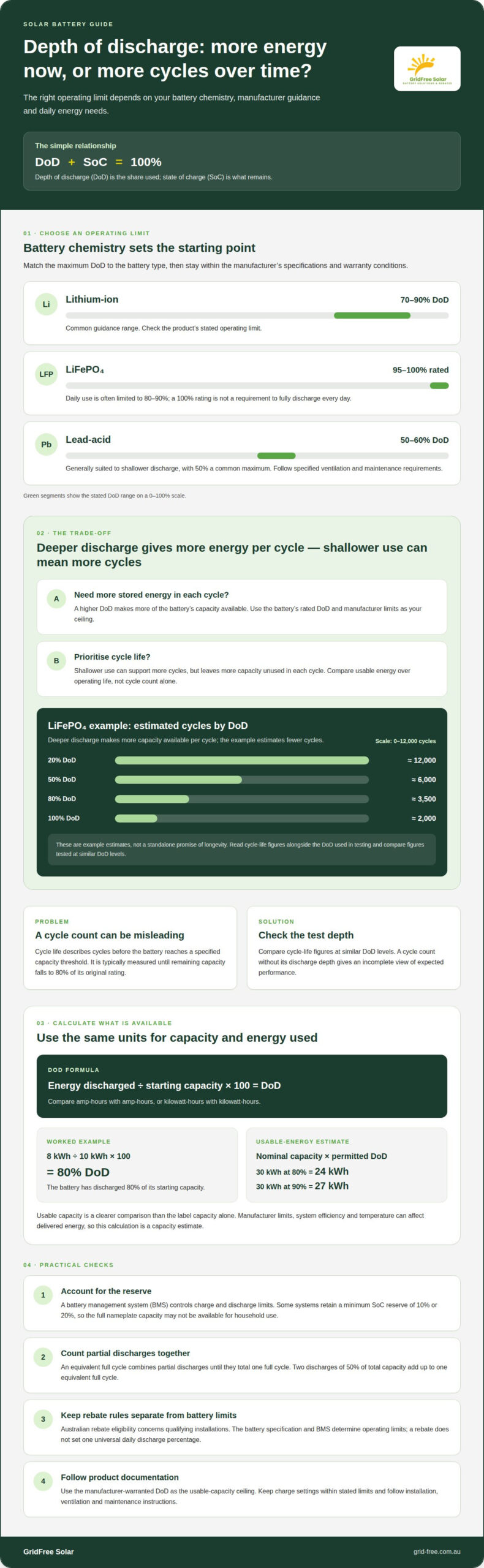
Match the maximum DoD to the battery chemistry, then follow its manufacturer’s operating limits. Lithium-ion guidance commonly gives a DoD of 70-90%. LiFePO4 batteries may be rated for 95-100%, although daily use is often limited to 80-90%. Lead-acid batteries are generally suited to 50-60%, with 50% a common maximum.
DoD measures the share of capacity already used; state of charge (SoC) measures what remains. They add up to 100%. For example, after using 7 kWh from a 10 kWh battery, DoD is 70% and SoC is 30%. This distinction helps you interpret the battery storage available for solar energy.
A battery management system (BMS) manages charge and discharge limits to keep operation within set boundaries. Some systems retain a minimum SoC reserve of 10% or 20%, which limits how deeply the battery can discharge. A reserve also means the full nameplate capacity may not be available for household use.
Australian rebates and DoD settings are separate considerations. Rebate eligibility concerns qualifying battery installations, while the battery specification and BMS determine operating limits. A rebate doesn’t set one universal daily discharge percentage for lithium, LiFePO4 or lead-acid storage.
Australian battery brands state DoD, usable capacity and warranty conditions in product documentation. Use the manufacturer-warranted DoD as the usable-capacity ceiling, and operate within any stated warranty limits. A 100% rating shouldn’t be treated as a requirement to discharge fully every day.
Charging, ventilation and maintenance requirements depend on the battery and its installation instructions. Keep charge settings within the manufacturer’s limits and follow specified ventilation and maintenance requirements, particularly for lead-acid systems. Deeper discharge can provide more energy per cycle, but the appropriate balance depends on the battery’s rated DoD and intended daily use.
DoD and battery cycle life
Depth of discharge affects the energy available from each cycle and how quickly capacity may degrade. Read cycle-life figures alongside the DoD used in testing, rather than treating them as a standalone promise of battery longevity.
Partial Discharges and Equivalent Full Cycles
An equivalent full cycle combines partial discharges until their total equals one full battery cycle. Two discharges of 50% of total capacity therefore add up to one equivalent full cycle. This helps explain why a battery used in smaller daily portions still accumulates cycles over time. For example, track energy discharged across separate uses, rather than treating each short discharge as a complete cycle.
DoD and LiFePO4 Cycle Life
LiFePO4 cycle-life estimates vary with DoD: one example gives approximately 12,000 cycles at 20%, 6,000 at 50%, 3,500 at 80% and 2,000 at 100%. These figures show the trade-off: deeper discharge makes more battery capacity available per cycle, while shallower use can support more cycles. Compare figures tested at similar DoD levels, because a cycle count without its discharge depth gives an incomplete view of expected performance.
Cycle Life and Battery Degradation
Cycle life describes the number of charge-and-discharge cycles before a battery reaches a specified capacity threshold. It’s typically measured until remaining capacity falls to 80% of its original rating. DoD affects the energy delivered per cycle and the number of cycles expected before that threshold. A 10% discharge generally has less effect on lifespan than a 40% discharge, while repeated deep cycles can use more stored energy each time.
Balance daily energy needs against the battery’s rated limits. A lower DoD may extend cycle life, but it also leaves more capacity unused in each cycle. The practical comparison is usable energy over the battery’s operating life, not cycle count alone. Follow the manufacturer’s DoD guidance and warranty conditions when setting operating limits.
Calculating battery depth of discharge
Calculate DoD by comparing the energy used with the battery’s capacity at the start of the cycle. The result is the share discharged, not the energy remaining.
Defining and Calculating Depth of Discharge
Depth of discharge is the proportion of a battery’s original capacity already used. Divide the energy discharged by the starting capacity, then multiply by 100 to express DoD as a percentage. For example, a battery rated at 200 Ah with 100 Ah used has a DoD of 50%. This calculation helps you measure battery use against its rated capacity, rather than relying only on an approximate charge indicator.
Calculating DoD as a Percentage
Use consistent units in both parts of the calculation: compare amp-hours with amp-hours, or kilowatt-hours with kilowatt-hours. For instance, 8 kWh discharged from a 10 kWh battery gives 8 ÷ 10 × 100, or 80% DoD. The same method works with a battery monitor’s energy readings. Its displayed result may differ slightly from a manual estimate because the monitor measures actual energy flow and the system’s operating conditions.
DoD and Usable-Energy Calculations
Usable energy is nominal capacity multiplied by the permitted DoD. A 30 kWh battery operating at 80% DoD provides 24 kWh of usable capacity; at 90%, it provides 27 kWh. Compare usable capacity, not nominal capacity alone, when assessing how much stored energy can serve your home. Manufacturers’ limits, system efficiency and temperature can affect delivered energy, so a calculation is a capacity estimate rather than a measure of every appliance’s consumption.
For planning, identify the battery’s nominal capacity and permitted DoD. Convert the percentage to a decimal, then account for the system’s operating limits. This gives a clearer estimate of the energy available for household use and distinguishes rated capacity from what you can draw in practice.
Meaning of battery depth of discharge
Depth of discharge describes how much of a battery’s capacity has been drawn from storage. A battery at 100% DoD has discharged its full stored energy, if it’s designed for that level. The term describes energy used, not the battery’s age, condition or remaining service life. Read it as an operating measure for a particular point in a charge cycle.
The rating and the actual operating level are different. A battery rated for 100% DoD is designed to safely discharge its full stored energy, but that doesn’t mean every system uses all capacity before recharging. A battery management system can preserve a reserve, so the displayed DoD and energy available to household loads reflect the system’s configured limits.
For example, some battery systems set a minimum state-of-charge reserve of 10% or 20%. That reserve remains stored rather than being available for routine use. It can support system operation or backup needs, depending on the configuration. The key distinction is between a battery’s maximum rated DoD and the depth reached during ordinary operation.
Typical home battery DoD ratings range from 80% to 100%, but the number alone doesn’t tell you how much energy reaches appliances. Usable storage also depends on nominal capacity and system limits. When comparing options, read the DoD rating alongside usable capacity and the battery’s charging settings. That gives a clearer picture than treating the largest percentage as automatically best.
DoD is not a direct measure of battery life. A displayed value describes how much capacity has been used in the current cycle; cycle life describes performance over repeated use. For a practical decision, relate the percentage to daily energy needs, reserve settings and the manufacturer’s operating limits. That is the key to solar battery depth of discharge explained.
If your current storage doesn’t match your household’s energy use, explore battery upgrade options as a next step.
GridFree Solar
GridFree Solar can help translate your storage needs into a practical solar solution for your home or business in Melbourne and Victoria. If your existing system no longer provides the usable capacity you need, consider a battery upgrade or replacement. For a new setup, GridFree Solar provides residential solar panel installation and solar and battery installation.
The right option depends on household energy use, your existing system and the battery’s operating limits. Weighing these factors helps match capacity to your needs instead of focusing on a DoD percentage alone.
For support with a solar or battery project, contact GridFree Solar to discuss your requirements.
Make your next storage decision with confidence
Understanding your battery’s operating limits is a starting point, not the whole system design. Energy use, your existing solar setup and storage goals all shape the right solution. With solar battery depth of discharge explained clearly, you can discuss those priorities and choose a system suited to your home or business in Melbourne and Victoria.
GridFree Solar provides battery upgrades and replacements, residential solar panel installation and commercial solar solutions in Melbourne and Victoria. Your next step may be reviewing an existing battery setup or planning solar and storage together. Start with the usable energy your system needs to provide, then consider how its battery settings support that goal.
Ready to discuss your solar or battery requirements? Contact GridFree Solar to start the conversation and take your next step with confidence.
Frequently Asked Questions
How the Depth of Discharge Affects Various Types of Batteries?
Battery chemistry determines how deeply a battery can be discharged while operating within its intended limits. Lead-acid batteries generally need a shallower discharge, while lithium-ion and LiFePO4 batteries are designed for deeper use. For a household choosing between battery types, compare the specified DoD and usable capacity together. A larger DoD rating alone doesn’t show how well a battery suits your daily energy demand.
What is the difference between usable and nominal capacity?
Nominal capacity is the battery’s stated total energy storage; usable capacity is the portion available to power loads within operating limits. A reserve setting or permitted DoD can leave some nominal capacity unavailable for normal use. This distinction matters when estimating what a battery can run overnight. Compare usable capacity between options, and check whether the stated figure refers to the battery or the complete system.
Does a higher depth of discharge always mean better performance?
No. A higher DoD can make more stored energy available before recharging, but regular deep discharges may reduce cycle life. The right balance depends on whether you prioritise using more energy each day or limiting battery wear. For example, a household with modest evening demand may not need to use the battery’s full permitted capacity routinely. Match the operating limit to actual consumption and backup priorities.
Does charging my battery to 100% also affect its lifespan?
It can, depending on battery chemistry and the manufacturer’s charging limits. For lithium-ion batteries, operating between 20% and 80% state of charge is commonly advised to avoid prolonged extremes. Some energy management systems let users set a maximum charge level, such as 95%, to support long-term battery health. Follow the battery’s specified settings, and distinguish an occasional full charge from a routine charging target.
Does deep discharging damage a LiFePO4 battery?
Repeatedly discharging a LiFePO4 battery to its maximum limit can increase degradation, even when the battery is rated for deep discharge. The permitted rating describes its designed operating boundary, not necessarily the best everyday setting for longevity. Use the battery management system’s reserve and the manufacturer’s operating limits to control routine discharge. This preserves a practical energy reserve while keeping operation within the battery’s intended range.
How Do You Improve the Lifespan of a Solar Battery?
Set charging and discharge limits within the manufacturer’s guidance, and avoid routine operation at extreme state-of-charge levels. Keep the battery within its specified temperature range and follow installation instructions for ventilation. Use the system’s monitoring tools to spot changes in available capacity or charging behaviour. These practices help manage heat, operating stress and repeated deep cycles, which can all affect battery condition over time.