Last Updated: November 2, 2026
Quick Summary
Off grid solar system design for homes starts with a load calculation, then sizes the array to winter sun hours, the battery to days of autonomy and usable capacity, and the inverter to peak demand. Every component is sized for the worst week of the year, not the best.
- Multiply daily energy use by 1.3 to account for inverter losses and wiring inefficiency.
- Design the array to winter sun hours, since cloudy days may deliver only two to three productive hours.
- A 10kWh lithium bank delivers around 8kWh usable energy; lead-acid delivers closer to 5kWh.
- For three days of autonomy at 8kWh daily, a lithium bank needs 30kWh nominal at 80% depth of discharge.
- Battery installations in Australia are governed by AS/NZS 5139:2019 alongside AS/NZS 3000 for wiring.
Table of Contents
- How an Off Grid Solar System Powers a Home
- Off Grid Solar System Sizing: Matching Supply to Your Daily Load
- Off Grid Solar Battery Sizing and Days of Autonomy
- Off Grid Solar System Components and How They Fit Together
- A Worked Design Example for a Typical Household
- Off Grid Solar System Cost and What Drives It
- Safety Standards, Installation and Commissioning
- Planning Your Off Grid System with GridFree Solar
- Frequently Asked Questions
How an Off Grid Solar System Powers a Home
An off grid solar system is a self-contained power supply that generates, stores and delivers electricity without any connection to the mains network.
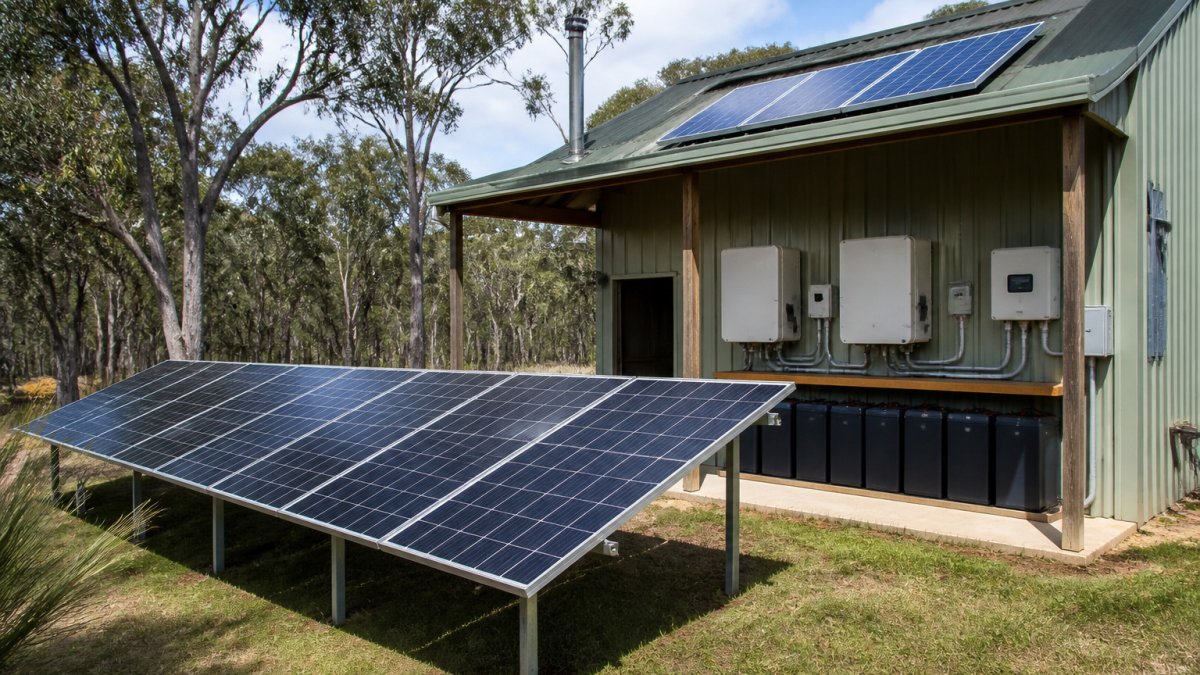
Sound system design sizes every component for the worst week of the year, not the best. The architecture is straightforward. Solar panels on the roof convert sunlight into direct current.
That chain sounds simple, and physically it is. The difficulty sits entirely in the design stage, where a mismatch between supply and demand shows up as flickering lights in July rather than a clean installation in March.
The distinction between an off-grid setup and its cousins matters before you size anything. A grid-connected system exports surplus power and draws from the network at night, so it needs no storage to function.
Off Grid Solar System Sizing: Matching Supply to Your Daily Load
Off-grid solar system sizing begins with a load calculation, not a panel count. Add up the wattage and daily running hours of every appliance you intend to power, then convert that to kilowatt-hours per day. A fridge cycling for eight hours at 150W consumes 1.2kWh; a laptop drawing 60W for five hours adds 0.3kWh. Multiply your total by 1.3 to account for inverter losses and wiring inefficiency.
The result is your daily energy demand. A calculation-focused guide walks you through working out your exact off-grid system size: calculate off grid solar system size. From there, divide by your location’s average daily sun hours to find the array size in kilowatts. Southern regions in winter may deliver only two to three productive sun hours on a cloudy day, while summer can exceed five.
Off Grid Solar Battery Sizing and Days of Autonomy
Off-grid solar battery sizing is where most designs fail. The common mistake is matching battery capacity to daily consumption and stopping there. A battery bank must carry your home through consecutive cloudy days, known as days of autonomy, and it must be sized on usable capacity, not nameplate capacity.
Depth of discharge is the deciding figure. A lithium iron phosphate battery can typically be discharged to around 80-90% of its rated capacity without damaging cycle life, while older lead-acid chemistry should not go below roughly half. That means a 10kWh lithium bank delivers around 8kWh of usable energy; the equivalent lead-acid bank delivers closer to 5kWh.
Battery chemistry also drives lifecycle economics. Lithium cells generally tolerate more cycles and hold their capacity longer, which is why the cycle rating on the datasheet deserves more attention than the headline price.
Off Grid Solar System Components and How They Fit Together
Off-grid solar system components fall into six groups, and each one constrains the others. The solar array sets generation. The charge controller manages the transfer to storage and must be rated for the array’s current. The battery bank sets autonomy. The inverter sets the peak load you can run at once, and it needs both a continuous rating and a surge rating for motor starts. Mounting and weatherproof housing protect the hardware. The backup generator covers the worst-case stretch.
Two wiring approaches exist. DC coupling connects the array to the charge controller and battery directly, which suits smaller systems and simpler fault diagnosis. AC coupling places a grid-interactive inverter between the array and the battery system, which helps when retrofitting storage to an existing solar installation. For details on integrating a generator as backup, see best off grid solar system with generator backup.
A Worked Design Example for a Typical Household
A worked example is the fastest way to see how the sizing rules interact. Take a modest rural home occupied year-round by two adults and one child.
| Appliance | Rated power | Daily hours | Daily energy |
|---|---|---|---|
| Fridge-freezer (cycling) | 150W average | 8 | 1.2kWh |
| LED lighting | 100W total | 5 | 0.5kWh |
| Television | 200W | 4 | 0.8kWh |
| Washing machine | 500W | 1 | 0.5kWh |
| Laptop and small devices | 150W total | 6 | 0.9kWh |
| Water pump (intermittent) | 800W | 1 | 0.8kWh |
| Microwave and kettle | 1,500W | 0.5 | 0.75kWh |
| Standby loads (router, chargers) | 30W continuous | 24 | 0.72kWh |
| Subtotal | 6.17kWh |
Apply a 1.3 efficiency factor for inverter losses, wiring, and battery round-trip inefficiency: 6.17 × 1.3 ≈ 8kWh per day. That is the design daily demand. Round up to 8kWh for the rest of the calculation.
Next, model the worst case, not the annual average.
Battery sizing follows days of autonomy. For three days at 8kWh daily, the bank needs 24kWh of usable storage.
Inverter sizing is driven by peak simultaneous load, not daily energy. Add the largest motor start (the water pump at 800W with a surge factor of roughly three) to the simultaneous household load.
Finally, run a seasonal sanity check. In winter, the 3kW array at three sun hours produces 9kWh, which covers the 8kWh demand with a small margin.
That configuration, 3kW array, 30kWh lithium bank, 5kW inverter, generator backup, is a starting point, not a quote. Roof orientation, shading, local sun hours, and the household’s actual behaviour will shift every figure.
Off Grid Solar System Cost and What Drives It
Off-grid solar system cost is driven by storage far more than by panels.
Cost depends on the variables that move the number: your daily load, your required days of autonomy, your battery chemistry choice, your site’s access for installation, and whether a generator is included. A larger load with modest autonomy can cost less than a smaller load designed for a week of independence. Current pricing depends on the specification, so check GridFree Solar’s website or request a quote for current prices.
Rebate eligibility also shifts the net figure. The Small-scale Renewable Energy Scheme and the Cheaper Home Batteries Program both apply to eligible installations, and the rules change. Confirm current eligibility with the Clean Energy Regulator before you commit, and ask your installer to document which certificates apply.
Safety Standards, Installation and Commissioning
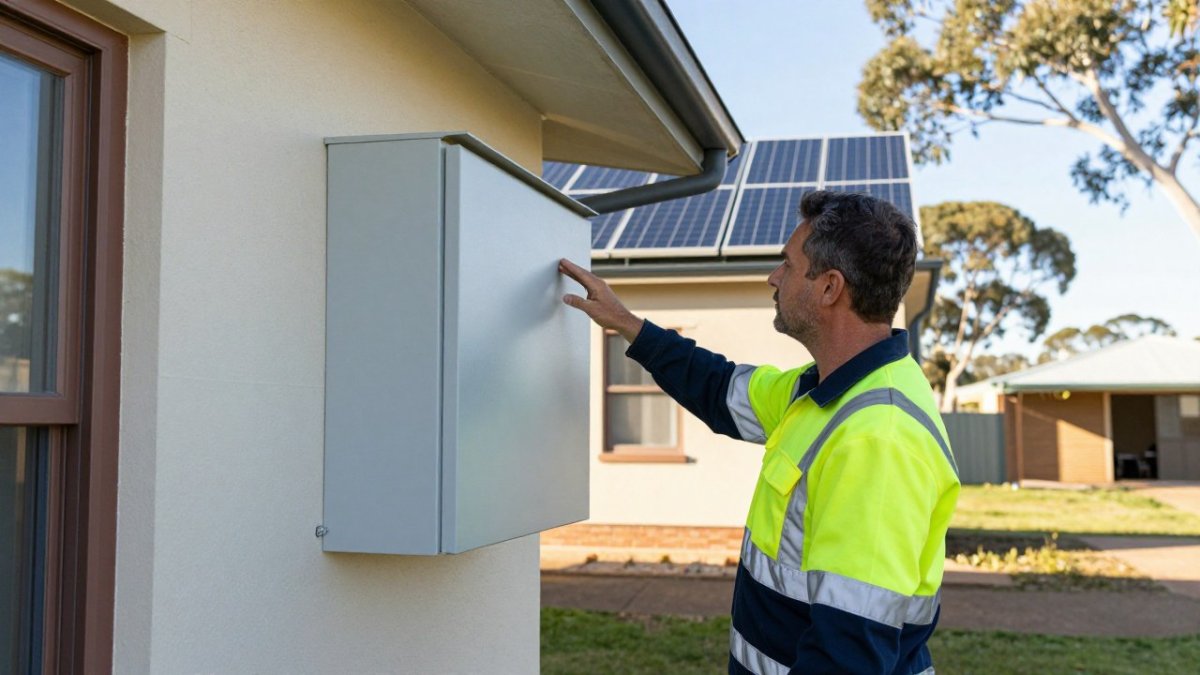
Battery installations in Australia are governed by AS/NZS 5139:2019, the standard for electrical installations with battery energy storage systems, alongside AS/NZS 3000 for general wiring. These standards specify clearance distances, ventilation, fire separation, signage, and labelling, and they exist because lithium batteries store significant energy in a small space.
A practical compliance checklist for homeowners:
- Location and separation: the battery enclosure must meet the clearance and fire-separation distances in AS/NZS 5139:2019, including distance from combustible materials, windows, doors, and escape routes.
- Ventilation: the enclosure must allow the ventilation the standard requires, particularly for chemistries that can vent flammable gases.
- Signage and labelling: warning signs, shutdown procedures, and circuit labelling must be present and legible, so emergency services can isolate the system safely.
- Protection devices: DC isolation, circuit breakers, and residual current devices must be correctly rated and installed on both the DC and AC sides.
- Documentation: as-built diagrams, the battery datasheet, and the commissioning record should be handed over at completion.
Commissioning should verify, in sequence: array open-circuit voltage and short-circuit current against the design; charge controller settings matched to the battery manufacturer’s datasheet; inverter output voltage and frequency under load; inverter surge behaviour on motor start; generator changeover and charging behaviour; and correct signage. With commissioning complete, the verified inverter and generator capacity can be compared with the loads the system must support, making it useful to calculate electrical load for a home office before adding it to the design.
Watch out: the most common safety failure is a battery installed in a location that met no one’s standard, often a cramped shed with no separation from combustible material. The consequence is not a warranty issue; it is a fire risk.
Once commissioned, monitoring is how you confirm the design is working. Most systems log daily yield, state of charge, and generator run hours. A common pattern is a battery that fails to reach full charge in winter; check for shading, dirty panels, a charge controller set to the wrong chemistry profile, or a load that has grown since design.
Planning Your Off Grid System with GridFree Solar
The design process rewards patience. For a broader Australia-specific off-grid guide and your next step toward engaging GridFree, see the off grid solar system guide Australia. Work out your load honestly, size the array to winter sun hours, size the battery to days of autonomy and usable capacity, then match the inverter to your peak demand. Get those four figures right and the rest is detail.
GridFree Solar offers CEC accredited installation, guidance on rebate eligibility, and CEC approved batteries. Its installers work to AS/NZS 5139:2019 and AS/NZS 3000. Ongoing maintenance and monitoring support is available after commissioning.
Frequently Asked Questions
How do you design an off grid solar system for a home?
Start with a load calculation: list every appliance, its wattage and daily run time, then convert to kilowatt-hours per day. Add a margin for peak demand and surge power from motors and pumps. From there you size the solar array to the worst-case sun hours, size the battery bank for your chosen days of autonomy, and match the inverter to continuous and surge loads. A qualified designer then checks the design against AS/NZS 5139:2019 and AS/NZS 3000 before installation.
How many solar panels are needed to run a house off grid?
It depends on your daily energy use and the sun hours at your site. A household using 15 kWh per day in a location averaging four peak sun hours needs roughly 4 to 5 kW of panels before efficiency losses, which is about 10 to 12 panels at 400 W each. Shading, seasonal variation and panel orientation all affect the final count, so off-grid solar system sizing should always be based on your own load figures rather than a rule of thumb.
How do you calculate the battery size for an off grid solar system?
Multiply your daily kilowatt-hour use by the number of days of autonomy you want, then divide by the usable depth of discharge. A home using 15 kWh per day with two days of storage and 90% usable capacity needs about 33 kWh of battery capacity. Off-grid solar battery sizing also has to account for battery efficiency and seasonal variation, so winter demand is the figure to design against.
What size inverter do I need for an off grid home?
Size the inverter for your peak demand, not your average use. Add up the appliances likely to run at once, then check the surge power of anything with a motor, such as a fridge, pump or air conditioner, which can draw two to three times its running wattage at startup. A 5 kW inverter suits many small households, but continuous and surge ratings both matter, and the inverter must be compatible with your battery and charge controller.
How much does it cost to install an off grid solar system?
Off-grid solar system cost depends on array size, battery capacity, inverter choice and site conditions such as cable runs and mounting. Battery storage is usually the largest line item, and lithium chemistry costs more upfront than lead-acid but offers more usable capacity and a longer lifecycle. Pricing varies, so ask GridFree Solar for a quote based on your load calculation rather than comparing headline figures.
Can an off grid solar system power a whole house?
Yes, provided the system is sized for the load. Whole-home off-grid systems are common on remote properties, but they work best when high-draw appliances such as electric heating, hot water and induction cooking are replaced with efficient alternatives or run during daylight. A load calculation will show whether your current usage fits a practical array and battery size, or whether some appliances need to change.
Getting an off-grid design wrong is expensive to fix, and the errors surface months later when the weather turns. If you want the load calculation, sizing and compliance handled by accredited specialists rather than guessed at, talk to us. Get started with GridFree Solar and build a system sized for your home’s worst week, not its best.
