
Solar and battery incentives in Victoria can stack, but the rules differ for businesses and households. For commercial solar battery incentives in Victoria, eligible businesses may combine SRES and VEU solar incentives for a discount of up to 35% off a solar system’s retail price. Eligible small businesses may also access the federal Cheaper Home Batteries Program.
It’s easy to assume a household rebate applies to a commercial site, or that claiming one incentive rules out another. The key is to distinguish solar support from battery support and check which eligibility conditions apply to your business.
This guide explains how SRES and Victoria’s VEU incentives may work together, when federal battery support may apply, and how system size and installation requirements affect eligibility. You’ll have a clearer basis for assessing support for your project in Melbourne or elsewhere in Victoria.
Key Takeaways
- Eligible Victorian commercial and industrial solar PV systems sized from 30 kW to 200 kW may qualify for the VEU discount, according to the Essential Services Commission of Victoria.
- Australia’s Cheaper Home Batteries Program is intended to cover roughly 30% of an eligible battery’s price upfront, according to the Australian Government Department of Climate Change, Energy, the Environment and Water.
- Learn how solar and battery support may be combined by assessing each scheme’s eligibility conditions separately.
- Solar Victoria’s Solar for Business Program ended on June 30, 2023. Understand which current incentive pathways may suit a commercial site instead.
Is My business eligible for commercial solar rebates under SRES?
Eligibility depends on the site, system size, equipment and incentive rules. Household rebates are separate from commercial support.
Business, system and equipment eligibility
For SRES, Victorian business solar systems from 30 kW to 100 kW may qualify for small-scale technology certificates (STCs). The STC calculation uses a system-size cap of 100 kW. Rooftop solar must use eligible panels and inverters, installed by a Solar Accreditation Australia-accredited installer. In Victoria, the VEU commercial and industrial solar panel discount applies to eligible solar PV systems sized from 30 kW to 200 kW, according to the Essential Services Commission of Victoria. The site must be non-residential.
Commercial incentives and tax deductions
Solar Victoria’s household PV rebate is not a general business rebate. From 1 July 2026, eligible households may receive A$1,400, subject to combined taxable income of A$150,000 or less and a property value under A$3 million. Businesses may also explore federal battery support: the Cheaper Home Batteries Program is intended to cover roughly 30% of an eligible battery’s upfront price, according to the Australian Government Department of Climate Change, Energy, the Environment and. For tax, the stated A$20,000 instant asset write-off applied to assets first installed between 1 July 2023 and 30 June 2026; it doesn’t establish a deduction for later installations. Tax treatment depends on applicable business deduction and depreciation rules.
Scheme deadlines and installation checks
SRES support is being phased out until 2030, while the federal battery program is available through 2030 and its rate steps down every six months. A battery’s eligibility and discount depend on usable capacity, system configuration and installation conditions. Before committing, review product eligibility, warranty terms and the site’s grid-connection requirements. Victorian commercial solar installations also need to meet applicable network connection requirements; battery integration should be planned around the existing system and connection arrangement.
Applications and participation programs
For an application, gather business and site details, system specifications, equipment records, installer information and invoices. These documents help establish what was installed and support certificate or rebate processing. A Victorian business can assess battery participation in a virtual power plant or demand-response arrangement separately from the installation rebate. The federal program’s conditions include VPP capability or evidence of high grid-connection costs for some sites near the grid. Participation can depend on location, battery and inverter compatibility, and program terms.
Federal battery rebate availability for small businesses
Small businesses may qualify for national battery support, while solar support depends on system size and scheme criteria. Keep battery incentives separate from household-only Solar Victoria assistance.
System sizes and estimated rebates
The actual upfront value depends on system size, location and certificate calculations. For batteries, eligible small-business installations may access the federal program, including batteries up to 100 kWh in Victoria. Check usable capacity and the solar system’s configuration, especially for an upgrade to an existing installation.
Rebate value by usable capacity
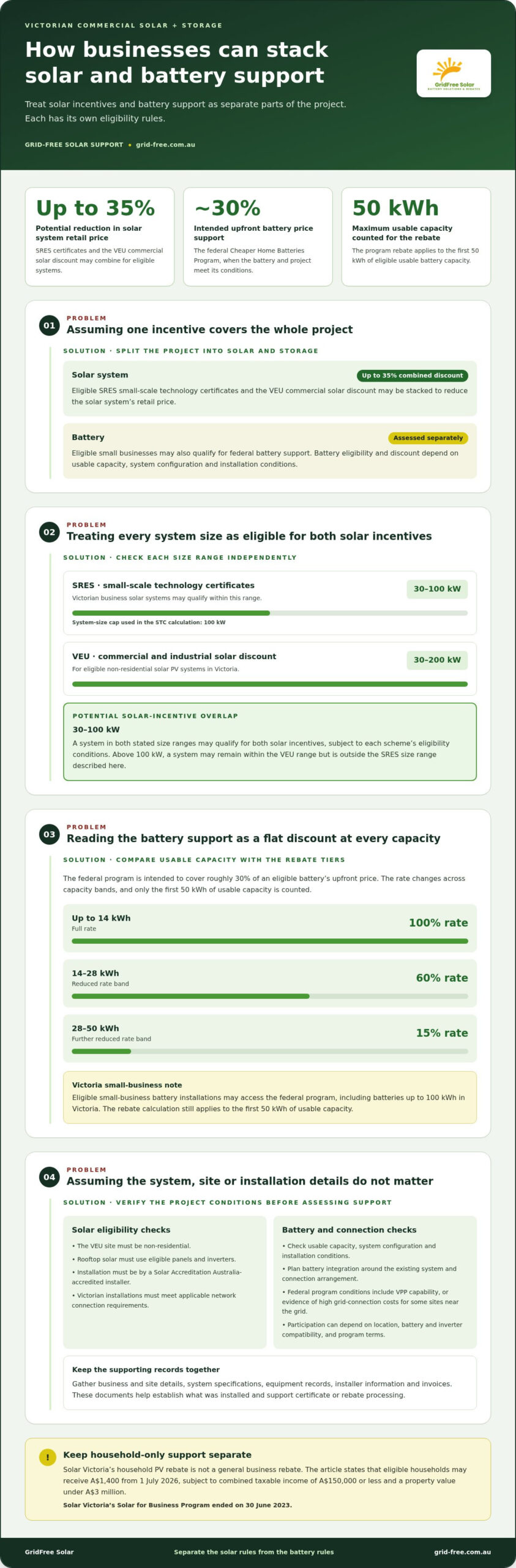
Australia’s Cheaper Home Batteries Program is intended to cover roughly 30% of an eligible battery’s price upfront, according to the Australian Government Department of Climate Change, Energy, the Environment and. Capacity up to 14 kWh receives the full rate; the 14-28 kWh band receives 60%, and the 28-50 kWh band receives 15%. The rebate applies to the first 50 kWh of usable capacity.
Across Victoria, NSW, Queensland and South Australia, the federal program is national and applies when eligibility conditions are met. State support differs: NSW has a commercial battery rebate identified for batteries from 20 kWh to 30,000 kWh, while Victoria’s business options include federal battery support and state solar incentives.
Solar Victoria’s Solar Homes Program is for eligible households, not a general commercial PV rebate. From 1 July 2026, its A$1,400 solar PV rebate requires combined taxable income of A$150,000 or less and property value under A$3 million.
Compare the battery’s usable capacity and solar configuration against each scheme’s criteria before selecting an upgrade. For integrated project planning, explore commercial solar and battery installation.
Stacking battery and solar incentives
Victorian businesses may combine eligible solar incentives, then assess battery support separately. SRES small-scale technology certificates and the VEU commercial solar discount can together reduce a solar system’s retail price by up to 35%. Federal battery support may add a separate discount when the battery meets its own eligibility criteria. That separation is central to understanding how commercial solar battery incentives in Victoria may be stacked.
Start by mapping the project into solar and storage components. Eligible solar PV systems from 30 kW to 100 kW may qualify for SRES certificates, while the VEU discount applies to eligible commercial and industrial systems from 30 kW to 200 kW. A system within both size ranges may qualify for both solar incentives. Above 100 kW, a system may still fit the VEU range but not the SRES size range described here.
Next, assess the battery against the federal program independently. Its discount is calculated using eligible usable capacity, with the first 50 kWh capped for rebate purposes. Adding storage does not automatically increase the solar certificate amount. Keep the solar system specifications and battery’s usable capacity distinct in estimates for commercial solar battery incentives in Victoria.
For eligible solar installations, STCs are based on estimated electricity generation until 2030. Retailers or installers normally apply for and sell certificates on the customer’s behalf, reducing the upfront amount. Check that a proposal identifies how certificate value is applied, rather than treating it as a separate cash payment.
Compare combined incentives with expected electricity use, daytime consumption and battery charging patterns. These factors affect potential savings and payback, while project capital costs affect financing interest. Households follow separate Solar Victoria criteria, so exclude household solar rebates from a business calculation. Choosing suitable equipment and an appropriately qualified installer can help keep a project aligned with applicable scheme requirements.
Are commercial battery incentives available through Solar Victoria or only for residential customers?
Solar Victoria support and commercial battery incentives are separate pathways. The state’s Solar Homes Program is designed for eligible households, while businesses should distinguish household solar rebates from incentives applying to commercial sites. Victoria’s Solar for Business Program ended on June 30, 2023, so it is not an open route for a new business application.
For batteries, the relevant current pathway for eligible small businesses is the Australian Government’s Cheaper Home Batteries Program. In Victoria, eligible business batteries may have capacity up to 100 kWh. The battery discount applies when storage is installed with a new or existing solar PV system smaller than 100 kW. That makes the existing solar system’s size and the planned battery’s eligible capacity central to the assessment.
Solar Victoria’s household PV rebate should not be treated as a business battery rebate. Its criteria include household income and property value, which are not business eligibility tests. Instead, assess the project in two parts: check commercial solar incentives against the PV system, then assess federal battery support against the battery and its connection to solar.
Before planning an installation, record whether the site is residential or non-residential, the solar system’s capacity, and whether the battery is new or being added to existing PV. Compare those details with the relevant scheme’s eligibility conditions. This avoids applying household criteria to a commercial site or assuming a past Victorian business program remains available. The distinction matters for new installations and battery upgrades, where system configuration can affect the applicable incentive route.
For a commercial site, plan solar and storage together so the proposed configuration aligns with the relevant incentive criteria. Explore commercial solar solutions for a project-specific system plan.
GridFree Solar: Battery Upgrade & Replacement
GridFree Solar helps Melbourne and Victorian businesses plan battery upgrades and replacements alongside commercial solar solutions. Turn to the team when existing storage needs an upgrade or when you’re assessing solar and battery installation for a commercial site.
Start by bringing together your current solar system details, proposed battery capacity and site energy needs. This gives you a clear basis for considering incentive eligibility and how the solar and storage components fit together. GridFree Solar also helps customers navigate and claim solar and battery rebates, connecting incentive questions with installation planning.
For a business assessing its next step, discuss your commercial solar and battery project with GridFree Solar. Contact the team or visit GridFree Solar online.
Turn incentive eligibility into a practical project plan
Shape your energy project around how the business uses power, what solar equipment is already installed, and whether storage is part of the plan. This gives you a clearer basis for comparing system options and organising the information needed to assess commercial solar battery incentives in Victoria.
GridFree Solar supports this planning through Commercial Solar Solutions, Battery Upgrade & Replacement, and Residential Solar Panel Installation. For a business, focus the discussion on the site’s solar setup, storage needs and project objectives. A well-defined scope makes it easier to consider the right installation pathway without treating every incentive as interchangeable.
Bring your current system details and energy priorities into the conversation. Contact GridFree Solar to discuss your options and take the next step towards a project plan that fits your business.
Frequently Asked Questions
Can the Rebate Be Combined with State Incentives?
Yes. A business may combine eligible solar incentives, then assess battery support separately. For example, a Victorian commercial solar installation that meets both SRES and VEU conditions may qualify under both solar schemes, while the battery is assessed against federal battery criteria. In your project estimate, list each incentive against the component it applies to. This helps prevent counting a solar discount as a battery rebate.
What is the Rebate?
A rebate is financial support that lowers the upfront cost of eligible equipment or installation. It may be applied as a discount rather than paid directly to the business. For commercial solar, federal support is commonly delivered through Small-scale Technology Certificates, while battery support comes through the Cheaper Home Batteries Program. Check whether an estimate shows a certificate value, an upfront discount or a separate payment.
Can energy rebates help small businesses as well?
Yes. Eligible Australian small businesses may access the federal Cheaper Home Batteries Program for qualifying battery installations. Eligibility depends on the site, battery, solar configuration and installation requirements, not business size alone. For example, a business adding storage to existing solar should assess the PV system and battery as one connected setup. Keep equipment and installation records to support the eligibility assessment.
What is the Aim of This Incentive?
The federal battery incentive aims to reduce the upfront cost of eligible storage and support battery uptake alongside solar. Storage lets a business use some of the electricity it generates after its panels stop producing. These are program rewards, not the government rebate.
What is the current rebate for solar batteries in Victoria?
The rate varies by capacity: up to 14 kWh receives the full rate, the 14-28 kWh band receives 60%, and the 28-50 kWh band receives 15%. The rebate applies to the first 50 kWh of usable capacity, so assess usable rather than nominal capacity.
What Victorian government rebates or incentives are available for commercial solar batteries in 2026?
Victoria’s VEU discount supports eligible commercial solar PV, not batteries themselves. Solar Victoria’s Solar Homes rebate is for eligible households, and the Solar for Business Program ended on June 30, 2023. For battery installations, eligible Victorian small businesses may instead access the national Cheaper Home Batteries Program. Assess solar and storage incentives separately, since a business may have different eligibility conditions for each part of its project.