
Federal support can combine with eligible state or territory incentives, but Victoria’s former A$8,800 interest-free loan for new battery installations has been scrapped. For home battery scheme eligibility in Victoria in 2026, the key federal rules include a new battery of 5 kWh to 100 kWh, connected to a new or existing solar PV system; the subsidy applies to the first 50 kWh of installed storage. Each local incentive has its own requirements, so combining support depends on the schemes involved.
It’s easy to assume a Victorian battery rebate works like the state’s solar panel incentives. The distinction matters: the federal Cheaper Home Batteries Program is available to eligible Victorians, while Victoria’s battery loan is no longer accepting applications. This guide explains who may qualify, which battery and installation requirements apply, how the federal discount is calculated, and what to consider when looking at other incentives. You’ll get a clearer view of how the rules fit together before deciding whether a home battery suits your household.
Key Takeaways
- Federal battery support can apply to eligible systems from 5 kWh to 100 kWh, but capacity, product and installation rules all matter.
- Victoria’s former A$8,800 interest-free loan for new battery installations has been scrapped; other state incentives have separate eligibility criteria.
- According to Solar Victoria, a Victorian property must be valued below A$3 million to meet the stated Solar Homes Program eligibility criterion.
- Compare the federal battery discount with any relevant state or territory incentive, as qualifying for one does not automatically mean qualifying for another.
- The installation date affects the federal discount, so understanding the timing and eligibility rules can help you assess your options.
Battery capacity and approved product requirements
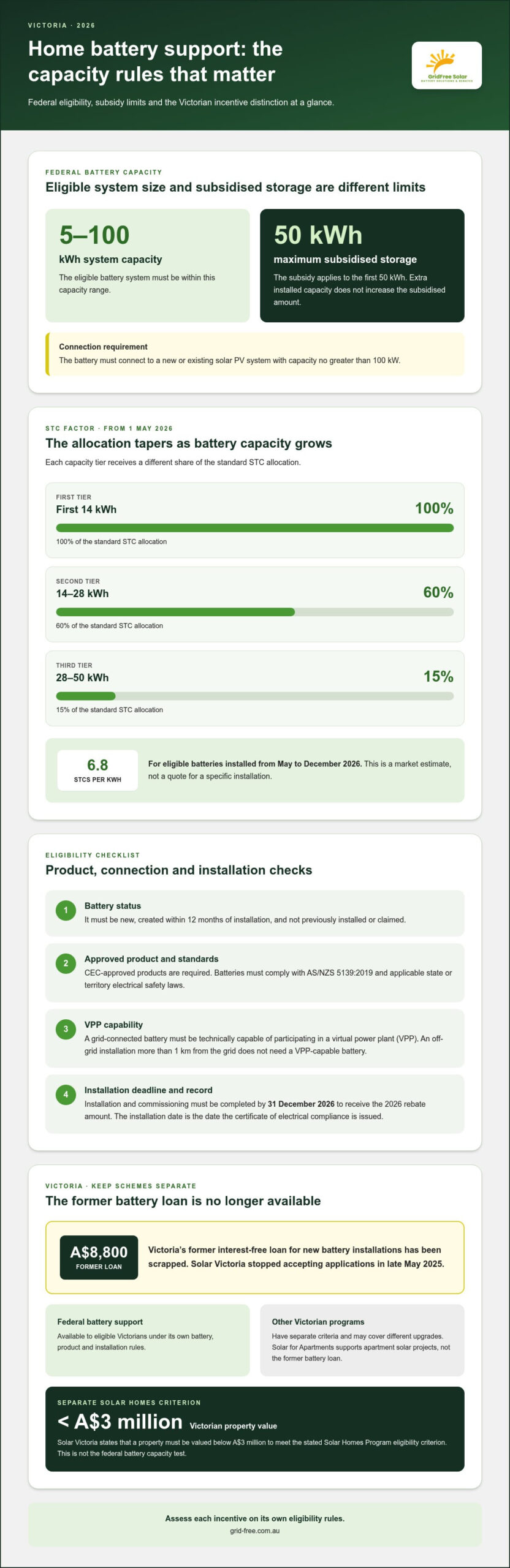
For the federal battery discount, the eligible system capacity is 5 kWh to 100 kWh. The system must connect to new or existing solar PV panels, and only the first 50 kWh of installed storage can receive the subsidy. A battery above that limit may still be installed, but its additional capacity does not increase the subsidised amount.
Capacity also affects how the Australian program allocates Small-scale Technology Certificates (STCs). From 1 May 2026, the STC Factor applies at 100% to the first 14 kWh of installed capacity. Storage from 14 to 28 kWh receives 60% of the standard STC allocation. The 28 to 50 kWh tier receives 15%. This taper means a larger battery does not receive the same discount per usable kilowatt-hour across its full capacity.
For eligible batteries installed from May to December 2026, the STC Factor is 6.8 STCs per kWh. These are market estimates, not a quote for a specific installation.
Product and connection requirements matter alongside capacity. Australian solar batteries must comply with AS/NZS 5139:2019 and applicable state or territory electrical safety laws. CEC-approved products are required, and a grid-connected battery must be technically capable of participating in a virtual power plant (VPP). An off-grid installation more than 1 km from the grid does not need a VPP-capable battery.
- Confirm the battery is new, was created within 12 months of installation, and has not previously been installed or claimed.
- Match it to a new or existing solar PV system with capacity no greater than 100 kW.
- Account for the 50 kWh subsidy cap and the lower STC allocation above 14 kWh.
For the incentive record, the installation date is the date the certificate of electrical compliance is issued. Eligible discounts are typically applied upfront to the installer’s quote, so retain the quote and compliance certificate with the battery details. Installation and commissioning by 31 December 2026 are required to receive the 2026 battery rebate amount.
Common reasons for ineligibility include a previously claimed battery, an unapproved product, capacity outside the 5 kWh to 100 kWh range, or no qualifying solar PV connection. Separately, Solar Victoria states that a Victorian property must be valued below A$3 million to meet the stated Solar Homes Program eligibility criterion. That property-value rule relates to Solar Homes eligibility, not the federal battery capacity test.
Compatibility with state and territory incentives
Federal battery support is designed to complement Commonwealth, state and territory incentives, but each scheme has its own eligibility rules. In Victoria, that distinction matters because the former state battery loan has ended.
Compatibility with Victorian incentives
Assess the federal battery discount separately from each Victorian incentive, rather than assuming one approval covers another. The federal Cheaper Home Batteries Program is available to eligible Victorians, while local incentives have their own government requirements.
Victoria’s former A$8,800 interest-free loan for new battery installations has been scrapped. Solar Victoria stopped accepting applications for that battery loan in late May 2025. It is therefore not a current state loan that households can add to federal support for a new solar battery.
Other Victorian programs support different upgrades. Solar for Apartments, for example, supports apartment solar projects, not the former battery loan. Check which equipment and installation a program covers before including its support in a battery budget.
Applying for a Victorian incentive
To assess support, match the household and proposed upgrade to the rules of the specific Victorian program. A solar incentive and a federal battery discount are separate forms of assistance, each with distinct eligibility conditions.
For example, a household in an eligible apartment building could explore Solar for Apartments for the building’s solar project, while assessing its battery installation separately under federal rules.
From 1 July 2026, the combined household income threshold for Victorian solar panel and hot water rebates is A$150,000 per year, according to Solar Victoria. These are solar and hot water criteria, not a replacement battery rebate.
For a practical assessment, identify the upgrade first, then compare its requirements with those of the relevant scheme:
- For a battery, assess the federal program’s battery and installation criteria.
- For apartment solar, consider Solar for Apartments and its building-level eligibility.
- For a Solar Homes panel rebate, assess the owner-occupier and income requirements.
Keep the incentives distinct in your calculations. A federal discount may reduce the eligible battery installation cost, while a Victorian program may support a different upgrade. The Australian program is intended to complement local incentives, but each scheme’s eligibility determines whether support can be combined. Households comparing battery rebate options can use the upgrade type and applicable program rules as the starting point.
Combining federal and state incentives
Federal and local support can work together, but each incentive has separate eligibility criteria. The Australian Government’s Cheaper Home Batteries Program provides a discount for eligible batteries, while state and territory schemes may support different upgrades or households. Assess each incentive separately rather than treating them as one combined application.
The federal discount is government-funded and works out to around 30% on eligible small-scale battery systems. The final value can vary because the rebate is issued through Small-scale Technology Certificates (STCs), whose market price fluctuates.
That estimate illustrates the federal component only. It is not a combined total with a Victorian incentive, and it does not establish eligibility for a separate state or territory program. The applicable STC Factor is set by the battery’s installation date.
Match Victorian support to the upgrade it covers. Solar for Apartments supports apartment solar projects, not a general top-up to the federal battery discount. The Victorian battery loan for new installations has been scrapped, so it cannot be included in a current combined battery package.
Use this distinction when estimating the upfront amount:
- Identify the battery’s federal discount using its eligibility and installation details.
- Assess any state or territory incentive against the upgrade and household criteria it specifically covers.
- Keep separate figures for battery support and other solar panels or clean energy assistance.
A second battery also needs careful treatment. An additional system may qualify for federal support if it has not previously claimed the rebate, the added capacity is at least 5 kWh, and total nominal capacity remains under 100 kWh. A battery system that has already received a rebate is ineligible for the federal subsidy. These rules prevent a previous claim from being counted again as fresh support.
When comparing incentives, ask whether each scheme covers the same installation or a distinct eligible upgrade. The federal program is intended to complement Commonwealth, state and territory incentives, but local requirements still apply. Calculate the battery discount separately, then combine it only with assistance for which the household and project meet the relevant criteria.
Eligibility under the Cheaper Home Batteries Program
Victorian households are assessed under the federal Cheaper Home Batteries Program, not a separate state battery loan. Eligibility depends on the battery, its solar connection, the premises and the installation.
Program eligibility requirements
The program supports eligible battery storage installed with a new or existing solar PV system. A battery without the required solar connection does not meet the stated system criteria.
The battery must be new, created within 12 months of installation, and not previously installed or claimed. Only one battery system per premises can receive the subsidy once. The program is not means tested, so household income does not determine federal eligibility.
The battery must be installed with a solar PV system of no more than 100 kW. Installers participating in Australia’s expanded Small-scale Renewable Energy Scheme must be trained and accredited through Solar Accreditation Australia. These requirements distinguish the federal discount from Victoria’s former A$8,800 free loan for new battery installations, which has been scrapped.
Connection type also affects the equipment criteria. A grid-connected battery must be technically capable of participating in a virtual power plant (VPP). An off-grid system more than 1 km from the grid does not need VPP capability. Off-grid properties close to the grid may need VPP-capable equipment or evidence that grid connection would be prohibitively costly.
Location, retailer and network restrictions
The stated eligibility tests focus on the battery, solar system and grid connection, rather than a named Victorian postcode or electricity retailer. Network connection still matters because it determines whether VPP capability applies.
For example, a grid-connected household needs a VPP-capable battery, while an off-grid property more than 1 km from the grid is exempt from that requirement. An off-grid site within 1 km must meet the VPP rule or the connection-cost evidence exception. These conditions make the property’s connection status more relevant than its postcode.
Victoria’s electricity network can affect how a battery connects and operates, but the program’s stated eligibility test is technical. The Cheaper Home Batteries Program does not use household income as a filter. Choosing a retailer does not replace the required solar PV connection, eligible battery or installer accreditation.
Keep the premises and installation records aligned. A previous claim at the property can prevent another battery system from receiving the subsidy, even if the proposed equipment otherwise meets program requirements. Check the battery’s history, solar connection and grid status together before including the discount in your installation plan.
How do I apply for a Victorian home battery incentive in 2026?
For an eligible battery, the federal discount is typically applied upfront to the installer’s quote. The installation date is the date the certificate of electrical compliance is issued, so timing affects the applicable STC Factor and discount. To receive the 2026 battery rebate amount, the battery must be installed and commissioned by 31 December 2026.
Follow this sequence to understand the federal incentive and its records:
- Assess whether the proposed battery and solar PV system meet the program’s eligibility requirements.
- Review the installation quote to see the eligible discount applied upfront.
- Retain the quote and certificate of electrical compliance, which records the installation date used for the rebate.
- Complete installation and commissioning by 31 December 2026 to receive the 2026 battery rebate amount.
The discount is delivered through Small-scale Technology Certificates, rather than a separate Victorian battery-loan application. The certificate’s issue date establishes the installation date for the federal claim. The applicable STC Factor depends on that date, and the STC market price can fluctuate, so the upfront discount may vary between installation periods.
Victoria’s former interest-free loan for new battery installations is no longer an application option. Solar Victoria stopped accepting applications for that battery loan in late May 2025, and the state has scrapped its A$8,800 loan. Victorian households therefore assess battery support through the federal program, rather than applying for that discontinued state loan.
A separate Solar Homes Program solar panel rebate has its own application pathway and eligibility tests. The property must be valued below A$3 million, and the combined household income threshold for Victorian solar panel and hot water rebates is A$150,000 per year from 1 July 2026, according to Solar Victoria.
State solar rebates may be released according to a program schedule. That schedule applies to solar panel rebates, not the federal battery discount. Property history also matters for the solar rebate: a home is ineligible if solar PV was installed there in the last ten years or its address has previously received a Solar Homes Program solar PV rebate.
Keep the two processes separate. A solar panel rebate does not replace battery eligibility, and a federal battery discount does not establish qualification for a Victorian solar rebate. For an eligible installation, explore battery rebate support alongside the relevant system requirements and installation timing.
GridFree Solar: Battery Upgrade & Replacement
GridFree Solar provides Battery Upgrade & Replacement for households assessing an existing solar setup or planning to increase energy storage. This is a practical next step when an older battery needs replacing or you’re considering how a new battery could work with your solar system.
GridFree Solar also provides solar and battery installation and residential solar panel installation. The right approach depends on whether you’re upgrading an existing system or planning a new installation. Understanding the federal eligibility criteria can help you discuss the battery capacity, solar connection and installation details for your project.
For help with a battery upgrade or replacement, contact GridFree Solar.
Make your battery decision with confidence
Eligibility is only one part of choosing a home battery. The next step is to consider how storage fits your household’s energy use, existing solar setup and plans for the property. Understanding eligibility for Victoria’s home battery scheme in 2026 gives you a clearer starting point for weighing those factors.
GridFree Solar provides Battery Upgrade & Replacement, Residential Solar Panel Installation and Commercial Solar Solutions. Choose the installation pathway that fits your needs, whether you’re updating an existing system or planning solar and battery installation together. A well-matched system starts with your requirements and takes the relevant technical and incentive rules into account.
Take the next step by discussing your battery plans and incentive options with GridFree Solar. Contact GridFree Solar about battery incentives and move forward with a clearer plan for your energy setup.
Frequently Asked Questions
Can the rebate be combined with state incentives?
Yes, federal battery support is intended to complement state and territory incentives, but each scheme has separate eligibility rules. In Victoria, the former interest-free loan for new battery installations has been scrapped, so it cannot be added to the federal discount. Other support, such as Solar for Apartments, applies to a different upgrade. Identify what each incentive funds before adding amounts together in your household budget.
Who is eligible?
Australian households may qualify for the federal discount if their battery and installation meet the program requirements. The system must be new, connected to a qualifying solar PV system, and within the eligible capacity range. The program is not means tested, so household income alone does not rule out eligibility. A previous battery claim at the premises can affect eligibility, even if a different household member applies.
What Victorian home battery rebates or schemes are available in 2026?
Victorians can access the federal Cheaper Home Batteries Program for eligible battery installations. Victoria’s former A$8,800 interest-free loan for new batteries has been scrapped, and applications for that loan stopped in late May 2025. Other Victorian assistance may apply to different projects, such as Solar for Apartments for eligible apartments, units and townhouses. That scheme supports apartment solar, rather than acting as a general battery rebate.
Who is eligible for the Victorian Home Battery Scheme in 2026?
There is no current Victorian battery loan scheme accepting applications in 2026. Eligible Victorian residents may instead qualify under the federal Cheaper Home Batteries Program, which assesses the battery, solar connection, premises and installation. For example, a household replacing an existing battery needs to consider whether the premises has already received a federal battery claim. The scheme is not means tested, so income is not a federal eligibility test.
What household income, property ownership, and existing solar requirements apply?
The federal battery program is not means tested and requires a new or existing solar PV connection. Victorian Solar Homes solar panel rebates have separate rules: they are for eligible owner-occupiers, and the property must meet the program’s property-value criterion. From 1 July 2026, the combined household income threshold for Victorian solar panel and hot water rebates is A$150,000 per year, according to Solar Victoria. Those state rules concern other rebates.
What battery capacity and product eligibility rules apply?
The federal program supports battery systems from 5 kWh to 100 kWh, installed with a solar PV system of no more than 100 kW. The battery must be new, created within 12 months of installation, and not previously installed or claimed. Only one system per premises can receive the subsidy once. For an additional battery, eligibility depends on whether the earlier system claimed the rebate and whether the added capacity meets program rules.
How much is the rebate or loan, and what are the 2026 price limits?
Victoria’s former A$8,800 battery loan is no longer available. The program’s stated limits concern capacity and eligibility; the rebate is not a fixed purchase-price cap.
Can Victorian residents combine battery incentives with the federal battery rebate or other schemes?
Victorian residents can access the federal battery rebate, which is designed to complement Commonwealth, state and territory incentives. Combining support depends on each scheme’s purpose and eligibility criteria. For instance, apartment solar assistance may apply to a building’s solar project, while federal support is assessed for an eligible battery. A battery that has already received the federal subsidy cannot receive that battery subsidy again.