
Timing can determine which support applies. For businesses weighing business solar panel tax incentives in Australia in 2026, eligible systems may receive an upfront discount through small-scale technology certificates (STCs), while tax relief may come through the small-business instant asset write-off or depreciation rules. STCs must be created and claimed within 12 months of installation, and eligible SRES systems must be expected to produce less than 250 MWh of electricity annually.
It’s reasonable to focus on the value of an incentive, but the installation date, system eligibility and business structure can also affect what you can claim and when. Small businesses with aggregated turnover under A$10 million may immediately deduct the full cost of eligible assets under the applicable threshold; other businesses may use depreciation rules. This guide explains how STCs work, which tax rules may apply, and how the timing of a commercial solar project can shape the claims process, so you can assess the options before committing to an installation.
Key Takeaways
- Eligible SRES systems must be expected to produce less than 250 MWh of electricity annually, and STCs must be created and claimed within 12 months of installation.
- STCs are generally applied as an upfront discount, but system eligibility and installation timing affect how the incentive works.
- Australian Government SRES changes supporting mid-scale solar PV are intended to apply to installations from 1 October 2026, subject to regulations being in place.
- Small businesses with aggregated turnover under A$10 million may immediately deduct the full cost of eligible assets under the applicable threshold; depreciation rules may apply in other cases.
- Plan the claims timeline alongside the installation: the relevant incentive, system size and business tax treatment can each shape when and how support is claimed.
Small-scale Technology Certificates (STCs) and eligibility
For eligible commercial solar systems in Australia, businesses may receive Small-scale Technology Certificates (STCs) under the Small-scale Renewable Energy Scheme. System capacity, expected generation, installation standards and claim timing all affect eligibility.
Solar system eligibility thresholds
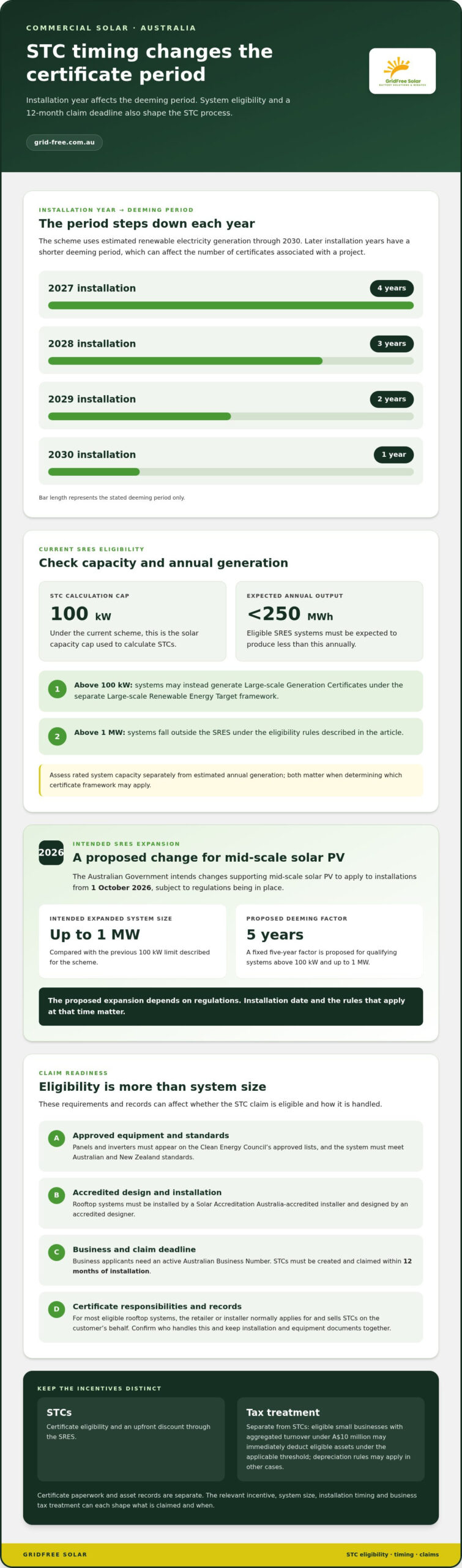
The SRES uses a 100 kW cap for the solar system size used to calculate STCs under the current scheme. Eligible systems must also be expected to produce less than 250 MWh of electricity annually. These thresholds matter because a commercial project’s capacity and expected output help determine which certificate framework may apply.
Systems above 100 kW can generate Large-scale Generation Certificates under the separate Large-scale Renewable Energy Target framework. Systems above 1 MW fall outside the SRES under the described eligibility rules. A business should therefore distinguish the system’s rated capacity from its estimated annual generation when assessing eligibility.
Eligibility for systems under 100 kW
Eligible commercial systems under 100 kW may receive an upfront discount through STCs. Each certificate represents approximately 1 MWh of anticipated renewable energy production, calculated using the scheme’s rules and the system’s location. For most eligible rooftop solar systems, the retailer or installer normally applies for and sells the certificates on the customer’s behalf.
The actual discount depends on the number of certificates created and their sale value. The system must meet Australian and New Zealand standards, and its panels and inverter must appear on the Clean Energy Council’s approved lists.
Business incentive eligibility pitfalls
Common eligibility pitfalls include selecting equipment that is not on the approved lists, overlooking installation requirements, or assuming every commercial system qualifies under the same scheme. Rooftop systems must be installed by a Solar Accreditation Australia-accredited installer and designed by an accredited designer. Business applicants also need an active Australian Business Number.
STCs for eligible commercial solar systems must be created and claimed within 12 months of installation. That deadline makes project records and claim responsibilities important from the outset. Ask who will create and sell the certificates, and keep the installation and equipment documents together.
Yes, STCs are available for eligible commercial solar installations in 2026, including systems within the current SRES size limit.
Keep STC paperwork and asset records separate. Certificate eligibility and the upfront discount are distinct from tax deductions, which depend on the relevant tax rules. Treating an incentive as automatic or confusing it with a deduction can lead to errors in project records and tax reporting.
Australian Government Small-scale Renewable Energy Scheme and small-scale technology certificates
The federal Small-scale Renewable Energy Scheme (SRES) supports eligible renewable energy systems through certificates. For commercial projects, system capacity and installation timing help determine which framework applies.
The Small-scale Renewable Energy Scheme
The SRES creates an incentive for eligible solar systems by allowing small-scale technology certificates (STCs) to reduce upfront costs. Certificate calculations use estimated renewable electricity generation through 2030, so installation year affects the deeming period.
Under the current scheme, the solar capacity used to calculate STCs is capped at 100 kW. Systems above 100 kW may instead generate Large-scale Generation Certificates under the separate Large-scale Renewable Energy Target framework. That distinction matters when planning a commercial solar rebate, because the applicable certificate type changes with project size.
Small-scale technology certificates
Each STC represents approximately 1 MWh of anticipated renewable energy production. The SRES calculates certificates using estimated generation, system capacity and location, then applies the relevant deeming period. For eligible rooftop systems, the retailer or installer normally applies for and sells STCs on the customer’s behalf.
The scheme’s deeming period steps down as the end of the Renewable Energy Target approaches. Rooftop solar installed in 2027 has a 4-year deeming period; installations in 2028 have 3 years, those in 2029 have 2 years, and 2030 installations have 1 year. This declining period can affect the certificate amount associated with a project.
Scheme expansion and federal certificates
The Australian Government intends SRES changes supporting mid-scale solar PV to apply to installations from 1 October 2026, subject to regulations being in place, according to the Department of Climate Change, Energy, the Environment and Water. The same department says the expanded SRES is intended to support solar systems up to 1 MW, compared with the previous 100 kW limit.
The expansion could bring some larger commercial projects into the SRES framework, rather than the existing division at 100 kW. The proposed change uses a fixed five-year deeming factor for qualifying systems above 100 kW and up to 1 MW. It also relies on regulations, so the installation date and applicable rules matter.
For eligible mid-scale systems, applications for STCs will not open until mid to late November 2026, according to the Clean Energy Regulator. Factor that application window into project timing and cash-flow planning. Systems above 1 MW remain outside the described SRES eligibility rules.
Large-scale Generation Certificates (LGCs) work differently: a commercial solar system over 100 kW can generate one LGC for each MWh of renewable electricity produced. LGC creation ends with Australia’s Renewable Energy Target in 2030, making the scheme’s timeframe relevant to larger project assessments. Businesses assessing a new installation can explore commercial solar solutions alongside the certificate framework that may apply.
What commercial solar incentives are available in 2026?
Commercial solar incentives may include federal certificates and state-based support, depending on the system and its location. Account for scheduled reductions when estimating the upfront discount and assessing future savings with GridFree Solar.
Federal incentive phase-out
Federal solar support reduces over time through the SRES deeming period and the Renewable Energy Target’s end date. The SRES estimates renewable generation through 2030, while the Australian Renewable Energy Target ends in 2030 and LGC creation ends with it.
Installation timing matters when planning a project. The installation year affects the deeming period used to calculate certificates for rooftop solar, while commercial systems may be subject to different certificate arrangements based on capacity. Estimate the incentive for the planned installation date, rather than relying only on a current estimate.
Annual reductions and the rebate end date
The STC deeming period decreases for rooftop solar systems installed in later years: it is 4 years in 2027, 3 years in 2028, 2 years in 2029 and 1 year in 2030. A shorter deeming period can mean fewer certificates, reducing the federal discount associated with an eligible system.
The SRES compliance cost for retailers is also designed to decrease each year through 2030. These changes make timing relevant, but they don’t create one universal rebate end date for every commercial project. System eligibility and the applicable certificate scheme remain central.
Federal STC incentives for solar panels
For eligible rooftop solar, STCs can reduce the upfront cost. The retailer or installer usually applies for and sells the certificates on the customer’s behalf. Certificate numbers depend on factors such as expected generation, system capacity, location and installation year.
For eligible commercial systems above 100 kW, Large-scale Generation Certificates may apply under the separate framework. Each LGC represents renewable electricity generated, and creation ends with the Renewable Energy Target in 2030. Businesses should distinguish STCs from LGCs when comparing federal support.
Combining federal and state programs
Some businesses may combine federal incentives with state programs. In Victoria, eligible businesses may combine SRES and Victorian Energy Upgrades (VEU) incentives for a discount of up to 35% of the solar system retail price. The standard VEU commercial solar activity covers eligible non-residential premises installing systems between 30 kW and 200 kW.
Victoria’s project-based activity may assess commercial solar projects larger than 200 kW under its applicable rules. Victorian commercial clients can also leverage local business sustainability grants specific to Melbourne council regions to further reduce capital outlay. State and federal eligibility can differ, so identify the project location and system capacity before combining incentives.
Estimate incentives in stages: identify the federal certificate pathway, then consider the relevant state program and its conditions. For example, a Victorian rooftop project may require consideration of both the Victorian Energy Upgrades (VEU) activity rules and the SRES certificate calculation. The discount depends on the incentives the project qualifies for and how each is calculated.
Small-business instant asset write-off and depreciation
Tax treatment is separate from the upfront STC discount. A business may also consider the instant asset write-off or depreciation for eligible solar and battery assets, subject to the applicable tax rules.
Small businesses with aggregated turnover under A$10 million may immediately deduct the full cost of eligible assets under the applicable threshold. The threshold and asset eligibility determine whether the write-off applies; turnover alone doesn’t establish that a solar system qualifies. If it doesn’t qualify for an immediate deduction, depreciation may spread deductions over the asset’s effective life.
For a business solar project, separate the certificate discount from the asset’s tax treatment. The discount affects the upfront project cost, while tax deductions relate to the business asset and the rules that apply to it. Keep invoices, installation records and STC details together so the amounts and timing are easy to account for.
How the write-off and depreciation differ
An instant asset write-off may allow the cost of an eligible asset to be deducted immediately, while depreciation generally recognises its cost over time. The applicable threshold, business turnover, asset eligibility and business use all matter. If a solar system is used partly for business and partly for another purpose, the business-use share may need to be considered.
Do not assume the whole project qualifies for an immediate deduction just because the business meets a turnover condition. A solar installation can include separate assets, such as panels, inverters and battery storage. Their tax treatment depends on the applicable rules and how the business acquires and uses them.
Battery storage installed with business solar falls under the same broad tax framework: consider the asset’s eligibility, cost, use and applicable deduction or depreciation rules. Pairing a battery with solar does not, by itself, establish an automatic tax treatment.
STC deeming periods and project timing
The STC deeming period affects the certificate calculation, not the tax life of the solar asset. Rooftop solar installed in 2027 has a 4-year deeming period; installations in 2028 have 3 years, those in 2029 have 2 years, and 2030 installations have 1 year. Keep this incentive calculation separate from depreciation records.
Installation timing also affects which scheme rules apply. For example, mid-scale solar projects need to account for the SRES changes intended to apply from 1 October 2026, subject to regulations being in place. The Clean Energy Regulator says applications for eligible mid-scale systems will not open until mid to late November 2026.
Planning records for the tax claim
Before installation, organise records showing system size, asset components, installation date, business use and any STC discount. These details help distinguish the incentive from the amount considered for tax treatment. If a battery is added to an existing solar system, keep its purchase and installation records too.
For a business installing solar and a battery together, record each component and retain the project’s certificate documents. This gives the business a clear basis for applying the relevant write-off or depreciation rules, rather than treating the STC discount as the tax deduction.
Timing and claiming business solar incentives
For commercial solar, the installation date can affect incentive eligibility and when a claim can be lodged. Include federal and state incentive timelines in project planning, alongside system design, installation and business record-keeping.
Before installation: establish the project details
Start with the system’s capacity, location and expected electricity generation. These details shape the applicable renewable energy scheme and certificate calculation. Review at least 12 months of electricity bills to plan a realistic system size against the business’s usage.
Eligibility also depends on installation and equipment requirements. Systems seeking the federal incentive must be installed by Solar Accreditation Australia-accredited installers, and eligible panels and inverters must appear on the Clean Energy Council’s approved lists. Confirm these requirements during project planning so the system aligns with the intended incentive pathway.
At installation: record the date and claim responsibility
The installation date anchors the STC claim window. STCs for eligible commercial solar systems must be created and claimed within 12 months of installation. Record the completion date and keep the system and installation documents together, so the claim can be managed within that period.
For most eligible rooftop solar systems, the retailer or installer applies for and sells the certificates on the customer’s behalf. Make that responsibility clear in the project paperwork. Keep the certificate discount separate from tax records: STCs and asset deductions are distinct parts of the project’s financial treatment.
For mid-scale projects: plan around 2026 dates
The Australian Government intends SRES changes for mid-scale solar PV to apply to installations from 1 October 2026, subject to regulations being in place. The Clean Energy Regulator says applications for eligible mid-scale systems will not open until mid to late November 2026. For a project near those dates, distinguish the installation date from the later application window.
This distinction matters for cash-flow planning. A project may be completed before applications open, so account for the claim process separately from the installation schedule. Keep installation evidence and system details ready for the relevant application stage.
For combined incentives: align project milestones
State programs can add their own timing conditions. In NSW, eligible businesses may receive a battery incentive under the Peak Demand Reduction Scheme from 1 September 2026. For a qualifying combined solar-and-battery project, the solar must be installed within the applicable 90-day period.
Map state milestones alongside federal STC deadlines before scheduling solar, battery storage and commissioning. For example, a NSW business planning a combined project needs to coordinate the solar installation window with the battery incentive timing, while keeping the federal certificate claim within its separate 12-month deadline.
Use a project calendar to track installation, certificate and state-program dates. If you’re planning a commercial project, discuss commercial solar installation as part of that timing plan.
GridFree Solar: Battery Upgrade & Replacement
GridFree Solar can help businesses move from incentive research to a planned solar project. Its Commercial Solar Solutions and solar and battery installation are relevant when you’re assessing a new system, while Battery Upgrade & Replacement suits businesses looking to increase storage capacity in an existing setup.
Consider GridFree Solar when comparing project options, assessing how battery storage fits your energy use, or planning around available solar and battery rebates. The team helps customers navigate and claim eligible rebates. Your business’s tax treatment remains a separate matter for your tax records. Clear project details, including system design and installation timing, connect incentive planning with practical next steps.
Contact GridFree Solar to discuss your commercial solar or battery project.
Turn your solar plan into the next step
The value of business solar panel tax incentives in Australia in 2026 depends on how well the project, installation timeline and business records work together. Treat the financial assessment and system design as connected decisions. A clear plan gives your business a practical basis for moving from incentive research to a considered investment.
GridFree Solar can help plan the next step with Commercial Solar Solutions, Residential Solar Panel Installation, and Battery Upgrade & Replacement. Whether you are planning a new commercial system or considering storage for an existing setup, match the project scope to your energy needs and incentive timeline. Keep tax treatment separate in your business records.
Move forward with a project plan that fits your business. Contact GridFree Solar to discuss your solar or battery requirements, and take the next step with confidence.
Frequently Asked Questions
Can I claim a federal rebate plus a state grant on the same system?
Yes, federal and state support can apply to one project when the system and business meet each programme’s rules. In Victoria, eligible businesses may combine SRES and Victorian Energy Upgrades incentives, with a combined discount of up to 35% of the system retail price. Keep records showing which programme supported each part of the project, and account for each incentive separately when reviewing the final project cost.
How Do STCs Work in Practice?
STCs are certificates linked to eligible renewable electricity generation, usually applied as an upfront discount. In practice, the retailer or installer normally creates and sells the certificates on the customer’s behalf. Keep the installation date and certificate paperwork together, as eligible commercial systems’ STCs must be created and claimed within 12 months of installation. The certificate count depends on factors including system capacity, location and installation year.
How Much Could Businesses Actually Save?
The incentive depends on system capacity, location, installation timing and the applicable scheme. The calculation is subject to final rules. Treat an estimate as one part of the financial assessment: electricity savings also depend on how much of the generated power the business uses or exports.
What federal solar tax incentives are available to Australian businesses in 2026?
For businesses assessing business solar panel tax incentives in Australia in 2026, federal support includes STCs and, separately, possible tax deductions or depreciation. STCs reduce upfront project costs; they aren’t the same as a tax deduction. The Australian Government intends SRES changes for mid-scale solar PV to apply from 1 October 2026, subject to regulations being in place. Installation timing and system eligibility affect the relevant pathway.
How does the Instant Asset Write-Off apply to business solar panels in Australia in 2026?
A small business with aggregated turnover under A$10 million may immediately deduct the full cost of eligible assets under the applicable threshold. Turnover alone doesn’t establish eligibility: the asset must also meet the relevant conditions and fall within that threshold. If it doesn’t qualify for an immediate deduction, depreciation may apply instead. Keep invoices and records of business use to support the treatment selected in the business tax return.
Can Australian businesses claim depreciation or capital allowances for solar systems in 2026?
Depreciation may apply if a solar asset is not eligible for an immediate deduction. Tax treatment concerns the business asset, while an STC discount is a separate incentive. Record asset components, installation date, business use and certificate details separately. For a project with panels, an inverter and battery storage, clear records help identify the assets and support the relevant deduction or depreciation treatment.
What are the eligibility rules and system-size limits for Australian business solar incentives in 2026?
Under the current SRES, the solar system size used to calculate STCs is capped at 100 kW, and eligible systems must be expected to produce less than 250 MWh annually. The Australian Government intends the expanded scheme to support systems up to 1 MW from 1 October 2026, subject to regulations. Business applicants need an active ABN, and eligible equipment and installation must meet scheme requirements.
How do business solar tax incentives differ by Australian state and territory in 2026?
Business solar panel tax incentives available in Australia in 2026 vary by location and programme. The ACT Sustainable Business Program offers eligible businesses up to $10,000 for energy and water efficiency upgrades, including solar and batteries. NSW has a commercial battery incentive from 1 September 2026. The City of Adelaide offers businesses a commercial solar rebate of 20% of eligible costs, capped at $2,500.