
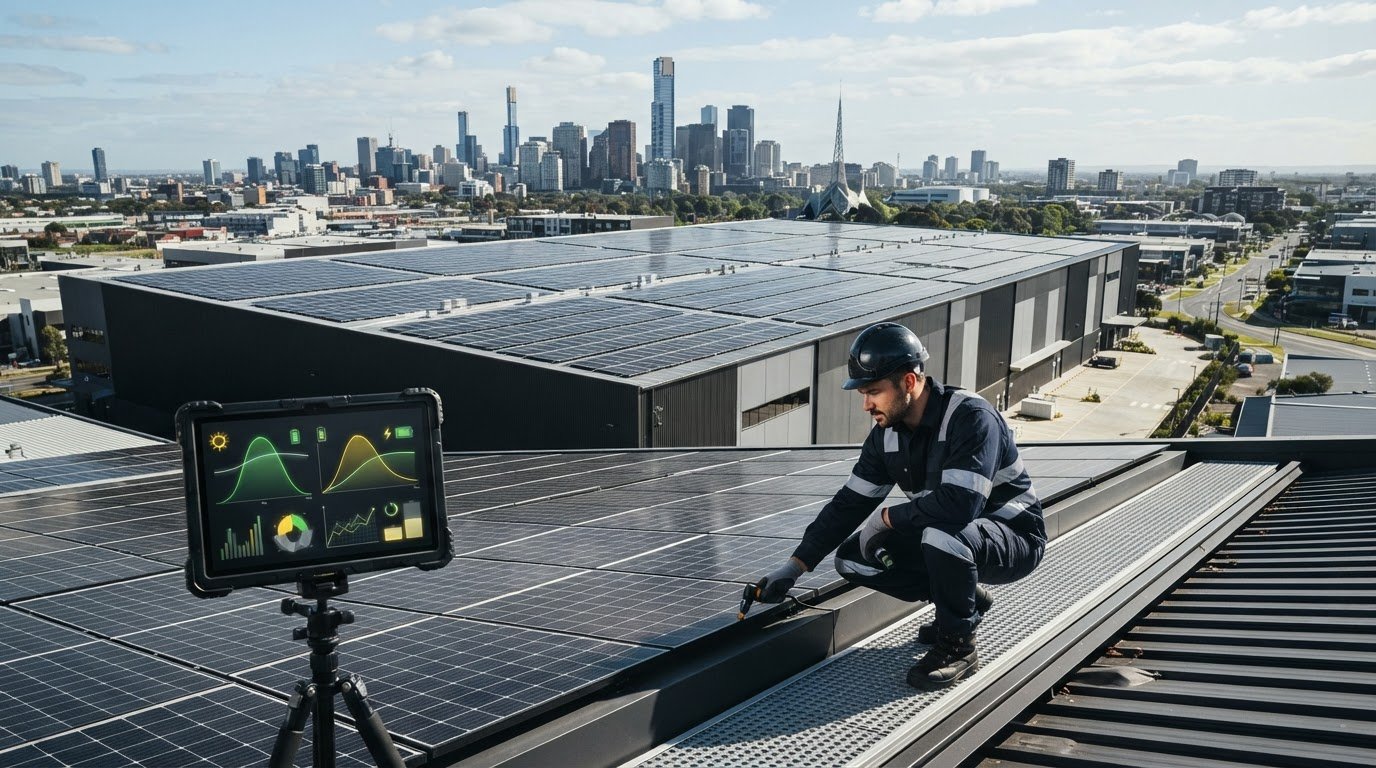
A larger solar system can look better in a calculator and still deliver a weaker return. For a Victorian business, a useful commercial solar ROI calculator Victoria estimate starts with actual energy use, not a postcode average. Generic tools can feel unreliable when they don’t reflect your operating hours, load profile or electricity tariff.
With the right inputs, you can build a clearer picture of potential savings before making a decision. This guide explains which business energy data matters, how tariff details and export credits affect the result, and why payback estimates are models rather than guarantees.
You’ll also learn how to compare solar-only with solar-plus-battery scenarios using consistent assumptions about generation, self-consumption and stored energy. We’ll cover what a site-specific assessment should clarify, including system design and battery needs where relevant. Real usage data and careful checks can turn an early estimate into a more informed view of commercial solar’s potential for your business.
Key Takeaways
- Use a commercial solar ROI calculator Victoria estimate as a starting point, then distinguish simple payback from ROI before weighing up a project.
- Keep energy and site information separate: bills and operating hours inform demand, while roof conditions and grid connection shape system design.
- Compare solar-only, solar-plus-battery and different system sizes using consistent inputs, and label assumptions that may change.
- Record each figure and its source so your finance team can reproduce the estimate and review how changes affect the result.
- GridFree Solar can use your business data to inform a tailored commercial solar assessment in Melbourne and Victoria.
What a commercial solar ROI calculator in Victoria should tell your business
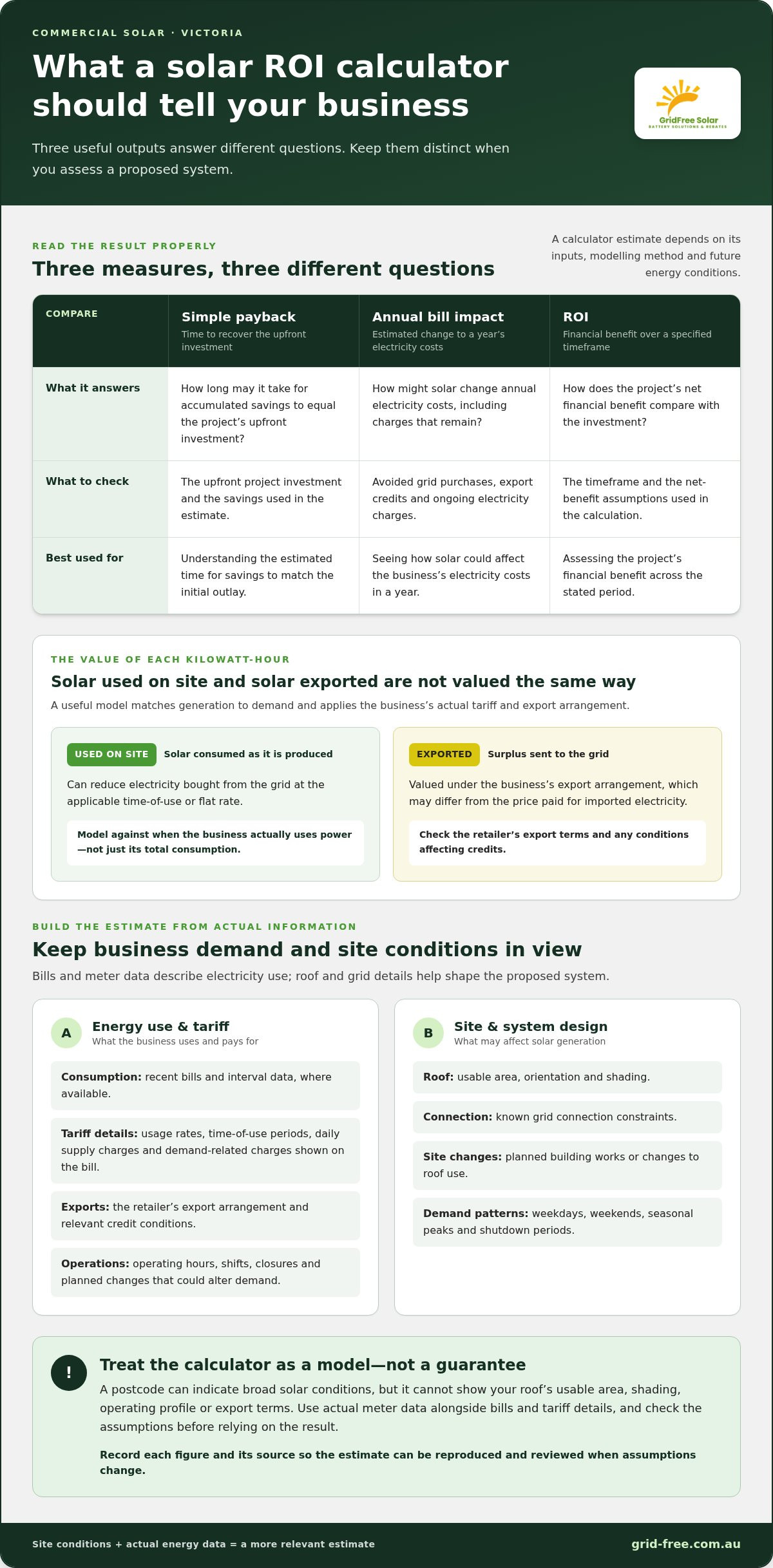
A useful commercial solar ROI calculator Victoria estimate connects a proposed system to the way your business uses electricity. It compares the investment and other stated inputs with the expected value of solar energy over a defined period. A postcode can indicate broad solar conditions, but it can’t show whether your site uses power while panels are generating or what your tariff pays for exported electricity.
Keep the outputs distinct. Simple payback estimates how long it may take for accumulated savings to equal the project’s upfront investment. Annual bill impact estimates how solar may change a year’s electricity costs, including avoided grid purchases and credits for exported surplus, alongside charges that remain. ROI compares the project’s net financial benefit with the investment over a specified timeframe. Each measure is useful, but each answers a different question.
Quotable definition: A commercial solar calculator produces an estimate, not guaranteed savings, because its result depends on the project inputs, modelling method and future energy conditions used.
What does a commercial solar ROI calculator actually estimate?
The value of each kilowatt-hour depends on how it’s used. Solar power consumed on site can reduce electricity bought from the grid at the applicable time-of-use or flat rate. Surplus sent to the grid is valued under the business’s export arrangement, which may differ from the price paid for imported electricity. A model that treats every unit generated as equally valuable can misstate the bill impact.
Check what the calculator includes: system investment, expected generation, self-consumption, export credits, ongoing electricity charges and the period used for its ROI calculation. Some models may also include incentives, but eligibility and value depend on the specific site and system. The Solar power in Australia overview provides broader sector context, but it can’t determine your project’s inputs or eligibility. Change an assumption, such as the tariff or operating schedule, and the result may change too.
Why a Victorian business needs more than a postcode
Generation estimates depend on the actual roof. Its orientation, available area and shading affect where a proposed array can be positioned and how much sunlight reaches it. Weather patterns also influence generation. A location-based estimate is a starting point, not a substitute for reviewing the site and proposed system design.
Next, match generation to demand. A business operating during the day may use more solar as it’s produced, while a site with high evening or overnight demand may rely more on grid electricity after generation falls. Operating hours alone don’t tell the full story, so use meter data alongside bills and tariff details to understand when consumption occurs. A postcode describes a location; site conditions and actual meter data make the estimate relevant to your business.
The business and Victorian site data that make ROI estimates useful
A commercial solar ROI calculator Victoria estimate becomes more useful when its inputs describe both the business’s electricity demand and the site’s capacity to generate solar. Start with measured information, not just an annual consumption figure. Total usage shows how much electricity the business buys; interval data reveals when it uses it and helps estimate how much solar can be consumed on site.
Quotable takeaway: Actual interval consumption is a stronger input than a generic usage estimate because it shows when your business draws electricity, not just how much it uses overall.
Gather Victorian business energy and tariff information
Collect recent electricity bills and available interval-meter data. Bills establish overall consumption and show the tariff structure, while interval records reveal demand patterns across the day. Together, they provide a more grounded basis for modelling solar use, grid imports and exports.
- Consumption: Gather interval data, where available, and bills covering representative trading periods.
- Tariff details: Record usage rates, time-of-use periods, daily supply charges and any demand-related charges shown on the bill.
- Exports: Note the retailer’s export arrangement and any conditions affecting credits.
- Operations: List operating hours, shifts and regular periods when the premises are closed.
- Planned changes: Flag expansions, new equipment or production changes that could alter future demand.
Tariffs and network charges vary by retailer, site and contract. Use the business’s current terms rather than a general Victorian rate, and verify them before relying on a calculation. For Victorian solar information, consult the Solar Victoria official website; assess any business incentive separately against the site and system’s eligibility.
Match the site and operating profile to the estimate
Record usable roof area, orientation and shading, along with any known grid connection constraints. Include planned building works or changes to roof use. These details help shape the proposed system size and generation estimate; the roof’s total area alone doesn’t show how much can practically be used.
Map demand across weekdays, weekends, seasonal peaks and shutdown periods. A business drawing substantial power during sunny operating hours may use a larger share of its solar generation directly. If demand is low during those hours and rises later, more generation may be exported instead. This distinction matters because on-site use and exported energy can have different financial values.
Bring bills, interval records and site details together before comparing results. A tailored commercial solar assessment can connect business usage, tariff information and site conditions with a project-specific view of system design and expected energy value.
Compare commercial solar ROI scenarios without trusting one headline number
One payback figure can hide the assumptions driving it. Use a commercial solar ROI calculator Victoria model to compare solar-only, solar-plus-battery and alternative system sizes against the same business load profile, tariff and modelling period. Change one major assumption at a time to see its effect and avoid attributing a better result to the wrong factor.
Separate confirmed inputs, such as bills, interval consumption and proposed system design, from assumptions, such as future tariffs, export credits, generation and changes to business operations. Record the source and date for each input. If an estimate includes an incentive, include it only after checking eligibility for the particular site and system.
Which assumptions can shift the result most?
Test self-consumption, export value, system output and future operating patterns individually. Tariff structure matters: solar used on site may offset a time-based import rate, while surplus exported to the grid is valued under the export arrangement. Don’t substitute a generic commercial tariff or system price for the project’s actual figures. Use current retailer and network terms, and clearly label any projection.
The table shows how an assumption may affect the model. These are relationships to test, not promised outcomes; actual results depend on the system and site.
| Assumption to change | Potential effect on estimated value | What to check |
|---|---|---|
| More solar consumed on site | May increase avoided grid purchases and improve modelled payback | Compare generation timing with interval demand |
| Lower export value | May reduce the value assigned to surplus generation | Use the business’s current export terms |
| Different system size or output | Can change generation, self-consumption and the investment comparison | Model site-fit alternatives using the same load data |
| Changed operating hours | May shift how much generation is used directly versus exported | Reflect planned changes, shutdowns and seasonal patterns |
When should a business model battery storage or VPP participation?
Model a battery when the site’s demand pattern and project design indicate stored energy could be useful. Compare the battery scenario with solar-only using consistent assumptions, including the project-specific investment and usable energy assumptions. Storage can change when solar energy is used, but it doesn’t guarantee savings or a shorter payback.
If considering a virtual power plant (VPP), include its value only where participation and current program terms apply to the proposed business system. The stated rewards are a $1 daily bonus, 15¢/kWh export credit, and free grid charging from 11 am-2 pm. Check site eligibility and current program terms before adding these rewards to the model. Present the result as a scenario, not a guaranteed return.
A practical workflow for turning your Victoria ROI estimate into a decision
A calculator result is a starting point, not a project decision. Use a repeatable process so your finance team can see where each figure came from, what remains uncertain and how the proposal compares with business needs. If information is missing, label it as an assumption. Don’t present a model built on incomplete inputs as a precise forecast of business savings.
- Collect the evidence. Gather electricity bills, available interval data, tariff details and operating schedules, along with relevant site information.
- Enter and label assumptions. Record the source and date for each input. Clearly mark estimates, such as future tariffs or changes in usage.
- Compare scenarios. Review solar-only, solar-plus-battery and alternative system sizes using consistent inputs and time periods.
- Review site conditions. Check that the proposed layout and generation assumptions reflect roof suitability, shading and grid connection conditions.
- Assess the proposal. Compare the model with the proposed system design, project scope, expected energy value and stated assumptions before deciding.
How to sanity-check calculator outputs
Look beyond the headline payback. Check whether the model accounts for export value, relevant tariff components and the system performance assumptions behind estimated generation. Then compare that generation with the business’s daytime consumption pattern. If the estimate relies on an unverified incentive, future tariff or operating change, flag it and review a scenario without it. This gives decision-makers a clearer view of what is established and what may shift.
Keep a simple assumption register alongside the estimate. For each input, note whether it’s measured, supplied in a proposal or estimated, and identify who can update it if conditions change. This makes the calculation easier for finance teams to reproduce and helps prevent an assumed figure being mistaken for a confirmed project detail.
What to prepare before a site-specific assessment
Bring together the records that explain both demand and site fit. Include recent bills, available interval data, the site address, roof details and operating schedules. Add planned equipment purchases, changes to occupancy, expansions or shifts in operating hours. These can change future consumption and affect whether the proposed system matches the business’s needs.
Use this information to move from a generic commercial solar ROI calculator Victoria result towards a project review grounded in site conditions and business use. GridFree Solar’s commercial solar design and installation assessment can connect your inputs to a tailored project proposal in Melbourne and Victoria. Discuss your commercial solar project with GridFree Solar.
How GridFree Solar can assess commercial solar ROI in Melbourne and Victoria
A calculator can show a direction. A site-specific assessment connects that estimate to your business. GridFree Solar provides commercial solar system design and installation for businesses in Melbourne and Victoria, considering actual energy use, site conditions and tariff information when shaping a project. This moves the discussion beyond a generic output towards a system proposal with assumptions your team can review.
Bring your commercial solar ROI calculator Victoria results as a starting point, not a forecast. GridFree Solar can use your bills, interval data and operating patterns to assess how system design relates to business demand. Tariff details and export arrangements help clarify how on-site use and surplus generation may contribute to the project’s energy value. Assess any incentive in the model against the specific site and system.
What a tailored commercial assessment should clarify
The assessment should explain how the proposed system fits the usable roof area, orientation, shading and grid connection conditions, as well as the business’s daily and seasonal demand. Where the load profile suggests a possible role for battery storage, its place in the system can be considered alongside solar generation and expected usage. Smart Energy Monitoring can help track system performance after installation, giving you visibility of how the system operates.
For battery projects, installation requirements matter alongside the financial model. Battery installations must follow AS/NZS 5139:2019, AS/NZS 3000, UN38.3, IEC 62040-1 and related standards. From 1 Mar 2026, installers must capture geotagged, timestamped photos of key labels and signage. Retailers and installers must also provide clear written documentation to consumers. Include these practical details in the project discussion, not just in the payback estimate.
Move from estimate to an informed project discussion
Prepare the information that makes the assessment specific: recent electricity bills, available interval data, the site address, roof details, tariff information and operating schedules. Add planned changes to equipment, occupancy or operating hours. If battery storage is relevant, include the scenario you want assessed and the assumptions behind it. Clear inputs make it easier to see which parts of the calculator result are supported by business data and which still rely on estimates.
GridFree Solar’s commercial solar solutions are designed around commercial and industrial energy demands, with system design and installation tailored to the project. Its CEC Accredited Installers can help translate your figures into a site-specific assessment, with rebate assistance where applicable. A clear proposal should set out system assumptions and project details so your team can make an informed comparison instead of relying on a single headline payback.
Ready to move from an estimate to a practical project discussion? Share your business energy information with GridFree Solar to explore a tailored commercial solar assessment for your Melbourne or Victorian site.
Turn your estimate into a confident next step
Your ROI model can do more than forecast savings. Use it to frame a practical investment discussion: what your business needs from the system, which assumptions matter to your decision, and what the next project stage must resolve. A commercial solar ROI calculator Victoria estimate is most useful when it leads to a clear, site-specific assessment rather than a number treated as a promise.
GridFree Solar works with businesses across Melbourne and Victoria, designing commercial solar solutions for commercial and industrial energy demands. As a CEC Accredited Installer, the team can help translate your business information into a project proposal shaped around your site and requirements.
Take the next step with the energy data and questions your team has gathered. Discuss a commercial solar assessment with GridFree Solar and explore what a tailored system could mean for your business. A well-grounded decision starts with the right information, and your estimate is a strong place to begin.
Frequently Asked Questions
Is a commercial solar ROI calculator accurate?
It can be useful for comparing options, but its estimate is only as dependable as the information entered. For a practical check, run the same scenario with cautious and more optimistic assumptions for generation or export value, then note how much the result changes. If a small input change shifts the decision, treat that uncertainty as a reason to investigate further, not as proof of a particular return.
What information do I need for a commercial solar ROI calculator in Victoria?
Start with recent bills, available interval-meter data, tariff details, operating hours and the business site address. For a commercial solar ROI calculator Victoria estimate, keep records aligned to the same billing periods where possible, so seasonal closures or unusual trading periods don’t distort comparisons. Add roof orientation, shading, usable area and expected operational changes. If a figure is missing, label the assumption and keep it distinct from measured business data.
How is commercial solar payback calculated?
Simple payback is generally estimated by comparing the project’s upfront investment with its expected annual net energy value. The calculation depends on assumptions about solar generation, electricity avoided through on-site use, export credits and any costs or incentives included in the model. Check whether the calculator uses annual savings consistently and what it counts as the investment. Different tools may define ROI and payback differently, so compare their methods as well as their outputs.
Can a commercial solar ROI calculator include a battery?
Yes, some calculators let you model storage, but the battery scenario needs assumptions about how and when it charges and discharges. Compare it with solar-only using the same business demand and tariff inputs. For battery STC eligibility, the battery must be installed with a solar PV system and have a capacity between 5 kWh and 100 kWh. Eligibility depends on the specific project, so don’t treat an incentive estimate as confirmed until it has been assessed.
Does a Victorian solar calculator account for shading and roof direction?
It depends on the tool and the site information it uses. Solar Victoria’s SunSPOT tool is described as using 3D roof mapping and Bureau of Meteorology weather data to estimate solar conditions. For a commercial property, treat that result as an initial guide: roof obstructions, shading at different times and the business’s load profile can affect how useful the estimate is. A site review can clarify details an address-based model may not capture.
Can I use a residential solar calculator for my business?
You can use one to understand the inputs that influence a solar estimate, but don’t treat its result as a commercial forecast. A business may have different trading schedules, seasonal demand, tariff arrangements and export terms from a household. For example, a tool built around household usage may not reflect a business that closes on weekends or changes production during the year. Use business records to build a model suited to the site.
What compliance information should a commercial battery installation include in 2026?
Project documentation should address installation in line with AS/NZS 5139:2019, AS/NZS 3000, UN38.3, IEC 62040-1 and related standards. From 1 Mar 2026, installers must capture geotagged, timestamped photos of key labels and signage. Retailers and installers must also provide clear written documentation to consumers. Keep these details with the project records so the business has a clear account of installation requirements and supporting information.