Table of Contents
- What solar inverter efficiency means
- How inverters convert DC electricity to AC electricity
- Peak inverter efficiency versus weighted efficiency ratings
- Typical solar inverter efficiency ranges and rating standards
- Factors that affect real-world inverter performance
- Solar inverter sizing and DC-to-AC conversion matching
- Solar inverter maintenance to preserve efficiency over time
- Comparing inverter efficiency ratings across different types
- Frequently Asked Questions
Last Updated: October 14, 2026
What solar inverter efficiency means
Solar inverter efficiency is the percentage of direct current (DC) electricity from your solar panels that an inverter successfully converts into alternating current (AC) electricity for use in your home. Not all the power flowing into an inverter reaches your switchboard, some energy dissipates as heat during the conversion process. An inverter rated at 97% efficiency means that for every 100 kilowatt-hours of DC power arriving from your panels, roughly 97 kWh becomes usable AC electricity, while approximately 3 kWh is lost.
This matters because energy loss directly reduces the financial return on your solar investment. A system with higher inverter efficiency generates more usable electricity from the same panel array, which translates to greater bill savings and faster payback on your installation cost.
Understanding efficiency ratings helps you make informed choices about which inverter suits your home’s needs. Different inverter types, sizes, and operating conditions all affect real-world performance, which is why a rating alone doesn’t tell the complete story.
How inverters convert DC electricity to AC electricity
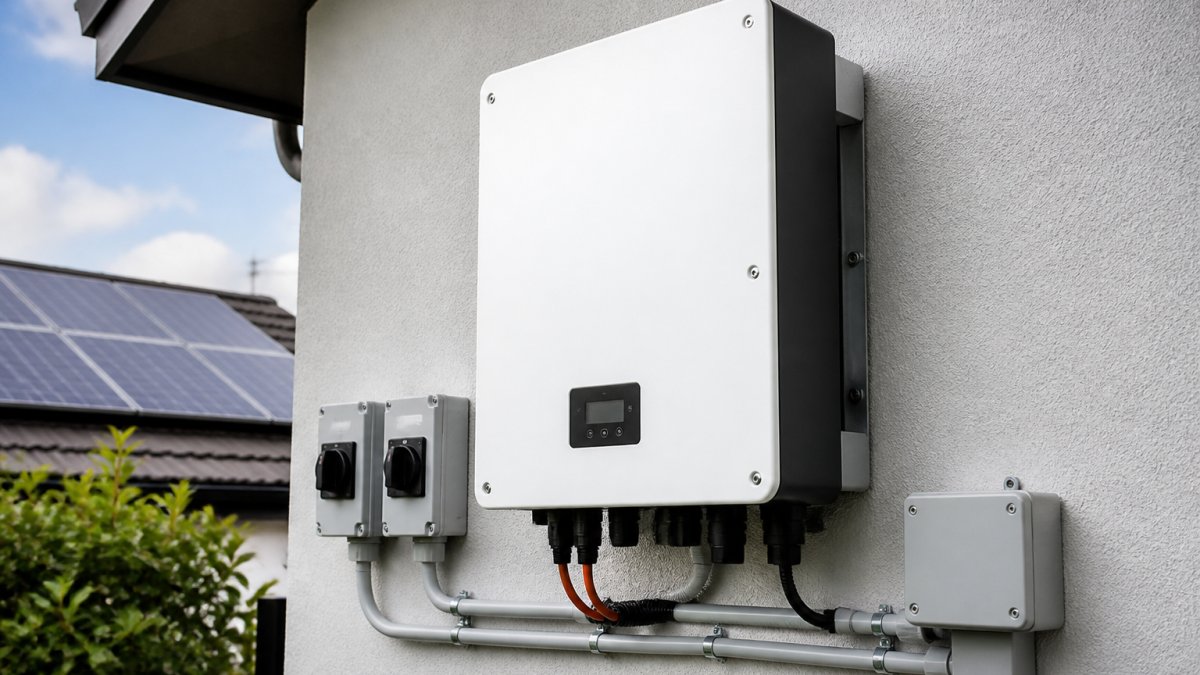
Inverters perform a critical transformation: they take the direct current flowing from your solar panels and switch it into the alternating current that powers household appliances and feeds into the grid. This conversion happens through high-frequency switching circuits that rapidly turn the DC voltage on and off, creating a wave-like AC output that matches the grid’s frequency (50 Hz in Australia).
The inverter’s internal components, transformers, capacitors, switching transistors, and control circuits, work together to reshape the DC input into a sine wave that alternates between positive and negative voltage. Modern inverters use sophisticated algorithms to match grid voltage and frequency precisely, ensuring seamless power flow. However, every component in this chain introduces small losses. Resistance in wiring dissipates energy as heat. Transformers lose power through magnetisation. Switching circuits consume energy to operate. These losses accumulate, which is why no inverter achieves 100% efficiency.
The quality of internal components directly affects how much energy escapes as waste. Higher-grade inverters use better materials and tighter tolerances, reducing these losses.
Peak inverter efficiency versus weighted efficiency ratings
Two different efficiency metrics describe inverter performance, and they tell different stories. Peak efficiency is the highest efficiency the inverter achieves at a specific operating point, usually around 75-80% of its rated capacity. This is the number manufacturers highlight because it’s impressive. A 98.5% peak efficiency rating sounds excellent, but it represents performance only under ideal conditions that rarely occur in real-world operation.
Weighted efficiency (also called California Energy Commission efficiency or CEC efficiency) is a more realistic measure. It calculates efficiency across multiple load points, from 10% to 100% of the inverter’s capacity, then weights them based on how often your system actually operates at each level. Most residential solar systems run below peak capacity for much of the day, so weighted efficiency better reflects what you’ll actually experience. A weighted efficiency of 96-97% is typical for quality string inverters, while peak efficiency might be 98.5%.
The difference matters when comparing inverters. An inverter with 98.5% peak efficiency and 96% weighted efficiency performs worse in real operation than one rated at 97.5% peak and 96.8% weighted. This approach gives you a clearer picture of annual energy production and helps avoid overpaying for headline numbers that don’t translate to household savings.
Typical solar inverter efficiency ranges and rating standards
Quality string inverters installed in Australian homes typically achieve weighted efficiency between 95.5% and 97.5%, depending on the inverter type and manufacturer. Three-phase inverters often perform slightly better than single-phase models at higher capacities. Microinverters (small units mounted on individual panels) usually range from 94% to 96.5% weighted efficiency, slightly lower than string inverters but with different advantages in shading situations.
Battery inverters and hybrid inverters, which handle both DC-to-AC conversion and battery charging, typically operate at 92-95% efficiency due to additional conversion stages. This double conversion is why battery efficiency matters as much as inverter efficiency in hybrid systems.
In Australia, inverters must comply with AS/NZS 3000 (electrical safety) and AS/NZS 5139:2019 (energy storage systems). These standards ensure equipment is safe and reliable, but they don’t specify minimum efficiency targets. The Clean Energy Council (CEC) publishes an approved products list that includes efficiency ratings for accredited inverters, which helps you identify models tested to consistent standards.
International standards like IEC 62040-1 (electrical safety for UPS systems) also apply to battery inverters. These certifications don’t determine efficiency, but they confirm the inverter has been tested for reliability and won’t damage your equipment or pose a fire risk, a critical consideration given the high-profile failures of poorly manufactured units in recent years.
Factors that affect real-world inverter performance
Efficiency isn’t static. Several operating conditions shift how much power your inverter actually converts. Temperature is the largest variable. Inverters are typically rated at 25°C, but Australian summer temperatures routinely exceed 35°C. As inverter components heat up, internal resistance increases, and efficiency drops by roughly 0.1-0.2% for every degree above the rating temperature. An inverter achieving 97% at 25°C might deliver only 96.2% on a 40°C afternoon.
Operating load also affects efficiency. Your inverter performs most efficiently between 50% and 90% of its rated capacity. At very low loads (10-20% capacity), efficiency dips because fixed losses in the circuitry become proportionally larger. At full load, efficiency also drops slightly due to increased current flowing through resistive components.
Partial shading on your solar array changes the DC voltage and current reaching the inverter, forcing it to operate outside optimal conditions. Mismatched panels or degraded modules create voltage irregularities that the inverter must manage, reducing efficiency. Microinverters handle this better than string inverters because each panel has its own converter, but the trade-off is slightly lower peak efficiency.
Age and maintenance gradually reduce efficiency. Dust and salt spray accumulating on cooling fins restrict airflow, causing the inverter to run hotter and less efficiently. Capacitors degrade over time, increasing internal losses. A five-year-old inverter typically operates 1-2% less efficiently than when new. Regular inspection and cleaning helps preserve performance.
Solar inverter sizing and DC-to-AC conversion matching
Choosing the right inverter size is crucial for maximising efficiency and avoiding costly clipping. Inverter clipping occurs when your solar panels generate more DC power than the inverter can convert. On sunny days, a 10 kW solar array connected to an undersized 8 kW inverter will lose the excess generation because the inverter simply cannot process it. That lost power never becomes usable electricity.
The DC-to-AC ratio (also called the panel-to-inverter ratio) describes this relationship. Most Australian installations use a ratio between 1.2:1 and 1.5:1, meaning the DC array capacity is 20-50% larger than the inverter’s AC rating. This is intentional. Your panels rarely operate at full rated capacity simultaneously, shading, temperature, and angle all reduce output.
However, oversizing too aggressively wastes money and causes clipping. A 15 kW panel array connected to an 8 kW inverter will clip severely on clear summer days, discarding 20-30% of potential generation. GridFree Solar designs each system with your specific location, roof orientation, and shading profile in mind, calculating the optimal DC-to-AC ratio to maximise usable output without overinvesting in panels.
Hybrid systems add another layer. Battery inverters must handle both solar generation and battery discharge, so sizing becomes more complex. An undersized hybrid inverter might limit how fast your battery charges from solar, reducing the energy you can store. Oversizing increases cost without proportional benefit.
Solar inverter maintenance to preserve efficiency over time
Your inverter’s efficiency depends partly on how well you maintain it. Dust, salt spray, and debris accumulate on cooling fins and vents, restricting airflow and forcing the unit to run hotter. In coastal areas, salt corrosion accelerates degradation of internal components. Regular cleaning, typically annual, or twice yearly in coastal zones, removes this buildup and helps the inverter dissipate heat more effectively.
Monitoring your inverter’s performance data reveals efficiency problems early. Modern inverters log operating temperature, input/output power, and efficiency metrics. If your inverter’s efficiency suddenly drops 1-2%, it often signals a developing fault: a failing capacitor, a cooling fan problem, or internal corrosion. Catching these issues early prevents complete failure and allows repairs before the inverter stops working entirely.
Battery inverters require additional attention. The cooling system must remain clear of obstructions. Battery terminals should be checked for corrosion. Firmware updates, released periodically by manufacturers, often improve efficiency and fix bugs. This proactive approach extends equipment life and maintains the energy production you’re paying for.
Comparing inverter efficiency ratings across different types
Different inverter architectures deliver different efficiency profiles. String inverters remain the most common choice for residential installations. A single inverter handles the entire solar array, keeping costs low and simplicity high. String inverters typically achieve 96-97% weighted efficiency, with excellent performance at moderate to high loads.
Microinverters mount on individual panels, each converting that panel’s output independently. This approach eliminates the voltage mismatch problems that occur when panels are partially shaded or aged differently.
Hybrid inverters combine solar conversion with battery charging and management. They sacrifice some efficiency to add functionality, typically operating at 92-95% weighted efficiency.
Three-phase inverters are designed for larger homes or commercial installations. They distribute the solar load across three electrical phases, improving efficiency and reducing stress on individual circuits. Three-phase units typically achieve 97-98% weighted efficiency, slightly higher than single-phase models at equivalent capacity.
When comparing specific models, request the CEC efficiency rating and ask about performance in Australian temperature conditions. A 97% efficiency rating at 25°C might drop to 95.8% at 40°C, a real difference in summer energy production.
Choosing the right inverter is one of the most important decisions in your solar installation. Efficiency directly determines how much of your solar generation becomes usable electricity, which drives your bill savings and payback timeline.
Frequently Asked Questions
What is the efficiency of a solar inverter?
Solar inverter efficiency measures the percentage of DC electricity from your panels that the inverter successfully converts into usable AC electricity for your home. Most modern inverters achieve 95-98% efficiency, meaning 2-5% of your solar energy is lost during conversion. Higher efficiency ratings mean more of your solar generation reaches your appliances and batteries, directly improving your system’s financial return.
What is the difference between peak efficiency and weighted efficiency?
Peak inverter efficiency is the maximum conversion rate achieved under ideal laboratory conditions, usually at 50% operating load. Weighted efficiency rating reflects real-world performance across a range of loads and conditions, weighted toward the operating points where your inverter spends most of its time. Weighted ratings are more representative of actual energy production in your home, making them a better basis for comparing inverters.
What factors affect solar inverter efficiency in real-world conditions?
Temperature, operating load, partial shading, and input voltage all influence real-world efficiency. Inverters perform best at moderate temperatures; extreme heat reduces efficiency. Operating at very low loads (early morning or cloudy days) also lowers efficiency compared to peak-load operation. Partial shading on panels forces the inverter to work harder. Understanding these factors helps you choose an inverter sized appropriately for your system and location.
Does inverter size affect solar system efficiency?
Yes. Oversizing your inverter (choosing one with much higher capacity than your panels produce) causes it to operate at very low loads most of the time, reducing efficiency. Undersizing creates clipping, where excess solar power is lost. Proper solar inverter sizing matches your panel array’s output to the inverter’s rated capacity, keeping the inverter operating in its most efficient range and maximising your energy harvest.
How much energy does a solar inverter lose during conversion?
Modern inverters lose 2-5% of input energy as heat during DC-to-AC conversion. On a 5 kW system producing 20 kWh per day, that represents roughly 400-1000 Wh lost daily. Over a year, total energy loss can be 150-300 kWh depending on your inverter’s efficiency rating and operating conditions. Choosing a high-efficiency inverter (96%+ rated) reduces this loss and improves your system’s overall yield.
Do solar inverters become less efficient over time?
However, dust accumulation, corrosion, and component degradation can gradually reduce performance. Regular maintenance, keeping vents clear, checking connections, and monitoring output, helps preserve efficiency.
How can I compare the efficiency of different solar inverters?
Compare weighted efficiency ratings rather than peak efficiency, as they reflect real-world performance. Check the inverter’s test certification (typically EN 50530 or equivalent standards) to ensure ratings are standardised. Look at efficiency across partial loads (25%, 50%, 75%), not just peak. Consider temperature derating specifications and warranty length as indicators of quality. Professional installers can model expected annual energy output based on your location and system design.