
Table of Contents
- Why Solar Self-Consumption Without a Battery Matters
- Start With Real-Time Solar System Monitoring and Maintenance Services
- Energy Load Shifting Techniques That Cut Your Evening Bill
- Timers, Smart Plugs, and Smart Home Integration for Appliance Scheduling
- How Solar Feed-In Tariffs in Australia Shape Your Strategy
- Seasonal Optimization and Grid-Tie Inverter Settings Most Owners Ignore
- Frequently Asked Questions
Last Updated: October 1, 2026
Why Solar Self-Consumption Without a Battery Matters
Solar self-consumption is the share of your solar generation that your home uses directly instead of exporting to the grid. Without a battery, every kilowatt-hour you use in real time is worth far more than the same unit sold back through a feed-in tariff.
Start With Real-Time Solar System Monitoring and Maintenance Services
Solar system monitoring and maintenance services give you the data you need to act. You cannot shift a load you cannot see.
Australian Energy Regulator guidance on energy bills
What to Track: Solar Yield, Base Load, and Peak Demand
Three numbers drive every decision:
- Solar yield: total kilowatt-hours your array produces each day
- Base load: the constant draw from fridges, standby, and always-on devices
- Peak demand: the hours your household pulls the most power, usually early evening
Track these for two weeks. Patterns emerge fast.
Check your inverter’s monitoring portal at the same time each day for a week. You’ll spot your base load sitting quietly under everything else, often running overnight when solar earns nothing.
Energy Load Shifting Techniques That Cut Your Evening Bill
Energy load shifting techniques move flexible appliance use into your solar window. The goal is simple: run heavy loads when the sun is up, not at 7pm.
- Run the dishwasher on a delay so it starts around midday
- Set the washing machine for late morning
- Heat water during peak solar hours
- Charge EVs between 10am and 3pm
Manual Scheduling vs Automated Load Management
Manual scheduling works, but it depends on you remembering. Automated load management uses timers, smart plugs, and inverter settings to run loads without input.
| Approach | Effort | Best For | Weakness |
|---|---|---|---|
| Manual scheduling | High, daily | Renters, simple setups | Easy to forget |
| Timer-controlled appliances | Low, set once | Dishwashers, hot water | No weather awareness |
| Smart plugs and app control | Medium | Mixed households | Needs Wi-Fi |
| Inverter-linked automation | Low | Pro-sumer setups | Higher upfront cost |
Timers, Smart Plugs, and Smart Home Integration for Appliance Scheduling
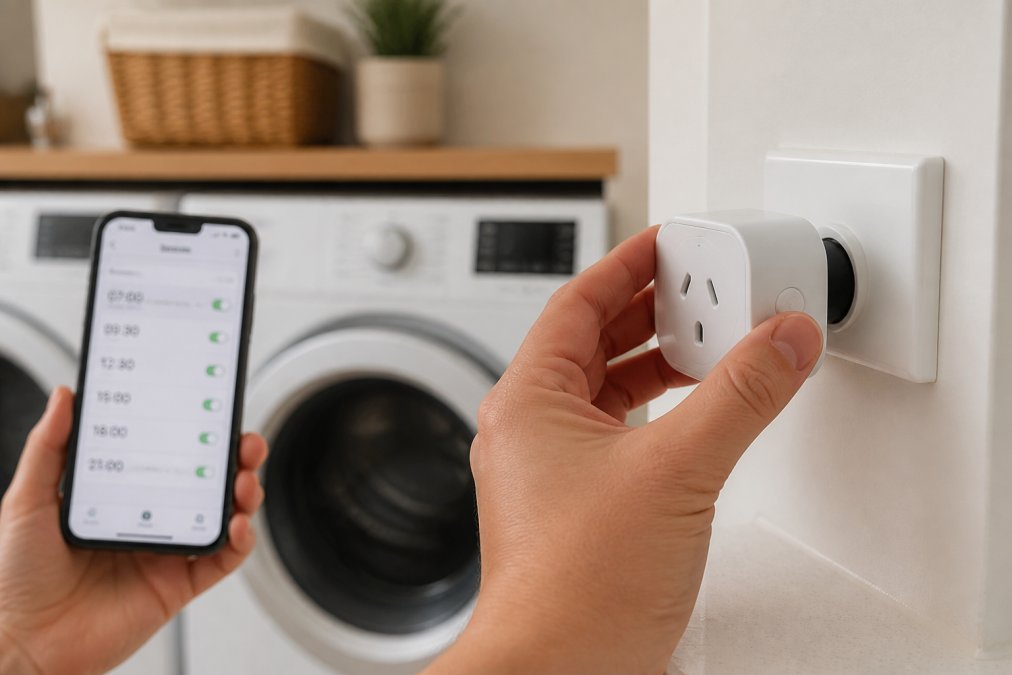
Appliance scheduling is where most households leave money on the table. A cheap timer solves a surprising amount of it, but the real gains come from making loads respond to what your inverter is actually producing, not just to a clock.
Start With Dumb Timers, Then Add Intelligence
A plug-in timer on a dishwasher or washing machine costs very little and needs no Wi-Fi. Set it once and it runs every day at the same time. That is enough for households with a predictable routine.
Three Tiers of Automation
- Time-based (timers, basic smart plugs). Runs at a fixed hour. Cheap, reliable, weather-blind.
- Condition-based (smart plugs plus a hub). Triggers when a condition is met, for example, when your inverter reports export above a set threshold.
- Predictive (home automation platforms). Uses forecast data and your own consumption history to decide when to start a load, then adjusts if conditions change.
How Solar-Aware Triggers Actually Work
The mechanism most guides skip is the data source. To trigger a load on surplus solar, your automation needs to know how much power is flowing. There are three common ways to get that number:
- Inverter API or local integration. Many modern inverters expose production and export data through a cloud API or a local Modbus connection. Home Assistant, for example, has community integrations for a wide range of inverter brands that pull this data every few seconds.
- A consumption meter or CT clamp. A clamp around your main feed measures net import/export directly. This is often more accurate than inverter data alone because it captures the whole house.
- A smart plug’s own reading. Useful for the appliance itself, but it tells you nothing about the rest of the house.
A Practical Starter Setup
- Buy two or three smart plugs for your biggest flexible loads, pool pump, dishwasher, washing machine.
- Set fixed schedules to match your solar window as a baseline.
- Add a smart hub or run a home automation platform on a small always-on device.
- Connect your inverter or a CT clamp so the platform can see live export.
- Write one rule per appliance: run when surplus is above X watts for Y minutes.
- Check the logs weekly for the first month and tune the thresholds.
What most guides miss is the base load. A smart plug on a fridge won’t help. A smart plug on a pool pump will.
Don’t schedule high-draw appliances to all start at the same moment. Stacking loads can trip circuits or exceed your inverter output, forcing a grid import at the worst time. Sequence them, hot water first, then laundry, then the pool pump, and leave headroom for the base load.
::: Optimizing the timing of these cycles provides an ideal opportunity to refine your water heater efficiency and ensure that thermal storage remains a reliable buffer for surplus solar energy.
If you are not ready for full automation, a single CT clamp plus one smart plug on your largest flexible load captures most of the benefit for a fraction of the effort.
How Solar Feed-In Tariffs in Australia Shape Your Strategy
Solar feed-in tariffs in Australia pay you for exported power, but the rate is usually well below what you pay to buy electricity. That gap decides your strategy.
- Compare your feed-in rate to your usage rate
- If export pays less, use the power yourself
- If evening export pays more, time what you send back
Clean Energy Council resources on solar and tariffs
Seasonal Optimization and Grid-Tie Inverter Settings Most Owners Ignore
Seasonal optimization matters more than most owners realise, and it is the angle almost every competing guide skips. Your solar window is not a fixed block of hours, it changes shape through the year, and your load strategy should change with it.
How the Solar Window Changes Through the Year
In summer, production starts early, peaks around the middle of the day, and stays strong into the late afternoon. The curve is long and relatively flat, which means you have many hours of usable surplus.
Adjusting Load Strategy by Season
- Summer: spread flexible loads across the whole window. Run the pool pump in the morning, laundry around midday, and hot water in the early afternoon. You have enough surplus to run several loads sequentially without importing.
- Winter: concentrate everything into the few strong hours around midday. Run one large load at a time, and prioritise the ones that deliver the most value per kilowatt-hour, usually hot water first, then laundry.
- Shoulder seasons: treat them as a blend. Watch your monitoring data for a week and shift the schedule to match what the array is actually producing.
A useful habit is to review your schedules at the start and end of daylight saving, when both the clock and the sun angle shift.
Grid-Tie Inverter Settings That Indirectly Raise Self-Consumption
Your inverter has settings that shape how much power leaves the property, and those settings affect self-consumption even though they are not marketed as self-consumption tools.
- Export limiting. Many inverters can be configured to cap how much power is exported to the grid. When the cap is reached, the inverter reduces output, which means any surplus you could have exported is instead curtailed. If you have flexible loads, export limiting is a signal to shift them into the middle of the day so the surplus is used rather than wasted.
- Time-based power profiles. Some inverters and gateways support schedules that change behaviour at set times, for example, prioritising self-use during peak tariff windows. Check your inverter’s manual or ask your installer whether this is available on your model.
- Zero-export mode. Some setups can be configured to prevent any export at all. This is uncommon in residential settings but appears where network connection rules or retailer agreements restrict export. In that mode, every kilowatt-hour you do not use on site is lost, so load shifting becomes essential rather than optional.
- Battery-ready or hybrid settings. Even without a battery, some hybrid inverters have a ‘self-use’ priority mode that changes how the unit dispatches power. Confirm with your installer whether your unit has one and whether it is enabled.
Before changing any inverter setting, note the current configuration and check whether your installer or retailer has placed conditions on export. Some network connection agreements require a set export limit, and changing it without approval can breach those terms.
Self-consumption without storage comes down to three things: knowing your numbers, shifting flexible loads into the solar window, and reviewing settings each season. The households that do best treat it as a seasonal routine, not a one-off setup.
Frequently Asked Questions
Is it possible to store solar energy without using batteries?
You cannot store solar energy without a battery, but you can store the value of it by shifting when you use power. Run high-draw appliances like washing machines, dishwashers, and pool pumps during peak solar generation, typically 10am to 3pm. Any surplus feeds into the utility grid under your solar feed-in tariff, which in Australia is usually lower than the retail rate you pay in the evening. Maximising solar self-consumption means using generation on site first, exporting only what you cannot use.
How can I shift my energy usage to match solar production peaks?
Use timer-controlled appliances and smart plugs to schedule loads for the middle of the day. Set your hot water system, pool pump, dishwasher, and washing machine to run between 10am and 3pm when solar generation is highest. For heating and cooling, pre-cool or pre-heat the house during the day so the thermal mass carries you into the evening. Smart home integration lets you automate this with rules based on solar yield rather than fixed clock times, which adapts to cloudy days.
How does the feed-in tariff impact the need for self-consumption?
A low solar feed-in tariff Australia-wide means exported power earns you far less than you pay for grid electricity. If you export a kilowatt-hour for a few cents and buy it back at 30 cents or more in the evening, every kilowatt-hour you self-consume instead is worth several times the export value. The lower your feed-in tariff relative to your usage rate, the stronger the case for load shifting and daytime usage. Check your retailer’s current rate before deciding how aggressively to shift.
Can smart home automation help increase solar self-consumption?
Yes. Smart home systems can read your inverter output and switch appliances on only when solar generation exceeds your base load. This is more accurate than fixed timers because it responds to actual solar irradiance, cloud cover, and seasonal changes. You can pair smart plugs with a home energy management app to trigger devices like the pool pump or EV charger when export would otherwise occur. It also gives you data to refine settings over time, which pairs well with professional solar system monitoring and maintenance services.
The challenge is simple: most households generate plenty of solar but still buy power in the evening. GridFree Solar helps you close that gap with CEC accredited installers, monitoring support, and systems compliant with AS/NZS 5033 and AS/NZS 3000. Our team also guides you through rebate options and smart monitoring so your system keeps performing. Connect now with GridFree Solar and start using more of the power you already generate.